 فوتون ميديكس












الفوتونات العميقة من الفئة الرابعة تعالج تصلب الكاحل الليفي لدى الكلاب
Synchronized multi-wavelength delivery drives rapid intra-articular photon saturation, combines microvascular reperfusion with aggressive synovial edema evacuation, and eliminates dermal thermal spikes using gated duty cycle cooling.
Orthopedic veterinary surgeons and canine rehabilitation specialists face an exasperating clinical wall when dealing with chronic tarsal joint ankylosis and secondary fibrotic periarthritis. A seven-year-old Rottweiler enters the clinic dragging its right hind paw, unable to flex the hock beyond fifteen degrees. Dense fibrotic scar tissue encases the calcaneal tendon and tarsal joint capsule following an old trauma, while extensive periarticular osteophytes lock the articulation in rigid extension. Long-term non-steroidal anti-inflammatory therapy had to be suspended after serum biochemistry revealed declining renal filtration values and severe gastrointestinal intolerance. When clinics attempt conservative management using a low-power cold laser therapy machine for dogs, light scatters across the fibrous, hyperkeratotic skin and thick joint capsule, depositing almost zero therapeutic energy at the subchondral bone level. Staff spend forty minutes holding low-output probes that fail to alter joint mechanics or relieve deep chronic inflammation.
Optical Penetration Across Stratified Tarsal Fibrous Envelopes
Photobiomodulation of the canine tarsus presents an unforgiving physical challenge. The talocrural and intertarsal joints are wrapped in dense collateral ligaments, thickened fibrocartilage, and heavy plantar fascial sheets. Incoming photons encounter immediate Rayleigh scattering from microstructural collagen bundles and Mie scattering from dense cellular matrices within the connective tissue sheath.
In dense fibrous capsular tissue, scattering coefficients dominate absorption across shallow red and low near-infrared spectra. Milliwatt devices cannot provide the photon flux required to survive this structural maze. Superficial tissues disperse the beam laterally within the first few millimeters, failing to achieve the minimum biological fluence threshold of four to eight Joules per square centimeter necessary to alter cellular metabolism at depths of three to five centimeters. Delivering adequate therapeutic thresholds to calcified joint margins demands high initial irradiance.
Biological dose-response principles governed by the Arndt-Schulz law dictate that underdosing leaves diseased chondrocytes in an idle catabolic state, while unmitigated continuous exposure causes photothermal tissue coagulation. High-power Class IV systems deliver the exact photon density required to break through dense joint envelopes while keeping surface tissues well within safe biological limits.
When high-fluence photons reach target synovial fibroblasts, chondrocytes, and tenocytes, cytochrome c oxidase within mitochondrial respiratory complex IV absorbs the radiation. This stimulates the dissociation of inhibitory nitric oxide, restoring electron transport along the inner mitochondrial membrane and expanding the cellular proton gradient. The rapid increase in adenosine triphosphate production supplies the metabolic energy needed to clear degraded extracellular debris, while simultaneously downregulating pro-inflammatory markers such as matrix metalloproteinase-nine and tumor necrosis factor-alpha.
تزامن الكروموفور المزدوج عبر الطيفين 980 نانومتر و1470 نانومتر
Tarsal ankylosis presents two opposing tissue challenges: severe microvascular ischemia within dense scar tissue, and stagnant, water-dense chronic synovial swelling. Monochromatic therapy platforms cannot address both barriers simultaneously. True structural restoration requires pairing distinct wavelengths that target specific biological chromophores.
The 980nm wavelength demonstrates high absorption in deoxygenated and oxygenated hemoglobin, accompanied by moderate interaction with water. Fibrotic tarsal capsules are notoriously hypovascular, leaving damaged ligament insertions deprived of oxygen and essential nutrients. Irradiating the region with 980nm energy induces localized photothermal vasodilation within compressed periarticular capillary networks, washing out acidic metabolic byproducts and driving oxygenated blood into hypoperfused connective tissue. This vascular stimulus triggers macrophage shifting from pro-inflammatory M1 phenotypes to pro-resolving M2 phenotypes, accelerating tissue repair.
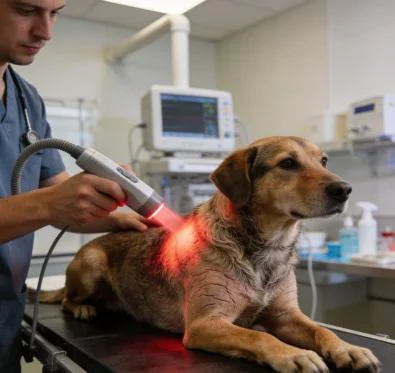
The 1470nm wavelength interacts directly with intracellular and interstitial water molecules. Its absorption coefficient in water is forty times higher than that of wavelengths in the 800nm to 900nm window. Chronic canine hock pathology is often complicated by persistent periarticular edema and hypertrophic synovial effusion. Direct application of 1470nm photon emissions excites water molecules, altering local tissue hydraulic pressure and accelerating lymphatic clearance to relieve intra-articular pressure without requiring invasive arthrocentesis.
Coordinating 980nm and 1470nm emissions within a synchronized delivery beam creates targeted clinical synergy. The 980nm wavelength restores microvascular circulation and cellular respiration, while the 1470nm wavelength disperses dense fluid pockets that would otherwise scatter therapeutic light. Clinicians evaluating an animal laser therapy machine require this dual-action capability to break down fibrotic barriers and deliver restorative photon energy directly into damaged cartilage.
زمن الاسترخاء الحراري وتعديل دورة التشغيل الديناميكية
Directing high average power into dense hock anatomy carries a tangible clinical hazard: thermal burns on dense, pigmented skin. Coarse hair coats and melanin-rich epidermal structures absorb photons rapidly, converting radiant power into thermal heat. Without precise temporal control, tissue temperatures quickly surpass the critical forty-three degrees Celsius mark where cellular proteins denature.
Overcoming this thermal barrier requires matching energy delivery to the thermal relaxation time of animal tissue. Thermal relaxation time represents the duration required for a biological tissue layer to lose fifty percent of its accumulated heat through natural microvascular dissipation. Canine dermis exhibits thermal relaxation constants in the millisecond domain. Continuous-wave laser output dumps heat into superficial layers faster than capillary blood flow can clear it, creating painful thermal spikes.
تحل دورات التشغيل النبضية هذه المشكلة من خلال تحويل الإرسال المستمر للفوتونات إلى نبضات دقيقة سريعة تفصل بينها فترات توقف حقيقية للاسترخاء الحراري. ويتيح التشغيل بدورات تشغيل تتراوح بين عشرين وأربعين في المائة تمرير قوى ذروية عالية عبر الأغلفة المفصلية السميكة، بينما تسمح فترات التوقف المتوسطة الخالية من الإشعاع للأنسجة السطحية بالتبريد بشكل طبيعي.
Adjusting pulse frequencies unlocks distinct biological effects: Frequencies between ten and one hundred Hertz stabilize peripheral nociceptive nerve fibers, dampening pain transmission along C and A-delta fibers. Frequencies between five hundred and one thousand Hertz stimulate localized lymphatic contractions, clearing persistent inflammatory effusions. Frequencies between two thousand and ten thousand Hertz maximize cytochrome c oxidase uptake within chondrocytes, accelerating extracellular matrix repair and parallel collagen remodeling.
Deploying balanced pulse gating on a modern dog laser therapy machine for sale allows clinicians to deliver deep volumetric dosages through dense periarticular structures without causing skin burns or animal agitation.
مقارنة بين البنى الهندسية عبر المنصات البيطرية من الفئة الرابعة
Navigating therapeutic equipment requires evaluating clear physical differences. Low-power pens, superficial mats, and continuous surgical units lack the beam dynamics, optical depth, and thermal management needed to treat dense hock fibrosis and deep canine joint pathology. Selecting the right high-power system demands a direct comparison of physical specifications.
| المقياس التشغيلي | وحدات التبريد ذات المستوى المنخفض | وحدات الفئة الرابعة ذات الموجة الواحدة المستمرة | أنظمة الفئة الرابعة الديناميكية متعددة الموجات |
| القدرة القصوى للضوء | 0.2 واط – 0.5 واط | 10 وات – 15 وات بشكل مستمر | 15 واط – 30 واط (ذروة مع بوابة) |
| أطوال موجات الانبعاثات | 635 نانومتر – 810 نانومتر، موجة واحدة | 810 نانومتر أو 980 نانومتر حصريًا | 980 نانومتر + 1470 نانومتر متزامنة |
| عمق اختراق الجلد | من 5 ملم إلى 10 ملم | من 25 مم إلى 35 مم | 50mm to 80mm into Dense Joints |
| خطر تراكم الحرارة في الجلد | غائب | ارتفاع كبير مع حركة بطيئة للمقبض | يتم التحكم فيه عن طريق التبريد بدورة العمل المُحدَّدة |
| التركيز السريري | الجروح الجلدية السطحية، التهاب الأذن | التمزقات العضلية السطحية المعممة | Chronic fibrotic ankylosis, deep joint disease |
| Canine Hock Treatment Time | 40 إلى 50 دقيقة | من 15 إلى 20 دقيقة | من 5 إلى 7 دقائق لكل مفصل |
| استهداف الكروموفورات الخلوية | أوكسيديز السيتوكروم سي فقط | إنزيم أوكسيديز السيتوكروم سي أو الهيموجلوبين | إنزيم أوكسيديز السيتوكروم سي، والهيموجلوبين، والماء |
Equipping a practice with veterinary hardware that pairs high peak power with distinct multi-wavelength options ensures adequate depth penetration across both small and large animal clinical presentations.
بروتوكول الحالة السريرية الموثقة
توضح الحالة الموثقة التالية استخدام التعديل الحيوي الضوئي للمفاصل العميقة في عيادة طبية متخصصة في جراحة العظام للحيوانات الصغيرة.
Case File Reference: VET-ORTHO-2026-7731
Subject: Canine, Rottweiler, Castrated Male
Age: 7 Years 8 Months
Weight: 44.5 kg
Confirmed Diagnosis: Severe Chronic Fibrotic Ankylosis and Osteoarthritis of the Right Tarsal Joint secondary to a healed partial rupture of the calcaneal tendon and chronic periarticular trauma. Orthogonal radiographic series revealed extensive periarticular bridging osteophytosis, calcified joint capsule thickening, and severe loss of tibiotarsal joint space.
Prior Therapy: Firocoxib administered at 5 mg/kg daily for eight months; discontinued due to declining renal perfusion markers and persistent gastric reflux. Adjunctive tramadol at 4 mg/kg twice daily produced sedation without measurable improvement in joint extension.
Clinical Presentation: Grade 4/5 pelvic limb lameness on the modified Glasgow scale. Marked periarticular swelling, severe fibrous induration surrounding the right calcaneus, and painful hock extension restricted to twenty degrees. Right thigh circumference measured 34.2 cm compared to 40.1 cm on the contralateral left limb.
بروتوكول العلاج السريري الكامل
| فهرس الجلسات | الجدول الزمني المنقضي | توازن الطول الموجي (980 نانومتر / 1470 نانومتر) | الطاقة القصوى أثناء التشغيل (واط) | تردد النبض ودورة التشغيل | إجمالي الطاقة المُقدَّمة (جول) | الطاقة الحرارية على سطح الجلد (جول/سم²) | الملاحظات السريرية والمعالم الميكانيكية الحيوية |
| الجلسة 1 | اليوم الأول | 75% / 25% | 12.0 واط | 50 هرتز، دورة تشغيل 30% | 3,200 جول | 21 ج/سم² | Heavy fibrotic resistance; slow circular sweeps applied across medial and lateral malleoli; patient accepted treatment calmly. |
| الجلسة 2 | اليوم الثالث | 70% / 30% | 14.0 واط | 50 هرتز، دورة تشغيل 35% | 3,600 J | 24 جول/سم² | Periarticular myofascial tension eased; passive hock flexion range increased from fifteen to twenty-five degrees. |
| الجلسة 3 | اليوم السادس | 65% / 35% | 15.0 واط | 100 هرتز، دورة تشغيل 40% | 4,000 J | 26 ج/سم² | Local fibrous edema decreased; patient initiates light toe-touch weight-bearing during slow indoor walking. |
| الجلسة 4 | اليوم التاسع | 60% / 40% | 16.0 واط | 250 هرتز، دورة تشغيل 40% | 4,400 جول | 29 ج/سم² | Lameness score reduced to Grade 3/5; morning joint stiffness resolved; patient rises without assistance. |
| الجلسة 5 | اليوم الثالث عشر | 50% / 50% | 18.0 واط | 500 هرتز، دورة تشغيل 45% | 4,800 جول | 32 ج/سم² | Palpable softening of periarticular fibrous bands; passive hock extension increased to forty degrees without pain vocalization. |
| الجلسة 6 | اليوم السابع عشر | 50% / 50% | 18.0 واط | 1,000 هرتز، دورة تشغيل 45% | 5,000 J | 33 ج/سم² | Weight-bearing stance analysis demonstrated 40% right hind load distribution; trotting gait initiated voluntarily. |
| الجلسة السابعة | اليوم الثاني والعشرون | 40% / 60% | 20.0 واط | 2,500 هرتز، دورة تشغيل 50% | 5,500 ج | 36 ج/سم² | Right thigh circumference measured at 36.8 cm, showing active muscle mass recovery from consistent limb loading. |
| الجلسة 8 | اليوم الثامن والعشرون | 40% / 60% | 20.0 واط | 5,000 هرتز، دورة تشغيل 50% | 5,500 ج | 36 ج/سم² | Lameness score dropped to Grade 1/5; dog comfortably manages stairs without hesitation or vocalization. |
| الجلسة 9 | اليوم 38 | 50% / 50% | 16.0 واط | 1,000 هرتز، دورة تشغيل 40% | 4,200 جول | 28 ج/سم² | Maintenance phase entry; owner reports daily thirty-minute leash walks on dirt and turf surfaces resumed. |
| الجلسة 10 | اليوم 52 | 50% / 50% | 14.0 واط | 500 هرتز، دورة تشغيل 35% | 3,800 جول | 25 جول/سم² | Full clinical functional recovery; hock range of motion maintained at fifty degrees; renal biomarkers stabilized at baseline. |
Therapy was delivered using a wide-angle divergent contact handpiece moving in continuous overlapping circular strokes across the medial and lateral malleoli, plantar tarsal ligament, and distal calcaneal insertion. The total treated surface covered approximately one hundred and fifty square centimeters around the right hock articulation.
النتائج السريرية وتكامل الممارسة العملية
Relying exclusively on non-steroidal anti-inflammatory medications for chronic canine joint degeneration carries substantial long-term health risks. Suppressing prostaglandin cascades masks mechanical discomfort without addressing dense fibrotic tissue or structural cartilage degradation. Prolonged pharmaceutical use frequently damages renal and gastric systems, leaving practitioners with few alternatives once organ toxicity forces drug cessation. Furthermore, salvage surgical procedures such as pantarsal arthrodesis require extensive bone plating, carry high infection risks, and permanently eliminate joint mobility.
High-power Class IV multi-wavelength laser therapy provides a non-invasive, drug-free alternative that addresses the physiological drivers of chronic joint pathology. Synchronizing 980nm microvascular stimulation with 1470nm water absorption delivers therapeutic photons straight through dense, fibrotic capsules into deep articular layers. Cellular ATP production increases, micro-ischemia clears, and chronic inflammatory effusions drain via stimulated lymphatic routes without requiring surgical intervention.
Integrating an advanced veterinary laser therapy platform into daily clinical workflows improves treatment efficiency and elevates patient care standards. Rehabilitation protocols wrap up in under seven minutes per joint, and measurable biomechanical improvements appear within four treatments. Patients regain natural weight-bearing ability without systemic organ toxicity, sparing pet owners the financial and emotional stress of complicated surgeries. Adopting high-performance laser technology equips modern veterinary facilities with a reliable, evidence-backed treatment foundation that preserves long-term joint function and enhances patient mobility.