 فوتون ميديكس












التغلب على الركود العضلي الهيكلي العميق في الرعاية الخارجية
Targeted multi-band photon penetration restores deep tenocyte mitochondrial metabolism, duty cycle pulsing prevents dermal thermal stacking, and selective hemoglobin absorption clears fibrotic microvascular congestion.
A private physical therapy clinic owner faces a familiar, frustrating bottleneck every afternoon. A patient with severe chronic supraspinatus tendinopathy and secondary adhesive capsulitis sits on the treatment plinth, wincing as the clinician attempts passive glenohumeral abduction past 60 degrees. The clinic schedule allows 30 minutes per appointment. The therapist spends the first 15 minutes administering passive ultrasound or moist heat packs, followed by hands-on joint mobilizations that cause intense discomfort, leaving the patient tense and guarding. By the time active exercise begins, the muscle spasms return, capsular tightness resists stretching, and the patient leaves in pain, questioning the pace of recovery. Meanwhile, practice directors struggle to scale throughput. Standard electrotherapy and low-power modalities merely warm the skin without reaching deep subacromial architecture. Investing in high-intensity class IV technology breaks this logjam, transforming the utility of laser therapy in physiotherapy from an adjunctive afterthought into a frontline driver of rapid structural remodeling. Delivering high-energy coherent light through dense fascia, thick tendons, and adipose tissue without inducing thermal injury demands an understanding of photon attenuation, chromophore interaction, and pulse gating.
Photon Attenuation Curves and Depth-Targeted Spectral Penetration
Projecting light into deep articular and tendinous structures requires overcoming complex biological absorption and scattering barriers. Skin, subcutaneous fat layers, and dense fascial envelopes attenuate incident light according to tissue-specific coefficients, dispersing non-coherent and low-intensity light long before it reaches the targeted joint capsule.
Wavelength-Selective Chromophore Coupling Across Tissue Strata
Achieving deep structural saturation without surface photothermal damage relies on combining complementary wavelengths inside modern physical therapy laser equipment:
- Microvascular recruitment and capillary clearing at 980nm: The 980nm wavelength coincides with the absorption peaks of oxygenated hemoglobin and dermal water layers. In chronic tendinopathies and adhesive capsulitis, periarticular capillary beds suffer from microvascular stasis, ischemia, and localized metabolic acidity. High-intensity 980nm photons generate controlled, localized thermal gradients within capillary networks, triggering endogenous endothelial nitric oxide release, opening collapsed microvascular beds, and stimulating lymphatic drainage around congested tendons.
- Cytochrome c oxidase stimulation and ATP replenishment at 1064nm: The 1064nm wavelength displays exceptionally low optical scattering within dense fibrous tissue matrices. Photons travel through thick deltoid fibers, overlying adipose layers, and dense fibrous sheaths to reach deep tenocytes and chondrocytes. Within the mitochondrial inner membrane, 1064nm photons bind to cytochrome c oxidase, displacing inhibitory nitric oxide, rebuilding transmembrane proton gradients, and driving rapid adenosine triphosphate (ATP) synthesis for cellular repair.
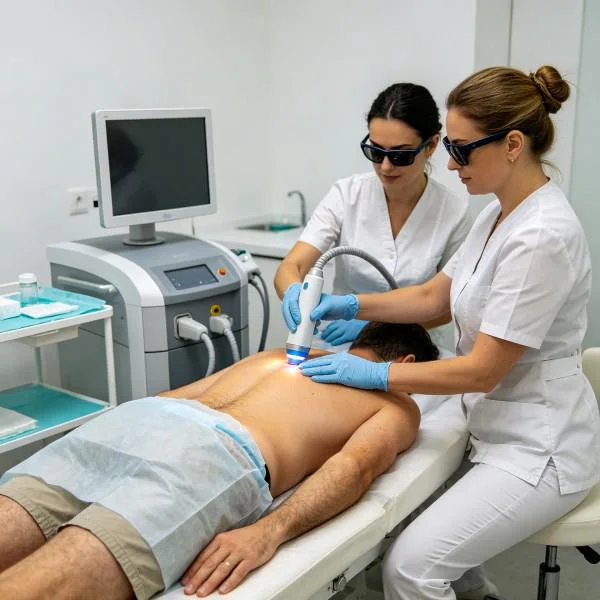
Managing Thermal Relaxation Time via Dynamic Duty Cycle Gating
Delivering fifteen to twenty-five Watts of continuous optical power into dense connective tissue challenges the thermal relaxation limits of human skin. Continuous wave delivery causes rapid superficial heat accumulation, triggering cutaneous nociceptors and risking burns before deep tendons absorb a therapeutic dose.
Advanced physical therapy laser machine architectures solve this problem through adjustable pulse duty cycle gating. By pulsing the emission between 10 Hz and 20,000 Hz with fine-tuned on/off pulse intervals, peak power reaches deep tissues during the active pulse phase, while the unheated interval allows capillary blood flow to carry away surface heat. This thermal gating keeps epidermal temperatures below 42 degrees Celsius, allowing clinicians to apply continuous high energy into the joint capsule without triggering surface pain or photothermal damage.
+--------------------------------------------------------------------------------------------------+
|                          DEEP SUBACROMIAL TISSUE PHOTON DYNAMICS                                 |
+--------------------------------------------------------------------------------------------------+
| Ergonomic Quartz Contact Handpiece Pressure                                                      |
|   |                                                                                              |
|   v                                                                                              |
| [Epidermis & Dermis]        ---> Surface heat dissipated via microsecond duty cycle pauses       |
|   |                                                                                              |
|   v                                                                                              |
| [Subcutaneous Adipose]     ---> Physical probe compression clears interstitial fluid barrier      |
|   |                                                                                              |
|   v                                                                                              |
| [Deltoid Muscle Sheath]     ---> 980nm dilates compressed vessels, clearing inflammatory waste   |
|   |                                                                                              |
|   v                                                                                              |
| [Subacromial Bursa]         ---> Fluid pocket effusion drained via stimulated lymphatic channels |
|   |                                                                                              |
|   v                                                                                              |
| [Supraspinatus Insertion]   ---> 1064nm activates Cytochrome C Oxidase to restore ATP production  |
+--------------------------------------------------------------------------------------------------+
Biomolecular Pathways: Suppressing Tenocyte Catabolism and Nociceptive Sensitization
Resolving chronic tendinopathy and capsular restriction requires addressing both structural tendon degeneration and persistent peripheral nerve sensitization. Injured tenocytes and inflamed synovial cells release catabolic cytokines, including interleukin-1 beta (IL-1β), tumor necrosis factor-alpha (TNF-α), and matrix metalloproteinases (MMPs), which break down type I collagen fibers and sensitize local C-fiber pain receptors.
Applying high-intensity laser energy interrupts this destructive biochemical cascade. Targeted near-infrared illumination downregulates nuclear factor kappa B (NF-κB) transcription inside tenocytes and synovial fibroblasts, decreasing the synthesis of inflammatory mediators like prostaglandin E2 (PGE2) and cyclooxygenase-2 (COX-2) to protect tissue integrity.
Simultaneously, high-flux class IV phototherapy acts directly on peripheral sensory nerve conduction. Delivering high photon doses hyperpolarizes unmyelinated C-fibers and thinly myelinated A-delta fibers within the articular capsule. Research by Chow and colleagues on photobiomodulation confirms that high-power near-infrared light induces a reversible nerve conduction block in peripheral nociceptors, reducing substance P accumulation and clearing local edema to provide rapid, lasting pain relief without reliance on pharmaceuticals.
Clinical Case Documentation: Outpatient Orthopedic Physical Therapy
The documented case below details the outpatient rehabilitation course of a patient with severe chronic supraspinatus tendinopathy and secondary adhesive capsulitis, treated using a multi-wavelength Class IV rehabilitation laser platform equipped with a quartz massage roller probe.
الملف الشخصي للمريض والبيانات السريرية الأساسية
- Case Identifier: PT-REHAB-2026-0428
- Patient Age / Sex: 53-Year-Old Female
- Primary Diagnosis: Chronic Supraspinatus Tendinopathy with High-Grade Partial-Thickness Intrasubstance Tear (Ellman Grade II), Subacromial Bursitis, and Secondary Stage II Adhesive Capsulitis, confirmed via Musculoskeletal Ultrasound and Shoulder MRI.
- History: 10 months of worsening right dominant shoulder pain and progressive loss of active mobility following a fall. Failed conservative physical therapy including therapeutic ultrasound, transcutaneous electrical nerve stimulation (TENS), and two subacromial cortisone injections. Patient unable to fasten clothing behind the back, comb hair, or reach overhead.
- Baseline Metrics: Numerical Pain Rating Scale (NPRS) at 8/10 during active elevation; Shoulder Pain and Disability Index (SPADI) at 76.5/100; Active Range of Motion (AROM) Abduction restricted to 58°, External Rotation restricted to 14°, Forward Flexion restricted to 82°.
Multi-Stage Treatment Regimen
The treatment course comprised ten clinical sessions scheduled over four weeks, progressing from early pain management and lymphatic drainage to deep joint biostimulation and functional mobility integration.
| رقم الجلسة. | Clinical Phase & Objective | Wavelength Setup | Operating Power (W) | تردد النبض (هرتز) | دورة التشغيل (%) | الطاقة المسلمة (J) | Cumulative Dose (J) |
| الجلسة 01 | Nociceptive Gating & Axillary Drainage | 980nm (65%) + 1064nm (35%) | 12.0 واط | 8,000 Hz | 40% | 3,600 J | 3,600 J |
| Session 02 | Posterior Capsule Myofascial Decompression | 980nm (60%) + 1064nm (40%) | 14.0 واط | 4,000 Hz | 50% | 4,200 جول | 7,800 ج |
| الجلسة 03 | Anterior Rotator Interval Flushing | 980nm (50%) + 1064nm (50%) | 16.0 واط | 2,000 هرتز | 60% | 4,800 جول | 12,600 جول |
| Session 04 | Coracohumeral Ligament Desensitization | 980nm (40%) + 1064nm (60%) | 18.0 واط | 500 هرتز | 65% | 5,400 J | 18,000 J |
| Session 05 | Deep Subacromial Bursa Effusion Drainage | 980nm (35%) + 1064nm (65%) | 20.0 واط | 250 هرتز | 70% | 6,000 J | 24,000 J |
| الجلسة 06 | Tenocyte Proliferation Induction | 980 نانومتر (30%) + 1064 نانومتر (70%) | 22.0 واط | 100 هرتز | 75% | 6,600 جول | 30,600 J |
| الجلسة 07 | High-Flux Collagen Synthesis Induction | 980 نانومتر (20%) + 1064 نانومتر (80%) | 24.0 واط | مستمر (CW) | 100% | 7,200 J | 37,800 J |
| الجلسة 08 | Supraspinatus Tendon Insertion Remodeling | 980 نانومتر (20%) + 1064 نانومتر (80%) | 24.0 واط | مستمر (CW) | 100% | 7,200 J | 45,000 J |
| الجلسة 09 | Dynamic Elevation Kinetic Chain Loading | 980 نانومتر (30%) + 1064 نانومتر (70%) | 20.0 واط | 150 هرتز | 75% | 6,000 J | 51,000 J |
| الجلسة 10 | Final Capsular Consolidation & Discharge | 980nm (40%) + 1064nm (60%) | 16.0 واط | 400 هرتز | 65% | 4,800 جول | 55,800 J |
مؤشرات التطور السريري والنتائج
WEEK 1 (Sessions 1-3):
- Deep contact sweeping over the axillary fold and posterior rotator cuff relieved periarticular tension.
- Resting nocturnal pain subsided; NPRS dropped from 8/10 to 4/10.
- Patient slept through the night on the affected side for the first time in five months after Session 2.
- Compensatory upper trapezius shrugging decreased as shoulder muscle guarding softened.

WEEK 2 (Sessions 4-6):
- Active abduction expanded from 58° to 104°; external rotation increased from 14° to 38°; forward flexion reached 120°.
- Patient fastened clothing behind the back without severe shoulder catching.
- SPADI score improved from 76.5/100 to 42.0/100.
- Ultrasound evaluation showed subacromial bursal effusion thickness decreased from 5.8 mm to 1.6 mm.

WEEK 3 (Sessions 7-8):
- Continuous wave delivery applied over the greater tuberosity and rotator interval with firm quartz compression.
- Patient performed light resistance band external rotation without joint catching or post-exercise ache.
- Diagnostic ultrasound showed improved supraspinatus fibrillar alignment and reduced peritendinous halo edema.

WEEK 4 (Sessions 9-10):
- Full active abduction restored (170°); external rotation reached 68°; forward flexion reached 168°.
- Final NPRS recorded at 1/10 during end-range overhead reaching and 0/10 at rest.
- SPADI score dropped to 6.8/100, representing near-complete functional recovery.
- Patient returned to uninhibited recreational activities without needing continued analgesic medication.
Comparative Analysis: High-Intensity Laser vs. Conventional Physical Therapy Modalities
Evaluating high-intensity class IV light alongside traditional clinical modalities demonstrates why modern outpatient rehabilitation practices rely on advanced laser platforms:
Therapeutic Ultrasound (1 MHz / 3 MHz)
Therapeutic ultrasound relies on mechanical sound waves to produce deep thermal friction and micro-cavitation. However, acoustic energy reflects strongly at bone-tendon interfaces, creating hot spots and risking periosteal pain over superficial bony landmarks like the humeral greater tuberosity. Furthermore, acoustic waves cannot stimulate mitochondrial respiratory enzymes. High-intensity class IV lasers deliver coherent optical energy without acoustic reflection, activating cellular cytochrome c oxidase and driving ATP synthesis rather than relying solely on non-specific heating.
Transcutaneous Electrical Nerve Stimulation (TENS)
TENS delivers low-voltage electrical currents across the skin to stimulate large-diameter A-beta nerve fibers, temporarily blocking pain signals according to the Melzack-Wall gate control theory. While TENS masks pain during stimulation, it does not alter underlying tissue biology, accelerate tendon healing, or improve local vascularity. High-intensity multi-wavelength laser therapy provides immediate pain gating while concurrently stimulating tenocyte collagen synthesis, microvascular recruitment, and inflammatory cytokine clearance, addressing the root physiological cause of the condition.
Moist Hot Packs and Superficial Diathermy
Moist heat packs warm the skin through superficial conduction, with nearly all thermal energy dissipating within the first two to three millimeters of subcutaneous fat. This warming increases superficial cutaneous blood flow without reaching deep joints, often causing superficial vasodilation while leaving deep tendons hypoxic. Modern class IV lasers bypass superficial adipose layers using near-infrared wavelengths, delivering concentrated energy straight to deep tendons and joint capsules to relieve pain and stiffness without cutaneous overheating.
التطبيق السريري العملي والدروس المستفادة على الصعيد التشغيلي
Achieving consistent clinical success with high-intensity laser systems in outpatient physical therapy requires structured execution:
- Dynamic compression using quartz massage probes: Clinicians should maintain firm, constant contact pressure with the quartz probe over periarticular tissues. Physical compression pushes superficial venous blood and interstitial fluid away from the beam path, creating an optimal optical pathway that delivers higher photon counts directly into deep target tissues.
- Two-phase regional sweeping: Begin every treatment session by sweeping proximal lymphatic drainage basins (such as the axillary fold and supraclavicular lymph node chains) before targeting the inflamed tendon or joint capsule directly. Clearing proximal lymphatic channels accelerates the evacuation of inflammatory byproducts.
- Frequency progression protocol: Begin with high pulse frequencies (4,000 Hz to 10,000 Hz) during early visits to calm hypersensitive peripheral nerve pathways, transition to moderate pulsing (100 Hz to 500 Hz) to improve local perfusion and clear capsular stiffness, and finish with continuous wave (CW) delivery to stimulate tenocyte metabolism and structural remodeling once acute pain has subsided.
Applying class IV multi-wavelength laser therapy grounded in tissue optical physics allows outpatient physical therapy clinics to resolve stubborn, chronic tendon and joint conditions, accelerating patient recovery and clinic efficiency.