 فوتون ميديكس












التغلب على انحباس العصب العميق في اعتلال الجذور العنقية
Targeted deep photonic saturation, selective hemoglobin deoxygenation resonance, and modulated thermal duty gating resolve perineural edema while protecting overlying muscular structures.
Rehabilitation teams routinely watch conservative treatments stall when dealing with chronic, multi-segmental cervical radiculopathy. Patients experience radiating brachial neuralgia, severe paraspinal spasms, and motor weakness that persist despite cervical traction, heavy pharmacotherapy, and spinal manipulations. Physical therapists trying to intervene with a standard medical grade cold laser therapy device quickly face an undeniable biological barrier: low-power outputs cannot penetrate past the dense cervical trapezius, splenius capitis, and deep paraspinal laminae. By the time photons reach a depth of two centimeters, radiant energy drops below cellular biostimulation thresholds, leaving the swollen nerve roots and compressed neural foramina unreached. Conversely, switching to continuous high-intensity irradiation introduces rapid epidermal overheating over the cervical spine, forcing early session shutoff. Solving this clinical impasse requires matching high photonic flux directly to nerve sheath edema, utilizing specific hemoglobin and water absorption dynamics, and controlling thermal dissipation with precision pulsing.
Optical Penetration Across Dense Cervical Musculoskeletal Layers
Delivering a therapeutic photonic dose to an impinged C6-C7 nerve root demands navigating a dense anatomical barrier consisting of keratinized skin, subcutaneous adipose tissue, thick fascial septa, and multiple layers of contracted postural musculature. Photons moving through these deep layers undergo continuous elastic scattering and diffuse reflection, as described in classical biological tissue optics by researchers like Steven Jacques and Britton Chance.
Forward scattering dominates in striated skeletal muscle, where parallel myofibrils act as anisotropic diffraction gratings that disperse coherent light laterally. In low-power modalities, beam intensity collapses exponentially, causing irradiance to drop beneath the biological trigger threshold of 0.01 W per square centimeter within the first 10 millimeters. To deliver adequate energy into deep intervertebral exit zones situated 35 to 50 millimeters beneath the dorsal skin surface, clinics must deploy a multi-wavelength therapy laser capable of sustaining high photon density. High incident flux ensures that even after extensive scattering and passive absorption through intervening muscle layers, an active therapeutic dose reaches deep nerve sheaths.
تنشيط الكروموفور ثنائي النطاق: ديناميكيات الهيموجلوبين وامتصاص الماء
Reversing nerve root ischemia and perineural fibrosis requires simultaneously addressing localized microvascular constriction and dense structural adhesions. A multi-wavelength protocol manages these distinct tissue factors through coordinated photobiological interactions:
The 980 nm wavelength exhibits strong absorption within localized hemoglobin, targeting congested microvascular networks surrounding irritated spinal nerve roots. Compressed cervical roots suffer from impaired venous outflow and capillary stasis, precipitating localized intraneural hypoxia and triggering intense neurogenic pain signals. Exposure to 980 nm light stimulates nitric oxide photodissociation from cytochrome c oxidase in cellular mitochondria. This biological event causes immediate microvascular dilation, improves local capillary perfusion, washes away accumulated acidic neuro-inflammatory mediators, and restores axonal adenosine triphosphate production, producing measurable neurogenic pain relief.
The 1470 nm wavelength corresponds directly to a sharp water absorption band, interacting with the primary constituent of perineural edema and interstitial ground substance. Inflammatory exudates around entrapped nerves create mechanical swelling within narrow bony foramina. The elevated water absorption profile of 1470 nm delivers controlled, non-destructive photothermal energy into the localized fluid accumulation, accelerating lymphatic drainage and softening dense collagen cross-links in fibrotic perineural tissues. Deploying an advanced laser therapy device from a specialized manufacturer ensures precise wavelength balancing, enabling clinicians to modulate deep thermal fields while targeting vascular and fluid components around the nerve root.
التحكم في الاسترخاء الحراري من خلال دورات التشغيل المُحدَّدة
Delivering high-power Class IV laser energy into sensitive paraspinal structures carries the risk of thermal accumulation in overlying skin layers. To prevent surface tissue overheating, the delivery profile must respect the thermal relaxation time of human skin and subcutaneous tissue, which ranges between 20 and 45 milliseconds.
Implementing structured micro-pulsing solves this clinical challenge. Delivering high peak power during microsecond pulses followed by planned quiescent intervals allows superficial capillaries and skin layers to conduct excess heat away safely. Meanwhile, coherent photon bundles travel continuously through deep target tissues. Regulating the duty cycle between 20% and 40% enables therapists to saturate the impinged nerve root with high cumulative energy while keeping epidermal temperatures comfortably below pain limits.
Clinical Protocol: Multi-Wavelength Class IV Laser Therapy in Recalcitrant Cervical Radiculopathy
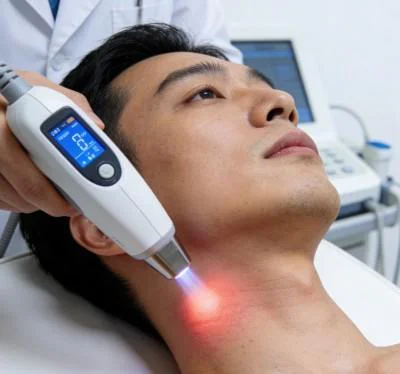
The following clinical data outlines an outpatient spine rehabilitation protocol applied to a patient suffering from long-standing cervical nerve root entrapment.
الملف الشخصي للمريض والتشخيصات الأساسية
- Case Identifier: FTM-NEURO-2026-0518
- Patient Age: 49
- الجنس: ذكر
- Primary Diagnosis: Chronic C6-C7 cervical radiculopathy secondary to foraminal stenosis and disc protrusion, symptom duration 10 months
- Prior Treatments: Oral gabapentin, oral corticosteroids, cervical traction (12 sessions), and epidural steroid injections (transient relief for three weeks followed by pain recurrence)
- Baseline Diagnostics: Cervical spine MRI confirmed a 4.6 mm posterolateral disc protrusion at C6-C7 with significant left neuroforaminal narrowing and visible root compression. Electromyography (EMG) revealed reduced conduction velocity and active denervation potentials in the left triceps and wrist flexor groups. The patient presented with intense radiating arm pain, paresthesia into the index and middle fingers, and diminished triceps reflex (1+). Baseline Visual Analog Scale (VAS) pain score registered 8.2/10 during neck extension. The Neck Disability Index (NDI) score stood at 64.0%.
معايير العلاج وجدول الجرعات الفني
The patient completed a four-week clinical protocol comprising twelve therapy sessions scheduled three times per week. Treatments incorporated continuous contact compression scanning along the left paraspinal gutter from C4 to T1 to blanch superficial capillary beds, combined with stationary pulsed delivery directed into the C6-C7 intervertebral foramen.
| نطاق الجلسة | نسبة الأطوال الموجية الضوئية | ذروة خرج الطاقة | تردد بوابة النبضات | دورة العمل الفعّالة | مدة الجلسة | كثافة الطاقة المستهدفة | إجمالي الطاقة المسلمة |
| الجلسات 1–3 | 80% 980 نانومتر، 20% 1470 نانومتر | 10.0 واط | 20 هرتز | 25% | 600 ثانية | 15,0 جول/سم² | 1,500 J |
| الجلسات 4–6 | 70% 980 نانومتر، 30% 1470 نانومتر | 12.0 واط | 40 هرتز | 30% | 540 ثانية | 21.6 J/cm² | 1,944 J |
| الجلسات 7–9 | 60% 980 نانومتر، 40% 1470 نانومتر | 14.0 واط | 60 هرتز | 35% | 480 ثانية | 28,0 جول/سم² | 2,352 J |
| الجلسات 10–12 | 50% 980 نانومتر، 50% 1470 نانومتر | 15.0 واط | 100 هرتز / تيار متردد مستمر | 50% | 420 ثانية | 35,0 جول/سم² | 3,150 J |
مقاييس التقدم السريري الموضوعية
Treatments proceeded without local anesthetics or skin cooling gels. Paraspinal surface temperatures were continuously tracked using an integrated infrared sensor to maintain epidermal temperatures under 41.5 degrees Celsius throughout every application.
| المعلمة السريرية | Pre-Treatment Baseline | بعد الجلسة الثالثة | ما بعد الجلسة 6 | بعد الجلسة التاسعة | الاختتام (الجلسة 12) | متابعة لمدة 90 يومًا |
| Radiating Arm Pain (VAS 0–10) | 8.2 | 5.6 | 3.1 | 1.4 | 0.4 | 0.0 |
| Neck Disability Index (NDI %) | 64.0% | 48.0% | 32.0% | 18.0% | 8.0% | 4.0% |
| C7 Dermatome Paresthesia Zone | Hand & Forearm | Forearm Only | Digits II-III Only | Intermittent Fingertips | تم حل المشكلة بالكامل | تم حل المشكلة بالكامل |
| Triceps Reflex Grade (0–4+) | 1+ (نقص النشاط) | 1+ | 2+ (عادي) | 2+ | 2+ | 2+ |
| Grip Strength Left Hand (kg) | 24.2 | 26.5 | 32.0 | 38.5 | 43.0 | 44.5 |
Biological Recovery and Tissue Normalization
Early sessions emphasized 980 nm light to reduce ischemic nerve pain and quiet ectopic firing from damaged sensory axons. Within the first three sessions, the patient’s resting radicular pain dropped from 8.2 to 5.6 on the VAS scale.
From the second week onward, increasing the 1470 nm ratio directed targeted photothermal energy into the fluid-congested nerve sheath and tight foraminal ligaments. This water-targeted interaction encouraged the clearance of perineural edema and relaxed paraspinal myofascial tension without cellular destruction. By session nine, radiating arm paresthesia had receded from the forearm to intermittent sensations in the fingertips, while left-hand grip strength improved from 24.2 kg to 38.5 kg. At the 90-day follow-up, repeat EMG testing demonstrated normalization of motor unit potentials, and the patient returned to full occupational duties without requiring pain medication or surgical referral.
High-Intensity Laser Therapy Versus Conventional Radiculopathy Interventions
Standard management protocols for chronic cervical radiculopathy carry significant clinical drawbacks. Long-term reliance on neuropathic medications and oral steroids offers transient symptom reduction while exposing patients to metabolic side effects, gastrointestinal distress, and cognitive clouding.
Epidural steroid injections deliver concentrated anti-inflammatory agents near the nerve root, but repeated injections risk dural puncture, localized infection, and structural weakening of adjacent connective tissues. Open spinal surgeries, such as anterior cervical discectomy and fusion (ACDF) or posterior foraminotomy, provide direct structural decompression but require extensive recovery periods, carry risks of adjacent segment disease, and create permanent surgical scarring that can cause chronic post-operative discomfort.
High-intensity Class IV laser therapy provides an advanced, non-invasive alternative. By combining 980 nm and 1470 nm wavelengths with controlled thermal relaxation gating, this method delivers high photon density past deep paraspinal muscle barriers directly into the compressed nerve root. Clinicians can resolve perineural edema, reverse microvascular ischemia, and restore normal neural conduction without mechanical disruption, systemic toxicity, or surgical downtime. Investing in high-performance optical platforms equips modern rehabilitation practices to deliver consistent, long-term functional recovery for patients facing complex spinal nerve compressions.