 فوتون ميديكس












التغلب على منحنيات تدهور التهاب المفاصل المتعدد لدى الكلاب المسنة
Dual chromophore affinity channels trigger microvascular oxygen release and interstitial fluid drainage while gated duty cycle emission protects atrophic articular skin.
An eleven-year-old Labrador Retriever sits splayed across the examination rug, unable to support its hindquarters without trembling, its stifle and elbow joints thickened by years of osteophytic remodeling. Long-term meloxicam administration had to be discontinued after renal biomarkers crested above safe limits, leaving the owner exhausted by nightly groaning, sleep disruption, and the heartbreak of watching an old companion struggle to reach its water bowl. The owner enters the consultation room anxious about invasive surgical interventions like percutaneous spinal decompression or joint fusion, having already gathered estimates on laser disc ablation dogs cost alongside the lifetime burden of physical rehabilitation. When the conversation turns toward conservative photobiomodulation, the primary barrier in clinical client communication is consistently the uncertainty around laser treatment for dogs with arthritis cost compared to whether photons can actually bypass fibrous capsular thickening, dense cortical bone, and atrophic subcutaneous fat without causing painful thermal hotspots on fragile geriatric skin.
Addressing severe chronic joint capsule degeneration requires calculating optical attenuation across dense, stratified, scarred tissue layers. When high-intensity photons pass through a chronically inflamed joint, light encounters hyperplastic synovial tissue, calcified osteophytes, and disorganized extracellular collagen networks. These irregular tissue planes cause severe Rayleigh and Mie scattering, quickly stripping superficial beams of their intensity before energy reaches deep subchondral nociceptive networks. Deploying high-intensity Class 4 multi-wavelength energy bridges this physical barrier, ensuring therapeutic photon density penetrates past hypertrophied capsular walls to relieve joint stiffness and chronic inflammation.
Stratified Tissue Extinction In Multi-Joint Degeneration
Degenerative joint disease in older canines presents severe optical hurdles compared to acute soft tissue injuries. Geriatric joints are surrounded by thinned, dry skin with uneven melanin deposits, followed by atrophic subcutaneous connective tissues, dense fibrotic joint capsules, and hard osteophytic margins that reflect incoming light beams.
[Incident High-Intensity Dual Photon Beam]
                     │
                     ▼ (Keratin Scattering & Epidermal Melanin Absorption)
        [Fragile Geriatric Dermal Layer]
                     │
                     ▼ (Photon Dispersion in Disorganized Collagen)
        [Fibrosed Chronic Joint Capsule]
                     │
                     ▼ (Rayleigh & Mie Scattering in Osteophytic Edges)
        [Inflamed Synovial Pouch & Fluid Hydrops]
                     │
                     ▼ (Residual Deep Fluence > Chondrocyte Trigger Threshold)
        [Eroded Articular Cartilage & Subchondral Nociceptors]
Standard near-infrared light scatters quickly within the outer three millimeters of thickened joint capsules. Underpowered equipment disperses uselessly in outer skin and fibrous tissues, never delivering therapeutic dosages to deep chondrocytes or subchondral bone. Delivering effective laser treatment for dogs with arthritis requires high-power Class 4 delivery configured with specific tissue-absorption profiles, ensuring therapeutic energy reaches deep articular targets instead of dissipating on the surface.
Clearing these stratified optical barriers demands simultaneous emission across complementary therapeutic wavelengths. By matching specific wavelengths to target chromophores, clinicians manipulate tissue penetration dynamics to bypass surface obstacles.
Target Tissue Substrate        Optimal Wavelength Band    Primary Physiological Mechanism
-----------------------------------------------------------------------------------------
Spastic Periarticular Muscle   980 nm                     Microvascular dilation, NO release
Effusive Synovial Capsule      1470 nm                    Targeted water clearance, joint decompression
Subchondral Nociceptive Bed    980 nm / 1470 nm Ratio     ATP synthesis, pain pathway inhibition
مخطط الهيموجلوبين عند طول الموجة 980 نانومتر والتروية الوعائية الدقيقة
The 980nm wavelength matches the peak absorption spectra of oxygenated and deoxygenated hemoglobin within the periarticular microvasculature. In chronic canine osteoarthritis, long-standing joint effusion and capsule fibrosis compress local capillary beds, starving periarticular muscles and ligaments of oxygen while trapping inflammatory lactic acid and bradykinin.
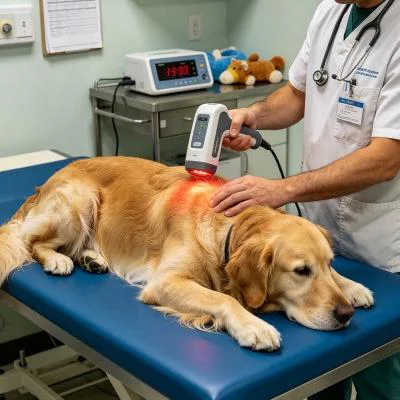
Absorbing 980nm photons causes rapid photothermal dilation within deep capillary networks around the diseased joint. Endothelial cells release nitric oxide, relaxing constricted vascular sphincters and restoring active microcirculation. This fresh wash of oxygen-rich blood clears acidic metabolites and delivers vital oxygen to ischemic myofascial tissues, stimulating cytochrome c oxidase within muscle mitochondria. Producing fresh adenosine triphosphate provides the cellular energy needed to release chronic compensatory spasms across the gluteal, hamstring, and triceps muscle groups.
The 1470nm Water Absorption Pathway In Chronic Joint Hydrops
Chronic arthritic joints accumulate excessive, stagnant synovial fluid within the joint capsule. This effusive swelling creates hydrostatic pressure that compresses sensory nerve endings against calcified joint margins, causing constant dull pain and limiting flexion. The 1470nm wavelength targets free and bound water molecules in this inflammatory fluid, providing an absorption coefficient significantly higher than standard near-infrared bands.
When 1470nm photons strike edematous capsular tissues, focused energy absorption alters extracellular matrix permeability. Trapped effusive fluid drains into surrounding lymphatic channels, relieving internal joint pressure. Combining 1470nm fluid mobilization with 980nm microvascular stimulation delivers rapid pain reduction, fundamentally improving clinic workflow and lowering the cumulative laser treatment for dogs with arthritis cost by reducing the total number of visits required to achieve functional mobility.
Duty Cycle Engineering To Prevent Periosteal Hyperthermia
Driving high average power through thin geriatric skin and prominent bony osteophytes carries a real risk of thermal injury. Thin dermal layers and compact bone surfaces in the stifle and elbow absorb continuous energy rapidly. If a continuous wave remains focused over exposed bony landmarks, heat accumulates quickly, causing periosteal pain and forcing clinicians to interrupt treatment before delivering an effective dose to the joint core.
Gated dynamic duty cycles prevent this thermal risk. Pulsing the laser beam intersperses microsecond pulse bursts with calibrated thermal relaxation intervals.
Continuous Wave (Thermal Runaway Over Osteophytes):
Power ────────────────────────────────────────── (Periosteal Thermal Risk & Pain)

Gated Dynamic Duty Cycle (Structured Thermal Dissipation):
Power ┌───┐    ┌───┐    ┌───┐    ┌───┐    ┌───┐
      │   │    │   │    │   │    │   │    │   │   (Maximum Intra-Articular Dose / Zero Burn)
Base  ┘   └────┘   └────┘   └────┘   └────┘   └────
      |Ton|    Toff     |
Because fibrosed capsular tissues lose heat faster than they absorb peak energy pulses, dynamic duty cycles let clinicians deliver high peak power through dense joint capsules while keeping skin and bone temperatures well within safe limits. Modulating duty cycles between 30 percent and 45 percent enables safe treatment directly over bony prominences, such as the tibial crest and humeral epicondyle, without thermal spikes.
Adjusting pulse frequencies between 10 Hertz and 800 Hertz aligns treatment delivery with clinical goals: lower frequencies suppress sensory nerve irritation for immediate pain relief, while higher frequencies stimulate chondrocyte cellular repair and extracellular matrix synthesis during later rehabilitation phases.
تقرير حالة سريرية ميدانية
The data below comes from Department of Veterinary Geriatrics and Orthopedic Rehabilitation records, documenting non-surgical recovery metrics in an aged canine with advanced multi-joint osteoarthritis.
الملف الشخصي للمريض وتصنيف المرحلة التشخيصية
Case File Number: VGO-2026-7731
Subject: Canine, Labrador Retriever
Age: 11 Years 3 Months
الجنس: أنثى (معقمة)
Weight: 36.8 Kilograms
Presenting Complaint: Severe difficulty rising from recumbency, bunny-hopping pelvic gait, audible crepitus in both stifles and the left elbow, inability to navigate three steps onto the porch.
Orthopedic Examination: Bilateral stifle effusion with extensive medial buttress formation; right stifle extension limited to 115 degrees; left elbow range of motion reduced by 25 degrees; severe compensatory longissimus dorsi spasm.
Radiographic Findings: Severe bilateral coxofemoral subluxation with acetabular rim remodeling, advanced bilateral stifle osteoarthritis with osteophytes exceeding 5 mm on the patellar poles, and left elbow joint space narrowing with periarticular sclerosis. Staged at COAST Stage 4. Pre-treatment Canine Brief Pain Inventory Pain Severity Score: 8.1 out of 10. Pain Interference Score: 8.5 out of 10.
| معرّف الجلسة | اليوم | Treatment Sites | تقسيم الطول الموجي | ذروة الطاقة (واط) | دورة التشغيل (%) | التردد (هرتز) | إجمالي الطاقة (J) | الملاحظات السريرية |
| S-01 | D-01 | Stifles, Hips, Left Elbow | 80% 980 نانومتر / 20% 1470 نانومتر | 10.0 | 30% | 15 | 3,200 | Severe guarding on extension; off-contact scanning applied; no dermal erythema. |
| S-02 | D-03 | Stifles, Hips, Left Elbow | 75% 980 نانومتر / 25% 1470 نانومتر | 12.0 | 35% | 30 | 4,000 | Myofascial tone in lumbar longissimus softens; patient lies down quietly during treatment. |
| S-03 | D-06 | Stifles & Lumbar Axis | 70% 980 نانومتر / 30% 1470 نانومتر | 14.0 | 35% | 60 | 4,800 | Rising latency from sternal recumbency drops by 5 seconds; stance widens. |
| S-04 | D-09 | Bilateral Stifles & Elbow | 65% 980 نانومتر / 35% 1470 نانومتر | 16.0 | 40% | 120 | 5,600 | Crepitus sensation softens; stifle circumferential swelling decreases by 1.1 cm. |
| S-05 | D-13 | Hips, Stifles, Paraspinal | 60% 980 نانومتر / 40% 1470 نانومتر | 18.0 | 45% | 250 | 6,500 | Dog walks up porch steps unassisted; tail wagging observed while greeting owner. |
| S-06 | D-17 | Multi-Joint Complex | 50% 980 نانومتر / 50% 1470 نانومتر | 20.0 | 45% | 500 | 7,200 | Stifle extension arc gains 16 degrees; weight-bearing distributes evenly on trot. |
| S-07 | D-22 | Regional Biomechanical Chain | 50% 980 نانومتر / 50% 1470 نانومتر | 18.0 | 40% | ديناميكي | 6,800 | Left elbow passive flexion smooth; Canine Brief Pain Inventory scores drop sharply. |
| S-08 | D-28 | Whole Kinematic Maintenance | 50% 980 نانومتر / 50% 1470 نانومتر | 16.0 | 35% | ديناميكي | 6,000 | Sustained 20-minute daily walking resumed; stable joint mobility without rescue drugs. |
مقاييس موضوعية لقياس التعافي الوظيفي
Day 1 (Intake Baseline)
[Pain Severity: 8.1/10]      ████████████████░░░░
[Rising Latency: 9.4s]       ████████████████████

Day 13 (Midway Status)
[Pain Severity: 4.0/10]      ████████░░░░░░░░░░░░
[Rising Latency: 4.2s]       █████████░░░░░░░░░░░

Day 28 (Protocol Completion)
[Pain Severity: 1.8/10]      ████░░░░░░░░░░░░░░░░
[Rising Latency: 1.6s]       ███░░░░░░░░░░░░░░░░░
By session eight on Day 28, the geriatric patient showed major functional improvement. Rising latency from sternal recumbency fell from 9.4 seconds down to 1.6 seconds. The Canine Brief Pain Inventory Pain Severity Score dropped from an initial 8.1 to 1.8, while the Pain Interference Score fell from 8.5 to 2.1, reflecting restored ease when standing, moving, and walking outdoors.
Bilateral stifle circumference decreased by an average of 1.4 centimeters, confirming the reduction of chronic inflammatory hydrops. Blood chemistry panels checked at Day 28 remained stable, avoiding the hepatic and renal complications common with long-term systemic pain medications.
Operational Value And Clinical Practice Economics
Managing geriatric multi-joint arthritis poses difficult dilemmas in daily veterinary operations. Long-term NSAID and corticosteroid protocols require continuous biochemical blood panels to monitor organ health, stressing clients financially and leading to sudden treatment stops when kidney or liver values rise. Invasive surgeries like joint arthrodesis carry severe perioperative risks, high financial burdens, and prolonged recovery times that many owners of senior dogs decline.
Low-power phototherapy units worsen this clinical bottleneck. Low-wattage hardware requires thirty to forty minutes of hands-on operator time to deliver modest photon numbers to a single joint. When treating multiple joints, such as both stifles, hips, and an elbow, low-power devices demand hours of staff labor, monopolizing exam rooms and inflating clinic overhead while delivering slow clinical improvement.
High-power Class 4 multi-wavelength protocols completely transform this workflow. Delivering up to twenty watts of peak power through balanced 980nm and 1470nm wavelengths cuts treatment times down to under ten minutes per anatomical region. This speed allows veterinary practices to treat multiple arthritic joints within a single fifteen-minute appointment, quadrupling room capacity while preventing patient stress and fatigue.
Gated pulse timing protects fragile, atrophic skin over osteophytic bone, preventing thermal injury while ensuring deep intra-articular energy penetration. Pet owners see noticeable improvements in posture, rising ease, and daily comfort within the first three visits, keeping client compliance high across the complete rehabilitation plan. For veterinary practices, pairing rapid multi-joint relief with streamlined appointment times turns complex geriatric arthritis cases into a predictable, non-invasive service that expands hospital caseload.