 فوتون ميديكس












الورم الليفي الأخمشي المخترق دون حروق جلدية
Deliver concentrated therapeutic photons through thick plantar aponeuroses using synchronized multi-wavelengths. Maximize dense collagen hydration targeting while promoting microvascular washout. Suppress superficial plantar discomfort through calibrated micro-pulsed duty cycles.
Podiatric and orthopedic rehabilitation clinics routinely face the stubborn, unyielding barrier of chronic plantar fasciopathy and deep plantar fibromatosis. A runner or warehouse manager steps into the examination room, unable to place their heel flat without sharp, knife-like pain across the medial calcaneal tubercle. Traditional treatment pathways deploy ultrasound heads, silicone heel cups, heavy cross-friction massage, and acoustic shockwave therapy. Yet, acoustic pulses on an acutely inflamed heel often cause extreme pain that triggers intense calf guarding, while low-output laser wands fail to penetrate the thick, keratinized skin of the sole. Ten minutes into traditional treatment, the thick calloused skin of the heel feels hot, but the degenerated plantar aponeurosis 2.5 centimeters beneath remains rigid, hypoperfused, and structurally disorganized.
Superficial heating fails because energy scatters heavily inside the thick stratum corneum and subcutaneous heel fat pad. When clinicians attempt to drive sufficient photons into deep plantar collagen using continuous-wave systems, epidermal thermal build-up occurs rapidly. The patient pulls away from burning sensations long before a therapeutic photobiomodulation dose ever reaches the degenerative fibroma core.
Overcoming this clinical standstill requires driving high-density photonic flux deep into fibrous fascial thickenings while completely shielding the sensitive, nerve-dense plantar dermis from thermal saturation.
Optical Impedance Across the Plantar Aponeurosis
Delivering light through the plantar aspect of the human foot presents an extreme optical challenge. The plantar sole features the thickest stratum corneum on the body, backed by an intricate, specialized heel fat pad composed of dense fibroelastic septa encasing pressurized adipose columns. When incoming photons strike this stratified architecture, forward light transmission drops dramatically due to intense multi-angle refraction and scattering.
Biological tissue absorption in the deep foot is dictated by three primary chromophores: epidermal keratin and melanin, microvascular hemoglobin, and the bound water within the thick collagenous aponeurosis.
In recalcitrant plantar fasciopathy and Ledderhose disease (plantar fibromatosis), the primary lesion sits beneath dense fat globules, anchored firmly into the calcaneal periosteum. Low-level Class III devices cannot overcome this optical barrier; over 90% of their photonic flux scatters within the first 3 millimeters of calloused skin and fibroelastic fat. The damaged plantar fascia receives near-zero irradiance, leaving chronic micro-tears and nodular fibromas stagnant in a low-energy, non-healing state.
Surmounting this optical loss requires the high photonic flux of a modern deep tissue laser therapy machine. Penetrating this dense architectural barrier without burning the tough plantar skin requires pairing cooperative wavelengths that target distinct physiological absorbers.
Keratinized Plantar Stratum Corneum (Scattering Barrier)
         │
         ▼
Pressurized Fibroelastic Fat Pad (Absorption Trap)
         │
         ▼
Peritendinous Capillary Loops (980nm Hemoglobin Hyperemia)
         │
         ▼
Plantar Fascial Hydrogel Matrix (1470nm Interstitial Water Targeting)
         │
         ▼
Calcified Fibromatous Enthesis (Mitochondrial Activation)
Targeting hemoglobin and water chromophores simultaneously transforms how stiff connective tissue responds:
At 980nm, photon capture aligns with oxygenated and deoxygenated hemoglobin absorption peaks. Chronic plantar fasciopathy is characterized by severe vascular occlusion, where tight fascial tension strangles local microvessels, creating an ischemic, acidic environment. The 980nm beam triggers immediate microvascular vasodilation, prompting circulating red blood cells to offload oxygen into starved tenocytes and washing out accumulated substance P and lactic acid.
At 1470nm, photon absorption shifts decisively toward water molecules trapped inside the dense, fibrotic aponeurosis. Interstitial water shows an absorption peak at 1470nm far higher than in the near-infrared 800nm band. Controlled water absorption creates focused micro-thermal fields that loosen dense collagen cross-links, rehydrating rigid fascial nodules and softening stiff scar tissue.
To deliver this high optical energy into the foot without causing surface skin burns, advanced pulse modulation is essential.
Duty Cycle Mechanics and Plantar Thermal Dissipation
Continuous-wave energy faces a rigid biological bottleneck on the plantar surface: the dense, poorly vascularized stratum corneum absorbs surface heat quickly, but cannot dissipate it through microvascular clearance as fast as thinner skin. When continuous photons strike the heel, surface temperatures rise rapidly, setting off intense burning sensations.
Precision pulse gating eliminates this surface thermal build-up. By slicing high-power beams into micro-pulsed duty cycles followed by controlled dark intervals, deep connective tissues receive intense peak irradiance while the thick epidermis cools down safely between pulses.
$$\text{دورة العمل (\%)} = \left( \frac{\tau_{\text{النبضة}}}{\tau_{\text{النبضة}} + \tau_{\text{التوقف}}} \right) \times 100$$
Where $\tau_{\text{pulse}}$ represents the active optical burst and $\tau_{\text{pause}}$ represents the cooling interval.
Applying 20W of continuous laser energy to the plantar fascia causes unacceptable surface heat within 4 seconds over the calloused heel. In contrast, running that same power through a 25% duty cycle delivers powerful peak bursts that penetrate through the thick fat pad, while the 75% dark cycle allows the tough outer skin to shed heat safely.
Blood flow in the vascular layers carries away surface heat, while the hypoperfused, deep fibrous nodule absorbs high-density photons, triggering cellular healing without epidermal irritation.
Multi-Wavelength Synergies in Plantar Fascial Architecture
Treating deep plantar pathology with a single wavelength fails to address the foot’s complex anatomy. Plantar fibromatosis involves calloused skin, fibroelastic fat compartments, thick aponeurotic collagen, and the calcaneal bone attachment. Each distinct layer features different water concentrations, vascular networks, and optical scattering properties.
Combining coordinated wavelengths establishes a continuous therapeutic gradient across all tissue depths:
[ Plantar Optical Penetration Matrix ]

810nm  ──► Mitochondrial Cytochrome c Oxidase (Cellular ATP Synthesis)
980nm  ──► Medial Calcaneal Capillary Perfusion (Nitric Oxide Release)
1064nm ──► Deep Fibroelastic Fat Septa (Forward Directional Penetration)
1470nm ──► Plantar Fascial Water Lattice (Fascial De-densification & Softening)
Pairing 980nm with 1470nm produces immediate biomechanical and circulatory improvements. The 980nm wavelength opens compressed microvascular beds around the calcaneal attachment, delivering fresh oxygen to ischemic tissue. At the same time, 1470nm targets bound water molecules within the stiff fascial nodule, breaking down cross-linked collagen bundles and softening rigid fibrous adhesions.
Clinicians using this dual-wavelength strategy quickly relieve plantar tension, allowing patients to resume pain-free walking and tolerate dynamic stretching and calf eccentric loading much earlier in their treatment.
Workflow Advantages of Deep Tissue Laser Therapy Systems
High-power Class IV platforms streamline clinical operations and patient recovery in busy sports medicine and podiatric clinics.
Clinicians managing chronic plantar fasciitis, Achilles tendinopathy, or stubborn plantar fibromas often spend extensive time on slow, painful manual interventions. Low-intensity Class III modalities require 30 to 40 minutes of scanning to deliver minimal joules through the foot’s thick fat pad. A modern deep tissue laser therapy machine cuts treatment times to under eight minutes while delivering meaningful, therapeutic energy directly to the injury site.
Rehabilitation directors and clinic managers evaluating a deep tissue laser therapy machine for sale see clear operational advantages:
First, practitioners deliver target therapeutic doses in 6 to 9 minutes, increasing daily patient throughput and eliminating clinician physical fatigue from aggressive manual friction.
Second, rapid pain relief breaks the patient’s antalgic limp, restoring normal walking mechanics and preventing secondary knee, hip, or lower back compensations.
Third, reliable deep-tissue cellular repair shortens recovery times, boosting patient satisfaction and delivering predictable clinical outcomes.
توثيق الحالات السريرية
The following case record details the clinical application of multi-wavelength high-intensity laser therapy for severe, treatment-resistant plantar fibromatosis and insertional plantar fasciopathy that had failed to respond to custom orthotics, night splints, and cortisone injections.
تفاصيل سجل القضية
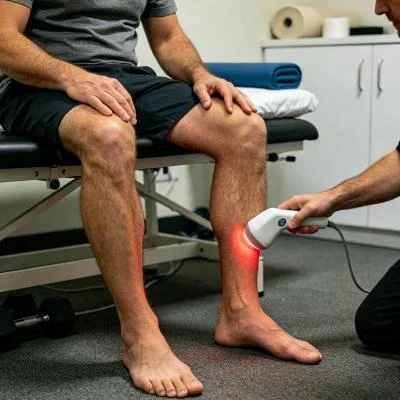
Case Identification: PODO-2026-F9104
Patient Demographics: 44-year-old male, distribution center operations manager
Primary Diagnosis: Chronic Recalcitrant Plantar Fasciopathy with Secondary Medial Band Plantar Fibromatosis (Ledderhose Disease, Stage II Focal Nodular Thickening, 1.8cm x 1.1cm)
Chronicity: 16 months of persistent pain; failed rigid custom orthotics, night splints, and two ultrasound-guided platelet-rich plasma (PRP) injections
Clinical Assessment: Palpable, firm, hyper-tender fibrous nodule located 2cm distal to the medial calcaneal tuberosity along the central plantar aponeurosis. Inability to bear weight comfortably during the first 20 minutes of morning standing (Numeric Pain Rating Scale: 9/10 morning pain, 6/10 constant aching throughout work shifts). Severe limitation in first metatarsophalangeal joint extension (Windlass test positive with sharp localized pain).
| معرّف الجلسة | بروتوكول Phase | تكوين الطول الموجي | متوسط الطاقة (واط) | تردد النبض ودورة التشغيل | مساحة المسح (سم²) | مدة العلاج | إجمالي الطاقة (جول) | مقياس الاستجابة السريرية |
| الجلسة 01 | إزالة الحساسية العصبية الوعائية | 980 نانومتر (70%) + 1470 نانومتر (30%) | 12.0 واط | 150 هرتز عند دورة تشغيل 30% | 100 | 06:15 | 4,500 J | Morning NPRS drops from 9/10 to 6/10; initial steps easier |
| الجلسة 03 | تليين المصفوفة اللفافية | 980 نانومتر (40%) + 1470 نانومتر (60%) | 16.0 واط | 300 هرتز عند دورة تشغيل 40% | 80 | 08:20 | 8,000 J | Plantar nodule softens under palpation; Windlass angle +12° |
| الجلسة 06 | التحفيز الحيوي الخلوي العميق | 810 نانومتر (30%) + 980 نانومتر (45%) + 1470 نانومتر (25%) | 20.0 واط | 1000 هرتز عند دورة تشغيل 50% | 110 | 08:20 | 10,000 J | Shift-end NPRS down to 2/10; weight-bearing normalized |
| الجلسة 09 | Enthesis Structural Remodeling | 980 نانومتر (40%) + 1470 نانومتر (60%) | 18.0 واط | 20 هرتز عند دورة تشغيل 30% (وضع التأثير العميق) | 70 | 07:25 | 8,000 J | First-step morning pain eliminated; calf tightness resolved |
| الجلسة 12 | التوحيد الحركي | 980 نانومتر (50%) + 1470 نانومتر (50%) | 15.0 واط | الموجة المستمرة (المسح الديناميكي) | 120 | 08:00 | 7,200 J | Zero resting pain; full 12-hour work shifts without flare-up |
ملاحظات متابعة الحالة
Sessions 01 through 03 focused on relieving neurovascular hypersensitivity around the medial calcaneal nerve branches and softening the stiff fat pad. Combining 980nm and 1470nm cleared chronic inflammatory fluid and relieved morning pain, allowing the patient to stand without sharp pain by the third session.
Sessions 04 through 08 targeted the dense collagen nodule inside the central aponeurotic band. The high water absorption of 1470nm softened the rigid, cross-linked fibroma, while 980nm stimulated capillary blood flow to flush out metabolic waste and recruit macrophages. Palpation showed the nodule had softened considerably, and the Windlass mechanism operated smoothly without catching.
By Session 12, follow-up musculoskeletal ultrasound revealed a 60% reduction in the thickness of the nodular mass, along with parallel, aligned collagen fibrils replacing the previous hypoechoic, disorganized tissue. The patient completed daily 15,000-step shifts in industrial footwear without pain or compensatory gait limping.
Biological Pathways in Plantar Fascial Regeneration
يحفز العلاج بالليزر للأنسجة العميقة عالي الكثافة عملية الشفاء من خلال آليات خلوية وخارج خلوية متكاملة:
Photonic Transmission (Mitochondrial Chromophores & Interstitial Water)
         │
         ├──► Dissociation of Inhibitory Nitric Oxide ──► Accelerated ATP Production
         │
         ├──► Interstitial Hydration Fluidization ─────► Softening of Cross-Linked Nodules
         │
         └──► Fibroblast Phenotype Modulation ────────► Organized Type I Collagen Deposition
When photons hit cytochrome c oxidase inside stressed tenocytes and fibroblasts, they displace inhibitory nitric oxide molecules. This allows oxygen to bind efficiently, speeding up the mitochondrial electron transport chain and driving a surge in adenosine triphosphate (ATP) production. Chronically fatigued cells regain the metabolic energy needed to initiate real structural repair.
Simultaneously, 1470nm photons excite water molecules bound within the stiff collagen matrix. The resulting micro-thermal fields break down rigid, cross-linked hyaluronic acid and proteoglycan chains, converting stiff, gelatinous scar tissue into a supple, hydrated matrix that glides smoothly during weight-bearing.
Downstream gene signaling shifts rapidly. Inflammatory mediators such as interleukin-1-beta, tumor necrosis factor-alpha, and cyclooxygenase-2 decrease, while vascular endothelial growth factor and basic fibroblast growth factor rise.
These biochemical changes prompt fibroblasts to lay down organized Type I collagen fibers instead of haphazard Type III scar tissue, restoring normal tensile strength and elasticity to the plantar aponeurosis.
A Targeted Approach to Plantar Rehabilitation
Conventional treatment for recalcitrant plantar fasciitis and plantar fibromatosis relies heavily on oral NSAIDs, cortisone injections, and extracorporeal shockwave therapy.
Systemic anti-inflammatory medications cause gastric and renal stress while doing nothing to restore blood flow to a choked, ischemic heel pad. Repeated cortisone injections into the plantar fascia carry significant risks, including permanent fat pad atrophy and sudden fascial rupture. Acoustic shockwave therapy can break up scar tissue, but its intense mechanical impact often causes severe discomfort that leads to protective muscle bracing or abandoned treatment courses.
High-power Class IV deep tissue laser therapy provides a focused, non-invasive alternative. It avoids systemic side effects, preserves the structural integrity of the fat pad, and avoids procedural pain. Clinicians can deliver thousands of therapeutic joules deep into thick plantar tissue and inflamed bone attachments within minutes.
This high-power photobiomodulation platform addresses plantar pain at its cellular and structural root. Rigid fibromas soften, microvascular circulation rebounds, and injured fascial fibers rebuild cleanly. It turns persistent, disabling foot pain into a predictable, lasting return to full mobility.