 FotonMedix












Superar los límites de la extrusión discal intervertebral canina
Dual-spectrum Class IV delivery balances water-phase decompression with hemoglobin photothermal perfusion, accelerating neurovascular regeneration and eliminating cutaneous heat spikes via gated duty-cycle modulation.
Veterinary neurologists face a frustrating barrier when a seven-year-old French Bulldog arrives on an emergency gurney with non-ambulatory tetraparesis from acute Hanson Type I cervical disc herniation. The patient displays severe spasticity across all four limbs, hypersensitivity along the cervical spine from C2 to C5, and absent conscious proprioception. High-dose systemic dexamethasone risks massive gastrointestinal ulceration, while decompressive ventral slot surgery introduces anesthetic instability, high financial costs, and weeks of postoperative recumbency. When practitioners attempt conservative therapy with standard sub-watt devices, light merely scatters across dense cervical musculature, delivering zero measurable photon fluence to the swollen spinal cord beneath thick vertebral arches. Technicians end up burning half an hour per session holding cold therapy probes that do nothing to stop progressive axonal swelling.
Optical Penetration Physics Through Stratified Neurological Pathways
Photobiomodulation targeting the canine spinal canal requires conquering intense optical scatter. The spinal cord sits beneath dense layers of dermis, subcutaneous adipose tissue, thick epaxial muscles, and calcified dorsal lamina. Photons directed at the cervical or thoracolumbar junction encounter two severe physical hurdles: Rayleigh scattering caused by microstructural collagen fibrils and Mie scattering caused by larger cellular organelle boundaries.
In canine spinal anatomy, scattering coefficients exceed absorption coefficients across low-nanometer visible light. Sub-watt therapeutic devices deliver insufficient photon density to survive this tissue maze. Photons disperse across the first few millimeters of superficial dermis, failing to reach the threshold required to trigger neurorepair. Reaching the dorsal horn and ventral motor neurons requires high surface irradiance to ensure that four to eight Joules per square centimeter penetrate to depths of four to seven centimeters.
According to research published in Photomedicine and Laser Surgery, target neurorehabilitation hinges on the biphasic Arndt-Schulz curve. Sub-therapeutic photon quantities elicit no functional metabolic cascade, while excessive, unmodulated continuous light induces cellular hyperthermia. High-irradiance Class IV therapy delivers the exact photon density required to stimulate chromophores within compressed spinal tissue, overcoming severe optical loss without thermal necrosis.
When sufficient photons reach injured spinal neurons, cytochrome c oxidase within mitochondrial respiratory complex IV absorbs the radiation. This event triggers the dissociation of inhibitory nitric oxide, restoring cellular respiration and elevating proton gradients across the inner mitochondrial membrane. Downstream, adenosine triphosphate synthesis accelerates, fueling sodium-potassium ATPase pumps to clear toxic intracellular sodium, limit post-ischemic swelling, and prevent secondary necrotic cascade expansion.
Chromophore Specificity: Coordinating 980nm Hemoglobin and 1470nm Water Interactions
Spinal cord trauma is characterized by a hostile microenvironment consisting of mechanical ischemia, extravasated red blood cells, and localized parenchymal edema. Monochromatic phototherapy cannot address this multifaceted cellular crisis. Efficient neurovascular salvage requires coordinating multiple wavelengths to target distinct primary tissue chromophores.
The 980nm wavelength demonstrates primary affinity for deoxygenated and oxygenated hemoglobin, coupled with moderate water absorption. Acute disc extrusion crushes microvascular capillary beds, triggering localized ischemia, secondary thrombosis, and tissue hypoxia. Direct application of 980nm energy stimulates photothermal vasodilation in peripheral collateral microvessels, clearing cellular debris and driving oxygen-rich blood into the ischemic penumbra. Furthermore, 980nm stimulation triggers macrophage polarization, transforming aggressive M1 neurotoxic phenotypes into pro-resolving M2 phenotypes that clear myelin debris.
The 1470nm wavelength interacts directly with intracellular and extracellular water molecules. Its absorption coefficient in water is forty times higher than that of near-infrared wavelengths below 1000nm. Disc herniation and subsequent spinal cord compression generate acute inflammatory edema within the tight epidural space, elevating interstitial pressure and starving motor neurons. Delivering 1470nm photons modulates water molecule vibration, optimizing local lymphatic absorption channels and dissipating compressive spinal edema without mechanical intervention.
Synchronizing 980nm and 1470nm emissions establishes clinical synergy. While 980nm restores microvascular perfusion and cellular respiration, 1470nm reduces the localized edema that blunts nerve conduction. Using a high-performance canine laser therapy machine capable of dynamic wavelength modulation allows clinicians to relieve acute spinal pressure and restore functional axonal conduction along damaged nerve roots.
Tiempo de relajación térmica y modulación dinámica del ciclo de trabajo
Directing high average power into dense cervical musculature presents a primary clinical risk: thermal burns. The canine coat and pigmented epidermal layers absorb light rapidly, converting photon energy into heat. If continuous radiation is applied, dermal surface temperatures quickly cross the critical forty-three degrees Celsius threshold, risking collagen denaturation and epidermal blistering.
Preventing thermal accumulation requires aligning delivery with the thermal relaxation time of animal tissue. Thermal relaxation time represents the duration required for a biological tissue layer to shed fifty percent of its accumulated heat through natural dissipation. Canine dermis displays thermal relaxation constants within the millisecond window. Continuous-wave laser output continuously dumps heat into superficial layers faster than capillary flow can clear it, resulting in painful thermal peaks.
Pulsed duty cycles solve this problem by slicing continuous emission into high-power bursts followed by true thermal resting phases. Utilizing a duty cycle between twenty and forty percent allows high peak powers to drive through thick paraspinal muscles, while the intermediate zero-emission phases let superficial tissues cool naturally.
Modulating pulse frequencies unlocks distinct clinical responses:
Frequencies between ten and one hundred Hertz inhibit peripheral nociceptive transmission along unmyelinated C fibers and thinly myelinated A-delta fibers, producing immediate neuro-analgesia.
Frequencies between five hundred and one thousand Hertz enhance localized lymphatic peristalsis, accelerating the drainage of epidural effusions.
Frequencies between two thousand and ten thousand Hertz stimulate mitochondrial enzymatic activity, accelerating the synthesis of neurotrophic factors and promoting axonal sprouting across the injury site.
Controlled duty cycle tuning on an advanced dog laser therapy machine allows operators to deliver deep volumetric doses through thick spinal musculature without triggering defensive movements or skin trauma.
Arquitectura comparativa entre plataformas veterinarias de clase IV
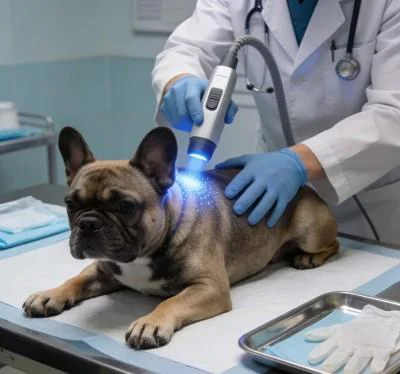
Navigating therapeutic options requires evaluating clear engineering distinctions. Basic low-level pens, flat consumer pads, and continuous surgical lasers cannot deliver the spatial power density, penetration depth, and thermal safety demanded by spinal cord trauma. Selecting the appropriate high-intensity system requires direct side-by-side analysis.
| Métrica de ingeniería | Dispositivos de bajo nivel para bajas temperaturas | Unidades de clase IV de onda única continua | Sistemas dinámicos de clase IV de múltiples ondas |
| Potencia de salida máxima | 0,2 W – 0,5 W | 10 W – 15 W en funcionamiento continuo | 15 W – 30 W (pico con puerta) |
| Longitudes de onda primarias | 635 nm – 810 nm, monomodo | Monocromático de 810 nm o 980 nm | 980 nm + 1470 nm sincronizados |
| Profundidad de penetración en los tejidos | De 5 mm a 10 mm | De 25 mm a 35 mm | 50mm to 80mm into Deep Neuro Structures |
| Acumulación térmica cutánea | Ausente | Alto con un movimiento lento de la pieza de mano | Evitado mediante refrigeración con ciclo de trabajo controlado |
| Enfoque clínico | Incisiones cutáneas superficiales, otitis | Broad superficial muscle soreness | Acute disc herniation, severe neurological lesions |
| Canine Cervical Session Time | De 35 a 45 minutos | De 15 a 20 minutos | 5 to 8 minutes per spinal segment |
| Cromóforos diana | Solo la citocromo c oxidasa | Citocromo c oxidasa o hemoglobina | Citocromo c oxidasa, hemoglobina y agua |
Investing in high-end veterinary equipment, such as an equine laser therapy machine for sale that adapts seamlessly between equine tendons and deep canine neurovascular pathology, delivers the power reserves, wavelength diversity, and pulse controls necessary to handle complex neurological cases.
Comprehensive Clinical Case Protocol
The following documented case outlines deep-tissue neurovascular photobiomodulation in a canine clinical neurology setting.
Case File Reference: VET-NEURO-2026-3194
Subject: Canine, French Bulldog, Intact Female
Age: 7 Years 1 Month
Weight: 12.8 kg
Confirmed Diagnosis: Acute Hanson Type I Intervertebral Disc Extrusion at C3-C4, resulting in severe spinal cord compression and epidural hemorrhage. Grade 4 neurological deficit confirmed via low-field MRI.
Prior Therapy: Emergency intravenous dexamethasone sodium phosphate at 0.2 mg/kg administered six hours post-onset; owner declined decompressive hemilaminectomy due to economic constraints. Patient placed on strict crate rest, bladder expression, and adjunctive gabapentin at 10 mg/kg three times daily.
Clinical Presentation: Non-ambulatory tetraparesis, score 4/5 on the modified Frankel scale. Spastic tone across all four limbs, severe cervical hyperpathia on light touch, absent postural reactions in thoracic and pelvic limbs, intact deep nociception. Superficial cervical musculature displayed severe secondary fasciculations.
Protocolo completo de tratamiento clínico
| Índice de sesiones | Cronología transcurrida | Wavelength Distribution (980nm / 1470nm) | Potencia máxima de funcionamiento (W) | Frecuencia de pulso y ciclo de trabajo | Energía total suministrada (julios) | Fluencia en la superficie de la piel (J/cm²) | Neurological and Biomechanical Milestones |
| Sesión 1 | Día 1 | 70% / 30% | 10,0 W | 50 Hz, ciclo de trabajo 25% | 2,400 J | 16 J/cm² | Severe neck guarding; gentle sweeping motion delivered over dorsal C2-C6 spine; muscle spasms resolved during scan. |
| Sesión 2 | Día 2 | 70% / 30% | 12,0 W | 50 Hz, ciclo de trabajo 30% | 2,800 J | 18 J/cm² | Cervical pain score dropped from 9/10 to 4/10; spontaneous head turning observed inside the recovery cage. |
| Sesión 3 | Día 4 | 60% / 40% | 14,0 W | 100 Hz, 35% Duty Cycle | 3 200 J | 21 J/cm² | Patient voluntary thoracic limb extension noted; reduced extensor rigidity; voluntary urinary voiding initiated. |
| Sesión 4 | Día 6 | 60% / 40% | 15,0 W | 250 Hz, ciclo de trabajo 40% | 3,600 J | 24 J/cm² | Delayed conscious proprioception returned to right thoracic limb; patient raised sternum without support. |
| Sesión 5 | Día 9 | 50% / 50% | 16,0 W | 500 Hz, ciclo de trabajo 45% | 4,000 J | 26 J/cm² | Proprioception returned to left thoracic and right pelvic limb; assisted standing achieved with sling support. |
| Sesión 6 | Día 13 | 50% / 50% | 16,0 W | 1.000 Hz, ciclo de trabajo 45% | 4 200 J | 28 J/cm² | Independent standing achieved for forty seconds; modified Frankel score upgraded to Grade 3 (ambulatory paraparesis). |
| Sesión 7 | Day 18 | 40% / 60% | 18,0 W | 2.500 Hz, ciclo de trabajo 50% | 4 800 J | 32 J/cm² | Independent ambulation resumed with moderate ataxia; proprioceptive knuckling resolved on hard ground surfaces. |
| Sesión 8 | Day 24 | 40% / 60% | 18,0 W | 5.000 Hz, ciclo de trabajo 50% | 4 800 J | 32 J/cm² | Symmetrical pelvic limb motor control observed; patient able to negotiate three low-rise therapy ramps. |
| Sesión 9 | Day 32 | 50% / 50% | 15,0 W | 1.000 Hz, ciclo de trabajo 40% | 3,600 J | 24 J/cm² | Neurological score upgraded to Grade 1; mild pelvic limb crossing observed only during sharp ninety-degree turns. |
| Sesión 10 | Día 45 | 50% / 50% | 12,0 W | 500 Hz, 30% Duty Cycle | 3,000 J | 20 J/cm² | Full clinical recovery; neurological examination revealed normal spinal reflexes, zero cervical pain, and normal gait. |
Treatment was applied using a wide divergent massage handpiece maintaining light perpendicular contact with clipped cervical skin. Sweeping patterns covered the cranial paraspinal muscles from the occiput down to the first thoracic vertebra, treating an anatomical area of roughly one hundred and fifty square centimeters.
Resultados clínicos e integración en la práctica clínica
Conservative management of canine neurological emergencies has historically carried grim prognoses or long recovery windows. Corticosteroids provide fleeting anti-inflammatory effects while increasing risks of pancreatitis, sepsis, and gastrointestinal perforation. When surgeries are off the table due to spinal cord compromise, poor health, or owner financial constraints, animals often face euthanasia due to persistent paralysis and loss of bodily control.
High-intensity Class IV photobiomodulation provides a powerful therapeutic pathway for acute neurological recovery. Coordinating 980nm microvascular stimulation with 1470nm interstitial water decompression delivers photons straight through the dorsal vertebrae into damaged neural pathways. Local mitochondrial energy production increases, micro-ischemia resolves, and compressive edemas drain via stimulated lymphatic routes without mechanical cutting.
Integrating high-power photobiomodulation transforms clinical practice capabilities. Treatments wrap up in less than ten minutes, and visible functional improvements routinely emerge within the first week of therapy. Patients regain motor control without organ-taxing drug loads, sparing owners the financial and emotional tolls of complex invasive surgery. Adding high-performance veterinary laser platforms establishes a repeatable, evidence-backed standard of care that preserves neurological function and elevates clinical outcomes across small animal and equine practices.