 FotonMedix




Overcoming Proximal Suspensory Desmitis in Warmblood Jumpers
Synchronized multi-wavelength photonic arrays bypass dense metacarpal fascia, calibrated 1470nm and 980nm chromophore absorption mobilizes chronic intraligamentous edema, and microsecond duty cycle modulation prevents epidermal thermal accumulation over dense equine flexor tendons.
Equine veterinary practitioners encounter a frustrating diagnostic impasse in competitive show jumping stables. A Grand Prix Warmblood gelding lands stiffly off a oxer, showing a sudden Grade 3 lameness with resistance to flexion of the distal limb. Diagnostic regional anesthesia localizes the pain to the proximal metacarpal region, and high-frequency ultrasound confirms a severe hypoechoic core lesion within the proximal suspensory ligament, bounded tightly against the palmar cortex of the third metacarpal bone. Traditional management paths present heavy clinical compromises. Months of stall confinement, cold water hydrotherapy, and shockwave therapy frequently result in dense, disorganized scar formation that tears immediately upon resuming jumping work. When trainers evaluate equine cold laser therapy, they encounter underpowered milliwatt systems that disperse in the skin and hair coat without ever reaching the deep sub-carpal fascial compartment. When considering whether invasive fasciotomy or neurectomy justifies the standard equine laser surgery risk profile, clinics must weigh surgical downtime against lasting functional recovery. Overcoming chronic proximal suspensory desmitis demands sufficient photon density delivered directly into the avascular ligamentous core to stimulate tenocyte repair and realign dense collagen bundles.
Deep Spatial Extinction and Optical Attenuation in Equine Tendinous Tissue
The proximal suspensory ligament of the horse presents an unforgiving anatomical barrier to optical energy transmission. Situated deep on the palmar aspect of the third metacarpal bone, the suspensory origin is shielded by thick equine skin, dense subcutaneous fascia, the deep digital flexor tendon, the superficial digital flexor tendon, and the accessory ligament (carpal check ligament). Photons delivered from a cutaneous applicator must penetrate through 35 to 55 millimeters of dense, collagenous, and fibro-fatty tissues before reaching the deep enthesis.
As light traverses these dense anatomical strata, Rayleigh and Mie scattering rapidly disperse forward-propagating photons. Equine tendon tissue exhibits high scattering coefficients due to the tightly packed, parallel arrangement of type I collagen fibrils. In underpowered modalities, forward beam propagation dissolves within the first few millimeters of superficial tissue, completely missing the deep suspensory architecture. High-intensity Class 4 therapeutic platforms overcome this threshold by providing the high incident irradiance required to saturate superficial absorption bands and drive a coherent forward photon flux into the deep palmar architecture.
Equine Palmar Metacarpal Stratification and Extinction Curve:
[Cutaneous Coat & Epidermis]  ===> Incident High-Density Flux (100% Incident Irradiance)
              |
[Superficial Flexor Tendon]   ---> Severe Mie Scattering across Dense Parallel Collagen (35% Loss)
              |
[Deep Digital Flexor & Check] ---> Forward Beam Attenuation & Microvascular Interception (45% Loss)
              |
[Proximal Suspensory Core]    ---> Residual Forward Photonic Field (Target Dose: 8-12 J/cm2 Fluence)
La eficacia clínica depende de que las emisiones del láser se adapten a las características de absorción de los cromóforos del tejido principal:
- 1470nm Hydro-Selective Matrix Decompression: Chronic suspensory desmitis generates severe intraligamentous fluid collection, interstitial proteoglycan accumulation, and compartment pressure within the unyielding sub-carpal fascia. The 1470nm wavelength interacts directly with free water molecules. Its high absorption coefficient in water allows targeted heating and mobilization of trapped interstitial edema, reducing hydrostatic compartment pressure on compressed microvascular loops and relieving mechanical tension on adjacent palmar nerves.
- Absorción de la hemoglobina a 980 nm y perfusión: The proximal suspensory ligament origin possesses notoriously sparse vascularity, relying on marginal periosteal and fascial vessels. The 980nm wavelength matches the optical absorption curve of oxygenated and deoxygenated hemoglobin. Radiant energy absorbed by blood vessels stimulates localized photothermal vasodilation, promoting microvascular perfusion to wash out necrotic debris, cellular breakdown products, and inflammatory cytokines.
- Activación del citocromo mitocondrial a 810 nm: Matching the peak absorption band of Cytochrome c oxidase, this wavelength stimulates the mitochondrial respiratory chain to accelerate cellular adenosine triphosphate synthesis in hypoxic tenocytes.
Delivering high-energy Class 4 laser power to equine limbs requires careful thermal management. Equine distal limbs lack thick subcutaneous adipose buffers, placing bone, tendons, and dense connective tissues close to the skin surface. Continuous-wave energy absorbed by epidermal melanin and dermal water can accumulate rapidly, and if skin temperatures exceed 42 degrees Celsius, thermal nociceptors trigger limb withdrawal and risk cutaneous thermal injury.
Pulsed Temporal Emission Dynamics across Equine Tendons:
Emission Phase (Pulse ON)  : |=========== High Peak Power Irradiance ===========|
                             [-------- Controlled Pulse Duration (t_on) --------]
Thermal Clearance (Pulse OFF): [ . . . . Cutaneous Thermal Relaxation (t_off) . . . . ]
                             Net Outcome: Deep ligamentous saturation without thermal trauma
Microsecond duty cycle modulation provides the necessary clinical protection. Operating across frequencies from 100Hz to 15,000Hz, system processors deliver high peak wattage to penetrate dense flexor tendons while inserting brief off-duty rest intervals. These intervals match the thermal relaxation time of the skin, allowing cutaneous capillary blood flow to dissipate heat while forward-moving photons penetrate deep into the ischemic ligamentous core.
Tenocyte Bioenergetics and Collagen Alignment Remodeling
Targeting proximal suspensory desmitis addresses the underlying failed healing response rather than merely suppressing local pain. Histological models documented in equine orthopedic studies by Dyson and Genovese show that chronic desmitis is marked by tenocyte rounding, loss of crimp pattern, microvascular thrombosis, and disorganized extracellular matrix deposition.
Under chronic repetitive strain, tenocytes suffer metabolic exhaustion. Mitochondrial membrane potentials drop, leading to decreased intracellular adenosine triphosphate synthesis. Lacking energy, local tenocytes fail to synthesize normal structural matrix proteins, instead depositing mechanically inferior type III collagen that tears easily under athletic loading.
Los fotones del infrarrojo cercano actúan directamente sobre el fotoaceptor mitocondrial principal, la citocromo c oxidasa (complejo IV). Bajo estrés hipóxico e isquémico causado por la compresión microvascular, el óxido nítrico se une al centro catalítico de la enzima, deteniendo la respiración mitocondrial. La irradiación del tejido lesionado desalojó el óxido nítrico mediante fotólisis dirigida, lo que permitió que el oxígeno se uniera y se restableciera el gradiente de bombeo de protones a través de la membrana mitocondrial interna.
Biological Progression of Equine Ligamentous Photobiomodulation:
[Photonic Absorption]   --> Complex IV Photolysis of Inhibitory Nitric Oxide
         |
[Mitochondrial ATP]     --> Fuels Tenocyte Extracellular Matrix Secretion
         |
[Procollagen Synthesis] --> Transitions Repair Matrix from Type III to Type I Collagen
         |
[Crimp Restoration]     --> Re-establishes Elastic Energy Storage and Tensile Strength
Esta vía biológica da lugar a varias respuestas terapéuticas:
- Upregulation of Type I Procollagen: Restoring mitochondrial ATP production provides the energy required for tenocytes to transcribe type I collagen, replacing weak type III collagen with dense, parallel fibrils that withstand tensile loading.
- Regulation of Matrix Metalloproteinases: Photonic stimulation balances the expression of matrix metalloproteinases and their tissue inhibitors, clearing disordered proteoglycans and realigning the ligamentous matrix along functional biomechanical lines.
- Agotamiento de los mediadores locales del dolor: High-intensity photon flux downregulates substance P and calcitonin gene-related peptide expression within sensory nerve terminals, reducing mechanical pain during weight-bearing.
- Resolution of Enthesis Edema: Selective photothermal absorption by water accelerates lymphatic drainage, decompressing the surrounding fascial compartment and easing pressure on the deep palmar nerves.
By stimulating tenocyte cellular metabolism and promoting collagen fiber alignment, targeted high-intensity Class 4 laser therapy addresses the structural causes of chronic ligamentous failure.
Clinical Stratification and Differential Diagnosis in Equine Podiatry and Orthopedics
Accurate clinical and sonographic assessment ensures energy is applied to correct tissue targets. Establishing appropriate treatment protocols requires differentiating between acute structural disruption, chronic enthesopathy, and secondary compartment syndromes:
- Acute Avulsion Fractures of the Third Metacarpal: Complete bone avulsions at the palmar cortical origin with displaced bone fragments require surgical stabilization or prolonged immobilization. Photobiomodulation cannot mechanically reattach structurally displaced bone fragments.
- Chronic Proximal Suspensory Desmitis with Core Disruption: The primary indication for deep multi-wavelength intervention. Horses display persistent Grade 2 to 3 lameness, pain on deep palmar palpation just distal to the carpus, and sonographic confirmation of hypoechoic core defects exceeding 25 percent of the ligament cross-sectional area.
- Secondary Deep Branch of Lateral Palmar Nerve Entrapment: Chronic ligament enlargement frequently compresses the adjacent deep branch of the lateral palmar nerve against the palmar cortex. High-intensity laser therapy mobilizes inflammatory fluid, softens surrounding fibrotic adhesions, and reduces perineural swelling.
- Proximal Suspensory Enthesopathy with Cortical Lysis: When chronic traction produces cortical remodeling, enthesophytes, or radiographically visible lysis at the palmar aspect of the third metacarpal, protocols must combine higher total energy with gentle mechanical stimulation to promote osteoblastic repair along the bone-ligament interface.
Calculating the correct therapeutic dose requires accounting for tissue scatter and absorption. Because overlying flexor tendons and thick skin attenuate up to 95 percent of surface photons, delivering an effective target dose of 8 to 12 Joules per square centimeter to a ligament 40 millimeters deep requires surface-applied doses ranging from 120 to 180 Joules per square centimeter across the palmar metacarpal region.
Comprehensive Clinical Case History: Equine Sports Medicine Center
El siguiente informe clínico detalla los datos clínicos iniciales, la matriz de parámetros y la trayectoria de recuperación objetiva observada durante una intervención con láser de alta potencia y múltiples longitudes de onda.
Perfil del paciente y pruebas diagnósticas iniciales
- N.º de expediente del departamento: FTM-EQ-2026-7241
- Paciente: Sujeto: 9-year-old Dutch Warmblood (KWPN) Gelding
- Disciplina: Show Jumping (1.45m Grand Prix Competitor)
- Cuadro clínico: Severe, chronic right forelimb proximal suspensory desmitis accompanied by marked performance decline, resistance to landing off jumps, and post-exercise swelling.
- Duración de los síntomas: 20 weeks of persistent lameness; unresponsive to stall rest, three sessions of focused extracorporeal shockwave therapy, and an ultrasound-guided platelet-rich plasma injection.
- Nivel funcional de referencia:
- AAEP Lameness Scale: Grade 3 / 5 (consistently visible at a trot on a straight line and lunging on a hard surface).
- Distal Limb Flexion Test: Strongly positive (marked exacerbation of lameness to Grade 4/5 for 15 strides).
- Deep Palmar Palpation: Moderate localized swelling, heat, and painful withdrawal response over the proximal third of the right palmar metacarpal region.
- Anestesia diagnóstica:
- Low four-point nerve block produced no change in lameness.
- Infiltration of the deep branch of the lateral palmar nerve resolved 85% of baseline lameness, confirming localization to the proximal suspensory origin.
- Ecografía musculoesquelética de alta frecuencia con fines diagnósticos:
- Cross-sectional area of the proximal suspensory ligament enlarged to 2.1 square centimeters (contralateral limb measured 1.3 square centimeters).
- Prominent, central hypoechoic core lesion involving 35% of the total cross-sectional area, showing complete loss of normal parallel fiber alignment.
- Mild irregularity and enthesophyte formation along the palmar cortex of the third metacarpal bone.
Protocolo de tratamiento estandarizado y matriz de energía cinética
El caballo se sometió a un ciclo de 12 sesiones clínicas repartidas en 4 semanas consecutivas (tres sesiones por semana durante cuatro semanas). El tratamiento se llevó a cabo utilizando una plataforma clínica de clase 4 de longitud de onda múltiple, con emisiones sincronizadas de 810 nm, 980 nm y 1470 nm, administradas mediante una pieza de mano óptica con rodillo de contacto de cuarzo y pirometría superficial integrada.
| Semana | Sesión | Relación de longitudes de onda | Potencia (W) | Frecuencia (Hz) | Ciclo de trabajo | Energía (J) | Superficie (cm²) |
| Semana 1 | S-01 | 810 nm (60%) 980 (40%) | 12,0 W en onda continua (CW) | Continuo | 100% | 5,400 J | 100 cm² |
| Semana 1 | S-02 | 810/980/1470 (5:3:2) | 16,0 W P | 250 Hz | 60% | 7.680 J | 100 cm² |
| Semana 1 | S-03 | 810/980/1470 (4:3:3) | 18,0 W P | 500 Hz | 50% | 8 640 J | 120 cm² |
| Semana 2 | S-04 | 810/980/1470 (4:3:3) | 20,0 W P | 1.000 Hz | 50% | 9.600 J | 120 cm² |
| Semana 2 | S-05 | 810/980/1470 (4:3:3) | 22,0 W P | 2.500 Hz | 45% | 9 900 J | 120 cm² |
| Semana 2 | S-06 | 810/980/1470 (3:3:4) | 24,0 W P | 4.000 Hz | 40% | 9.600 J | 140 cm2 |
| Semana 3 | S-07 | 810/980/1470 (3:3:4) | 26,0 W P | 6.000 Hz | 40% | 10 400 J | 140 cm2 |
| Semana 3 | S-08 | 810/980/1470 (3:3:4) | 26,0 W P | 6.000 Hz | 10 400 J | 140 cm2 | |
| Semana 3 | S-09 | 810/980/1470 (4:3:3) | 24,0 W P | 3.000 Hz | 50% | 11,520 J | 140 cm2 |
| Semana 4 | S-10 | 810/980/1470 (4:3:3) | 22,0 W P | 1.500 Hz | 50% | 10 560 J | 120 cm² |
| Semana 4 | S-11 | 810/980/1470 (4:3:3) | 18,0 W P | 500 Hz | 50% | 8 640 J | 120 cm² |
| Semana 4 | S-12 | 810/980 (50% : 50%) | 15.0 W CW | Continuo | 100% | 7,200 J | 100 cm² |
Progresión clínica acumulada
| Punto de control | Grado de cojera según la AAEP | Respuesta a la flexión | Palpation Score | Cross-Sectional Area | Core Defect Percentage |
| Pretratamiento | 3.º curso / 5.º curso | 4.º y 5.º de primaria | Dolor intenso | 2.10 cm2 | 35% Hypoechoic Core |
| Post-S-03 | 2.º curso / 5.º curso | 3.º curso / 5.º curso | Moderate Pain | 1.95 cm2 | 30% Hypoechoic Core |
| Post-S-06 | 1.º curso / 5.º curso | 2.º curso / 5.º curso | Mild Sensitivity | 1.68 cm2 | 18% Filling In |
| Post-S-08 | Calificación: 0,5 / 5 | 1.º curso / 5.º curso | Negativo | 1.48 cm2 | 8% Focal Defect |
| Post-S-10 | Calificación: 0 / 5 | Calificación: 0,5 / 5 | Negativo | 1.38 cm2 | Linear Bridging |
| Post-S-12 | Calificación: 0 / 5 | Calificación: 0 / 5 | Negativo | 1.32 cm2 | Complete Fiber Alignment |
| Seguimiento de 90 días | Calificación: 0 / 5 | Calificación: 0 / 5 | Negativo | 1.30 cm2 | Restored Crimp Pattern |
Comentario clínico sobre los hitos del tratamiento
During Sessions 1 through 3, therapy focused on preparing the deep palmar tissue and introducing the 1470nm wavelength to mobilize interstitial edema around the proximal suspensory compartment. Continuous-wave delivery at 12.0 Watts across the flexor tendons relaxed surrounding muscle bellies and reduced superficial tissue congestion. By Session 3, lameness improved from Grade 3 to Grade 2, and the horse demonstrated reduced flinching during palmar palpation.
Sessions 4 through 8 transitioned to higher peak outputs, running from 20.0 to 26.0 Watts. Operating at frequencies between 1,000Hz and 6,000Hz with 40 to 45 percent duty cycles delivered high photon flux to the deep bone-ligament interface while keeping skin temperatures below 41.0 degrees Celsius. By Session 6, follow-up ultrasound showed the cross-sectional area had reduced from 2.10 to 1.68 square centimeters, with hypoechoic core filling progressing from 35 percent down to 18 percent. The horse began controlled walking exercise under saddle without lameness exacerbation.
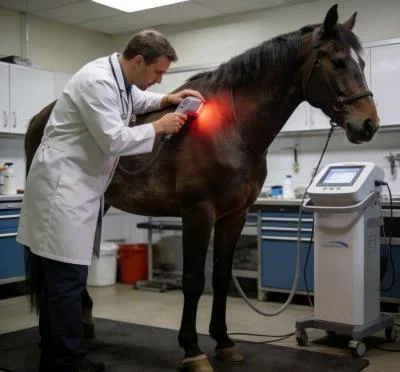
Sessions 9 through 12 focused on consolidating collagen remodeling. Operating at higher peak pulses and transitioning to continuous-wave emissions stimulated long-term tenocyte protein synthesis and collagen realignment. By Session 12, baseline lameness resolved completely, flexion tests were negative, and ultrasound confirmed total resolution of the core defect with restored linear fiber alignment. The gelding progressed through a structured jump-schooling program, resuming competition at 1.40m within 12 weeks. At the 90-day follow-up, the ligament measured a normal 1.30 square centimeters on ultrasound, showing normal crimp pattern under polarized evaluation, with zero recurrence of lameness under full training loads.
Velocidad de escaneo de la pieza de mano y control térmico de la superficie
Administering high-power Class 4 laser therapy over equine distal limbs requires strict procedural discipline. Because the skin overlying the palmar metacarpus is thin and directly covers bone and tendon margins, leaving the handpiece static will rapidly elevate skin temperatures beyond safe thresholds.
Handpiece Trajectory along the Equine Palmar Metacarpal Region:
[Zone 1: Carpal Canal & Accessory Base] <---> Longitudinal Sweeping Strokes (5 cm/s, CW Delivery)
[Zone 2: Proximal Suspensory Enthesis]  <---> Overlapping Spirals with Quartz Compression (3 cm/s)
[Zone 3: Mid-Body Suspensory Region]   <---> Cross-Hatch Transverse Passes along the Borders (4 cm/s)
[Zone 4: Distal Suspensory Branches]   <---> Linear Contouring around the Sesamoidean Bones
La aplicación clínica se rige por una serie de parámetros técnicos clave:
- Velocidad de barrido cinético: La óptica de tratamiento debe mantener un movimiento continuo por toda la zona de tratamiento a velocidades comprendidas entre 3 y 5 centímetros por segundo. De este modo, se garantiza la penetración de los fotones hacia las estructuras profundas del objetivo, al tiempo que se evita la acumulación localizada de calor en la superficie de la piel.
- Compresión mecánica de cuarzo: Over the proximal suspensory origin, the clinician applies firm manual pressure (2.0 to 2.5 kg) using a convex quartz roller handpiece. This displaces superficial venous and capillary blood, decreasing competitive light absorption by hemoglobin and increasing direct photon penetration into the deep avascular ligament core.
- Monitorización térmica en tiempo real: The handpiece incorporates an integrated infrared pyrometer that measures real-time skin surface temperature. The clinical objective is to maintain skin temperature within the therapeutic window of 39.0 to 41.5 degrees Celsius. If surface temperatures approach 42.0 degrees Celsius, the operator accelerates scanning speed or reduces the pulse duty cycle, preserving total energy delivery while protecting superficial tissues.
High Intensity Laser Integration in Equine Sports Medicine
Managing chronic suspensory desmitis highlights the trade-offs inherent in conventional veterinary modalities. High-intensity Class 4 laser therapy provides a targeted, non-invasive alternative across several common equine treatment approaches:
| Modalidad de tratamiento | Profundidad objetivo | Mecanismo principal | Limitaciones clínicas |
| Terapia con luz de baja intensidad | De 2 mm a 6 mm | Fotoquímica superficial | Cannot penetrate thick flexor tendons |
| Extracorporeal Shockwave | Variable (Acoustic) | Mechanical Cavitation & Trauma | Requires sedation; procedural discomfort |
| Platelet-Rich Plasma | Local Infiltration | Autologous Growth Factor Release | High cost; prolonged post-injection rest |
| Surgical Fasciotomy & Neurectomy | Direct Surgical Margin | Decompression & Nerve Transection | Invasive; risk of suspensory rupture |
| Fenilbutazona, un AINE sistémico | Systemic Distribution | Inhibición sistémica de la COX | Renal & right dorsal colitis toxicity |
| Láser multionda de clase 4 | 35 mm to 60 mm | Fotobiomodulación y eliminación de líquidos | Requiere equipo de grado clínico |
Low-Level Light Therapy operates in the milliwatt range. While it can aid superficial skin abrasions or coronary band injuries, its low energy cannot penetrate the dense flexor tendon bundle to reach the proximal suspensory origin. High-power systems deliver the incident irradiance needed to maintain an effective forward-propagating photon field that reaches the deep enthesis.
Extracorporeal shockwave therapy generates high-energy acoustic pulses to stimulate revascularization, but the procedure can be uncomfortable for horses, requiring chemical sedation and leaving residual soreness that interferes with rehabilitation schedules. Platelet-rich plasma therapy introduces concentrated autologous growth factors directly into ligament tears, but post-injection inflammation requires several months of strict stall confinement before athletic loading can resume.
Surgical fasciotomy and plantar neurectomy mechanically decompress the compartment and eliminate pain sensation, but transecting the sensory nerve removes natural protective pain feedback, raising the risk of catastrophic suspensory rupture during subsequent athletic jumping. Systemic nonsteroidal anti-inflammatory drugs like phenylbutazone reduce acute inflammation, but long-term administration carries documented risks of right dorsal colitis and renal papillary necrosis while failing to stimulate structural collagen synthesis.
When considering equine laser therapy cost alongside clinical outcomes, high-power multi-wavelength Class 4 laser therapy bridges the gap between passive rest protocols and invasive surgical interventions. By combining deep tissue penetration, targeted wavelength absorption, and real-time surface thermal monitoring, this modality accelerates tenocyte cellular repair, mobilizes deep compartment edema, and promotes organized collagen remodeling without the systemic toxicities or prolonged downtime of invasive procedures.