 FotonMedix




Cómo tratar de forma segura la desmitis crónica del ligamento suspensorio en caballos
Multi-wavelength Class IV photon penetration targets hypovascular desmocytes, clears deep periligamentous edema through water resonance, and prevents thermal injury over cortical bone via microsecond duty cycle modulation.
A 9-year-old Warmblood gelding shifts weight restlessly in a treatment stall, reluctant to load the left hindlimb. The trainer runs a hand down the plantar aspect of the metatarsus, stopping just distal to the hock where the horse pins its ears and snatches the leg upward. Musculoskeletal diagnostic ultrasound confirms desmitis crónica del ligamento suspensorio proximal with a thirty percent cross-sectional hypoechoic defect, marked enlargement of the suspensory body, and irregular cortical margins along the proximal plantar aspect of the third metatarsal bone. Shockwave therapy, ultrasound-guided biological injections, and ninety days of strict stall rest produced modest temporary gains, but as soon as slow trot work resumed, Grade 3 lameness flared up again.
Managing chronic proximal suspensory desmitis presents one of the most stubborn anatomical hurdles in equine sports medicine. The proximal suspensory ligament sits deep within the proximal cannon, sandwiched between the third metatarsal bone and overlying splint bones, covered by the deep digital flexor tendon and a thick plantar fascial band. The core of this ligament is hypovascular, fibrotic, and mechanically constrained. In this dense anatomical space, low-power continuous devices fail: photons reflect off thick fascia or absorb prematurely within superficial soft tissues, leaving ischemic fibroblasts untouched. Successfully driving regenerative repair into this deep ligamentous cradle demands the safest class of veterinary laser therapy equipment, engineered to deliver therapeutic photon doses through dense connective tissue without triggering periosteal thermal discomfort.
Attenuation Gradients and Chromophore Dynamics in Deep Tendon Structures
Photons traveling toward the equine proximal suspensory ligament face multiple tissue layers: pigmented coat hair, a thick dermis, the plantar fascial sheath, and surrounding hypovascular flexor structures. Under standard biological tissue attenuation dynamics, low-wattage continuous light loses more than eighty-five percent of its irradiance within the first eight millimeters of soft tissue, never reaching the deep fascial margin where suspensory enthesopathies anchor.
Reaching therapeutic thresholds within deep ligamentous lesions requires targeted multi-wavelength interactions within the near-infrared spectrum:
- 980 nm Microvascular Activation: Chronic desmitis involves severe microvascular compromise and local tissue hypoxia. Light at 980 nm matches the natural absorption peak of oxygenated and deoxygenated hemoglobin, generating subtle, non-ablative photothermal expansion within spastic microcapillaries. This process reopens constricted collateral vessels, evacuates trapped inflammatory metabolites, and restores local tissue oxygenation without causing surface blisters.
- Estimulación profunda de los fibroblastos a 1064 nm: Exhibiting low scattering coefficients and minimal absorption by melanin and water, the 1064 nm band penetrates straight through the overlying flexor tendons and dense plantar fascia. It delivers photon energy directly to dormant desmocytes within the injured ligament core, stimulating mitochondrial adenosine triphosphate synthesis to drive structural cellular remodeling.
- 1470 nm Interstitial Fluid Mobilization: Deep ligamentous injury leads to trapped fluid within the inelastic plantar compartment, causing painful nerve compression. The high absorption profile of 1470 nm light in water targets stagnant interstitial edema directly, accelerating fluid uptake through lymphatic drainage channels and reducing chronic intra-compartmental pressure.
Understanding these multi-wavelength mechanics demonstrates the veterinary practices laser therapy equipment benefits in advanced performance medicine. Rather than spending forty minutes holding an underpowered device with questionable tissue penetration, clinicians can sweep high-density photon energy across the proximal metatarsus in ten minutes, delivering predictable tissue stimulation during routine stable calls.
Eliminating Thermal Stress Over Cortical Bone with Duty Cycle Regulation
Delivering high-power Class IV photomedicine over the equine proximal cannon presents a distinct physical challenge: the proximal suspensory ligament lies directly adjacent to the cortical bone of the third metatarsal. Delivering unpulsed, continuous-wave high-power energy over this region risks elevating periosteal temperatures, which triggers pain, limb snatching, and patient distress.
This physical challenge explains why many veterinary clinics hesitation laser therapy devices persists among sport-horse practitioners. Equine veterinarians worry that high-wattage equipment will heat sensitive bony margins, agitate high-strung performance horses, or cause cutaneous burns beneath dense hair coats.
Microsecond duty cycle regulation eliminates this risk by dividing continuous light emission into rapid micro-bursts separated by cooling intervals:
Continuous Wave: [================ Cumulative Thermal Buildup ================] -> Periosteal Hotspot Risk
Pulsed 50% Duty: [== Pulse ON ==] [ Thermal Relaxation ] [== Pulse ON ==]      -> Deep Ligament Saturation
During the active pulse phase, high peak power drives photons deep through overlying fascial structures into the ligamentous core. During the dark phase, local microcapillary blood flow in the skin and subcutaneous tissue dissipates surface heat. Because deep ligamentous tissue retains photonic stimulation while vascularized surface tissues cool rapidly, the injured suspensory core receives therapeutic photon density while adjacent periosteal surfaces remain safe and cool.
This reliable thermal control ensures equine practitioners can deliver high-energy treatments without patient restraint issues, turning a previously stressful therapy into a calm, cooperative stable routine.
Clinical Protocol and Objective Ultrasonographic Outcomes
According to connective tissue photobiomodulation frameworks documented by Dyson and substantiated across equine orthopedic trials, near-infrared light alters collagen remodeling in injured ligaments. Photonic stimulation upregulates tenocyte and desmocyte proliferation, increases production of decorin and high-tensile type I collagen fibrils, and reduces excessive scar-related type III collagen deposition.
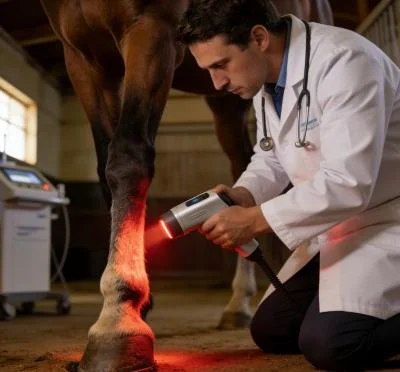
The following clinical case details this multi-wavelength protocol in an elite competition horse suffering from chronic, non-responsive proximal suspensory desmitis.
Case Record: Equine Chronic Hindlimb Proximal Suspensory Desmitis
- Identificador del caso: EQUINE-2026-SPORTS-0582
- Perfil del paciente: 9-year-old Dutch Warmblood gelding, show jumping competitor
- Masa corporal: 580 kg
- Diagnóstico: Chronic left hind proximal suspensory desmitis (hindlimb PSD) with secondary insertion enthesopathy at the proximal plantar aspect of MtIII; Grade 3 lameness on the AAEP scale; transverse ultrasound revealed a 30% cross-sectional hypoechoic core defect and marked ligament enlargement (cross-sectional area 1.82 cm²; normal contralateral baseline 1.25 cm²)
- Tratamiento conservador previo: Extracorporeal shockwave therapy (three sessions), single ultrasound-guided platelet-rich plasma injection, ninety days of stall rest; temporary reduction in lameness followed by acute relapse upon initiating trot work
Parámetros del protocolo de tratamiento integral
| Número de sesión | Phase of Tissue Rehabilitation | Potencia de salida (W) | Modo de funcionamiento y ciclo de trabajo | Distribución espectral objetivo | Frecuencia (Hz) | Energía total (julios) | Fluencia (J/cm²) |
| 01 | Acute Nociceptive Control | 12,0 W | Por impulsos (ciclo de trabajo 35%) | Máximo de 980 nm / Enfoque capilar | 3.000 Hz | 3,600 J | 9,0 J/cm² |
| 02 | Eliminación del edema intersticial | 15,0 W | Por impulsos (ciclo de trabajo 40%) | Máxima de 1470 nm / Enfoque en el agua | 2.000 Hz | 4 800 J | 12,0 J/cm² |
| 03 | Deep Fascial Decongestion | 18,0 W | Por impulsos (ciclo de trabajo 45%) | Mezcla equilibrada de 980 nm / 1064 nm | 1.000 Hz | 6,000 J | 15,0 J/cm² |
| 04 | Desmocyte Energy Saturation | 22,0 W | Superpulsado (ciclo de trabajo 50%) | Dominancia de penetración (1064 nm) | 500 Hz | 7,200 J | 18,0 J/cm² |
| 05 | Extracellular Matrix Synthesis | 25,0 W | Pulsado (ciclo de trabajo 50%) | Matriz espectral equilibrada multiespectral | 200 Hz | 8,000 J | 20,0 J/cm² |
| 06 | Collagen Fibrillogenesis Induction | 25,0 W | Pulsado (ciclo de trabajo 50%) | Deep Structural Remodeling Mix | 100 Hz | 8,000 J | 20,0 J/cm² |
| 07 | Functional Fiber Realignment | 22,0 W | Barrido dinámico continuo | Broad Spectrum Regenerative Mix | CW / Dinámico | 7,000 J | 17.5 J/cm² |
| 08 | Biomechanical Consolidation | 18,0 W | Por impulsos (ciclo de trabajo 40%) | Perfil de mantenimiento equilibrado | 30 Hz | 5.500 J | 13.7 J/cm² |
Ultrasonographic Defect Fill and Lameness Progression
Proximal Suspensory Core Defect (% of Cross-Sectional Area):
Pre-Treatment: [==============================] 30%
Session 03:    [====================] 20%
Session 06:    [==========] 10%
Session 08:    [=] 2% (Echogenic fiber fill, linear alignment)

AAEP Lameness Grade (0 to 5 Scale):
Pre-Treatment: [==============================] Grade 3
Session 03:    [====================] Grade 2
Session 06:    [==========] Grade 1
Session 08:    [] Grade 0 (Sound under tack)
By the third session, the horse showed complete resolution of pain upon deep palpation over the proximal plantar metatarsus, standing squarely on both hindlimbs in the stall. Ultrasound evaluation at session six revealed clear echogenic fill within the previous core defect and parallel fiber alignment across the ligament body. At the conclusion of eight treatments over four weeks, cross-sectional area reduced from 1.82 cm² to 1.31 cm², the horse trotted sound without lameness, and controlled ridden exercise commenced six weeks ahead of standard conservative projections.
Clinical Workflow Reliability in Equine Practice
Managing chronic ligament injuries in performance horses often traps clinicians between extended box rest and costly surgical options. Radial neurectomy and plantar fasciotomy require general anesthesia, carry prolonged convalescence periods, and risk irreversible neurogenic complications. Conversely, repetitive systemic non-steroidal anti-inflammatory administration simply masks pain while leaving underlying hypovascular lesions prone to reinjury.
Implementing high-power Class IV technology delivers distinct clinical and operational benefits:
1. Direct Non-Invasive Stimulation of Deep Connective Tissue
Rather than waiting months for passive remodeling to occur in poorly vascularized tissues, high-intensity phototherapy drives targeted energy through dense fascial layers directly into the lesion, stimulating cellular metabolism and physiological collagen deposition.
2. High Procedural Efficiency for Equine Ambulatory Calls
Ambulatory practitioners working on tight farm-call schedules cannot afford to spend forty minutes holding a low-output probe against a restless horse. A high-output platform delivers complete, deep therapeutic doses in eight to ten minutes of continuous sweeping application, allowing clinicians to maintain tight mobile schedules while providing high-standard care.
3. Clear Functional Recovery That Reassures Owners and Trainers
Equine trainers and owners closely track limb sensitivity, heat, and willingness to work. Achieving tangible reductions in palpation soreness and visible improvements in gait symmetry within the first three treatments gives clients confidence in the recovery plan, improving compliance with controlled exercise schedules.
High-power Class IV photomedicine provides a reliable, high-throughput solution for chronic, performance-limiting orthopedic conditions in sport horses. By projecting targeted multi-wavelength photon energy past dense anatomical barriers directly into deep connective tissue lesions, equine practitioners can resolve chronic lameness, accelerate return to competition, and keep equine athletes performing at their best.