 FotonMedix




Resolving Deep Digital Flexor Core Lesions and Navicular Stasis
High-density near-infrared photon flux penetrates thick hoof wall structures, activates dormant fibrocartilage chondrocytes, and restores microvascular perfusion without surface thermal degradation.
Degenerative podotrochlear syndrome combined with deep digital flexor tendinitis represents one of the most stubborn lameness challenges in modern equine sports practice. Equine practitioners routinely hit a clinical dead end: passive stall rest leads to weak, disorganized fibrous scarring, while standard modalities scatter across tough periople, thick keratinized hoof walls, and dense fibrocartilage envelopes without delivering adequate photon density to the lesion core. Overcoming this penetration barrier requires high-intensity multi-wavelength photonic control capable of driving reparative energy through dense hoof and connective structures directly into the damaged tendon matrix.
Multi-Layer Optical Attenuation across Hoof Keratin and Tendon Sheaths
Equine podotrochlear anatomy presents an extremely challenging optical barrier. Near-infrared light directed at the palmar aspect of the foot or the deep digital flexor tendon must penetrate the outer hair coat, dense skin, collateral sesamoidean ligaments, deep digital flexor tendon sheath, and dense fibrocartilaginous flexor cortex before reaching target soft tissue structures three to six centimeters deep.
Photon transport through living equine tissue follows an exponential decay curve governed by scattering and selective molecular chromophore absorption. Melanin in dark equine hair and the basal epithelial layers acts as an immediate optical filter, while cellular membranes and dense parallel collagen bundles scatter uncollimated beams. Standard low-power veterinary units lose their operational photon flux within the first few millimeters of tissue, generating superficial heat while failing to alter cellular pathways in deep hypoechoic tendon cores or congested navicular spongiosa.
High-power Class IV multi-wavelength systems resolve this physical attenuation by matching specific optical profiles to individual tissue targets. An 810nm output directly targets the oxidized copper centers of cytochrome c oxidase inside tenocyte mitochondria. Stimulating this terminal respiratory enzyme boosts adenosine triphosphate synthesis, increases mitochondrial membrane potential, and triggers rapid cellular repair.
Pairing 810nm with a 980nm wavelength leverages high simultaneous absorption by oxygenated hemoglobin and interstitial fluid. This combination generates a controlled micro-thermal gradient that triggers local microvascular dilation, opening dormant capillary beds to clear inflammatory irritants like substance P and bradykinin.
When targeting the insertion of the deep flexor tendon onto the third phalanx or the distal sesamoidean impar ligament, adding a 1064nm output extends physical penetration even deeper. Because 1064nm exhibits minimal melanin absorption and low scatter, it penetrates through thick fibrous envelopes to reach intra-articular spaces and chronic enthesopathies.
Integrating a multi-spectral Class IV equine laser platform allows targeted application of equine laser therapy, driving therapeutic irradiance deep into strained ligament bodies while avoiding surface heat buildup.
Thermal Relaxation Time and Duty Cycle Gating in Distal Limbs
Delivering continuous-wave energy across sensitive equine distal limbs introduces real clinical risks. Continuous delivery generates a steady heat accumulation in static tissue. If continuous photon absorption outpaces passive capillary heat clearance, local tissue temperatures climb toward the critical 43-degree Celsius threshold, risking dermal burns, cellular stress, and localized swelling.
Clinical protocols eliminate this thermal vulnerability by matching energy delivery directly to the Thermal Relaxation Time of targeted structures. Thermal relaxation time represents the duration required for treated tissues to dissipate half of their absorbed heat through passive capillary conduction.
Applying calibrated pulse duty cycles breaks up energy delivery into microsecond bursts:
Duty Cycle (%) = [Pulse On Duration / (Pulse On Duration + Pulse Off Duration)] x 100
Restricting the active pulse duration to a fraction of the tissue cooling window allows deep tendon fibrils and neurovascular junctions to absorb high-energy packets without retaining excessive heat. The alternating pulse-off intervals provide enough quiet time for local blood flow to carry residual heat safely away into surrounding tissues.
When treating acute tendon tears or deep chronic suspensory lesions, adjusting duty cycles between 20% and 40% permits peak power levels up to 30W. These brief, high-energy pulses penetrate dense tissue boundaries, triggering deep photobiomodulation while keeping surface temperatures well within safe, comfortable levels.
Procurement Considerations for an Equine Laser Therapy Machine for Sale
Equine hospital administrators and sports team veterinarians looking at an equine laser therapy machine for sale must evaluate technical specifications against the demanding conditions of barn and trackside practice.
Historic veterinary markets were long dominated by low-power units that produce superficial warmth without sufficient photon density to stimulate deep cellular repair. Modern sports medicine practices have moved away from these underpowered systems, adopting multi-wavelength Class IV platforms that transition easily between acute desmitis therapy, chronic sacroiliac photobiomodulation, and non-invasive pain management.
Practical field considerations dictate key hardware requirements:
- Dynamic Wavelength Modulation: Units must deliver multiple simultaneous wavelengths (such as 810nm, 915nm, 980nm, and 1064nm) to address different tissue depths, from superficial check ligaments down to deep sacroiliac joints.
- Advanced Thermal Regulation: Systems must include active skin temperature sensors or cryo-thermoelectric handpieces to prevent thermal injury over dark, coarse horse coats during high-power treatments.
- Barn-Ready Portability and Durability: Devices must withstand dusty barn environments, operate reliably on mobile battery packs, and feature durable armored fiber cables that resist accidental damage around high-strung horses.
Investing in a dedicated multi-wavelength equine laser platform equips clinicians to manage severe competitive lameness on site, accelerating return-to-work timelines and protecting long-term athletic value.
Biological Cascades in Degenerated Equine Tendons and Ligaments
Chronic tendon strain in sport horses is characterized by poor collagen alignment and stagnant blood flow. Tenocytes within long-standing core lesions enter a state of functional dormancy, failing to produce sufficient structural matrix components. As a result, the damaged tendon remains weak, swollen, and prone to reinjury upon return to intense training.
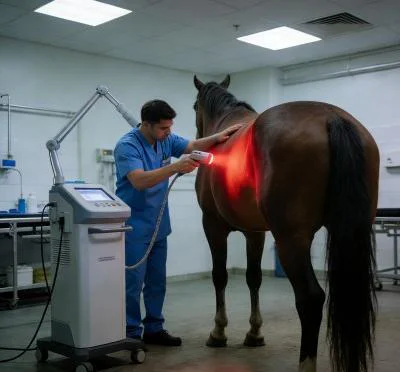
Deploying Class IV medical laser systems breaks this chronic stagnation through three distinct biological steps:
- Microvascular Perfusion and Angiogenesis: High photon irradiance triggers the release of vascular endothelial growth factor (VEGF) and basic fibroblast growth factor (bFGF) from perivascular cells. This initiates organized capillary sprouting into the poorly vascularized core of the deep digital flexor tendon and navicular bursa.
- Tenocyte Proliferation and Collagen Transition: Photon absorption accelerates procollagen mRNA transcription in local fibroblasts and tenocytes. Stimulating damaged connective tissue promotes the production of robust, parallel Type I collagen fibers rather than weak, disorganized Type III scar tissue, restoring normal tensile strength to healing tendons.
- Fascial Gliding and Adhesion Softening: Focused laser irradiation softens mature fibrous adhesions between the tendon body and surrounding paratenon. Restoring smooth tissue sliding dynamics allows horses to regain normal joint extension and biomechanical shock absorption during high-speed gallop and landing.
Standardized Clinical Practice and Detailed Treatment Record
The following treatment log outlines an integrated clinical protocol addressing severe chronic deep digital flexor tendinopathy paired with navicular bursitis in an elite racing Thoroughbred.
Clinical Registry Record: FMX-2026-EQ6188
| Parameter Group | Specification Detail | Clinical Target Value |
| Identificación del caso | N.º de caso clínico | FMX-2026-EQ6188 |
| Patient Demographics | Age / Breed / Sex | 5 Years / Thoroughbred / Stallion (Flat Racing Athlete) |
| Primary Pathologies | Tendon Diagnosis | Chronic Deep Digital Flexor Tendinopathy (Left Forelimb, Distal Pastern Zone, Grade 3 Lameness) |
| Secondary Pathologies | Bursa Diagnosis | Chronic Navicular Bursitis with Palmar Cortical Bone Remodeling (Vascular Congestion) |
| Device Configuration | Operational Classification | Multi-Wavelength High-Intensity Class IV Equine Laser |
| Delivery Mechanics (Tendon Body) | Transcutaneous Handpiece | Deep-Tissue Collimated Focus Handpiece with Real-Time Thermal Sensor |
| Delivery Mechanics (Navicular Zone) | Hoof-Wall Handpiece | High-Irradiance Contact Optical Probe with Sapphire Cooling Tip |
| Wavelength Balance (Tendon Body) | Quad-Spectrum Ratio | 810nm (40%) + 915nm (20%) + 980nm (25%) + 1064nm (15%) |
| Wavelength Balance (Navicular Zone) | Tri-Spectrum Ratio | 810nm (45%) + 980nm (30%) + 1064nm (25%) |
| Operational Power (Tendon Body) | Wattage Setting | 20.0W Peak Duty-Cycle Pulsed Mode |
| Operational Power (Navicular Zone) | Wattage Setting | 25.0W Peak Duty-Cycle Pulsed Mode |
| Pulse Frequency (Tendon Body) | Repetition Rate | 12.0 Hz modulated down to 3.0 Hz |
| Pulse Frequency (Navicular Zone) | Repetition Rate | 8.0 Hz modulated down to 2.0 Hz |
| Energy Dose Per Tendon Session | Total de julios suministrados | 4,800J across palmar pastern and digital sheath margins |
| Energy Dose Per Navicular Session | Total de julios suministrados | 5,500J through collateral sulci, palmar heel bulbs, and coronary band |
| Motion Profile During Delivery | Technique Protocol | Slow continuous sweeping motion at 2 centimeters per second |
| Surface Preservation System | Cutaneous Safeguard | Contact Cryo-Thermoelectric Chilling Ring (4°C) |
Evolución del tratamiento y parámetros clínicos objetivos
| Fase del tratamiento | Lameness Grade (AAEP 0-5 Scale) | Distal Limb Palpation & Hoof Tester Score (0-10) | DDFT Core Lesion Cross-Section on Ultrasound (%) | Digital Pulse & Bursa Effusion Grade (0-3 Scale) | Functional Status and Tissue Observations |
| Línea de base (pretratamiento) | Grade 3.5 (Severe head bob at trot, landing toe-first) | 9.0 / 10 (Intense withdrawal on palmar hoof testing) | 22% Hypoechoic Core Lesion | Grade 3 (Bounding digital pulse, tense bursa swelling) | Significant distension of the digital flexor tendon sheath; shortened stride on left forelimb |
| Day 8 (Session 3) | Grade 2.5 | 6.0 / 10 | 17% (Peritendinous edema 45% cleared) | Grade 2 (Digital pulse noticeably dampened) | Heat over palmar pastern reduced; horse landing flat-footed at walk |
| Week 3 (Session 7) | Grade 1.5 | 3.5 / 10 | 10% (Active cellular bridging across core) | Grade 1 (Trace bursa distension) | Horse sound at walk, mild asymmetry on hard circle trot; hand-walking expanded to 25 minutes |
| Week 6 (Session 12) | Grade 0.5 (Barely perceptible hitch on tight turns) | 1.0 / 10 | 3% (Hyperechoic matrix filling lesion bed) | Grade 0 (Resting digital pulse baseline) | Controlled straight-line jogging under tack initiated; zero digital sheath heat |
| Week 10 (Final Evaluation) | Grade 0.0 (Sound on straight lines, hard track, and circles) | 0.0 / 10 (Completely non-reactive to hoof testers) | 0% (Continuous parallel Type I collagen fiber pack) | Grade 0 (Complete anatomical stability) | Full architectural restoration on ultrasound and MRI; stallion returned to competitive race training |
Scientific Citations and Biophysical Frameworks
The clinical efficacy of near-infrared photobiomodulation in equine musculoskeletal rehabilitation is supported by research led by Dr. Tracy A. Turner, published in Veterinary Clinics of North America: Equine Practice. His clinical investigations verified that high-intensity laser energy accelerates cellular healing, suppresses inflammatory enzymes, and improves microcirculatory perfusion in chronic tendon and ligament strains.
The biophysical mechanisms linking high-irradiance photon absorption to accelerated soft tissue repair were documented by Dr. Chukuka S. Enwemeka in Photomedicine and Laser Surgery. His research established that laser irradiation upregulates collagen production, organizes newly formed collagen bundles, and accelerates tensile strength recovery in damaged connective tissues compared to untreated controls.
Further validation of cellular repair pathways comes from research by Dr. Tiina Karu, published in the Journal of Photochemistry and Photobiology B: Biology. Her work confirmed that near-infrared photon absorption activates cytochrome c oxidase within mitochondrial membranes, boosting adenosine triphosphate synthesis and initiating downstream gene expressions that drive tenocyte proliferation and extracellular matrix repair.
In competitive equine sports medicine, clinical trials conducted by Dr. Kevin K. Haussler and colleagues in the American Journal of Veterinary Research confirmed that targeted Class IV laser therapy improves spinal flexibility, reduces localized muscular hypertonicity, and shortens rehabilitation timelines in performance horses suffering from chronic back pain and sacroiliac dysfunction.
Clinical Realities: High Intensity Laser vs Conventional Approaches
Transitioning from conventional management strategies to high-power Class IV equine laser therapy transforms recovery curves across performance sports barns and veterinary surgical centers.
Traditional management of severe equine tendon and ligament injuries relies heavily on prolonged stall rest, ice water boots, and systemic non-steroidal anti-inflammatory drugs like phenylbutazone. While prolonged rest keeps the horse quiet, it frequently leads to weak, disorganized scar tissue formation that remains vulnerable to reinjury as soon as intense training resumes. Long-term use of systemic anti-inflammatory medications carries well-known risks of right dorsal colitis, gastric ulceration, and renal papillary necrosis. When conservative rest fails, clinicians often resort to invasive pin firing, surgical desmotomy, or repeated shockwave sessions that cause acute procedural pain and localized tissue micro-trauma.
Applying high-intensity equine laser therapy provides a non-invasive alternative that treats the underlying pathology directly. By projecting high photon densities deep into dense ligamentous insertions, it calms irritated nerve endings, clears inflammatory fluid collections, and stimulates tenocytes to lay down parallel, resilient Type I collagen without mechanical trauma or chemical toxicity. Horses experience rapid pain relief, maintain tissue elasticity during healing, and return to competitive performance with a significantly lower risk of reinjury.
Equine veterinary practices and performance stables adopt these advanced laser systems to elevate their standard of care. By addressing the true cellular drivers of tendon breakdown and ligament strain, they deliver predictable, long-term athletic recovery that keeps equine athletes performing at their peak safely.