 FotonMedix












Come evitare il riscaldamento cutaneo nel dolore cronico al grande trocantere
Deliver deep optical flux across dense fascia lata envelopes with dual-wavelength precision. Relieve enthesophyte microvascular stasis while fluidizing thickened bursal hydrogels. Prevent cutaneous thermal spikes over bony prominences using microsecond-gated duty cycles.
A specialized sports medicine and joint preservation consult sees this frustrating condition every week: a 51-year-old marathon runner sits gingerly on the side of her right hip, unable to lie on her lateral side at night or complete a ten-minute jog without sharp, burning pain over the greater trochanter radiating down her lateral thigh. The clinical diagnostic workup confirms recalcitrant Greater Trochanteric Pain Syndrome (GTPS) with Stage II gluteus medius insertional tendinopathy and secondary calcific trochanteric bursitis. She has cycled through sixteen weeks of heavy eccentric loading that aggravated her pain, two ultrasound-guided corticosteroid injections that triggered severe post-injection flare-ups and fat atrophy, and multiple home sessions using a handheld consumer device sold as a pain relief laser therapy device that failed to penetrate past the skin. The lateral hip tissues feel fibrous, cold, and thickened under palpation. When previous operators pushed continuous power on basic light therapy devices to drive energy through the dense iliotibial band, the patient pulled away from sharp, stinging dermal heat over the greater trochanter long before therapeutic photons reached the inflamed enthesis.
Low-power modalities fail because forward optical irradiance attenuates rapidly across dense subcutaneous adipose deposits and thick fascial sheets. Forcing continuous power through this superficial barrier causes surface thermal energy to accumulate instantly. The patient pulls away from intolerable skin burning, ending the session well before the deep tendinous insertion receives an adequate photobiomodulation dose.
Overcoming this lateral hip bottleneck requires projecting concentrated, high-irradiance optical energy past the dense iliotibial band directly into the gluteus medius enthesis while keeping the thin skin over the bony prominence cool and protected.
Optical Scattering Across the Iliotibial Band and Trochanteric Bursa
Delivering light into the greater trochanteric complex presents a challenging anatomical hurdle. Photons must pass through stratified epidermis, cross dense subcutaneous adipose compartments, penetrate the thick collagenous sheets of the iliotibial tract, and cross the multi-locular trochanteric bursa before reaching the gluteus medius and minimus footprints. Under the Kubelka-Munk optical scattering model, light experiences severe multi-directional scattering across these layered boundaries, causing an exponential decay in forward irradiance.
Inside human musculoskeletal structures, three primary endogenous absorbers dictate photon pathways: cutaneous melanin, microvascular hemoglobin, and interstitial water.
In chronic trochanteric bursitis and gluteal tendinopathy, the core pathology involves dense collagen disorganization, tendon micro-tears, and endovascular capillary thrombosis within the avascular fibrocartilaginous enthesis, located 4.0 to 6.5 centimeters beneath the lateral hip skin. Low-intensity Class III devices cannot penetrate this physical depth; over 95% of their light scatters into shallow dermal and adipose tissues. The ischemic tendon insertion receives virtually zero energy, leaving degenerated collagen fibers trapped in hypoperfusion and chronic mechanical friction.
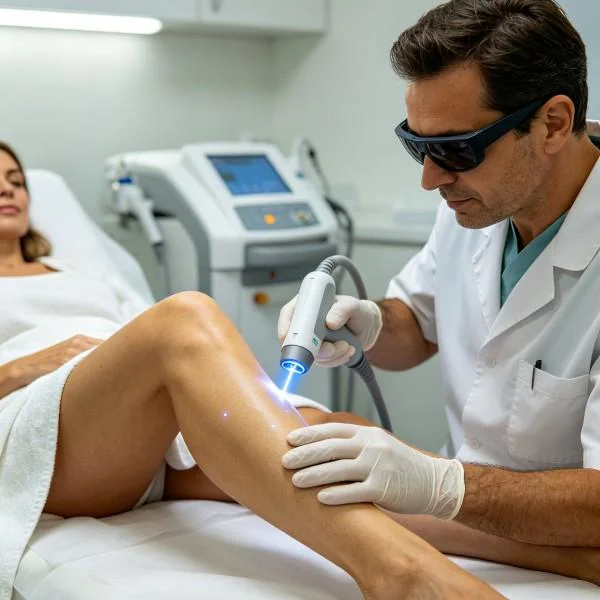
Per superare questa ripida curva di decadimento è necessario un dispositivo per la terapia laser ad alta irradianza finalizzato al sollievo dal dolore, in grado di erogare un’elevata potenza di picco senza superare le soglie termiche superficiali.
Lateral Hip Dermis & Subcutaneous Adipose (Scattering Trap)
         │
         ▼
Iliotibial Band & Gluteal Aponeurosis (Dense Collagenous Sheath)
         │ (1470nm Interstitial Water Absorption & Fluidization)
         ▼
Peritendinous Capillary Loops (Ischemic Microvascular Congestion)
         │ (980nm Hemoglobin Hyperemia & NO Offloading)
         ▼
Gluteus Medius Footprint & Enthesis (Mitochondrial ATP Surge)
Targeting hemoglobin and water chromophores in tandem transforms how degenerated hip connective tissue responds:
At 980nm, photon capture aligns with absorption peaks for oxygenated and deoxygenated hemoglobin. In chronic gluteal tendinopathy, high compressive loading from the iliotibial band chokes local microcirculation, creating localized ischemia and trapping inflammatory cytokines like interleukin-1-beta, tumor necrosis factor-alpha, and substance P. The 980nm wavelength triggers localized vasodilation, prompting circulating red blood cells to offload bound nitric oxide, clearing sluggish microcirculation and restoring oxygen delivery to starving tenocytes.
At 1470nm, photon absorption shifts toward bound water molecules within swollen bursal sacs and thick fascial planes. Interstitial water absorbs 1470nm light at rates significantly higher than in the 800nm zone. This controlled absorption creates micro-thermal fields that break down rigid, polymerized proteoglycan matrices, clearing chronic inflammatory exudate around the trochanteric bursa and restoring smooth sliding mechanics across the lateral hip.
Delivering this combined optical power into deep pelvic structures without scorching the skin requires precise pulse gating.
Duty Cycle Mechanics and Cutaneous Thermal Clearance Over Bony Prominences
Continuous-wave light delivery encounters a hard biological limit over the greater trochanter: the thin skin overlying the bony prominence absorbs surface heat quickly, but damaged local autonomic tone prevents adequate microvascular flushing of that thermal load. When continuous photons strike the lateral hip, surface temperatures spike within seconds, setting off intense burning sensations.
Il gating di precisione degli impulsi al microsecondo elimina questo accumulo termico superficiale. Suddividendo la luce ad alta intensità in impulsi della durata di microsecondi, separati da intervalli di oscurità controllati, le strutture tendinee profonde ricevono un’irraggianza di picco elevata, mentre la pelle sensibile si raffredda in modo sicuro tra un impulso e l’altro.
$$\text{Duty Cycle (\%)} = \left( \frac{\tau_{\text{active}}}{\tau_{\text{active}} + \tau_{\text{pause}}} \right) \times 100$$
Where $\tau_{\text{active}}$ represents active optical delivery and $\tau_{\text{pause}}$ represents the thermal relaxation pause.
Applying 24W of continuous laser energy over the greater trochanter triggers uncomfortable skin heating within 4 seconds over the bone. In contrast, running that same power through a 25% duty cycle delivers powerful peak bursts that penetrate through the dense iliotibial tract, while the 75% dark phase allows surface tissues to shed heat safely into the room and the moving handpiece.
Blood flow in the vascular layers carries away surface heat, while the hypoperfused, degenerated gluteal tendon absorbs high photon density, initiating cellular healing without epidermal irritation.
Multi-Wavelength Synergies in Lateral Hip Rehabilitation
Treating complex trochanteric pathology with a single wavelength leaves critical parts of the anatomy unaddressed. GTPS involves skin, subcutaneous fat, the thick iliotibial band, multiple synovial bursae, and dense fibrocartilaginous tendon insertions. Each distinct anatomical layer features unique water content, vascular density, and optical scattering properties.
La combinazione di lunghezze d'onda coordinate crea un gradiente terapeutico continuo in tutte le profondità dei tessuti:
[ Lateral Hip Tissue Interaction Matrix ]

810nm  ──► Mitochondrial Cytochrome c Oxidase (Surge in Tenocyte ATP Synthesis)
980nm  ──► Peritendinous Capillary Perfusion & NO Release (Flushing Inflammatory Fluid)
1064nm ──► Deep Gluteus Medius Bellies (Forward Directional Penetration)
1470nm ──► Bursal Hydration Shells (Fluidizing Rigid Proteoglycan Matrices)
Pairing 980nm with 1470nm produces immediate biomechanical and circulatory improvements. The 980nm beam opens compressed microvascular beds, delivering fresh oxygen to ischemic tenocytes. At the same time, 1470nm targets bound water molecules inside the swollen trochanteric bursa, softening rigid collagen cross-links and draining localized fluid.
Clinicians evaluate this high-irradiance approach as the best laser therapy device for pain in stubborn lower extremity enthesopathies, making subsequent heavy slow resistance training and pelvic stability drills far more productive.
Clinical Protocol Deployment in Sports Rehabilitation
High-power Class IV platforms have transformed how specialized orthopedic centers and sports medicine clinics manage refractory lower limb tendinopathies.
Physicians dealing with chronic gluteal tendinopathy, proximal hamstring tears, or recalcitrant adductor strains often face slow patient progress. Low-intensity Class III modalities require 35 to 45 minutes of scanning to deliver minimal joules through the thick iliotibial tract, producing negligible clinical improvements. A high-output Class IV platform cuts treatment times to under eight minutes while driving meaningful, therapeutic energy directly into degenerated tendon insertions.
Specialized sports rehabilitation departments utilizing high-output systems experience distinct operational and clinical advantages:
In primo luogo, gli operatori riescono a somministrare dosi significative di energia terapeutica in 6-8 minuti, ottimizzando il numero di pazienti trattati giornalmente ed eliminando l’affaticamento fisico dei medici causato dall’intenso sfregamento manuale.
Second, rapid pain relief breaks the patient’s Trendelenburg gait compensation, restoring normal pelvic kinematics during walking and running.
Third, reliable deep-tissue cellular repair restores microvascular blood flow, accelerating tendon collagen remodeling and preventing chronicity.
Documentazione dei casi clinici
The following case record details the clinical application of multi-wavelength high-intensity laser therapy for severe, refractory greater trochanteric pain syndrome and gluteus medius tendinopathy that had failed to respond to corticosteroid injections, shockwave therapy, and prolonged eccentric exercise.
Dettagli della scheda del caso
Case Identification: ORTHO-2026-H9041
Patient Demographics: 51-year-old female, competitive master marathon runner
Primary Diagnosis: Severe Recalcitrant Greater Trochanteric Pain Syndrome of the Right Hip (Stage II Gluteus Medius Insertional Tendinopathy with Partial-Thickness Intrasubstance Tearing and Chronic Trochanteric Bursitis)
Chronicity: 14 months of worsening lateral hip pain; failed two ultrasound-guided peritendinous corticosteroid injections, failed 12 sessions of radial extracorporeal shockwave therapy due to severe procedural discomfort
Clinical Assessment: Severe focal tenderness over the lateral and posterosuperior facets of the greater trochanter upon light palpation. Single-leg stance test positive on the right side at 12 seconds with sharp lateral hip pain. Trendelenburg gait present during active walking (Numeric Pain Rating Scale: 8/10 during weight-bearing and single-leg loading, 6/10 constant nocturnal aching preventing side-lying sleep). Inability to perform lateral step-ups or run without severe limping.
| ID sessione | Protocollo di fase | Configurazione della lunghezza d'onda | Potenza media (W) | Frequenza di impulso e ciclo di lavoro | Area di scansione (cm²) | Durata del trattamento | Energia totale (Joule) | Parametro di risposta clinica |
| Sessione 01 | Bursal Desensitization | 980 nm (70%) + 1470 nm (30%) | 14,0 W | 120 Hz con ciclo di lavoro 20% | 180 | 06:40 | 5.600 J | Resting NPRS drops from 6/10 to 4/10; night sleep restored |
| Sessione 03 | Ammorbidimento della matrice fasciale | 980 nm (45%) + 1470 nm (55%) | 18,0 W | 250 Hz con ciclo di lavoro 25% | 150 | 08:20 | 9,000 J | Single-leg stance reaches 22 sec; IT band tightness eases |
| Sessione 06 | Biostimolazione dei tenociti | 810 nm (30%) + 980 nm (45%) + 1470 nm (25%) | 22,0 W | 800 Hz con ciclo di lavoro 35% | 200 | 08:20 | 11,000 J | Palpation tenderness down to 3/10; Trendelenburg gait cleared |
| Sessione 09 | Rimodellamento profondo dell’entesi | 980 nm (40%) + 1470 nm (60%) | 20,0 W | 20 Hz con ciclo di lavoro 25% (modalità Deep Impact) | 120 | 07:25 | 8.900 J | Single-leg stance exceeds 45 sec; lateral step-ups tolerated |
| Sessione 12 | Consolidamento cinetico | 980 nm (50%) + 1470 nm (50%) | 16,0 W | Onda continua (scansione dinamica) | 220 | 08:00 | 7.680 J | Zero resting or exertion pain; dynamic 5km running resumed |
Note sull'evoluzione del caso
Sessions 01 through 03 focused on clearing trochanteric bursal effusion, reducing local tissue acidosis, and dampening unmyelinated C-fiber nociceptive signaling around the lateral cutaneous nerve pathways. The combination of 980nm and 1470nm cleared inflammatory edema around the facet attachments, reducing nighttime throbbing and allowing the patient to sleep on her right side for six hours without waking by the end of the first week.
Sessions 04 through 08 targeted the thick, fibrotic scar tissue within the iliotibial band and the degenerated gluteus medius tendon insertion. High water absorption at 1470nm softened the rigid proteoglycan gel, while 980nm and 810nm stimulated capillary blood flow to flush out metabolic waste and recruit reparative tenocytes. Single-leg stance duration increased from 12 seconds to 35 seconds, and the Trendelenburg limp disappeared during standard walking.
By Session 12, palpation over the greater trochanter elicited zero sharp tenderness. Follow-up musculoskeletal ultrasound demonstrated complete resolution of the trochanteric bursal effusion, with linear, parallel collagen fibril alignment replacing the previous hypoechoic, disorganized defect. The patient completed progressive 5-kilometer treadmill trials and heavy single-leg loading drills without hip pain or post-exercise inflammatory swelling.
Biological Pathways in Tendon Enthesis Repair
La terapia laser ad alta intensità per i tessuti profondi stimola il processo di guarigione attraverso meccanismi cellulari ed extracellulari integrati:
Photonic Absorption (Tenocytes & Peritendinous Water Matrix)
         │
         ├──► Photodissociation of Nitric Oxide ──► Accelerated Tenocyte ATP Output
         │
         ├──► Interstitial Hydration Cleaving ───► Softening of Cross-Linked Bursal Walls
         │
         └──► Endothelial Cell Activation ────────► Microvascular Revascularization
When photons hit cytochrome c oxidase inside stressed tenocytes and endothelial cells, they displace inhibitory nitric oxide molecules. This allows oxygen to bind unimpeded, accelerating the mitochondrial respiratory chain and producing a dramatic surge in adenosine triphosphate (ATP). Starving tenocytes regain the metabolic energy needed to maintain collagen synthesis and extracellular matrix turnover.
Concurrently, 1470nm photons excite water molecules bound within the dense proteoglycan gel surrounding the trochanteric bursa. The resulting micro-thermal fields break down rigid collagen cross-links, converting viscous ground substance into a fluid state and draining chronic inflammatory exudates.
Downstream gene signaling shifts rapidly. Inflammatory cytokines like interleukin-1-beta, tumor necrosis factor-alpha, and matrix metalloproteinases drop steadily, while transforming growth factor-beta and basic fibroblast growth factor rise.
These biochemical changes prompt tenocytes to remodel disorganized scar tissue into aligned, elastic Type I collagen fibers, restoring tensile resilience to the gluteal tendon insertion.
Moving Beyond Injections and Outdated Conservative Care
Conventional management for recalcitrant greater trochanteric pain syndrome relies heavily on oral NSAIDs, repeated corticosteroid injections, and open or endoscopic bursectomy.
Systemic anti-inflammatory medications cause gastric and renal stress while doing nothing to resolve the microvascular ischemia or tendon disorganization of the hip enthesis. Repeated cortisone injections directly into the trochanteric bursa provide only transient relief, carrying severe risks of local subcutaneous fat necrosis, skin depigmentation, and acute tendon rupture. Surgical bursectomy and iliotibial band lengthening mechanically decompress the area, but introduce surgical risks like infection, nerve injury, chronic weakness, and months of postoperative rehabilitation.
High-power Class IV deep laser therapy provides a focused, non-invasive alternative. It avoids systemic drug toxicity, preserves native tendon architecture, and eliminates surgical trauma. Clinicians can deliver thousands of therapeutic joules deep into contracted iliotibial bands and ischemic tendon insertions within minutes.
Applying high-intensity multi-wavelength phototherapy targets trochanteric pain at its biological and vascular source. Swollen bursal tissues soften, microvascular circulation rebounds, and damaged tendon fibers heal cleanly. It turns months of agonizing lateral hip pain into a predictable, lasting return to full running mechanics and active athletic performance.