 포톤메딕스
포톤메딕스












개 음낭 절제술 후 혈종 발생의 에너지 병목 현상
Targeted hemoglobin and water absorption profiles resolve deep vascular pooling while microsecond gating halts thermal spread across thin scrotal margins.
A six-year-old intact male Boxer is rushed back into the surgical prep room thirty-six hours after an open orchiectomy with scrotal ablation. The prescrotal and inguinal region is tense, purple, and swollen to three times its normal volume. Digital palpation reveals active subcutaneous capillary bleeding, severe seroma formation, and painful skin margin dehiscence that causes the dog to thrash against physical restraint. The owner stands at reception in distress: they initially weighed traditional scalpel procedures against laser neutering for dogs cost expectations, only to end up with acute post-operative hemorrhage and an open surgical wound. Standard cold packs and pressure wraps do nothing to stop the bleeding, high-dose NSAIDs carry renal risks under surgical blood loss, and low-power units cannot stop deep interstitial bleeding. The clinical team faces a clear choice: take the dog back into emergency surgery or deliver enough high-intensity photons to seal leaking microvessels and drain edema without burning the thin, inflamed scrotal skin.
Resolving acute surgical dead space hemorrhage requires understanding photon attenuation across blood-soaked soft tissues. Dense pooled hemoglobin and edematous fluids scatter and absorb light quickly, preventing standard low-level beams from reaching the damaged capillaries beneath. Superficial photons disperse uselessly in pooled blood, failing to trigger platelet aggregation or cellular repair. Delivering high-intensity Class 4 dual-wavelength photobiomodulation provides the energy density needed to penetrate deep hematomas while maintaining safe temperatures on compromised skin edges.
Optical Extinction In Surgical Effusion And Hematomas
Post-operative scrotal tissue presents a difficult optical challenge. Intact scrotal skin contains dense epidermal melanin, while underlying dead space fills with red blood cells, interstitial fibrin, and serosanguinous fluid.
[Incident High-Intensity Dual Photon Beam]
                    │
                    ▼ (Melanin Absorption & Dermal Scatter)
      [Fragile Thin Epidermal Margins]
                    │
                    ▼ (Extense Extinction in Extravasated Blood)
      [Dense Subcutaneous Hematoma & Dead Space]
                    │
                    ▼ (Water Resonance & Hydrostatic Redistribution)
      [Interfascial Inguinal Edema Beds]
                    │
                    ▼ (Residual Deep Flux > Hemostatic & Biostimulation Threshold)
      [Ruptured Microvascular Stems & Retractor Muscle Beds]
Extravasated blood rapidly absorbs standard near-infrared light, turning shallow treatments into superficial surface heat rather than deep cellular repair. Underpowered devices lose their energy in the top millimeter of pooled blood, failing to stimulate tissue repair. When pet owners ask how much does laser therapy cost for dogs, the answer depends directly on the technology used: underpowered units require dozens of lengthy sessions with minimal improvement, whereas high-intensity Class 4 devices reach the bleeding vessels quickly, resolving acute issues in just a few treatments.
Overcoming these deep tissue barriers requires simultaneous emission across two complementary wavelengths. Matching specific wavelengths to the target chromophores allows energy to pass through pooled blood and act directly on damaged tissues.
Target Tissue Layer            Matched Spectrum Band      Primary Hemostatic & Healing Mechanism
-------------------------------------------------------------------------------------------------
Active Bleeding Microcapillaries 980 nm                    Selective hemoglobin photocoagulation
Edematous Dead Space Fluid     1470 nm                    Targeted water clearance, decompression
Deep Surgical Stumps & Dermis  980 nm / 1470 nm Ratio     Mitochondrial ATP synthesis, collagen synthesis
The 980nm Hemoglobin Profile And Microcapillary Sealing
The 980nm wavelength targets the absorption peaks of both oxygenated and deoxygenated hemoglobin. In post-surgical hematomas, ruptured capillaries continuously leak blood into subcutaneous dead spaces, delaying healing and increasing infection risks.
Absorbing 980nm photons causes targeted photothermal coagulation within microscopic vessels. The energy heats intra-luminal red blood cells slightly, triggering platelet aggregation and fibrin cross-linking to seal weeping capillary walls without burning surrounding tissue. At the same time, this energy activates cytochrome c oxidase within vascular endothelial cells, restoring adenosine triphosphate production to jump-start cellular repair and strengthen newly formed capillary beds.
The 1470nm Water Resonance In Severe Post-Surgical Edema
Post-operative dead space complications often involve severe fluid build-up, creating painful swelling that stretches surgical suture lines. The 1470nm wavelength targets free water molecules within this fluid, offering a water absorption coefficient far higher than standard near-infrared wavelengths.
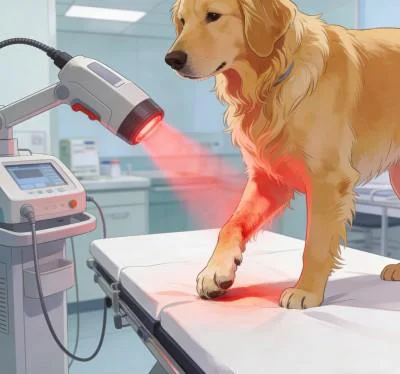
Targeting water molecules with 1470nm photons alters fluid pressure within swollen tissues. Trapped exudate drains into surrounding lymphatic vessels, relieving tension on surgical incision edges. Combining 1470nm fluid mobilization with 980nm vascular repair quickly resolves bruising and reduces pain. This speed helps reduce the overall cold laser therapy for dogs cost by cutting the total number of clinic visits needed to heal the wound.
Duty Cycle Engineering To Prevent Epidermal Necrosis
Delivering high-power photons to inflamed, bruised surgical margins carries a real risk of thermal injury. Thin scrotal skin absorbs continuous energy rapidly. If a continuous wave remains focused on these fragile margins, heat builds up quickly, causing tissue breakdown, suture failure, and increased pain.
Dynamic duty cycle pulsing removes this thermal hazard. Pulsing the laser beam intersperses rapid microsecond bursts with controlled cooling intervals.
Continuous Wave (Thermal Runaway on Surgical Incisions):
Power ────────────────────────────────────────── (Wound Dehiscence & Burn Risk)

Gated Dynamic Duty Cycle (Controlled Thermal Relaxation):
Power ┌───┐    ┌───┐    ┌───┐    ┌───┐    ┌───┐
      │   │    │   │    │   │    │   │    │   │   (Deep Penetration / Zero Burn)
Base  ┘   └────┘   └────┘   └────┘   └────┘   └────
      |Ton|    Toff     |
Because inflamed skin and underlying fluids lose heat faster than they absorb peak energy pulses, dynamic duty cycles let clinicians deliver high peak power through hematomas while keeping surface temperatures safe. Operating between 30 percent and 45 percent duty cycles enables safe treatment directly over fresh incision lines and bruised skin.
Adjusting pulse frequencies between 10 Hertz and 600 Hertz tailors the biological effect: low frequencies block pain signaling along sensory nerve pathways, while higher frequencies speed fibroblast migration and collagen deposition across the incision.
임상 현장 사례 보고
The data below comes from emergency veterinary soft-tissue surgery logs, documenting recovery metrics in a severe post-operative hematoma following scrotal ablation.
환자 프로필 및 진단 병기 분류
Case File Number: STS-2026-3190
Subject: Canine, Boxer
나이: 6세 5개월
Sex: Male (Recently Castrated)
Weight: 32.1 Kilograms
Presenting Complaint: Acute inguinal and prescrotal swelling 36 hours after castration and scrotal ablation, active capillary oozing between sutures, purple skin discoloration, refusal to sit.
Physical Examination: Firm, fluctuant 12 cm by 9 cm hematoma centered over the surgical site; localized skin hyperthermia; severe wound guarding with an acute pain score of 8 out of 10.
Ultrasonographic Diagnosis: High-resolution ultrasound shows extensive subcutaneous fluid pooling with swirling cellular debris, confirming an active dead-space hematoma with no abdominal wall herniation. Pre-treatment Glasgow Composite Measure Pain Scale score: 14 out of 24.
| 세션 ID | 일 | 치료 사이트 | 파장 분포 | 피크 전력(W) | 듀티 사이클(%) | 펄스 주파수 (Hz) | 총 에너지(J) | 임상 관찰 |
| S-01 | D-01 | Inguinal Margin & Base | 80% 980nm / 20% 1470nm | 8.0 | 30% | 10 | 1,600 | Intense guarding; off-contact scanning used; bleeding stops by the end of the session. |
| S-02 | D-02 | Hematoma Core & Margins | 75% 980nm / 25% 1470nm | 9.0 | 35% | 25 | 2,100 | Bruising changes from deep purple to dull red; fluid tension decreases on palpation. |
| S-03 | D-04 | Incision Line & Inguinal | 70% 980nm / 30% 1470nm | 10.0 | 35% | 50 | 2,500 | Suture line remains intact; fluid pooling volume drops by 40 percent on ultrasound. |
| S-04 | D-06 | Prescrotal Dead Space | 65% 980nm / 35% 1470nm | 12.0 | 40% | 100 | 3,000 | Boxer transitions from standing to sitting comfortably; acute pain reactions subside. |
| S-05 | D-08 | Surgical Site Margin | 60% 980nm / 40% 1470nm | 14.0 | 45% | 250 | 3,600 | Minimal seroma remains; skin margins show healthy pink granulation tissue. |
| S-06 | D-11 | Scar Base & Inguinal | 50% 980nm / 50% 1470nm | 15.0 | 45% | 500 | 4,000 | Swelling fully resolves; surgical incision lines close with no drainage. |
| S-07 | D-14 | Linear Incision Line | 50% 980nm / 50% 1470nm | 12.0 | 40% | 동적 | 3,200 | Primary sutures removed; skin tensile strength confirmed sound without dehiscence. |
| S-08 | D-18 | Tissue Remodeling Zone | 50% 980nm / 50% 1470nm | 10.0 | 35% | 동적 | 2,400 | Full cosmetic healing; normal skin elasticity restored across the inguinal region. |
Objective Tissue Healing Metrics
Day 1 (Emergency Admission)
[Pain Score: 14/24]       ██████████████░░░░░░
[Hematoma Width: 12 cm]   ████████████████████

Day 6 (Mid-Treatment)
[Pain Score: 5/24]        █████░░░░░░░░░░░░░░░
[Hematoma Width: 4.8 cm]  ████████░░░░░░░░░░░░

Day 14 (Suture Removal)
[Pain Score: 1/24]        █░░░░░░░░░░░░░░░░░░░
[Hematoma Width: 0 cm]    ░░░░░░░░░░░░░░░░░░░░
By session seven on Day 14, the post-operative hematoma was fully resolved. The Glasgow Composite Measure Pain Scale score dropped from 14 to 1, showing that the dog was resting comfortably without distress. The extensive 12-centimeter fluid pocket was completely cleared, allowing the veterinary team to remove all skin sutures on schedule without wound reopening.
Follow-up ultrasound on Day 18 confirmed that subcutaneous dead spaces had closed, replaced by organized, healthy connective tissue. The patient recovered smoothly without needing surgical drainage, blood transfusions, or prolonged courses of antibiotics and anti-inflammatory drugs.
Clinical Workflow Advantages Over Conventional Revision
Post-operative surgical complications like hematomas and seromas place heavy demands on veterinary clinics. Traditional revision often requires reopening the surgical site under general anesthesia to find bleeding vessels, insert passive drains, and re-suture fragile, inflamed skin. This approach carries real risks of infection, adds substantial surgical costs, and prolongs recovery for an already stressed patient. Relying on simple cold packs and compression wraps rarely stops deep bleeding, leaving pets in pain and owners frustrated by slow progress.
Low-power light therapy often fails in these scenarios. Low-wattage units cannot deliver sufficient energy through pooled blood and deep fluid collections, requiring thirty-minute sessions that yield little noticeable improvement. This hands-on demand ties up technicians and exam rooms while driving up expenses for the pet owner.
High-intensity Class 4 dual-wavelength protocols solve these clinical bottlenecks. Delivering up to fifteen watts of peak power through balanced 980nm and 1470nm wavelengths shortens treatment times to under seven minutes per session. This efficiency allows veterinary practices to seal weeping vessels and mobilize trapped fluid rapidly, keeping the dog calm and comfortable on the exam table.
Dynamic pulse timing protects bruised, sensitive skin from overheating, preventing thermal injury along healing incision lines. Pet owners see visible reductions in swelling and bruising within the first two visits, easing worries over total expenses and ensuring completion of the full recovery plan. For veterinary practices, combining rapid vascular sealing with reliable non-surgical healing turns stressful surgical complications into predictable, successful patient outcomes.