 포톤메딕스
포톤메딕스












심각한 개 고관절 이형성증의 광생체조절 요법에서 나타나는 병목 현상
High water and hemoglobin absorption coefficients drive deeper target delivery while dynamic duty cycles suppress thermal accumulation.
A ten-year-old German Shepherd steps onto the clinic floor with dragging hocks and trembling pelvic limbs, barely able to sit without groaning. The veterinary team knows the diagnostic protocol: bilateral coxofemoral osteoarthritis and secondary lumbar myofascial spasm. NSAIDs yield liver enzyme spikes, hydrotherapy brings minimal muscle tone restoration, and traditional cold light units merely illuminate the surface fur without delivering therapeutic energy to the subchondral bone. Deep joint capsules in large breeds sit beneath dense coats, pigmented skin, subcutaneous adipose deposits, and heavy gluteal musculature. Surface-level photon delivery dissipates long before reaching deep target tissues, leaving the patient stiff and owners frustrated by recurring mobility loss.
Solving this physical barrier requires calculating the optical attenuation curve across stratified tissue barriers. When high-energy photons enter mammalian skin, scattering in fibrous connective structures and absorption by competing chromophores limit irradiance at the target depth. Superficial layers act as an optical filter. To reach deep articular chondrocytes and periarticular nerve endings, photon density must remain above the biological stimulation threshold after navigating dermal collagen, dense lipid sheets, and vascular beds.
Overcoming Tissue Scattering In Deep Canine Joints
Treating deep musculoskeletal disorders in large animals requires overcoming exponential light decay. Melanin in the epidermal basal layer presents the primary barrier, absorbing broad swaths of incoming light and transforming energy into surface heat rather than usable biochemical signals. Beneath the dermal baseline, subcutaneous fat causes intense forward scattering, dispersing a narrow beam into an unfocused optical cone. Muscle tissue then strips photon density further through hemoglobin absorption.
[Incident Beam at Skin]
          │
          ▼ (Melanin Absorption & Thermal Risk)
[Epidermal / Dermal Layer]
          │
          ▼ (Rayleigh & Mie Scattering in Fat Matrices)
[Subcutaneous Adipose Layer]
          │
          ▼ (Hemoglobin Stripping: Oxy/Deoxy Bands)
[Deep Gluteal Musculature]
          │
          ▼ (Residual Photon Flux > Biological Threshold)
[Coxofemoral Capsule & Subchondral Bone]
Reaching therapeutic thresholds inside the coxofemoral joint capsule demands calibrated wavelength selection. Photons must penetrate dense tissue without creating thermal hot spots in the outer layers. Operating an advanced pet laser therapy device requires balancing deep penetration with superficial protection. The goal is delivering an effective dose of Joules per square centimeter directly to inflamed synovial membranes rather than dissipating energy in outer soft tissue.
Dual and multi-wavelength architectures address these depth-specific obstacles by pairing distinct absorption spectra. Wavelength selection controls target specificity throughout stratified anatomy.
Tissue Layer Target         Optimal Wavelength         Primary Biological Mechanism
-----------------------------------------------------------------------------------------
Vascular Muscle Beds         980 nm                     Hemoglobin release, microcirculation
Extracellular Matrix         1470 nm                    Targeted interstitial water uptake
Synovial Fluid & Capsule     980 nm / 1470 nm Blend     Anti-inflammatory cytokine wash
980nm 헤모글로빈 프로파일 및 미세혈관 관류
The 980nm band targets deoxygenated and oxygenated hemoglobin absorption peaks within deep capillary beds. Applying this wavelength dilates constricted vascular networks surrounding degenerate joints. As red blood cells absorb this energy, local temperature increases slightly within physiological margins, triggering endothelial nitric oxide release.
This localized vascular shift produces immediate clinical benefits. Perfusion flushes acidic metabolic waste and bradykinin out of inflamed periarticular tissue. Fresh oxygenation reaches ischemic muscle fibers locked in chronic guarding spasms. Delivering these photons via class 4 laser therapy for dogs accelerates cellular respiration by stimulating cytochrome c oxidase within muscle mitochondria, replenishing adenosine triphosphate reserves needed to break sustained myofascial contractions.
The 1470nm Water Resonance Mechanism
Water represents the primary constituent of joint capsules, synovial fluids, and surrounding fascia. The 1470nm wavelength targets the water absorption band, exhibiting an absorption coefficient significantly higher than standard near-infrared spectra. This specific resonance acts directly on interstitial fluid dynamics.
Interactions between 1470nm photons and free water molecules alter extracellular matrix permeability. Edematous accumulation inside an arthritic joint creates hydrostatic pressure that compresses sensory nerve fibers. By stimulating lymph drainage and mobilizing bound interstitial fluid, this wavelength decompresses nociceptive endings. Integrating 1470nm into class 4 laser therapy pets protocols addresses both structural inflammation and acute pain signals without relying on systemic analgesics.
Duty Cycle Engineering To Prevent Thermal Injury
Higher average power is essential for driving photons through deep muscle masses, but continuous wave emission creates rapid heat accumulation in pigmented canine dermis. Without controlled delivery, thermal rise limits treatment duration, forcing clinicians to stop before reaching therapeutic target doses. Dynamic duty cycles solve this problem.
Pulsing the beam interrupts continuous energy delivery, introducing thermal relaxation intervals between successive emissions. Biological tissue cools faster than it absorbs peak energy pulses, allowing clinicians to maintain elevated peak power to reach deep joint pockets while keeping skin temperatures within safe parameters.
Continuous Wave (Constant Thermal Accumulation):
Power ───────────────────────────────────────── (High Surface Burn Risk)

Gated Dynamic Duty Cycle (Controlled Thermal Relaxation):
Power ┌─┐   ┌─┐   ┌─┐   ┌─┐   ┌─┐   ┌─┐   ┌─┐
      │ │   │ │   │ │   │ │   │ │   │ │   │ │   (Deep Penetration / Zero Burn)
Base  ┘ └───┘ └───┘ └───┘ └───┘ └───┘ └───┘ └───
      |Ton| Toff |
A 50 percent duty cycle cuts surface heat build-up in half compared to continuous waves, while preserving the photon density needed to overcome subcutaneous fat barriers. Adjusting frequencies between 10 Hertz and 500 Hertz lets clinicians customize energy delivery: lower frequencies target acute neural firing for analgesia, while higher frequencies stimulate cell proliferation and tissue repair.
Dynamic phase delivery prevents cellular accommodation. Varying pulse shapes throughout the treatment session ensures mitochondrial enzymes remain responsive, maximizing cumulative adenosine triphosphate synthesis across every stage of the patient’s recovery program.
임상 현장 사례 보고
The following data comes from Veterinary Orthopedic and Rehabilitation Department records, documenting objective mobility recovery in a geriatric patient.
환자 프로필 및 진단 병기 분류
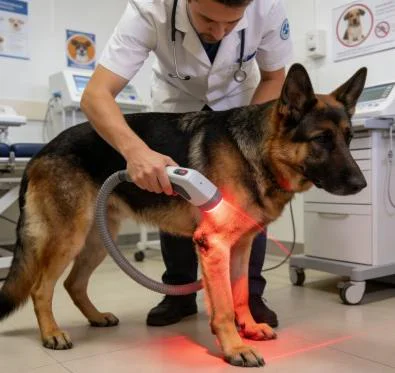
Case File Number: VOR-2026-8841
제목: 개, 독일 셰퍼드
나이: 10세 4개월
성별 성별: 수컷(중성화)
Weight: 38.5 Kilograms
Presenting Complaint: Severe bilateral hindlimb lameness, difficulty rising from recumbency, progressive loss of lumbar epaxial muscle mass, refusal to climb steps.
Radiographic Findings: Severe bilateral coxofemoral subluxation, extensive osteophytosis along the femoral neck and acetabular rims, secondary spondylosis deformans at L5-S1.
Diagnostic Staging: Canine Osteoarthritis Staging Tool Stage 4 (Severe end-stage degenerate joint disease). Pre-treatment Canine Brief Pain Inventory Pain Severity Score: 7.8 out of 10. Pain Interference Score: 8.2 out of 10.
| 세션 ID | 일 | 대상 영역 | 파장 분할 | 피크 전력(W) | 듀티 사이클(%) | 주파수(Hz) | 총 에너지(J) | 임상 관찰 |
| S-01 | D-01 | Bilateral Hips & Lumbar | 80% 980nm / 20% 1470nm | 12.0 | 40% | 20 | 3,200 | Guarded posture; palpation triggers pain reactions; slow sweeping speed used. |
| S-02 | D-03 | Bilateral Hips & Lumbar | 75% 980nm / 25% 1470nm | 14.0 | 45% | 50 | 3,800 | Reduced myofascial tension in longissimus dorsi; skin shows no erythema. |
| S-03 | D-05 | Bilateral Hips & Lumbar | 70% 980nm / 30% 1470nm | 16.0 | 50% | 100 | 4,500 | Rising time from sternal recumbency drops by 4 seconds; relaxed hip extension. |
| S-04 | D-08 | 양측 엉덩이 | 60% 980nm / 40% 1470nm | 18.0 | 50% | 250 | 5,200 | Joint palpation resistance decreases; improved weight-bearing during stance. |
| S-05 | D-11 | Bilateral Hips & Stifles | 60% 980nm / 40% 1470nm | 20.0 | 50% | 500 | 6,000 | Trotting on lead without vocalization; secondary stifle strain stabilized. |
| S-06 | D-14 | Bilateral Hips & Lumbar | 50% 980nm / 50% 1470nm | 20.0 | 55% | 1000 | 6,500 | Range of motion during passive extension improves by 18 degrees bilaterally. |
| S-07 | D-18 | Bilateral Hips & Lumbar | 50% 980nm / 50% 1470nm | 22.0 | 50% | 동적 | 7,000 | Stride length increases; owner stops rescue carprofen administration. |
| S-08 | D-22 | Regional Maintenance | 50% 980nm / 50% 1470nm | 20.0 | 45% | 동적 | 6,200 | Patient navigates clinic steps unassisted; stable gait symmetry achieved. |
객관적 진전 지표
Week 0 (Baseline)
[Pain Severity: 7.8/10]  ████████████████░░░░
[Passive Extension: 110°] ███████████░░░░░░░░░

Week 2 (Mid-Protocol)
[Pain Severity: 4.2/10]  ████████░░░░░░░░░░░░
[Passive Extension: 122°] ████████████░░░░░░░░

Week 4 (Protocol Exit)
[Pain Severity: 2.1/10]  ████░░░░░░░░░░░░░░░░
[Passive Extension: 134°] █████████████░░░░░░░
By session eight on Day 22, the patient showed substantial functional recovery. Static weight-bearing symmetry shifted from a 78:22 forelimb-to-hindlimb distribution back to a balanced 61:39 ratio. The Canine Brief Pain Inventory Interference Score dropped from an initial 8.2 to 2.3, reflecting restored ease when rising and walking.
Thermal imaging confirmed elimination of chronic lumbar hotspots caused by compensatory load carriage. Blood panels remained stable throughout care, avoiding the organ stress common with long-term pharmaceutical protocols.
기존 치료법에 비해 갖는 실질적인 장점
Standard veterinary protocols for severe canine hip dysplasia face real-world clinical hurdles. Long-term NSAID therapy carries persistent risks of renal compromise, gastric ulceration, and hepatic strain, requiring regular blood panels that stress clients financially and shorten safe treatment windows. Physical rehabilitation alone often struggles when joint pain is too acute for active participation. Simple surface cold light units rarely deliver adequate photonic dosage past thick skin coats and fat pads, burning valuable clinic labor hours on low-impact sessions.
Deploying high-intensity Class 4 dual-wavelength protocols transforms daily operations and patient outcomes. High power cut session durations down to under ten minutes, letting veterinary staff achieve deep, consistent cellular stimulation without overtiring the dog. Controlled dynamic pulsing eliminates heat risks on dark-pigmented skin, delivering predictable pain relief that reduces reliance on rescue medications.
Pairing targeted 980nm microvascular stimulation with 1470nm interstitial fluid mobilization relieves chronic joint capsule inflammation at its source. Pets move with visible ease, owners observe tangible daily improvements in mobility, and veterinary practices gain an evidence-based clinical solution for complex orthopedic cases.