 포톤메딕스
포톤메딕스












노령 고양이의 요천추 추간판 통증 극복하기
Targeted multi-wavelength Class IV photon deposition mobilizes compressive disc edema, stimulates perineural microvascular reperfusion, and prevents thin-skin thermal spikes through microsecond duty cycle regulation.
A 13-year-old Domestic Shorthair cowers inside the open carrier on the examination table, refusing to jump down. When the clinician palpates the lumbosacral junction at L7-S1, the cat growls, turns around, and attempts to bite. Radiographs and non-contrast CT reveal severe lumbosacral stenosis with ventral spondylosis deformans, marked facet joint osteoarthritis, and secondary sciatic nerve compression. The cat can no longer step over the rim of the litter box, leading to painful periuria on the living room rug. Long-term non-steroidal anti-inflammatories are medically prohibited due to Stage 2 chronic kidney disease with an elevated symmetric dimethylarginine level of 18 mcg/dL, while oral gabapentin at therapeutic levels causes profound sedation, pelvic limb ataxia, and loss of appetite. The owner stands in tears, facing the prospect of progressive paralysis or premature euthanasia.
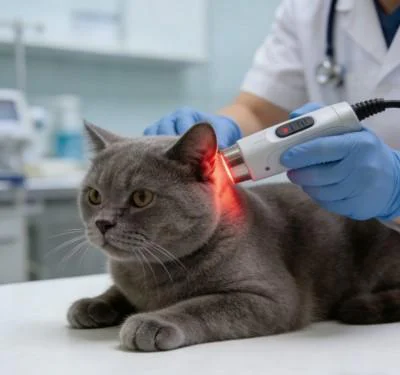
Managing spinal neuro-orthopedic pain in senior feline patients exposes an intense clinical contradiction. Feline skin is paper-thin with sparse subcutaneous adipose tissue, meaning high continuous surface irradiance quickly triggers thermal distress and fear. At the same time, the target pathology lies under thick paraspinal longissimus musculature and dense cortical bone plates of the lumbosacral junction. Trying to address this deep compressive neuropathy using low-output handheld units fails because of physical energy loss: low-power light scatters and extinguishes within the superficial dermis, leaving the nerve roots starved of therapeutic photons. Establishing a successful protocol of laser therapy for cats requires moving beyond low-output devices to high-density, multi-wavelength Class IV systems engineered to penetrate deep osseous barriers without causing epidermal thermal spikes.
Optical Attenuation Curves and Specialized Photonic Windows
When photons strike feline fur and skin, they encounter immediate reflection and tissue scatter. In senior cats, dehydration, coat thinning, and localized muscle spasms alter optical properties. According to biological tissue optical window principles, light below 700 nm experiences heavy scattering and melanin absorption, dissipating completely before reaching subcutaneous layers.
Driving sufficient photon density into the deep lumbosacral canal requires balanced spectral delivery across specific near-infrared absorption bands:
- 980 nm Microvascular Reperfusion: Compressive disc lesions cause venous stasis, local tissue hypoxia, and accumulation of acidotic metabolites around the cauda equina. Photons at 980 nm match the optical absorption peak of oxygenated and deoxygenated hemoglobin. This interaction generates subtle photothermal micro-gradients that open constricted microcapillaries, evacuate ischemic toxins, and restore microvascular perfusion to compressed nerve roots without systemic blood pressure spikes.
- 1064 nm Deep Osseous Penetration: With negligible scattering and low absorption across water and melanin, 1064 nm penetrates through dense fascial layers and thick vertebral lamina. It delivers photon energy directly to injured perineural Schwann cells and spinal root ganglia, stimulating mitochondrial cytochrome c oxidase activity and restoring adenosine triphosphate synthesis.
- 1470 nm Selective Water Absorption and Edema Decompression: Compressive disc pathology creates localized inflammatory edema within the narrow vertebral canal, producing mechanical pressure on sensory nociceptors. Light at 1470 nm exhibits strong affinity for water molecules, mobilizing stagnant interstitial fluid pockets and accelerating local lymphatic clearance to decompress the neural canal.
Clinics often utilize a heavy dog med laser designed for broad canine muscle groups, but applying those same continuous-wave protocols to a fragile cat risks overheating the animal. High-performance platforms resolve this by integrating automated feline presets that calibrate power output, spot size, and wavelength balance to target deep spinal roots without causing surface heat spikes.
Thermal Mitigation Through Microsecond Duty Cycle Pulsing
Applying high-intensity Class IV photomedicine to small animal spinal tracts carries real thermal safety risks. Continuous-wave high-power emission quickly elevates temperatures at the epidermal-dermal junction, causing sharp pain and triggering feline escape reflexes.
Active microsecond duty cycle regulation eliminates this danger by dividing continuous photon emission into controlled micro-bursts separated by thermal relaxation intervals:
Continuous Wave: [================ Continuous Heat Accumulation ================] -> High Burn Risk in Cats
Pulsed 35% Duty: [== Pulse ON ==] [ Thermal Dissipation ] [== Pulse ON ==]      -> Deep Neural Saturation
During the active pulse phase, high peak irradiance drives photons past dense paraspinal muscles and vertebral lamina straight to the spinal cord. During the dark phase, capillary blood flow in the skin whisks away surface thermal energy. Because deep neurological structures lose heat much slower than vascularized dermis, therapeutic photon density accumulates around the nerve root while surface tissues remain cool and comfortable.
This precise thermal management allows veterinary teams to deliver complete therapeutic doses in under four minutes. The cat relaxes comfortably on the mat without physical restraint, eliminating staff stress and preventing treatment-induced fear.
Clinical Protocol and Objective Functional Recovery
According to neural photobiomodulation frameworks documented by Rochkind and supported in feline orthopedic trials published in the Journal of Feline Medicine and Surgery, near-infrared photobiomodulation suppresses pro-inflammatory cytokines such as tumor necrosis factor-alpha and interleukin-6, while upregulating brain-derived neurotrophic factor to accelerate nerve regeneration.
The following case record details this multi-wavelength protocol in a geriatric feline patient with severe chronic lumbosacral stenosis managed alongside renal-friendly supportive care.
Case Record: Geriatric Feline Lumbosacral Stenosis and Cauda Equina Syndrome
- 사건 식별번호: NEURO-2026-FELINE-0931
- 환자 프로필: 13-year-old male neutered Domestic Shorthair
- 체질량: 4.1 kg
- 진단: Hansen Type II lumbosacral disc protrusion at L7-S1 with moderate cauda equina compression, secondary bilateral sciatic neuralgia, and lumbosacral spondylosis; severe pelvic limb weakness, tail paresis, and reluctance to jump; Feline Musculoskeletal Pain Index (FMPI) score: 41/68; concurrent IRIS Stage 2 Chronic Kidney Disease
- 이전의 보존적 치료: Gabapentin at 5 mg/kg orally every 12 hours caused excessive sedation and hindlimb dragging; oral non-steroidal anti-inflammatory drugs contraindicated due to borderline renal values; acupuncture produced minimal relief due to defensive patient resistance
종합 치료 프로토콜 매개변수
| 세션 번호 | Phase of Neurological Care | 출력 전력 (W) | 작동 모드 및 듀티 사이클 | 표적 스펙트럼 분포 | 주파수(Hz) | 총 에너지(줄) | 유량(J/cm²) |
| 01 | Acute Nociceptive Dampening | 4.0 W | 펄스 방식 (30% 듀티 사이클) | 최대 980 nm / 모세관 초점 | 3,500 Hz | 480 J | 4.0 J/cm² |
| 02 | Interstitial Edema Clearance | 5.0 W | 펄스 방식 (35% 듀티 사이클) | 최대 1470 nm / 물 집중 | 2,000 Hz | 650 J | 5.4 J/cm² |
| 03 | Paraspinal Myofascial Release | 6.0 W | 펄스 방식 (35% 듀티 사이클) | 균형 잡힌 980 nm / 1064 nm 혼합 | 1,200 Hz | 840 J | 7.0 J/cm² |
| 04 | Schwann Cell Energy Saturation | 7.0 W | 슈퍼펄스 방식 (40% 듀티 사이클) | 투과 주파수 (1064 nm) | 500Hz | 1,050 J | 8.7 J/cm² |
| 05 | Axonal Regeneration Induction | 7.5 W | 펄스 방식 (40% 듀티 사이클) | Multi-spectral balanced array | 200 Hz | 1,200 J | 10.0 J/cm² |
| 06 | Motor Nerve Sprouting Phase | 8.0 W | 펄스 방식 (40% 듀티 사이클) | Deep Axonal Matrix Focus | 100Hz | 1,350 J | 11.2 J/cm² |
| 07 | Functional Kinetic Mobilization | 6.5 W | 연속 동적 스윕 | 다중 스펙트럼 재생 믹스 | CW / 다이내믹 | 1,170 J | 9.7 J/cm² |
| 08 | Long-Term Mobility Maintenance | 5.0 W | 펄스 방식 (35% 듀티 사이클) | 균형 잡힌 유지보수 프로필 | 30 Hz | 800 J | 6.6 J/cm² |
Longitudinal Pain Index Evolution and Litter Box Compliance
Feline Musculoskeletal Pain Index (FMPI, Lower Score = Less Pain):
Pre-Treatment: [==================================] 41
Session 03:    [==========================] 28
Session 05:    [================] 16
Session 08:    [=======] 6 (Substantial pain reduction)

Litter Box Stepping Success Rate (% of Urinations Inside Box):
Pre-Treatment: [========] 20% (Frequent periuria outside box)
Session 03:    [================] 45%
Session 05:    [============================] 80%
Session 08:    [===================================] 100% (No inappropriate elimination)
By the third session, the cat tolerated palpation over the L7-S1 junction without vocalizing, and voluntary tail elevation returned. By session five, paraspinal muscle hypertonicity subsided completely, and the cat stepped into a standard 15-centimeter litter box without hesitation. At the conclusion of eight treatments over four weeks, the FMPI score dropped from forty-one down to six, daily gabapentin was discontinued, and the patient moved comfortably around the home without renal strain.
Economic Value and Clinical Practicality for Feline Practice
Managing chronic feline mobility disorders often leaves veterinary teams balancing client finances against clinical efficacy. Clients frequently ask about the ongoing laser therapy for cats cost when facing lifetime medication expenses. Conventional long-term therapy involves repeated blood chemistry panels, routine kidney monitoring, and prescription analgesics that accumulate substantial costs without repairing the underlying tissue damage.
Investing in high-power Class IV technology delivers clear financial and clinical advantages:
1. Cost-Effective Drug-Free Treatment Plans
A standard course of six to eight Class IV treatments resolves pain and mobility deficits without ongoing pharmaceutical purchases. This predictable upfront investment spares clients the escalating costs of liver and kidney blood panels, providing superior long-term clinical and financial value.
2. High Patient Turnover in Busy Practices
Low-power therapy wands require twenty minutes of tedious application that feline patients resist. A high-output Class IV system delivers targeted doses in three to four minutes of comfortable sweeping, allowing technicians to manage patient schedules efficiently without treatment bottlenecks.
3. Tangible Recovery That Builds Client Retention
Cat owners track clear markers of comfort: whether their cat uses the litter box, climbs onto the sofa, and purrs during petting. Delivering visible improvements in mobility and posture within the first three sessions reassures owners, building trust and strengthening long-term commitment to hospital wellness plans.
High-power Class IV photomedicine offers a practical, high-throughput solution for chronic spinal and mobility disorders in feline patients. By projecting targeted multi-wavelength photon energy past dense paraspinal tissues directly into compressed nerve roots, veterinary practices can resolve chronic pain, eliminate reliance on systemic drugs, and help senior cats enjoy active, comfortable lives.