 포톤메딕스




개에서 난치성 지간 농피증 극복하기
Quad-wavelength Class IV photon deposition clears deep dermal granulomas, stimulates microvascular drainage of fistulous tracts, and prevents thermal damage on pigmented footpads via microsecond duty cycle modulation.
A 4-year-old English Bulldog sits on a mobile veterinary exam mat, constantly chewing its right forepaw while leaving bloody, purulent smears across the floor. The client has driven across town and spent thousands of dollars over eight months, desperate for an answer. Physical palpation reveals thickened, fibrotic interdigital webs, ruptured draining fistulas oozing bloody exudate, and severe secondary pododermatitis that makes the dog pull its paw back in agony. Previous systemic treatments with cefpodoxime, oral apoquel, and daily chlorhexidine foot soaks provided brief respites before the deep-seated follicular cysts ruptured again, creating thick scar tissue and persistent microbial pockets. The dog limps heavily, the owner is exhausted from relentless cleaning routines, and the clinic schedule is falling behind.
Chronic interdigital furunculosis presents a difficult anatomical bottleneck in small animal dermatology. The interdigital web contains dense fibrous tissue, swollen sebaceous glands, and deep rupture tracts buried beneath thick keratinized epidermis and dark, pigmented skin. Low-output therapeutic equipment fails here because of physics: low power cannot project sufficient photon density through the thickened, hyperkeratotic dermis. The light scatters, loses energy, and dissipates as useless surface warmth before reaching the infected follicular remnants. Resolving these chronic dermal fistulas requires shifting to high-throughput, most used veterinary laser therapy equipment capable of delivering dense fluence deep into infected tissue pockets to halt chronic inflammatory granulomas.
Dermal Scattering Gradients and Chromophore Targeting in Fibrotic Paws
Photons directed at chronic pododermatitis encounter immediate resistance. Hyperkeratotic footpads, dense scar tissue from ruptured follicles, and high melanin content in dark canine skin cause severe optical reflection. Under typical biological tissue attenuation models, single-wavelength low-intensity light loses more than eighty-five percent of its irradiance within the first three millimeters of fibrotic skin.
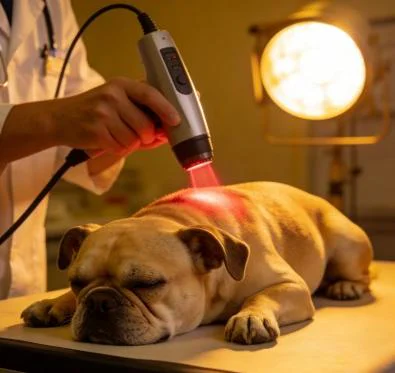
Reaching therapeutic thresholds within deep interdigital granulomas requires coordinated multi-wavelength energy delivery across key absorption windows:
- 980 nm Hemoglobin Resonance and Microcapillary Decongestion: Chronic draining tracts foster venous congestion and microvascular pooling. Light at 980 nm matches the absorption peaks of oxygenated and deoxygenated hemoglobin, generating mild, localized photothermal expansion that reopens microcapillaries. This process clears inflammatory byproducts, flushes stagnant serosanguinous fluid from fistulas, and increases localized delivery of circulating antibiotics.
- 1064 nm Deep Fibroblast Modulation: With negligible melanin and water absorption, the 1064 nm wavelength penetrates straight through thick plantar epidermis and dense scar tissue. It delivers targeted photon density to deep granulomas, shifting macrophages from a destructive inflammatory M1 profile into a reparative M2 phenotype to stop persistent tissue breakdown.
- 1470 nm Interstitial Fluid Mobilization: Swollen interdigital webs trap excessive interstitial edema, causing tight skin tension and severe pain during weight-bearing. The high absorption of 1470 nm light by water targets trapped fluid collections directly, accelerating lymphatic drainage and softening hard fibrous tissue.
Delivering this coordinated biological effect in outpatient and ambulatory workflows is why veterinarians seek the most used veterinary laser therapy equipment for small animals. Instead of wasting thirty minutes holding a low-power probe that barely warms the skin surface, a practitioner can sweep high-density photon energy across all four paw webs in five minutes, restoring comfort to swollen, infected paws.
Duty Cycle Modulation to Protect Pigmented Footpads
Applying high-energy Class IV photomedicine to interdigital spaces introduces a real clinical challenge: canine footpads contain heavy melanin concentrations and thick keratin layers, which absorb light readily. Delivering continuous-wave energy at high wattage over dark, pigmented paw skin can cause rapid surface heat buildup, triggering patient distress and increasing the risk of thermal injury.
마이크로초 단위의 듀티 사이클 조절은 고강도 펄스와 열적 이완 간격을 교대로 배치함으로써 이러한 위험을 제거합니다:
Continuous Wave: [================ Cumulative Thermal Buildup ================] -> Epidermal Hotspot Risk
Pulsed 40% Duty: [== Pulse ON ==] [ Thermal Relaxation ] [== Pulse ON ==]      -> Deep Granuloma Saturation
During the active pulse phase, high peak power drives photons deep into underlying fistulous tracts and thickened dermal beds. During the dark phase, capillary blood flow in the skin dissipates surface heat. Because deep granulomatous tissue cools much slower than the surface skin, therapeutic energy accumulates at the target pathology while surface footpads remain cool and comfortable.
This reliable thermal control is why mobile practitioners prioritize the best veterinary laser therapy unit for mobile vets. Portable, battery-ready systems let practitioners enter homes or field locations, deliver high-power treatments safely without wall outlets, and pack away equipment in minutes.
임상 프로토콜 및 객관적 치유 지표
According to clinical dermatology frameworks established by Frank and confirmed across canine pododermatitis research in Veterinary Dermatology, near-infrared photobiomodulation alters the local immune microenvironment. It downregulates pro-inflammatory cytokines such as tumor necrosis factor-alpha and interleukin-8, accelerates epithelial wound closure, and stimulates ordered collagen deposition to seal draining tracts.
The following clinical case details this multi-wavelength protocol in a severe case of chronic, refractory canine interdigital pyoderma managed alongside targeted antimicrobial stewardship.
Case Record: Chronic Canine Interdigital Furunculosis and Fibrosis
- 사건 식별번호: DERM-2026-MOBILE-0471
- 환자 프로필: 4-year-old male neutered English Bulldog
- 체질량: 26.5 kg
- 진단: Severe chronic bilateral forelimb interdigital furunculosis, Grade 4 pododermatitis with multiple draining fistulas across webs II, III, and IV; dense interdigital scar tissue and hyperkeratosis; secondary Malassezia and Staphylococcus pseudintermedius overgrowth confirmed on surface cytology
- 이전의 보존적 치료: Oral cefpodoxime at 10 mg/kg once daily for eight weeks, oclacitinib at 0.5 mg/kg every 12 hours, and daily medicated wipes; temporary decrease in pruritus followed by relapse of fistulous tracts, severe paw licking, and Grade 2 weight-bearing lameness
종합 치료 프로토콜 매개변수
| 세션 번호 | 조직 회복 단계 | 출력 전력 (W) | 작동 모드 및 듀티 사이클 | 표적 스펙트럼 분포 | 주파수(Hz) | 총 에너지(줄) | 유량(J/cm²) |
| 01 | Acute Exudate & Pain Control | 8.0 W | 펄스 방식 (35% 듀티 사이클) | 최대 980 nm / 모세관 초점 | 3,500 Hz | 1,800 J | 6.0 J/cm² |
| 02 | 간질성 부종의 소실 | 10.0 W | 펄스 방식 (40% 듀티 사이클) | 최대 1470 nm / 물 집중 | 2,000 Hz | 2,400 J | 8.0 J/cm² |
| 03 | Granuloma Decongestion | 12.0 W | 펄스 방식 (45% 듀티 사이클) | 균형 잡힌 980 nm / 1064 nm 혼합 | 1,200 Hz | 3,200 J | 10.6 J/cm² |
| 04 | Deep Macrophage Phenotype Shift | 15.0 W | 슈퍼펄스 방식 (50% 듀티 사이클) | 투과 주파수 (1064 nm) | 500Hz | 4,200 J | 14.0 J/cm² |
| 05 | Fibrotic Remodeling Phase | 16.0 W | 펄스(50% 듀티 사이클) | 4파장 균형 배열 | 250 Hz | 4,800 J | 16.0 J/cm² |
| 06 | Epithelial Closure Induction | 16.0 W | 펄스(50% 듀티 사이클) | 딥 콜라겐 매트릭스 포커스 | 100Hz | 4,800 J | 16.0 J/cm² |
| 07 | Functional Skin Barrier Recovery | 14.0 W | 연속 동적 스윕 | 다중 스펙트럼 재생 믹스 | CW / 다이내믹 | 3,800 J | 12.6 J/cm² |
| 08 | Maintenance Dermal Hardening | 10.0 W | 펄스 방식 (40% 듀티 사이클) | 균형 잡힌 유지보수 프로필 | 30 Hz | 2,800 J | 9.3 J/cm² |
Longitudinal Clinical Score and Lesion Resolution
Canine Pododermatitis Severity Index (0 to 18 Scale, Lower = Normal):
Pre-Treatment: [==================================] 16 (Severe exudate, fistulas)
Session 03:    [======================] 10 (Exudate ceased, swelling reduced)
Session 05:    [============] 5 (Fistulas closed, erythema fading)
Session 08:    [==] 1 (Smooth, non-painful interdigital webs)

Daily Paw-Licking Time (Minutes Per Day):
Pre-Treatment: [==============================] 180 min
Session 03:    [==================] 95 min
Session 05:    [========] 35 min
Session 08:    [=] 5 min (Normal grooming baseline)
By the third session, active serosanguinous oozing stopped completely, and the dog ceased overnight paw biting. Cytology at session five revealed a marked decrease in bacterial phagocytosis, while all draining fistulous tracts sealed over with healthy granulation tissue. At the end of the eight-session protocol over four weeks, interdigital skin thickness normalized, systemic antibiotics were discontinued, and the dog walked without any lameness or tenderness.
Clinical Workflow Advantages Over Long-Term Medication
Managing chronic interdigital pyoderma with repeated courses of oral antibiotics and immunosuppressants carries severe long-term complications. Months of broad-spectrum antibiotic therapy create multidrug-resistant bacterial strains like MRSP, while prolonged steroid or immunosuppressive use thins fragile skin and damages liver and kidney function. When medications stop, lesions frequently flare back up, frustrating owners and leaving clinicians with few options.
Integrating high-power Class IV technology creates direct advantages for clinical teams and mobile practices:
1. Breaking the Antibiotic Resistance Cycle
Rather than relying solely on systemic drugs that struggle to penetrate poorly vascularized scar tissue, high-intensity phototherapy drives microvascular perfusion, accelerating the delivery of circulating white blood cells and natural host defenses into infected granulomas.
2. High Patient Turnover for Busy Mobile Practices
Mobile practitioners cannot afford to spend forty minutes on a single paw with weak, low-power wands. High-output platforms deliver complete therapeutic doses across all interdigital spaces in six to eight minutes, keeping mobile appointments on schedule without compromising clinical outcomes.
3. Immediate Client Satisfaction in Home Environments
Pet owners quickly notice when bleeding stops, foul odors dissipate, and frantic paw-chewing subsides. Demonstrating visible clinical improvements within the first three treatments builds strong client confidence, improving long-term compliance with foot hygiene and lifestyle management.
High-power Class IV photomedicine offers a practical, high-throughput solution for stubborn dermatological conditions that fail conventional medication. By delivering calibrated multi-wavelength photon density past dense, hyperkeratotic skin layers, veterinarians can resolve chronic fistulas, reduce drug reliance, and restore comfortable mobility for their patients.