 포톤메딕스




만성 발뒤꿈치 뒤쪽 활액낭염 및 아킬레스건 저산소증의 치료
Multi-spectral photon delivery overcomes thick fibrocartilage attenuation, breaks persistent peritendinous inflammatory loops, and prevents thermal boundary buildup through microsecond duty cycle modulation.
A recreational marathon runner or active worker hobbles into an orthopedic clinic, wincing each time the posterior heel makes contact with the ground. Every push-off triggers a localized, sharp burning sensation at the posterior calcaneus that radiates upward into the Achilles tendon midportion. The retrocalcaneal space is visibly enlarged, red, and tender to light touch, while passive dorsiflexion causes sharp pain as the inflamed bursa pinches against the bony calcaneal prominence. The patient has already tried eccentric heel drops, immobilization boots, and multiple courses of systemic anti-inflammatory drugs without lasting relief. Cortisone injections carry an unacceptably high risk of catastrophic tendon rupture in this anatomical region, leaving clinicians with few traditional non-surgical options. The clinical obstacle inside the treatment room is tissue density: the retrocalcaneal bursa is buried beneath the thick Achilles tendon insertion and dense plantar-fascial continuations. Delivering non-coherent light or low-output modalities fails because photons scatter within superficial fibrous sheaths long before reaching the hypoxic synovial lining. Resolving this chronic bursal inflammation requires driving calibrated coherent photon fluxes directly through dense posterior fibrocartilage to shut down inflammatory mediators and clear trapped lymphatic effusion.
Optical Penetration Across Dense Fibrocartilage and Synovial Boundaries
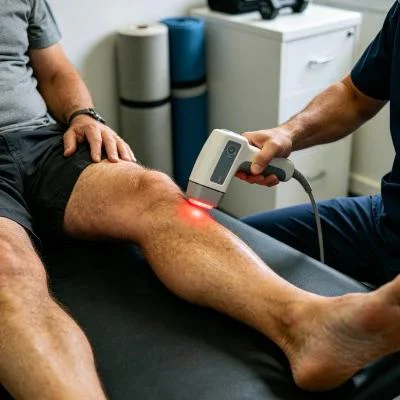
Delivering therapeutic photon counts into the retrocalcaneal space requires overcoming high optical reflection and scattering coefficients. The Achilles tendon consists of dense, parallel type I collagen bundles that scatter light, requiring specific near-infrared wavelengths capable of penetrating connective barriers.
Target Chromophore Coupling in Inflamed Retrocalcaneal Envelopes
Achieving deep therapeutic saturation relies on matching coherent wavelengths to primary target chromophores in inflamed retrocalcaneal and peritendinous tissues:
- Capillary microvascular recruitment at 980nm: The 980nm wavelength matches the optical absorption profile of oxygenated hemoglobin and interstitial water. Chronic bursitis traps stagnant interstitial fluids and inflammatory cytokines inside a restricted anatomical pouch. Delivering 980nm energy creates localized microthermal gradients along the vascular bed, widening dormant post-capillary venules and stimulating regional lymphatic reabsorption.
- Mitochondrial enzyme stimulation at 1064nm: Photons operating at 1064nm exhibit low scatter in dense human collagen matrices. These photons penetrate deep into the retrocalcaneal space, reaching cytochrome c oxidase within dormant fibroblasts, tenocytes, and synovial cells. Stimulating unit IV of the respiratory chain boosts adenosine triphosphate (ATP) synthesis, providing the energy needed to repair damaged collagen and resolve chronic cellular inflammation.
Thermal Safety Profiles and Variable Duty Cycle Regulation
Delivering high-energy class IV laser therapy into the posterior heel requires precise thermal management. The posterior calcaneus has thin subcutaneous adipose coverage and lies close to the skin surface. Emitting continuous wave (CW) high-power energy directly over this bony prominence quickly overwhelms the skin’s thermal relaxation capacity, risking thermal discomfort and skin irritation.
Variable pulse duty cycle gating solves this technical problem. By modulating beam emission into rapid microsecond pulses (from 50 Hz up to 15,000 Hz) with adjustable active and rest phases, high peak photon densities reach deep retrocalcaneal structures while allowing surface tissue to cool between pulses. Capillary blood flow disperses heat during the off-cycle, keeping epidermal temperatures well below 42 degrees Celsius. Clinicians can maintain steady tissue contact, applying high energy directly to the injury site for reliable laser therapy for inflammation without causing thermal damage to the skin.
+--------------------------------------------------------------------------------------------------+
|                          RETROCALCANEAL TISSUE PHOTON PROPAGATION                                |
+--------------------------------------------------------------------------------------------------+
| Quartz Roller Contact Compression Application                                                   |
|   |                                                                                              |
|   v                                                                                              |
| [Posterior Heel Epidermis]  ---> Pulse duty cycle prevents cutaneous heat accumulation           |
|   |                                                                                              |
|   v                                                                                              |
| [Kager's Fat Pad Interface] ---> Physical handpiece pressure displaces local edema fluid        |
|   |                                                                                              |
|   v                                                                                              |
| [Achilles Tendon Fibers]    ---> 1064nm penetrates dense type I collagen bundles with low scatter|
|   |                                                                                              |
|   v                                                                                              |
| [Retrocalcaneal Bursa]      ---> 980nm dilates congested capillaries, draining cytokine pools    |
|   |                                                                                              |
|   v                                                                                              |
| [Calcaneal Periosteum]      ---> Downregulation of COX-2, PGE2, and substance P nociception      |
+--------------------------------------------------------------------------------------------------+
Biochemical Pathways: Halting Chronic Inflammatory Cascades
Chronic retrocalcaneal bursitis persists because inflamed synovial cells continuously release inflammatory mediators, including interleukin-1 beta (IL-1β), tumor necrosis factor-alpha (TNF-α), and prostaglandin E2 (PGE2). This inflammatory soup sensitizes unmyelinated nociceptors and activates matrix metalloproteinases, degrading surrounding tendon fibers.
Applying targeted laser for inflammation breaks this destructive cycle by downregulating nuclear factor kappa B (NF-κB) transcription inside synovial fibroblasts. This reduces the production of inflammatory cytokines and decreases vascular permeability, halting the continuous buildup of fluid in the retrocalcaneal bursa.
Simultaneously, using class IV laser therapy for pain relief alters peripheral nerve conduction. High-flux near-infrared photons suppress action potential conduction in sensitized peripheral C-fibers and A-delta nociceptors. Research by Enwemeka and colleagues on optical photobiomodulation confirms that sustained near-infrared irradiation decreases neurogenic inflammation, reduces local edema, and provides rapid pain relief by interrupting chronic nociceptive signaling.
Clinical Case Documentation: Outpatient Sports Rehabilitation
The following documented record outlines an outpatient rehabilitation course for a patient presenting with chronic retrocalcaneal bursitis and insertional Achilles tendinopathy, treated using a multi-wavelength Class IV rehabilitation laser platform equipped with a quartz massage roller.
환자 프로필 및 임상적 기저 상태
- Case Identifier: SPORTS-BURS-2026-1188
- Patient Age / Sex: 47-Year-Old Male
- Primary Diagnosis: Chronic Retrocalcaneal Bursitis with Secondary Insertional Achilles Tendinopathy (Grade II, confirmed via High-Resolution Musculoskeletal Ultrasound) alongside localized retrocalcaneal fluid effusion measuring 6.2 mm.
- History: 6 months of persistent posterior heel pain following an increase in running mileage. Failed conservative protocols including eccentric loading, shoe modifications, and oral NSAIDs. Morning heel stiffness lasting over 45 minutes; inability to walk barefoot or jog without severe pain.
- Baseline Metrics: Numerical Pain Rating Scale (NPRS) at 8/10 during morning weight-bearing; Victorian Institute of Sport Assessment-Achilles (VISA-A) score at 38/100; Ankle Active Dorsiflexion limited to 2° with knee extended; Retrocalcaneal sagittal diameter on ultrasound measured at 6.2 mm.
다단계 치료 요법
The treatment protocol consisted of ten sessions distributed over four weeks, advancing from acute lymphatic drainage and nociceptive calming to high-energy tissue regeneration.
| 세션 번호. | 임상 단계 및 목적 | 파장 설정 | 작동 전력 (W) | 펄스 주파수 (Hz) | 듀티 사이클(%) | 전달되는 에너지(J) | 누적 선량 (J) |
| 세션 01 | Nociceptive Gating & Tibial Drainage | 980nm (65%) + 1064nm (35%) | 12.0 W | 8,000 Hz | 40% | 3,600 J | 3,600 J |
| 제2회 세션 | Medial/Lateral Calcaneal Decongestion | 980nm (60%) + 1064nm (40%) | 14.0 W | 4,000 Hz | 50% | 4,200 J | 7,800 J |
| 세션 03 | Kager’s Fat Pad Micro-Perfusion | 980nm (50%) + 1064nm (50%) | 16.0 W | 2,000 Hz | 60% | 4,800 J | 12,600 J |
| 제4회 세션 | Bursal Effusion Fluid Evacuation | 980nm (50%) + 1064nm (50%) | 18.0 W | 500Hz | 65% | 5,400 J | 18,000 J |
| 제5회 세션 | Deep Enthesis Anti-Inflammatory Push | 980nm (40%) + 1064nm (60%) | 20.0 W | 200 Hz | 70% | 6,000 J | 24,000 J |
| 제6회 세션 | Synovial Cell Membrane Normalization | 980nm (30%) + 1064nm (70%) | 22.0 W | 100Hz | 75% | 6,600 J | 30,600 J |
| 제7회 세션 | High-Flux Tenocyte ATP Resynthesis | 980nm (20%) + 1064nm (80%) | 24.0 W | 연속(CW) | 100% | 7,200 J | 37,800 J |
| 제8회 세션 | Collagen Fibril Matrix Realignment | 980nm (20%) + 1064nm (80%) | 24.0 W | 연속(CW) | 100% | 7,200 J | 45,000 J |
| 제9회 세션 | Dynamic Dorsiflexion Stress Adaptation | 980nm (30%) + 1064nm (70%) | 20.0 W | 150 Hz | 75% | 6,000 J | 51,000 J |
| 세션 10 | 최종 조직 통합 및 퇴원 | 980nm (40%) + 1064nm (60%) | 16.0 W | 400 Hz | 65% | 4,800 J | 55,800 J |
임상 경과 및 결과 지표
WEEK 1 (Sessions 1-3):
- Gentle sweeping around the medial and lateral malleoli and Kager's triangle improved local drainage.
- Post-session NPRS dropped from 8/10 to 3/10; morning heel stiffness shortened from 45 minutes to 15 minutes.
- Palpation revealed reduced localized swelling and heat over the posterior calcaneus.

WEEK 2 (Sessions 4-6):
- Ankle active dorsiflexion expanded from 2° to 10° without posterior impingement pain.
- Follow-up ultrasound showed the retrocalcaneal fluid pocket decreased from 6.2 mm to 2.1 mm.
- VISA-A functional score improved from 38 to 61.

WEEK 3 (Sessions 7-8):
- High-intensity continuous wave delivery applied directly over the calcaneal insertion with firm quartz contact.
- Patient began pain-free eccentric heel drops on flat ground with no swelling flare-up after sessions.
- Tendon hypoechoic thickening on ultrasound showed clear structural improvement and fibrillar alignment.

WEEK 4 (Sessions 9-10):
- Full active dorsiflexion restored (15° with knee extended).
- Retrocalcaneal fluid effusion completely resolved on ultrasound (under 1.0 mm, within normal limits).
- Final NPRS recorded at 0/10 at rest and 0/10 during dynamic hop and single-leg calf raise tests.
- VISA-A score reached 92/100, clearing the patient for a structured return-to-running program.
비교 분석: 고강도 레이저 대 기존 치료법
Evaluating high-intensity class IV light against common physical and medical therapies highlights why sports medicine practices rely on multi-wavelength lasers for recalcitrant posterior heel pain.
Corticosteroid Infiltration
While cortisone injections offer short-term pain relief by suppressing localized inflammation, their use near the Achilles tendon is clinically problematic. Infiltrating corticosteroids into or around the retrocalcaneal bursa degrades collagen structures, inhibits tenocyte proliferation, and significantly increases the risk of complete Achilles tendon rupture. Class IV laser therapy provides strong anti-inflammatory action non-invasively, stimulating local microcirculation and cell metabolism without weakening the structural tendon matrix.
체외 충격파 치료(ESWT)
Radial or focused shockwave therapy uses mechanical acoustic waves to stimulate tissue healing and break down calcifications. However, delivering high-energy acoustic pulses directly over an acutely inflamed retrocalcaneal bursa and sensitive calcaneal periosteum can be painful, often requiring local anesthesia or causing treatment intolerance. High-intensity laser therapy delivers energy smoothly and comfortably. The soothing warmth of balanced 980nm/1064nm light relaxes local muscle guarding and reduces pain, allowing clinicians to combine phototherapy with gentle manual mobilization in the same session.
경구용 비스테로이드성 항염증제(NSAIDs)
Systemic oral medications distribute throughout the entire body, muting overall pain signaling while exposing patients to gastric irritation, renal strain, and cardiovascular risks. Furthermore, avascular fibrocartilage and restricted bursal spaces receive poor drug concentrations from systemic circulation. High-intensity laser treatment targets concentrated therapeutic energy directly at the affected site, shutting down localized inflammatory cytokines without systemic toxicity.
실무적 임상 적용 및 운영상 시사점
Achieving consistent clinical success with high-intensity laser therapy for deep bursitis requires sound application methods:
- Dynamic compression with quartz massage probes: Firmly pressing the quartz handpiece into the medial and lateral soft-tissue borders of the Achilles tendon displaces superficial fluids and compresses subcutaneous fat. This clears an optical pathway that delivers higher photon densities directly into the retrocalcaneal bursa.
- Two-stage regional sweeping: Begin each session by sweeping the proximal calf muscles, popliteal space, and retro-malleolar channels to open regional lymphatic pathways before treating the inflamed bursa directly.
- Frequency progression protocol: Use high pulse frequencies (4,000 Hz to 8,000 Hz) during early visits to calm irritated pain fibers, transition to moderate pulsing (100 Hz to 500 Hz) to clear fluid effusions, and finish with continuous wave (CW) delivery to stimulate collagen remodeling once acute inflammation has cleared.
Applying class IV multi-wavelength laser therapy grounded in tissue optical physics allows outpatient sports medicine clinics to resolve chronic, stubborn retrocalcaneal bursitis and return patients to pain-free movement.