 포톤메딕스
포톤메딕스












난치성 수근관 증후군에서 정중신경 압박 해소
Direct concentrated photonic flux into the transverse carpal ligament using synchronized dual-wavelength emission. Relieve tenosynovial microvascular ischemia while liquefying rigid subsynovial glycosaminoglycan matrices. Eliminate palmar cutaneous heat accumulation using precision microsecond-gated duty cycles.
An occupational medicine consultation room frequently reveals the stubborn reality of recurrent median nerve entrapment: a 46-year-old assembly line quality auditor sits cradling her dominant right wrist, rubbing her thumb, index, and middle fingers to shake off persistent, sickening numbness. Her nerve conduction study confirms severe carpal tunnel syndrome with prolonged distal sensory latency and reduced motor amplitudes. Over seven months of worsening symptoms, she cycled through nocturnal wrist cock-up splints that stiffened her joint, a fluoroscopically guided cortisone injection that yielded only three weeks of relief, and multiple attempts with an over-the-counter gadget marketed as the best home laser for pain that barely produced mild dermal warmth. Her hand feels clumsy, weak, and cold, waking her up multiple times each night with lancinating paresthesias. When past therapists dialed up power on basic continuous units to drive energy through the dense flexor retinaculum, the patient flinched from sharp, burning sensations across the sensitive palmar skin long before therapeutic photons reached the ischemic median nerve.
Low-power consumer systems fail because optical irradiance rapidly dissipates across the thick, keratinized palmar stratum corneum and dense fibrous aponeurosis. When uncalibrated continuous devices are pushed to higher wattages, superficial thermal energy accumulates immediately. The patient pulls away from intolerable skin stinging, ending the session well before the compressed carpal canal receives an adequate photobiomodulation dose.
Overcoming this wrist entrapment bottleneck requires projecting high-irradiance optical energy directly past the thick transverse carpal ligament into the ischemic nerve trunk while keeping the delicate palmar skin cool and pain-free.
Optical Scattering Across Palmar Fascia and the Flexor Retinaculum
Delivering therapeutic light into the carpal tunnel presents a formidable anatomical challenge. Photons must pass through an ultra-dense palmar stratum corneum, traverse thick subcutaneous connective tissue columns, penetrate the rigid collagenous transverse carpal ligament, and cross inflamed subsynovial connective tissue before reaching the median nerve. Under the Kubelka-Munk optical scattering model, light experiences severe multi-directional scattering across these stratified fibrous boundaries, causing an exponential decay in forward irradiance.
인체의 생물학적 구조 내부에서는 피부 멜라닌, 미세혈관의 헤모글로빈, 간질수라는 세 가지 주요 내인성 흡수체가 광자의 이동 경로를 결정합니다.
In chronic carpal tunnel syndrome, the primary pathology involves non-inflammatory subsynovial fibrosis, microvascular capillary thrombosis, and endoneurial edema within the flexor compartment, located 1.5 to 2.5 centimeters beneath the proximal palmar crease. Low-intensity Class III devices cannot penetrate this physical depth; over 92% of their light scatters into shallow epidermal and aponeurotic layers. The median nerve receives virtually zero energy, leaving the compressed axons trapped in chronic hypoperfusion and ischemic conduction block.
Overcoming this steep attenuation curve requires a high-irradiance laser therapy machine for pain capable of delivering high peak power without exceeding surface thermal thresholds.
Keratinized Palmar Stratum Corneum (Scattering Trap)
         │
         ▼
Palmaris Longus Tendon & Palmar Aponeurosis (Dense Fibrous Barrier)
         │ (1470nm Interstitial Water Absorption & Fluidization)
         ▼
Perineural Microvascular Loops (Ischemic Capillary Congestion)
         │ (980nm Hemoglobin Hyperemia & NO Offloading)
         ▼
Compressed Median Nerve Trunk & Flexor Synovium (Cellular ATP Surge)
헤모글로빈과 물의 발색단을 동시에 표적으로 삼으면 신경 허혈의 악순환을 끊을 수 있다:
At 980nm, photon capture aligns with absorption peaks for oxygenated and deoxygenated hemoglobin. In carpal tunnel syndrome, elevated carpal tunnel pressure chokes epineurial and endoneurial microcirculation, creating localized ischemia and trapping inflammatory cytokines like interleukin-1-beta, prostaglandin E2, and vascular endothelial growth factor. The 980nm wavelength triggers localized vasodilation, prompting circulating red blood cells to offload bound nitric oxide, clearing sluggish capillary stasis and restoring oxygen delivery to starving Schwann cells and sensory axons.
At 1470nm, photon absorption shifts toward bound water molecules within the swollen flexor tenosynovium and thick transverse carpal ligament. Interstitial water absorbs 1470nm light at rates significantly higher than in the 800nm zone. This controlled absorption creates micro-thermal fields that break down rigid, polymerized glycosaminoglycan matrices, clearing chronic inflammatory edema around the compressed carpal canal and relieving physical pressure on the nerve.
Delivering this combined optical power into compact, nerve-dense wrist spaces without scorching the skin requires precise pulse gating.
Duty Cycle Mechanics and Palmar Cutaneous Thermal Clearance
Continuous-wave light delivery encounters a hard biological limit over the palmar aspect of the wrist: the thick, keratin-dense palmar skin absorbs surface heat quickly, but damaged autonomic microvessels cannot dilate properly to clear that thermal load. When continuous photons strike the proximal palm, surface temperatures spike within seconds, setting off intense burning sensations.
정밀한 마이크로초 단위 펄스 게이트링 기술을 통해 이러한 표면 열 축적을 방지합니다. 고강도 빛을 제어된 암간격으로 분리된 마이크로초 단위의 펄스로 분할함으로써, 깊은 관절 구조에는 높은 피크 조도가 전달되는 동시에 민감한 피부는 펄스 사이에서 안전하게 냉각됩니다.
$$\text{Duty Cycle (\%)} = \left( \frac{\tau_{\text{pulse}}}{\tau_{\text{pulse}} + \tau_{\text{cooling}}} \right) \times 100$$
Where $\tau_{\text{pulse}}$ represents active optical delivery and $\tau_{\text{cooling}}$ represents the thermal relaxation pause.
Applying 15W of continuous laser energy over the carpal tunnel triggers uncomfortable skin heating within 3 seconds over the thenar eminence. In contrast, running that same power through a 20% duty cycle delivers powerful peak bursts that penetrate through the thick transverse carpal ligament, while the 80% dark phase allows surface tissues to shed heat safely into the room and the moving handpiece.
Blood flow in the vascular layers carries away surface heat, while the hypoperfused, compressed median nerve absorbs high photon density, initiating cellular healing without epidermal irritation.
Multi-Wavelength Synergies in Carpal Tunnel Connective Tissue
Treating complex wrist nerve entrapment with a single wavelength leaves critical parts of the pathology unaddressed. Carpal tunnel syndrome involves keratinized skin, dense palmar aponeurotic fibers, nine sliding digital flexor tendons, hypertrophic synovium, and the median nerve trunk. Each distinct anatomical layer features unique water content, vascular density, and optical scattering properties.
조화를 이룬 파장들을 결합함으로써 모든 조직 깊이에 걸쳐 끊김 없는 치료 농도 구배를 형성합니다:
[ Carpal Tunnel Tissue Interaction Matrix ]

810nm  ──► Mitochondrial Cytochrome c Oxidase (Surge in Axonal ATP Synthesis)
980nm  ──► Epineurial Capillary Perfusion & NO Release (Flushing Stagnant Metabolites)
1064nm ──► Deep Digital Flexor Tendon Cores (Forward Directional Penetration)
1470nm ──► Subsynovial Hydration Shells (Fluidizing Dense Cross-Linked Collagen)
Pairing 980nm with 1470nm produces immediate biomechanical and circulatory improvements. The 980nm beam opens compressed microvascular beds, delivering fresh oxygen to ischemic axons. At the same time, 1470nm targets bound water molecules inside the swollen subsynovial connective tissue, softening rigid collagen cross-links and draining localized fluid.
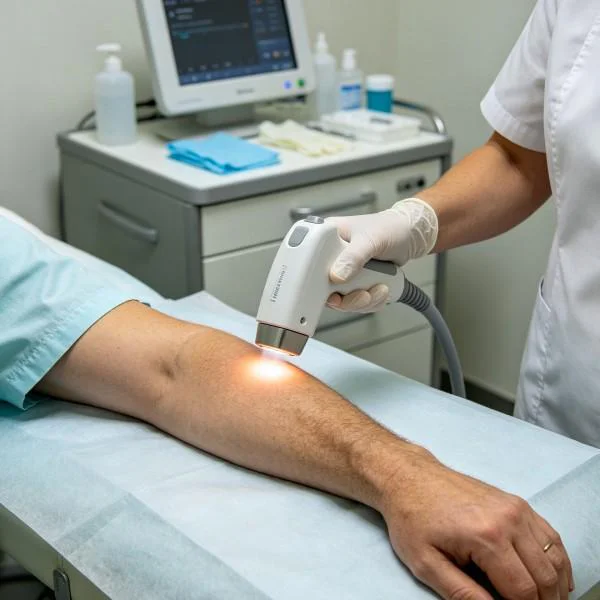
Clinicians use this dual-action delivery to loosen tight, guarded flexor tunnels, making subsequent manual tendon gliding drills, median nerve flossing, and ergonomic workstation re-adaptation far more productive.
Clinical Protocol Deployment and Surgical Context
High-power Class IV platforms have transformed how specialized hand clinics, occupational health practices, and physical therapy departments manage severe peripheral nerve entrapments.
Physicians and certified hand therapists managing chronic carpal tunnel syndrome, pronator teres syndrome, or cubital tunnel compression often face limited options between failed conservative modalities and surgical intervention. Low-intensity Class III modalities require 35 to 45 minutes of scanning to deliver minimal joules through the palmar aponeurosis, producing negligible clinical improvements. While a precision surgical laser machine serves a distinct role in operating suites for endoscopic release of the transverse carpal ligament and precise soft-tissue tenolysis, an external non-invasive high-power Class IV platform delivers therapeutic photonic flux through intact palmar tissue to decompress and regenerate ischemic nerve fibers without an incision.
Specialized hand rehabilitation practices utilizing high-output systems experience distinct operational and clinical advantages:
First, practitioners achieve meaningful therapeutic energy doses in 5 to 7 minutes, optimizing daily patient throughput and eliminating clinician physical fatigue from prolonged manual friction.
Second, rapid nocturnal paresthesia reduction restores deep, uninterrupted sleep cycles within the first week of treatment.
Third, reliable deep-tissue cellular repair restores microvascular blood flow, clearing hand clumsiness, improving two-point discrimination, and preventing permanent thenar atrophy.
임상 사례 기록
The following case record details the clinical application of multi-wavelength high-intensity laser therapy for severe, treatment-resistant carpal tunnel syndrome that had failed to respond to nocturnal splinting, corticosteroid injections, and ergonomic adjustments.
사건 기록 상세 정보
Case Identification: HAND-2026-C7721
Patient Demographics: 46-year-old female, senior assembly line quality auditor
Primary Diagnosis: Severe Chronic Right Carpal Tunnel Syndrome (Bland Classification: Grade 5 Severe Sensory and Motor Deficit with Marked Distal Motor Latency Prolongation)
Chronicity: 11 months of progressively worsening pain and numbness; failed 12 weeks of rigid nocturnal cock-up splinting, failed one ultrasound-guided corticosteroid injection into the carpal tunnel
Clinical Assessment: Constant tingling and numbness throughout the median nerve distribution of the right hand. Phalen’s test positive at 14 seconds with acute shock sensation into the thumb and index finger; Tinel’s sign strongly positive at the wrist crease. Two-point discrimination elevated to 9mm on the index fingertip (normal <5mm). Weakness in abductor pollicis brevis (4-/5 manual muscle test) with early flattening of the thenar eminence (Numeric Pain Rating Scale: 8/10 during night waking, 5/10 constant dull ache during work shifts). Pinch grip strength measured at 3.5 kg on the right versus 7.8 kg on the left.
| 세션 ID | Phase 프로토콜 | 파장 구성 | 평균 전력(W) | 펄스 주파수 및 듀티 사이클 | 스캔 영역 (cm²) | 치료 기간 | 총 에너지(줄) | 임상 반응 지표 |
| 세션 01 | Perineural Desensitization | 980nm (75%) + 1470nm (25%) | 10.0W | 100 Hz @ 20% 듀티 사이클 | 80 | 05:20 | 3,200 J | Night waking drops from 4 times to 2 times; tingling softens |
| 세션 03 | Subsynovial Matrix Softening | 980nm (45%) + 1470nm (55%) | 12.0W | 250 Hz @ 25% 듀티 사이클 | 60 | 06:40 | 4,800 J | Phalen latency increases to 32 sec; palmar tightness eases |
| 제6회 세션 | 축삭 생체자극 | 810nm (30%) + 980nm (45%) + 1470nm (25%) | 15.0W | 800 Hz @ 35% 듀티 사이클 | 90 | 06:40 | 6,000 J | Two-point discrimination drops to 6mm; pinch strength: 5.2 kg |
| 제9회 세션 | Deep Retinacular Remodeling | 980nm (40%) + 1470nm (60%) | 14.0W | 20 Hz @ 25% 듀티 사이클 (딥 임팩트 모드) | 50 | 05:45 | 4,830 J | Phalen test negative at 60 sec; thenar strength hits 5/5 |
| 제12회 | 신경혈관 경화증 | 980nm (50%) + 1470nm (50%) | 12.0W | 연속파 (동적 스윕) | 100 | 06:00 | 4,320 J | Zero nocturnal paresthesia; pinch strength restored to 7.4 kg |
사건 진행 기록
Sessions 01 through 03 focused on relieving subsynovial congestion, clearing local tissue acidosis, and dampening unmyelinated C-fiber nociceptive signaling around the epineurial vascular branches. The combination of 980nm and 1470nm cleared inflammatory edema around the transverse carpal ligament, reducing nocturnal burning and allowing the patient to sleep five continuous hours by the end of the first week.
Sessions 04 through 08 targeted the thick, fibrotic scar tissue within the flexor retinaculum and the ischemic median nerve core. High water absorption at 1470nm softened the rigid proteoglycan gel, while 980nm and 810nm stimulated capillary blood flow to flush out metabolic waste and recruit reparative Schwann cells. Two-point discrimination improved from 9mm to 5mm, and pinch grip strength increased from 3.5 kg to 6.1 kg.
By Session 12, Phalen’s test and Tinel’s sign were completely negative. Follow-up electrodiagnostic testing revealed that median distal sensory latency improved from 4.8ms down to a normal 3.1ms, and distal motor latency normalized to 3.7ms. The patient resumed full-time quality auditing duties involving repetitive digital manipulation without hand fatigue, clumsiness, or paresthesias.
Cellular Pathways in Median Nerve Regeneration
High-intensity deep tissue laser therapy stimulates neural healing through integrated cellular and extracellular mechanisms:
Photonic Absorption (Mitochondria & Subsynovial Water Matrix)
         │
         ├──► Dissociation of Inhibitory Nitric Oxide ──► Accelerated Axonal ATP Output
         │
         ├──► Interstitial Hydration Cleaving ────────► Decompression of Carpal Tunnel Edema
         │
         └──► Endothelial Cell Activation ─────────────► Epineurial Reperfusion
When photons hit cytochrome c oxidase inside stressed median nerve axons and Schwann cells, they displace inhibitory nitric oxide molecules. This allows oxygen to bind unimpeded, accelerating the mitochondrial respiratory chain and producing a dramatic surge in adenosine triphosphate (ATP). Starving axons regain the metabolic energy needed to maintain axonal membrane transport and rebuild damaged myelin sheaths.
Simultaneously, 1470nm photons excite water molecules bound within the dense proteoglycan gel surrounding the flexor tendons. The resulting micro-thermal fields break down rigid collagen cross-links, converting viscous ground substance into a fluid state and draining chronic inflammatory exudates through collateral lymphatic channels.
하류 유전자 신호전달이 급격히 변화한다. 인터루킨-1-베타, 종양괴사인자-알파, 시클로옥시게나제-2와 같은 염증성 사이토카인은 감소하는 반면, 신경성장인자와 혈관내피성장인자는 증가한다.
These biochemical changes prompt Schwann cells to remyelinate bare axonal segments, restoring normal action potential velocities and eliminating the sensory blunting and motor weakness that define chronic entrapment neuropathy.
Moving Beyond Pharmacological Masking and Invasive Release
Conventional management for severe carpal tunnel syndrome relies heavily on oral NSAIDs, repeated cortisone injections, and open or endoscopic carpal tunnel release surgery.
Systemic anti-inflammatory medications cause gastrointestinal bleeding and kidney strain while doing nothing to resolve the physical ischemia or mechanical compression of the median nerve. Repeated cortisone injections directly into the carpal tunnel provide only temporary relief, carrying severe risks of permanent nerve damage, tendon rupture, and dermal atrophy. Surgical release severs the transverse carpal ligament, which relieves pressure but permanently alters the biomechanics of the carpal arch, often leading to loss of grip strength, painful pillar pain, scar hypersensitivity, and weeks of lost work.
High-power Class IV deep laser therapy provides a focused, non-invasive alternative. It avoids systemic drug toxicity, preserves native carpal arch stability, and eliminates surgical trauma. Clinicians can deliver thousands of therapeutic joules deep into compressed retinacular spaces and ischemic nerve trunks within minutes.
Applying high-intensity multi-wavelength phototherapy targets median nerve entrapment at its biological and vascular source. Swollen subsynovial tissues soften, microvascular circulation rebounds, and damaged nerve fibers heal cleanly. It turns agonizing, sleep-depriving hand numbness into a predictable, lasting return to full manual dexterity and productive professional performance.