 FotonMedix












Барьеры, препятствующие рассеиванию фотонов при межпозвоночной дисковой болезни шейного отдела у собак
Targeted hemoglobin and water resonance bands restore nerve root microperfusion while microsecond duty cycle pulsing shields cervical vertebrae from thermal accumulation.
A seven-year-old Beagle enters the emergency exam room with its neck lowered close to the floor, eyes rolling upward in distress while vocalizing sharply at every minor cervical turn. Palpation of the cranial cervical column triggers immediate spastic guarding across the brachiocephalicus, splenius, and trapezius muscle groups, accompanied by distinct thoracic limb knuckling and nerve root signature lameness on the right side. Radiographs and subsequent advanced imaging confirm an acute-on-chronic C4-C5 Hansen Type I intervertebral disc extrusion, creating significant ventral dural compression and marked foraminal nerve entrapment. The client faces a difficult financial and medical crisis: ventral slot decompressive surgery carries estimates well over five thousand dollars alongside serious risks of vertebral instability, while high-dose systemic dexamethasone protocols risk gastrointestinal perforation and severe immunosuppression. Standard conservative protocols relying on an underpowered cold laser machine for dogs fail repeatedly because shallow milliwatt energy scatters in the deep cervical muscle layers long before reaching the spinal floor. The clinical team faces an urgent technical challenge: deliver high-density photon fluence past dense cervical laminae and transverse processes to resolve nerve root hypoxia without overheating the sensitive superficial tissues.
Overcoming deep cervical disc herniation requires calculating the photon attenuation curve across dense muscular layers and irregular osseous structures. Light passing toward the ventral cervical spinal cord must cross dermal melanin, subcutaneous adipose tissue, the thick brachiocephalicus and rhomboideus muscle bellies, and the dense mineralized bone of the cervical vertebrae. Cortical bone and complex muscle bundles induce severe Rayleigh and Mie scattering, quickly dispersing superficial beams before they reach the spinal canal. To halt secondary neuronal ischemia and promote rapid functional recovery, photon flux arriving at the compressed dural floor must exceed the biological activation threshold. Utilizing high-intensity Class 4 ivdd laser therapy bridges this depth deficit, giving clinicians the power and spectral control needed to stimulate cellular repair in hypoxic spinal roots without risking thermal tissue damage.
Optical Extinction Across Dense Cervical Spine Anatomy
Navigating photon transmission into the canine cervical vertebral canal involves severe tissue extinction hurdles. Unlike the flat epaxial muscles of the lumbar region, the cervical spine is enveloped in thick, multi-directional muscle layers that absorb and scatter incoming light. Cortical bone and the prominent transverse processes reflect and diffuse photons, while dense vascular muscle tissue strips energy through hemoglobin absorption.
[Incident High-Intensity Dual Photon Beam]
                     │
                     ▼ (Melanin Absorption & Deep Fur Scatter)
        [Dense Cervical Dermal & Adipose Layer]
                     │
                     ▼ (Hemoglobin Stripping in Brachiocephalicus Beds)
        [Deep Splenius & Longus Colli Musculature]
                     │
                     ▼ (Rayleigh & Mie Scattering in Cortical Bone)
        [C4-C5 Vertebral Bodies & Transverse Processes]
                     │
                     ▼ (Delivered Fluence > Neuroregenerative Threshold)
        [Compressed Ventral Dural Floor & Exiting C5 Nerve Root]
Low-power modalities lose their coherence within the superficial muscle layers, failing to deliver therapeutic energy to compressed motor and sensory pathways. To stimulate axonal repair and reduce intramedullary pressure, photon density must remain biologically active inside the epidural space. Delivering effective laser therapy for dogs with ivdd requires matching tissue-specific chromophores to deep spinal targets rather than relying on shallow surface illumination.
Для преодоления этих многоуровневых барьеров требуется одновременное воздействие в диапазоне взаимодополняющих спектральных пиков. Синхронизация этих длин волн позволяет врачам устранять сужение сосудов, спазм мягких тканей и эпидуральный отек в рамках одного сеанса лечения.
Target Tissue Stratum          Optimal Spectrum Band      Primary Physiological Dynamic
-----------------------------------------------------------------------------------------
Spastic Cervical Musculature   980 nm                     Microvascular dilation, NO induction
Intramedullary Cord Edema      1470 nm                    Selective water drainage, decompression
Entrapped Cervical Nerve Roots 980 nm / 1470 nm Ratio     Mitochondrial ATP synthesis, pain block
The 980nm Hemoglobin Profile And Cervical Reperfusion
The 980nm wavelength matches the peak absorption profiles of oxygenated and deoxygenated hemoglobin within cervical paraspinal capillary beds. In acute cervical disc herniation, mechanical compression chokes spinal microvessels, starving motor neurons and sensory roots of oxygen while trapping lactic acid within the deep cervical musculature.
Поглощение фотонов с длиной волны 980 нм вызывает локальное фототермическое расширение сосудов в глубоких капиллярных сетях вокруг позвоночного канала. Эндотелиальные клетки выделяют оксид азота, что приводит к расслаблению сфинктеров из гладких мышц и восстановлению микрососудистой перфузии. Этот приток насыщенной кислородом крови вымывает кислые метаболиты и медиаторы воспаления из области сдавленных нервных корешков, стимулируя цитохром-С-оксидазу в митохондриях нейронов. Восстановление синтеза аденозинтрифосфата обеспечивает метаболическую энергию, необходимую для поддержания мембранного потенциала и сохранения выживших аксонов.
The 1470nm Water Absorption Pathway In Foraminal Nerve Edema
Mechanical disc rupture produces acute inflammatory fluid pooling within the narrow spinal canal and intervertebral foramina, generating hydrostatic pressure that intensifies nerve root pain. The 1470nm spectrum specifically targets free and bound water molecules in this inflammatory fluid, providing an absorption coefficient significantly higher than standard near-infrared bands.
When 1470nm photons strike edematous paraspinal tissues, targeted energy absorption alters interstitial fluid pressure gradients. Trapped fluid drains into collateral lymphatic networks, decompressing the spinal cord and exiting nerve roots. Combining 1470nm fluid mobilization with 980nm microvascular stimulation delivers rapid neurovascular decompression. This coordinated action makes ivdd laser therapy a dependable non-surgical option, stabilizing acute spinal trauma before irreversible nerve damage occurs.
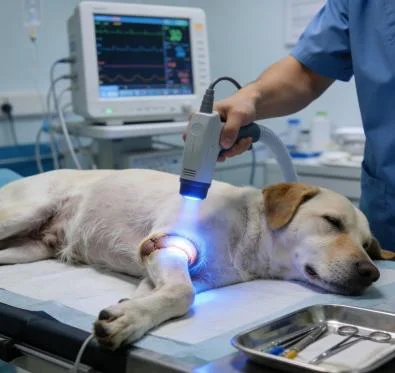
Duty Cycle Engineering For Cervical Bone Safety
Delivering high-power photons through soft tissue over the cervical spine carries a real risk of thermal buildup. Cortical bone on the dorsal spinous processes and transverse wings absorbs continuous wave energy rapidly. If an unmodulated beam stays focused over these bony landmarks, thermal accumulation triggers periosteal pain and potential tissue irritation, forcing clinicians to stop treatment before delivering an effective dose to the spinal canal.
Динамические рабочие циклы с ограничением мощности предотвращают такие тепловые всплески. Модуляция пучка заключается в чередовании микросекундных импульсных серий с откалиброванными интервалами тепловой релаксации.
Continuous Wave (Thermal Runaway Over Cervical Processes):
Power ────────────────────────────────────────── (Periosteal Thermal Risk & Pain)

Gated Dynamic Duty Cycle (Structured Thermal Dissipation):
Power ┌───┐    ┌───┐    ┌───┐    ┌───┐    ┌───┐
      │   │    │   │    │   │    │   │    │   │   (Deep Canal Penetration / Zero Burn)
Base  ┘   └────┘   └────┘   └────┘   └────┘   └────
      |Ton|    Toff     |
Because dense cervical muscle and bone dissipate heat faster than they absorb peak energy pulses, dynamic duty cycles let clinicians deploy high peak irradiance through the muscular layers while maintaining safe surface temperatures. Operating between 30 percent and 45 percent duty cycles enables safe, comfortable treatment directly over the cervical spine.
Adjusting pulse frequencies between 10 Hertz and 500 Hertz tailors the biological effect: low frequencies suppress substance P transmission to relieve acute cervical root pain, while higher frequencies stimulate Schwann cell proliferation and axonal remodeling during later rehabilitation phases.
Отчет о клиническом случае
The data below comes from Veterinary Neurology and Neurosurgical Rehabilitation unit records, documenting non-surgical recovery metrics in a canine patient with severe acute cervical intervertebral disc extrusion.
Характеристика пациента и определение стадии заболевания
Case File Number: VNN-2026-4472
Subject: Canine, Beagle
Возраст: 7 лет 4 месяца
Пол: Самка (стерилизована)
Weight: 11.2 Kilograms
Presenting Complaint: Acute low neck carriage, severe vocalization upon minor head movement, refusal to eat from ground level, non-weight-bearing right thoracic limb lameness.
Neurological Examination: Grade 3 cervical myelopathy and radiculopathy; severe hyperpathia upon gentle lateral neck flexion; delayed conscious proprioception in the right thoracic limb; intact withdrawal reflexes; nerve root signature posture on the right forelimb.
Imaging Diagnosis: Cervical CT and high-resolution MRI show acute Hansen Type I disc extrusion at C4-C5 with 45 percent ventral spinal canal compression and right-sided intervertebral foraminal stenosis. Pre-treatment Modified Frankel Score: 3 (Ambulatory tetraparesis with severe cervical hyperesthesia).
| Идентификатор сеанса | День | Место лечения | Распределение длин волн | Пиковая мощность (Вт) | Рабочий цикл (%) | Частота импульсов (Гц) | Общая энергия (Дж) | Клинические наблюдения |
| S-01 | D-01 | C3-C6 Paraspinal Field | 80% 980 нм / 20% 1470 нм | 7.0 | 30% | 15 | 1,600 | Severe neck guarding; off-contact scanning applied over lateral cervical gutters. |
| S-02 | D-02 | C3-C6 & Splenius Muscle | 75% 980 нм / 25% 1470 нм | 8.0 | 35% | 25 | 2,000 | Brachiocephalicus spasms soften; dog elevates head to horizontal without crying. |
| S-03 | D-04 | C4-C5 Foraminal Exit Zone | 70% 980 нм / 30% 1470 нм | 9.0 | 35% | 50 | 2,400 | Right forelimb nerve root signature resolves; dog accepts elevated bowl feeding. |
| S-04 | D-06 | C3-C7 & Brachial Plexus | 65% 980 нм / 35% 1470 нм | 10.0 | 40% | 100 | 2,800 | Conscious proprioception in right forepaw normalizes; lateral neck motion returns. |
| S-05 | D-09 | Cervical Spine & Shoulders | 60% 980 нм / 40% 1470 нм | 12.0 | 40% | 200 | 3,400 | Full weight bearing on right thoracic limb; compensatory trapezius spasm clears. |
| S-06 | D-13 | C2-T1 Paraspinal Chain | 50% 980 нм / 50% 1470 нм | 14.0 | 45% | 400 | 4,000 | Normal neck extension arc restored; dog ambulates with steady thoracic gait. |
| S-07 | D-18 | Региональная нейроваскулярная ось | 50% 980 нм / 50% 1470 нм | 12.0 | 40% | Динамический | 3,600 | Lateral cervical flexion pain-free; Modified Frankel Score rises to Grade 5. |
| S-08 | D-25 | Cervical Maintenance Zone | 50% 980 нм / 50% 1470 нм | 10.0 | 35% | Динамический | 2,800 | Full functional agility restored; patient clears flat outdoor walking drills. |
Объективные показатели функционального восстановления
Day 1 (Intake Baseline)
[Frankel Score: 3/5]         ████████████░░░░░░░░
[Cervical Motion Arc: 35°]   ███████░░░░░░░░░░░░░

Day 6 (Midway Status)
[Frankel Score: 4/5]         ████████████████░░░░
[Cervical Motion Arc: 75°]   ███████████████░░░░░

Day 25 (Protocol Completion)
[Frankel Score: 5/5]         ████████████████████
[Cervical Motion Arc: 110°]  ████████████████████
By session eight on Day 25, the patient achieved complete functional recovery. The Modified Frankel Score rose from 3 to 5, demonstrating full neurological recovery with normal postural reactions. Right thoracic limb conscious proprioception delay normalized to under 0.5 seconds, fully resolving the previous nerve root signature lameness.
Manual examination confirmed complete resolution of cervical hyperpathia and muscular splinting throughout the C3-C6 vertebrae. Cervical lateral flexion range of motion expanded to 110 degrees symmetrically, allowing the dog to resume daily activities under a structured home exercise protocol.
Практические преимущества по сравнению с традиционными методами
Managing acute canine cervical IVDD presents difficult clinical decisions in veterinary practice. Decompressive ventral slot surgery involves substantial financial costs, requires specialized neurosurgical facilities, and carries risks of post-operative vertebral subluxation, hemorrhage, and prolonged hospital stays. Conservative medical care relying solely on high-dose corticosteroids or NSAIDs brings serious risks of gastrointestinal ulceration, pancreatitis, and systemic immunosuppression, without directly resolving the microvascular compression strangling the spinal cord.
Underpowered low-level phototherapy units worsen these clinical delays. Low-wattage hardware requires prolonged session times of thirty to forty minutes to deliver minimal photon quantities through thick cervical muscles and dense bone. This hands-on demand ties up technicians and examination suites, driving up clinic labor overhead while delivering slow, inconsistent clinical progress.
High-power Class 4 multi-wavelength protocols eliminate these clinical bottlenecks. Delivering up to fourteen watts of peak power through balanced 980nm and 1470nm wavelengths cuts hands-on treatment times down to under eight minutes per cervical segment. This delivery speed allows veterinary practices to treat deep neurological structures efficiently, tripling daily room capacity while keeping cervical patients calm on the treatment mat.
Dynamic duty cycle pulsing protects sensitive tissues over the cervical transverse processes, preventing thermal spikes on dense, dark-coated limbs. Pet owners see noticeable reductions in neck spasms and radicular pain within the first three visits, validating their commitment and keeping compliance high across the complete rehabilitation plan. For veterinary practices, combining deep spinal canal penetration with rapid treatment times turns complex canine neurological cases into a dependable, non-invasive clinical service.