 FotonMedix












Устранение трудноизлечимого фасциального защемления при спазмах в грудопоясничном отделе позвоночника
Penetrate dense posterior thoracolumbar aponeuroses with coordinated photonic wavelengths. Balance hemoglobin vasodilation against intracellular hydration resonance. Prevent surface thermal saturation using targeted sub-millisecond duty cycles.
High-volume spine rehabilitation clinics constantly encounter the rigid, board-like lower back that refuses to budge. The patient walks in with a stiff, antalgic lean, unable to hinge at the hip or sit without sharp, bilateral lumbar spasms. Traditional physical therapy pathways dictate warm hydrocollator packs, electrical stimulation, and deep percussive massage. Yet, after 45 minutes of mechanical pounding, the dense thoracolumbar fascia remains bound down, locking the erector spinae in protective, ischemic spasm.
Superficial heating pads only raise the temperature of the skin and subdermal fat by 1 to 2 degrees Celsius, merely triggering superficial cutaneous vasodilation. When therapists reach for a basic low-power laser therapy device for pain relief, the photonic flux scatters within the first 4 millimeters of dermis. Boosting the power output on uncalibrated continuous systems risks thermal discomfort for the patient long before adequate photonic energy reaches the deep multifidus layers.
Resolving entrenched spinal hypertonicity requires delivering sustained, deep-reaching optical doses directly through dense collagenous sheets without causing dermal overheating.
The Structural Impasse of the Thoracolumbar Junction
The thoracolumbar fascia consists of multiple layers of dense regular connective tissue reinforced by cross-hatched collagen bundles. This dense architectural sheath wraps the erector spinae, multifidus, and quadratus lumborum muscles, anchoring them directly to the lumbar spinous processes and iliac crests.
When chronic mechanical stress or micro-tearing occurs, hyaluronic acid lubricating these fascial sheaths polymerizes, transitioning from a fluid state into a dense, sticky gel. The sliding mechanism between muscle layers degrades, creating localized hypoxia, lactic acidosis, and trigger points that compress terminal sensory branches of the dorsal rami.
Stratum Corneum & Subcutaneous Adipose
         │ (Photon Scattering & Dispersion)
         ▼
Thoracolumbar Aponeurosis (Dense Cross-Linked Collagen)
         │ (1470nm Aqueous Cleaving)
         ▼
Microvascular Capillary Beds (Ischemic Spasm Zone)
         │ (980nm Hemoglobin Oxygen Surge)
         ▼
Deep Multifidus & Erector Spinae Core (Cellular Repair)
Treating deep spinal dysfunctions demands an energy platform capable of reaching deep layers without getting trapped at the surface. A Class IV laser therapy machine provides high-irradiance photonic delivery that overcomes rapid tissue scattering.
Targeting specific chromophores simultaneously breaks the cycle of fascial stiffness:
At 980nm, photons hit high absorption bands for deoxygenated and oxygenated hemoglobin. In chronic spinal spasms, tight muscle fibers choke local microcirculation, trapping inflammatory cytokines. The 980nm wavelength triggers localized vasodilation, prompting red blood cells to offload oxygen into starved myofibrils while carrying away metabolic waste.
At 1470nm, photon absorption shifts heavily toward tissue water. Water molecules around stiff fascial sheaths absorb this energy, creating micro-thermal gradients that break down dense, cross-linked hyaluronic acid gels. This softens the rigid thoracolumbar sheath, restoring normal sliding between muscle planes.
Delivering this combined optical energy requires precise pulsing control to keep surface tissues cool and comfortable.
Duty Cycle Mechanics and Microvascular Thermal Dissipation
Continuous-wave energy poses a fundamental challenge in deep tissue therapy: the skin heats up much faster than deeper, denser structures can absorb the therapeutic dose. The thermal relaxation time of the epidermal layer is brief, meaning incoming continuous photons quickly saturate surface layers and fire sensory heat receptors.
Advanced pulse gating overcomes this limitation. By slicing continuous energy into microsecond bursts followed by controlled dark intervals, deep tissue receives maximum peak power while the epidermis cools down safely between pulses.
$$\text{Average Power (W)} = \text{Peak Power (W)} \times \left( \frac{\text{Pulse Duration}}{\text{Pulse Duration} + \text{Pulse Interval}} \right)$$
Applying 24W of continuous energy over the lumbar paraspinal zone causes surface heat buildup within seconds. Modulating that same optical power through an ultra-short 25% duty cycle delivers powerful peak bursts that punch through dense fascial layers while surface tissues disperse heat during dark intervals.
Perfusion carries heat away from the surface, while hypoperfused deeper target tissues capture the required photonic energy to stimulate cellular repair.
Multi-Frequency Modulation Across Spinal Connective Planes
Chronic lumbar dysfunction rarely stays confined to a single tissue plane. A rigid back involves skin, adipose layers, dense aponeurotic sheets, and deep paraspinal muscle bellies. Each distinct tissue layer features unique water content, vascular density, and optical scattering properties.
Deploying calibrated wavelengths concurrently ensures complete, uniform energy delivery throughout the spinal column:
[ Deep Spinal Absorption Dynamics ]

810nm  ──► Mitochondrial Cytochrome c Oxidase (Cellular ATP Generation)
980nm  ──► Paraspinal Capillary Hyperemia (Flushing Inflammatory Fluid)
1064nm ──► Deep Structural Myofibrils (Max Forward Penetration)
1470nm ──► Extracellular Water Chains (Fascial De-densification)
Pairing 980nm and 1470nm creates immediate mechanical and circulatory changes. The 980nm beam opens compressed microvascular beds, flooding hypoxic paraspinal fibers with fresh blood. At the same time, 1470nm targets the water matrix within the stiff thoracolumbar aponeurosis, breaking up dense collagen cross-links.
Clinicians use this dual-action delivery to loosen tight, guarded spinal structures, making subsequent manual adjustments and spinal decompression techniques noticeably smoother and more comfortable.
Clinical Efficiency with Class IV Laser Muscle Therapy
High-power platforms change how busy orthopedic rehabilitation centers manage complex spinal cases.
Clinicians dealing with acute facet joint pain, lumbar radiculopathy, or severe postural contractures often spend substantial time warming up tissue with manual techniques. A high-output laser muscle therapy machine cuts preparation times down to minutes by delivering thousands of therapeutic joules deep into muscle structures.
This focused power profile delivers concrete advantages in daily clinical practice:
First, practitioners achieve therapeutic target doses in 8 to 10 minutes, avoiding long, fatiguing manual friction sessions.
Second, rapid pain relief breaks protective muscle guarding, enabling patients to transition into stabilization and core rehab exercises earlier in their care plan.
Third, consistent cellular stimulation accelerates recovery pathways, helping facilities maintain steady, predictable patient progression.
Документация по клиническим случаям
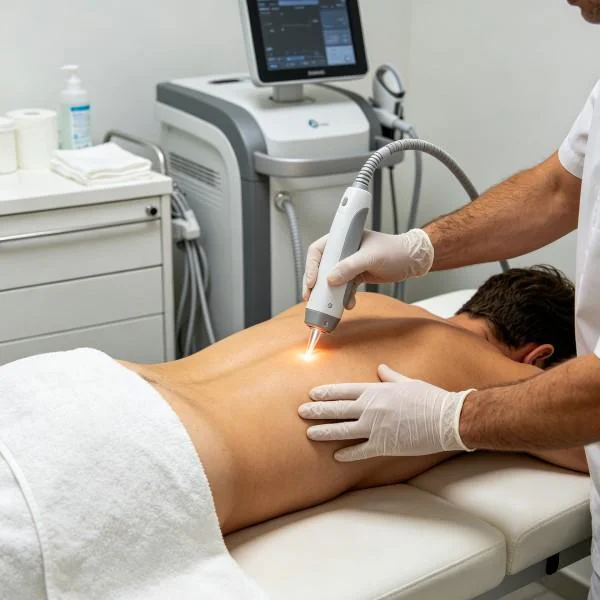
The following case record details the clinical application of multi-wavelength high-intensity laser therapy for severe, chronic thoracolumbar fascial stiffness and lumbar hypertonicity unresponsive to conventional modalities.
Сведения о деле
Case Identification: SPINE-2026-L4092
Patient Demographics: 45-year-old male, industrial logistics supervisor
Primary Diagnosis: Chronic Bilateral Lumbar Paraspinal Myofascial Pain Syndrome with Severe Thoracolumbar Fascial Adhesion and Secondary L4-L5 Facet Joint Guarding
Chronicity: 22 weeks of persistent symptoms; limited relief from dry needling, heat packs, and oral muscle relaxants
Clinical Assessment: Palpable, hyper-dense bilateral bands spanning L1 to S1 across the erector spinae and multifidus. Standing lumbar flexion limited to 32 degrees due to intense pulling pain (Numeric Pain Rating Scale: 7/10 at rest, rising to 9/10 during trunk flexion). Significant limitation in lumbar extension and pelvic tilt mechanics.
| Идентификатор сеанса | Протокол «Phase» | Конфигурация длины волны | Средняя мощность (Вт) | Частота импульсов и коэффициент заполнения | Площадь сканирования (см²) | Продолжительность лечения | Полная энергия (джоули) | Показатель клинического ответа |
| Сессия 01 | Neurovascular Calming | 980nm (65%) + 1470nm (35%) | 14,0 Вт | 150 Hz @ 35% Duty Cycle | 250 | 08:20 | 7,000 J | NPRS drops from 7/10 to 5/10; tissue guarding eases |
| Сессия 03 | Fascial De-densification | 980 нм (45%) + 1470 нм (55%) | 18,0 Вт | 350 Hz @ 45% Duty Cycle | 200 | 09:15 | 10,000 J | Lumbar flexion increases by 18°; fascial bands soften |
| Занятие 06 | Глубокий клеточный биостимулятор | 810nm (25%) + 980nm (50%) + 1470nm (25%) | 22,0 Вт | 800 Hz @ 50% Duty Cycle | 220 | 09:05 | 12,000 J | NPRS down to 3/10; baseline mobility restored |
| Сессия 09 | Deep Structural Remodeling | 980 нм (40%) + 1470 нм (60%) | 20,0 Вт | 15 Hz @ 30% Duty Cycle (Deep Pulse Mode) | 180 | 08:20 | 10,000 J | Lumbar flexion hits 78°; facet joint pain cleared |
| Занятие 12 | Kinetic Stabilization | 980 нм (50%) + 1470 нм (50%) | 16,0 Вт | Continuous Wave (Sweeping Motion) | 300 | 08:20 | 8,000 J | Zero resting pain; full work duty resumed |
Заметки о ходе рассмотрения дела
During Sessions 01 to 03, the 980nm and 1470nm protocol reduced protective spinal guarding. The thermal targeting of water in the thoracolumbar sheath restored tissue elasticity, increasing lumbar flexion by 18 degrees by the end of the first week.
Sessions 04 through 08 targeted deep muscular ischemia in the multifidus and sacrospinalis attachments. Combining vascular stimulation at 980nm with cellular stimulation at 810nm flushed stagnant tissue fluid and lowered resting pain scores down to 3/10.
By Session 12, the bilateral fascial bands were supple and responsive to palpation. Dynamic lumbar range of motion matched normal anatomical baselines, and the patient completed standard industrial lifting assessments without compensatory movements or pain flares.
Intracellular Dynamics and Cellular Energy Pathways
The clinical impact of high-intensity laser therapy rests on clear intracellular pathways:
Photonic Penetration to Muscular Depth
         │
         ├──► Absorption by Cytochrome c Oxidase ──► Accelerated ATP Synthesis
         │
         ├──► Intercellular Water Excitation ─────► Hyaluronic Acid Fluidity
         │
         └──► Endothelial Cell Activation ────────► Targeted Nitric Oxide Release
When photons hit terminal respiratory chains within muscle cell mitochondria, they encourage cytochrome c oxidase to shed inhibiting nitric oxide molecules. This clear binding pathway lets oxygen attach unimpeded, driving the production of adenosine triphosphate (ATP) across chronically fatigued muscle units.
Concurrently, 1470nm photons target water shells surrounding immobilized collagen bundles. The resulting micro-thermal fields transform dense, viscous hyaluronic acid back into an open fluid, restoring frictionless gliding across deep fascial layers.
Gene transcription changes soon follow. Inflammatory markers like interleukin-6 and prostaglandin E2 drop steadily, while anti-inflammatory mediators and vascular endothelial growth factors increase.
These cellular shifts break chronic inflammatory feedback loops, supporting rapid, natural soft tissue recovery.
Evolving Beyond Conventional Modalities
Traditional protocols for chronic lower back spasms rely heavily on oral NSAIDs, central muscle relaxants, cortisone trigger-point injections, and superficial heat applications.
Oral medications circulate throughout the whole body, often causing gastrointestinal irritation and kidney strain while merely masking pain signals without addressing structural stiffness. Repeated steroid injections into spinal connective tissues can weaken connective tissue over time, potentially accelerating degenerative changes.
Superficial hot packs and light massage give temporary comfort, but they fail to drive meaningful healing energy through dense connective sheaths.
Class IV multi-wavelength laser therapy provides a focused, direct alternative. It skips systemic metabolic pathways, protects structural tissue integrity, and prevents dermal surface burns. Therapists can deliver targeted photonic energy centimeters deep into hypertonic muscle bellies and tight fascial layers within minutes.
This high-power photobiomodulation platform addresses stubborn spinal pain at its anatomical and cellular source. Muscle guarding subsides, local blood flow returns, and damaged tissues heal cleanly. It turns persistent, disabling lower back pain into a manageable, structured path toward long-term functional recovery.