 فوتون ميديكس










Cervical Radiculopathy and Nerve Root Penetration Limits
High-intensity Class 4 laser systems resolve cervical radiculopathy by pairing 30W five-wavelength output with 980nm microcirculatory stimulation and pulsed duty cycles, driving photons past dense paraspinal neck muscles without overheating sensitive cervical skin.
Walk into an outpatient neurology and orthopedic clinic at 9:40 AM on a Tuesday, and you will see one of the most exhausting clinical presentations in upper-quadrant rehabilitation. A 39-year-old male software architect sits rigidly on the examination table with his right arm cradled against his chest, unable to turn his head to the right or sit at a monitor for fifteen minutes without burning pins-and-needles shooting down his forearm into his index and middle fingers. Over the past five months, he has cycled through mechanical cervical traction that aggravated his jaw, oral gabapentin that fogged his concentration during code reviews, and an epidural steroid injection consultation he wanted to postpone. When clinicians attempt to treat C6-C7 nerve root compression using a conventional جهاز العلاج بالليزر البارد المعتمد من إدارة الغذاء والدواء الأمريكية, the appointment quickly turns into an exercise in optical frustration. The inflamed cervical nerve root sleeve lies buried beneath three to four centimeters of skin, upper trapezius, splenius capitis, and dense semispinalis musculature, while the overlying skin on the lateral neck is thin, densely innervated, and remarkably sensitive to heat. Low-power cold units lose virtually all their photons before reaching the intervertebral foramen, whereas turning up a traditional single-wavelength high-power laser over the neck rapidly spikes skin temperature and forces the operator to pull away.
Why Cervical Anatomy Defeats Standard Modalities
Treating cervical radiculopathy exposes a sharp physical contradiction in non-invasive rehabilitation: severe photon scattering across layered posterior neck muscles paired with low thermal tolerance on thin cervical skin. Unlike the thick plantar heel pad or lateral hip, the posterior and lateral neck features minimal subcutaneous adipose padding over dense, overlapping muscle bellies—specifically the upper trapezius, levator scapulae, splenius capitis, and semispinalis cervicis—shielding the deep cervical facet pillars and intervertebral foramina.
According to tissue optics research published in the Journal of Biomedical Optics, biological scattering coefficients in human dermis and skeletal muscle extinguish nearly 90 percent of low-power near-infrared light within the first 10 to 15 millimeters of penetration. When a clinic relies on a standard low-level جهاز العلاج بالليزر البارد المعتمد من إدارة الغذاء والدواء الأمريكية operating below 500 milliwatts, the residual photon fluence reaching a depth of 3.5 centimeters drops far below the cellular activation threshold established by the Arndt-Schulz law. The clinician spends twenty minutes holding an applicator against the neck while the compressed, edematous C6-C7 nerve root sleeve receives almost zero photochemical stimulus.
محاولة التغلب على هذا النقص في التغلغل باستخدام موجة مستمرة ذات طول موجي واحد وأقدم الليزر للعلاج بالليزر creates an immediate thermal hazard. Single-wavelength 980nm lasers carry strong absorption affinity for both intracellular water and hemoglobin. Because the cervical region is densely vascularized by superficial jugular tributaries and cutaneous capillary plexuses, delivering 10W or 12W in continuous wave mode causes energy to accumulate rapidly in the upper dermis. Within ten seconds, skin surface temperatures climb past 43 degrees Celsius, causing an acute stinging heat sensation and triggering protective scalene and trapezius muscle guarding.
| الطريقة السريرية | القدرة الناتجة النموذجية | عمق الاختراق الفعلي | Primary Mechanism in Cervical Pathology | Main Clinical Bottleneck in Radiculopathy |
| Cervical Mechanical Traction | Mechanical / Intermittent | Joint space distraction | Temporary foraminal decompression | Frequent TMJ discomfort; rebound muscle spasm post-session |
| الموجات فوق الصوتية العلاجية | 1,0 – 1,5 واط/سم² | 2.0 – 3.5 سم | Acoustic deep heating of myofascial tissue | Risk of periosteal overheating along cervical transverse processes |
| ليزر بارد منخفض الطاقة (الفئة 3B) | < 0.5 واط | 0.5 – 1.5 سم | التحفيز السطحي لإنزيم أوكسيديز السيتوكروم سي | Insufficient photon density to reach deep cervical nerve roots |
| ليزر متعدد الأطوال الموجية من الفئة 4 | حتى 30 واط | ما يصل إلى 15.0 سم | الاستهداف المتزامن للصباغ باستخدام البوابات النبضية | Requires strict vascular avoidance and duty-cycle calibration |
Resolving this clinical paradox requires a multi-wavelength optical platform capable of separating deep tissue penetration from epidermal heat accumulation. Systems engineered like the FotonMedix LaserMedix-Max solve this exact contradiction by synchronizing five distinct wavelengths—650nm, 810nm, 915nm, 940nm, and 980nm—at peak power outputs reaching 30W. By spreading optical energy across five complementary biological chromophores rather than concentrating all wattage into a single superficial absorber, clinicians achieve true deep penetration reaching the cervical nerve root and deep paraspinal stabilizers while keeping cervical skin comfortably warm.
منحنيات توهين الفوتونات والتآزر متعدد الأطوال الموجية
فهم أسباب نجاح منصة ذات خمسة أطوال موجية في العصر الحديث العلاج الطبيعي بالليزر where single-wavelength units fail requires examining how each specific wavelength behaves as it traverses sequential cervical tissue layers along the optical attenuation curve.
- 650 نانومتر (تعديل مستقبلات الألم الجلدية): Absorbed within the upper 2 to 3 millimeters of the cervical epidermis and superficial dermis by melanin and surface microvessels. It calms hypersensitive cutaneous nerve endings along the C5-T1 dermatomes, reducing the tactile allodynia and burning skin sensitivity that frequently accompany acute cervical radiculitis.
- 810 نانومتر (تسريع إنتاج ATP في الميتوكوندريا): Positioned directly at the peak absorption spectrum of cytochrome c oxidase inside cellular mitochondria. As established in photobiomodulation research led by Dr. Michael Hamblin at the Wellman Center for Photomedicine, 810nm photons dissociate inhibitory nitric oxide from the mitochondrial respiratory chain, accelerating adenosine triphosphate (ATP) synthesis and driving Schwann cell and axonal repair along irritated cervical nerve roots.
- 915 نانومتر و940 نانومتر (نطاق الاختراق العميق): Located in the optical trough where water and melanin absorption drop to minimal levels while hemoglobin interaction remains active. These two wavelengths bypass the upper trapezius and splenius capitis with minimal scattering loss, carrying high photon density down to depths of 3 to 5 centimeters to reach the cervical intervertebral foramen, facet capsule, and deep multifidus attachments.
- 980 نانومتر (تروية الأوعية الدموية وإزالة الوذمة): Strongly absorbed by intracellular water and oxygenated hemoglobin. It generates controlled, localized micro-thermal gradients inside the deep paraspinal and periradicular vascular bed, reducing blood viscosity, dilating arterioles, and accelerating lymphatic drainage of inflammatory edema compressing the nerve root sleeve.
Regulating Cervical Thermal Relaxation via Pulsed Duty Cycles
Delivering 15W to 24W of optical power into the posterior and lateral neck safely depends on respecting the thermal relaxation time of thin cervical skin. Thermal relaxation time defines how quickly a heated tissue volume sheds 50 percent of its absorbed thermal energy to surrounding structures. Because cervical skin is substantially thinner than lumbar or gluteal skin and overlies rich superficial vascular networks, continuous wave irradiation causes heat to stack rapidly at the dermal-epidermal junction.
عندما تكون الشدة عالية الليزر للعلاج بالليزر runs in super-pulsed and gated duty cycles—such as operating at 1500Hz with a 50 percent duty cycle—the system fires high-intensity peak pulses capable of driving photons past the paraspinal muscle fascia, separated by microsecond off-periods. During each off-period, the cervical epidermis dissipates excess heat through dermal capillary blood flow while the deep periradicular tissue continues accumulating photochemical energy. Paired with real-time therapeutic temperature indication technology built into the treatment handpiece, clinicians monitor skin thermal kinetics continuously, holding tissue warming inside the optimal therapeutic zone without ever triggering a heat withdrawal reflex.
Reversing Periradicular Edema and Neurogenic Inflammation
Cervical radiculopathy is rarely caused by static mechanical bone compression alone; surgical and MRI studies consistently show that acute radicular pain is driven by chemical neuritis and venous congestion inside the tight intervertebral foramen. When a bulging C6-C7 posterolateral disc or uncovertebral osteophyte irritates the nerve root sleeve, local mast cells and macrophages release phospholipase A2, prostaglandin E2 (PGE2), interleukin-6 (IL-6), and tumor necrosis factor-alpha (TNF-α). This biochemical cascade triggers intraneural edema, impairs axoplasmic transport, and causes ectopic firing along both sensory C-fibers and motor axons.
عالي الطاقة العلاج الطبيعي بالليزر disrupts this neuroinflammatory loop across three physiological mechanisms simultaneously. First, the photothermal micro-gradient generated by 940nm and 980nm wavelengths increases periradicular venous and lymphatic outflow, physically reducing nerve root swelling inside the narrow neural foramen. Second, the photochemical cascade triggered by 810nm photons downregulates pro-inflammatory cytokine expression and restores sodium-potassium pump homeostasis across demyelinated nerve segments. Third, high-intensity near-infrared irradiation temporarily slows conduction velocity along hyperactive nociceptive fibers, breaking the reflexive upper trapezius and levator scapulae spasm within minutes of treatment.
Clinical Case Study: Refractory C6-C7 Cervical Radiculopathy
The following documented clinical case illustrates how calibrated five-wavelength ratios, pulsed duty-cycle gating, and progressive Joule dosing resolve refractory cervical nerve root compression that failed traction, oral neuropathic medication, and standard physical therapy.
حالة المريض والخصائص المرضية الأساسية
- تحديد الحالة: Neuro-Spine-2026-2185
- التركيبة السكانية للمرضى: 39-year-old male, senior software architect, right-hand dominant, BMI 24.6, posterior-lateral paraspinal neck thickness measured at 3.2 cm over C6-C7 via diagnostic ultrasound.
- التشخيص السريري: Right C6-C7 cervical radiculopathy secondary to a Grade II right paracentral disc protrusion with mild foraminal narrowing and periradicular edema (confirmed on cervical spine MRI), accompanied by severe right upper trapezius and levator scapulae myofascial guarding.
- مدة الأعراض: 5 months of progressive neck pain radiating into the right medial scapular border, lateral arm, dorsal forearm, and index/middle fingers, accompanied by paresthesia and mild grip weakness.
- التدخلات السابقة التي باءت بالفشل: 6 weeks of outpatient physical therapy (intermittent mechanical cervical traction, TENS, isometric neck exercises), oral gabapentin (300mg three times daily), and a 10-day oral methylprednisolone taper.
- المقاييس الموضوعية الأساسية: Visual Analog Scale (VAS) radicular arm pain score of 8.5/10; Neck Disability Index (NDI) score of 52% (severe disability); Positive Spurling’s compression test reproducing distal finger tingling within 3 seconds; Active cervical right rotation limited to 38 degrees.
هندسة البروتوكولات ومعايرة الأطوال الموجية
Because the target C6-C7 neural foramen sat beneath 3.2 centimeters of hypertonic paraspinal musculature while requiring strict protection of the anterior carotid triangle and thyroid cartilage, the clinical team structured an 8-session multi-wavelength protocol emphasizing deep penetration wavelengths (810nm, 915nm, and 940nm) paired with 980nm edema clearance. Irradiation was applied via a non-contact scanning technique across a 180 cm² posterior-lateral cervical and periscapular grid extending from the C3 spinous process down to T3 and laterally across the upper trapezius and medial scapular border, strictly avoiding the anterior neck.
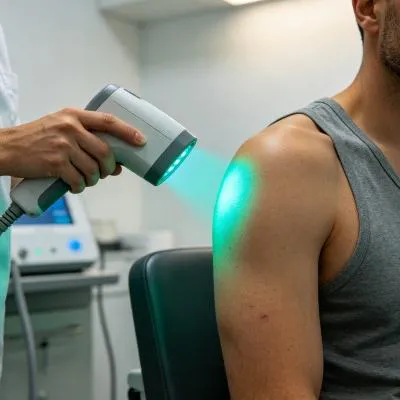
During Sessions 1 through 3, higher pulsing frequencies and a 50 percent duty cycle were prioritized to achieve rapid periradicular edema drainage and dorsal root ganglion analgesia while keeping cervical epidermal temperatures strictly below 39.5 degrees Celsius. From Session 4 onward, peak output increased to 22W and 24W with higher duty cycles to accelerate axonal recovery and deep myofascial remodeling as the patient initiated deep neck flexor endurance training and neural gliding exercises.
| رقم الجلسة | المرحلة السريرية | تكوين نسبة الطول الموجي | ذروة الطاقة (واط) | التردد (هرتز) ودورة العمل | إجمالي الطاقة المُزودة (جول) | تقنية الولادة التشريحية | النتائج الوظيفية والسريرية بعد الجلسة |
| الجلسة 1 | Periradicular Edema & Analgesia | 650 نانومتر (5٪)، 810 نانومتر (25٪)، 915 نانومتر (25٪)، 940 نانومتر (25٪)، 980 نانومتر (20٪) | 15 W | 1800 هرتز (دورة تشغيل بنسبة 50٪) | 4,050 J | 180 cm² posterior-lateral cervical grid; serpentine scan at 4 cm/sec | Immediate VAS drop from 8.5/10 to 5.5/10; burning forearm pain noticeably dulled |
| الجلسة 2 | Periradicular Edema & Analgesia | 650 نانومتر (5٪)، 810 نانومتر (25٪)، 915 نانومتر (25٪)، 940 نانومتر (25٪)، 980 نانومتر (20٪) | 16 واط | 1500 هرتز (دورة تشغيل بنسبة 50٪) | 4,800 جول | 180 cm² grid; focused scan over right C5-T1 paraspinal lamina | Slept 6 continuous hours without waking from arm paresthesia; right rotation reached 48° |
| الجلسة 3 | Foraminal Decongestion & Spasm Release | 650 نانومتر (5٪)، 810 نانومتر (30٪)، 915 نانومتر (25٪)، 940 نانومتر (25٪)، 980 نانومتر (15٪) | 18 واط | 1000 هرتز (دورة تشغيل بنسبة 60٪) | 5,940 ج | 200 cm² including levator scapulae & medial scapular border | VAS arm pain down to 3.5/10; tapered daytime gabapentin dose under physician guidance |
| الجلسة 4 | Neural Biostimulation & Axonal Repair | 650 نانومتر (5٪)، 810 نانومتر (35٪)، 915 نانومتر (25٪)، 940 نانومتر (20٪)، 980 نانومتر (15٪) | 20 واط | 600 هرتز (دورة تشغيل بنسبة 70٪) | 7,200 J | 200 cm²; dynamic gentle contralateral cervical side-bending scan | Spurling’s test negative for distal finger tingling; initiated deep neck flexor activation |
| الجلسة 5 | Neural Biostimulation & Axonal Repair | 650 نانومتر (5٪)، 810 نانومتر (35٪)، 915 نانومتر (25٪)، 940 نانومتر (20٪)، 980 نانومتر (15٪) | 22 واط | 500 هرتز (دورة تشغيل بنسبة 70٪) | 8,470 J | 200 cm²; combined irradiation with gentle median nerve slider drills | VAS pain at 2/10 after 4 hours of computer work; right index finger sensation normalized |
| الجلسة 6 | إعادة تشكيل عميق للأنسجة العضلية اللفافية والكبسولية | 650 نانومتر (5٪)، 810 نانومتر (40٪)، 915 نانومتر (25٪)، 940 نانومتر (20٪)، 980 نانومتر (10٪) | 24 واط | 300 هرتز (دورة تشغيل بنسبة 80٪) | 9,600 جول | 220 cm² covering cervical spine, upper trapezius & rhomboids | Neck Disability Index improved from 52% to 20%; active right rotation reached 68° |
| الجلسة السابعة | إعادة تشكيل عميق للأنسجة العضلية اللفافية والكبسولية | 650 نانومتر (5٪)، 810 نانومتر (40٪)، 915 نانومتر (25٪)، 940 نانومتر (20٪)، 980 نانومتر (10٪) | 24 واط | 200 هرتز مع بوابة (دورة تشغيل بنسبة 80٪) | 10,360 J | 220 cm²; targeted high-fluence delivery to C6-C7 paraspinal portal | VAS pain at 0.5/10 during full 8-hour workday; completely off all neuropathic medications |
| الجلسة 8 | الدمج الوظيفي | 650 نانومتر (5٪)، 810 نانومتر (35٪)، 915 نانومتر (25٪)، 940 نانومتر (20٪)، 980 نانومتر (15٪) | 20 واط | 600 هرتز (دورة تشغيل بنسبة 70٪) | 7,200 J | 200 cm²; full cervicothoracic maintenance sweep | Final VAS 0/10; NDI score dropped to 6% (no disability); full 78° cervical rotation restored |
Foraminal Opening Positioning During Irradiation
A decisive technical detail in treating cervical radiculopathy is positioning the cervical spine to open the ipsilateral neural foramen during laser delivery. When a patient sits upright with a forward head posture, the lower cervical segments fall into extension, narrowing the C6-C7 intervertebral foramen and compressing the nerve root sleeve. Beginning in Session 4, the clinician positioned the patient seated with his forehead resting comfortably on a padded treatment table support in 15 degrees of slight cervical flexion and 10 degrees of contralateral left side-bending. This posture mechanically widened the right C6-C7 intervertebral foramen while thinning the overlying upper trapezius muscle layer, allowing the collimated 810nm and 915nm beams delivered through the 30mm optical spacer handpiece to reach the periradicular space with maximum optical efficiency.
Clinical Value: High-Intensity Laser vs. Traditional Cervical Care
For neurology clinics, spine rehabilitation centers, and outpatient physical therapy practices, cervical radiculopathy presents a delicate balance between achieving rapid symptom relief and avoiding invasive procedures. Traditional conservative pathways frequently fall short. Oral neuropathic drugs such as gabapentin or pregabalin blunt central pain signaling without resolving local periradicular edema, often causing dizziness, fatigue, and cognitive slowing that interfere with desk-based professions. Mechanical cervical traction can temporarily unload disc pressure, yet excessive pull frequently triggers reactive splenius and scalene guarding or temporomandibular joint pain. Cervical epidural steroid injections carry rare but serious neurological risks and provide inconsistent long-term relief when deep muscular hypertonicity persists.
Transitioning from a low-power جهاز العلاج بالليزر البارد المعتمد من إدارة الغذاء والدواء الأمريكية to a multi-wavelength Class 4 platform equips clinicians with a non-invasive, drug-free intervention that resolves periradicular inflammation directly at the foraminal level. Delivering 5,000 to 10,000 Joules safely through dense paraspinal neck muscles in an 8-minute session calms radiating arm pain within the first two appointments. Patients discontinue sedating medications earlier, tolerate targeted cervical stabilization and neural mobilization exercises without guarding, and return to full cognitive and occupational performance weeks faster. For clinic directors, resolving complex radicular spine cases without invasive referrals strengthens physician partnerships, improves patient retention, and maximizes treatment room efficiency.