 فوتون ميديكس




الخلل المزمن في مفصل العجز الحرقفي يعيق الدفع
Dual-wavelength coherent photon deposition reaches deep axial articulatio sacroiliaca planes, clears chronic neuro-inflammatory effusion, and shields deep gluteal fascia via pulsed duty gating.
A ten-year-old Holsteiner gelding competing in Grand Prix show jumping abruptly begins refusing oxers on tight turns, kicking out when asked to strike off into the right-lead canter and displaying a dull, inverted top line. Grooms notice hollowed gluteal muscles and marked tension when brushing over the croup. The primary care vet observes uneven tuber sacrale heights, asymmetric sacroiliac motion during the collected trot, and an obvious loss of hindquarter impulsion that no amount of gymnastic work or chiropractic adjustment can correct. Standard management—deep blind ultrasound-guided injections of triamcinolone acetonide and sarapin into the sacroiliac ligament space combined with systemic flunixin meglumine—buys a few weeks of muffled pain before the horse reverts to dragging its hocks, failing lead changes, and fighting the rider’s seat.
The equine sacroiliac junction presents an insurmountable physical barrier to superficial therapies. The joint articulates several inches beneath the heavy lumbar-sacral fascia, the middle gluteal muscle mass, and the dorsal sacroiliac ligament branches. This dense muscular and fibrous mantle acts as a natural dampener, blunting the reach of superficial heat, standard electro-therapies, and radial acoustic waves. Meanwhile, repeated needle insertions into these deep ligamentous attachments carry significant risks of hematoma formation, sciatic nerve irritation, and irreversible fascial scarring. Performance barns require non-invasive physical energy capable of driving therapeutic fluences down through twenty centimeters of dense gluteal tissue to resolve chronic subchondral micro-fractures and desmitis at the primary articular facet without stressing the nervous athlete.
Deep Photon Attenuation Across High-Mass Pelvic Musculature
Delivering therapeutic photon flux into the equine axial skeleton requires overcoming intense optical scattering across dense, multi-layered musculature. The horse’s rump features heavy cutaneous layers, thick fascial sheaths, and multiple tiers of dense, myoglobin-rich middle and deep gluteal muscles. Photons entering biological tissue undergo exponential decay governed by scatter and absorption coefficients that disperse low-power emissions within the superficial subcutaneous layers.
Applying targeted Class IV laser horse therapy overcomes this biological barrier by utilizing high peak photon density delivered through broad-beam optical apertures. When targeting tissues buried ten to fifteen centimeters deep, surface irradiance must be calibrated to ensure that an effective energy density of 8 to 12 Joules per square centimeter reaches the joint capsule itself. According to biological photon transport models based on the radiative transport equation in high-density tissue, low-fluence equipment fails because photon survival decreases exponentially with depth. True bio-stimulation within the deep sacroiliac joint requires calibrated peak power that forces photons beyond the superficial muscular barrier without accumulating excessive thermal energy in the skin and subcutaneous coat.
Chromophore Excitation Dynamics of 980nm and 1470nm Emission
Clinical success in deep joint disorders depends on simultaneously targeting multiple molecular chromophores to address both vascular congestion and structural inflammation. Chronic sacroiliac dysfunction involves severe micro-circulatory stagnation within the dense dorsal ligaments alongside inflammatory fluid buildup inside the tight joint capsule.
Deploying the 980nm wavelength targets deoxygenated and oxygenated hemoglobin within the deep pelvic vasculature. Light absorption by heme groups induces the rapid photodissociation of nitric oxide from cytochrome c oxidase in the respiratory chain of endothelial cells. This biochemical switch triggers powerful vasodilation in deep, chronic, ischemic muscular beds, opening collapsed capillary networks, restoring arterial oxygen delivery to starving desmocytes, and clearing acidic metabolic waste from spasming gluteal muscles.
Simultaneously, the 1470nm wavelength targets free and bound water molecules in the interstitial space and synovial lining. Water absorption at 1470nm is substantially higher than in traditional near-infrared wavelengths below 1000nm. Within an inflamed, congested sacroiliac joint capsule, this selective energy transfer mobilizes pooled interstitial fluid, reduces joint capsule distension, and eases hydrostatic pressure against local sensory nerves. Harnessing this dual-wavelength action through a specialized laser for horses allows the veterinarian to clear painful bursal effusion and revascularize scarred ligament insertions within a single clinical treatment.
+-----------------------------------------------------------------------------+
| Pelvic Layer          | Optical Barrier        | Photonic Interaction       |
+=======================+========================+============================+
| Gluteal Dermis/Hair   | Melanin / Scatter      | High Peak Fluence Bypass   |
+-----------------------+------------------------+----------------------------+
| Middle Gluteal Muscle | Myoglobin / Scatter    | 980nm Hemoglobin Perfusion |
+-----------------------+------------------------+----------------------------+
| Dorsal SI Ligament    | Dense Type I Collagen  | Cytochrome C Bio-Energy    |
+-----------------------+------------------------+----------------------------+
| SI Articular Capsule  | Synovial Fluid Effusion| 1470nm Water Dissipation   |
+-----------------------+------------------------+----------------------------+
Thermal Gating via Microsecond Duty Cycle Modulation
Directing multi-watt therapeutic light through the heavy musculature of the equine hindquarter presents a real risk of photothermal buildup in the superficial fascia. Horses possess dense sensory innervation across the croup and rump; excessive heat accumulation rapidly prompts swishing tails, defensive stamping, or violent kicks, compromising the safety of handlers and equipment. Furthermore, unmitigated continuous-wave exposure risks thermal coagulative damage to superficial dermal layers before the deeper joint planes ever receive a therapeutic dose.
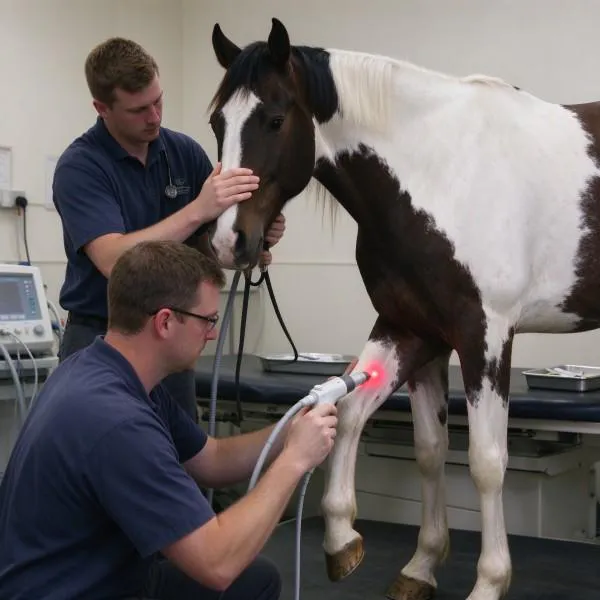
Advanced duty cycle gating prevents thermal accumulation. By breaking continuous optical emission into microsecond square-wave pulses—maintaining duty cycles between 25% and 45% at repetition frequencies ranging from 400 Hz to 5,000 Hz—the emission provides bursts of peak energy followed by an off-period that honors the thermal relaxation time of the tissue. Peak power drives photons through the gluteal muscle layers, while the off-phase allows thermal energy to dissipate into the microvascular circulation. Clinicians investing in a dedicated laser horse system must ensure that pulse switching circuits deliver crisp square waves without power drift, ensuring deep photon penetration while maintaining a cool, soothing touch on the equine patient’s skin.
Sacroiliac Joint Desmitis and Osteoarthritis Clinical Case Record
The following multi-phase clinical rehabilitation protocol was conducted at the Elite Equine Spinal Rehabilitation Facility, evaluating a premier jumping mount through structural restoration and competition re-entry.
Case Identifier: EQ-SPINE-2026-0785
Subject: 10-year-old Holsteiner Gelding, Show Jumping (1.50m Grand Prix)
Clinical Diagnosis: Chronic Bilateral Sacroiliac Joint Dysfunction (Right worse than Left), Grade 3 Sacroiliac Desmitis with periarticular enthesopathy, marked gluteal muscle atrophy, and secondary thoracolumbar fascial hypertonicity
Baseline Metrics: Lameness Grade 3/5 on a right-lead canter circle; asymmetrical pelvis with the right tuber sacrale elevated 1.5 cm; severe pain response on deep palpation of the sacroiliac ligament margin; nuclear scintigraphy showed intense localized radiopharmaceutical uptake across the right sacroiliac joint
| مرحلة العلاج | الجدول الزمني | مزيج الطول الموجي | طاقة الخرج (واط) | التردد (هرتز) | دورة العمل | التوهج (جول/سم²) | Total Energy per Side |
| Phase 1: Sessions 1-4 | Day 1 to Day 8 | 980nm 65% / 1470nm 35% | 20 واط (قيمة قصوى) | 500 هرتز | 25% | 8.5 جول/سم² | 5,100 Joules |
| Phase 2: Sessions 5-9 | Day 11 to Day 22 | 980 نانومتر 50% / 1470 نانومتر 50% | 25 W Peak | 1,500 هرتز | 35% | 12,0 جول/سم² | 7,200 جول |
| Phase 3: Sessions 10-15 | Day 26 to Day 40 | 980nm 35% / 1470nm 65% | 30 W Peak | 3,500 هرتز | 45% | 15.5 J/cm² | 9,300 Joules |
| Phase 4: Sessions 16-20 | Day 45 to Day 60 | 980 نانومتر 50% / 1470 نانومتر 50% | 22 واط في الذروة | 300 هرتز | 30% | 9,0 جول/سم² | 5,400 جول |
By session 5, palpation over the dorsal sacroiliac ligaments elicited zero defensive kicking or dipping. Re-evaluation under saddle on day 35 revealed clean, fluid right-lead canter strike-offs without head-tossing or tail-swishing. Follow-up nuclear scintigraphy at day 60 demonstrated a 75% reduction in radiopharmaceutical bone phase uptake across the right sacroiliac joint margins. The horse resumed jumping courses at 1.30m on day 75 and returned to Grand Prix competition within four months without any analgesic support.
Photobiomodulation Outclasses Corticosteroid Injections and Muscle Relaxants
Standard medical interventions for sacroiliac disease fail because they provide temporary sensory relief without regenerating damaged connective tissues. Injecting potent corticosteroids deep into the sacroiliac space shuts down osteoblast activity and weakens dense ligamentous fibers, accelerating degenerative joint disease and increasing the risk of long-term pelvic instability. Blind needle placement under field conditions frequently misses the tight joint margin, depositing steroids into surrounding musculature and causing local tissue wasting. Muscle relaxants and long-term NSAIDs provide temporary symptomatic masking while introducing risks of gastric ulcers, renal papillary necrosis, and uncoordinated gait patterns that endanger horse and rider over fences.
Transitioning to high-intensity Class IV photon therapy offers a non-invasive, structural alternative. Coherent light energy penetrates the deepest pelvic structures, activating mitochondrial energy production and triggering the synthesis of healthy, organized Type I collagen within damaged ligaments. Free from the systemic risks of chemical pharmaceuticals and the trauma of repeated needle punctures, the horse experiences genuine tissue regeneration, restored joint mobility, and lasting relief from pelvic pain. Performance riders, trainers, and veterinarians gain a sustainable rehabilitation method that maintains athletic impulsion, protects the equine musculoskeletal system, and secures a reliable career on the show circuit.