 فوتون ميديكس












Overcoming Deep Sacroiliac Instability in Equine Athletes
Quad-wavelength Class IV photon deposition reaches deep axial sacroiliac ligaments, downregulates pro-inflammatory cytokines, and manages periosteal bone interface heat accumulation through microsecond duty cycle regulation.
An 8-year-old Irish Sport Horse gelding enters the lameness exam circle with a history of refusing jumps, trailing the hindquarters during canter transitions, and demonstrating marked asymmetry across the tuber sacrale. Digital palpation over the cranial gluteal region triggers bilateral muscle clamping, lumbar lordosis, and defensive kicking. Nuclear scintigraphy and percutaneous transgluteal ultrasound confirm chronic bilateral desmopathy of the dorsal sacroiliac ligament accompanied by marked subchondral sclerosis at the sacroiliac joint margin. Over the previous four months, the horse underwent ultrasound-guided peri-articular corticosteroid infiltration, mesotherapy along the thoracolumbar chain, and extensive core rehabilitation. The pain response diminished temporarily, but resumed forcefully the moment collection work restarted, leaving the trainer frustrated by poor performance and the owner anxious over career-ending lameness.
Chronic sacroiliac joint dysfunction presents one of the most demanding anatomical hurdles in equine sports medicine. The sacroiliac joint complex sits deep beneath thirty to forty millimeters of thick gluteal musculature, dense thoracolumbar fascia, and overlying cranial pelvic bone architecture. Low-output therapeutic gear fails here because the physics of tissue transmission work against it: uncalibrated low-power beams scatter, reflect, and degrade into superficial skin warmth long before reaching the deep sacroiliac joint capsule. Resolving chronic pelvic dysfunction requires deploying the safest class of veterinary laser therapy equipment, combining balanced multi-wavelength penetration with real-time thermal duty cycle management to deliver high therapeutic photon density without burning the skin.
Tissue Attenuation Dynamics and Spectral Absorption in Deep Pelvic Structures
Photons traveling toward the equine sacroiliac joint encounter massive optical barriers. The dense hair coat, dark skin pigmentation, thick fascial sheaths, and massive gluteus medius muscle containing dense concentrations of light-absorbing myoglobin quickly disperse uncollimated beams. Under standard biological tissue attenuation curves, low-intensity single-wavelength light loses more than eighty-eight percent of its power within the first twelve millimeters of tissue depth, leaving deep pelvic ligaments completely untreated.
Reaching therapeutic thresholds within deep sacroiliac ligaments requires coordinated multi-wavelength energy delivery across distinct biological absorption windows:
- رنين الهيموجلوبين عند 980 نانومتر وإعادة فتح الأوعية الدموية الدقيقة: Chronic sacroiliac strain induces severe microcirculatory ischemia and venous stasis across the lumbosacral junction. Light at 980 nm aligns with the optical absorption peak of oxygenated and deoxygenated hemoglobin. This triggers gentle, non-ablative photothermal expansion within spastic microcapillaries, re-establishing collateral blood flow, clearing trapped inflammatory byproducts, and restoring local tissue oxygenation without causing surface tissue damage.
- 1064 nm Deep Fibrocartilage Penetration: Exhibiting low scattering coefficients and minimal absorption across water and melanin, the 1064 nm wavelength travels straight through dense muscle bellies and thick pelvic fascia. It deposits photon energy directly into deep sacroiliac ligaments and fibrocartilaginous joint surfaces, stimulating mitochondrial cytochrome c oxidase activity and cellular adenosine triphosphate production in damaged desmocytes.
- 1470 nm Interstitial Fluid Mobilization: Degenerative sacroiliac disease produces chronic peri-ligamentous edema that increases pressure on local dorsal nerve roots. Light at 1470 nm exhibits strong affinity for water molecules, mobilizing stagnant interstitial fluid pockets and rapidly reducing tissue tension without invasive needle fenestration.
Understanding these multi-wavelength mechanics highlights the tangible veterinary practices laser therapy equipment benefits in performance horse medicine. Rather than spending forty minutes holding an underpowered device that only warms the rump, clinicians can sweep high-density photon energy across both sacroiliac zones in ten minutes, delivering deep structural repair during regular stable calls.
Preventing Periosteal Hotspots with Microsecond Duty Cycle Modulation
Delivering high-power Class IV photomedicine across the equine pelvic girdle presents a direct thermal challenge: the tuber sacrale and dorsal iliac crest lie close to the skin surface, surrounded by dense muscular layers. Applying unpulsed, continuous-wave high-power light over these bony landmarks risks overheating the periosteum, causing sudden pain, kicking reflexes, and patient distress.
This physical challenge explains why veterinary clinics hesitation laser therapy devices persists among sport-horse veterinarians. Practitioners worry that high-wattage equipment will heat sensitive bony margins, agitate high-strung competition horses, or cause skin burns beneath dense hair coats.
Microsecond duty cycle regulation eliminates this risk by dividing continuous light emission into controlled micro-bursts separated by thermal relaxation intervals:
Continuous Wave: [================ Cumulative Thermal Buildup ================] -> Periosteal Hotspot Risk
Pulsed 50% Duty: [== Pulse ON ==] [ Thermal Relaxation ] [== Pulse ON ==]      -> Deep Ligament Saturation
During the active pulse phase, high peak power drives photons deep through overlying gluteal muscles into the sacroiliac joint. During the dark phase, local microcapillary blood flow in the skin and subcutaneous tissue dissipates surface heat. Because deep pelvic ligaments retain photonic stimulation while surface tissues cool rapidly, the injured joint capsule receives therapeutic photon density while adjacent periosteal surfaces remain safe and cool.
This reliable thermal control ensures equine practitioners can deliver high-energy treatments without patient restraint issues, turning a previously stressful therapy into a calm, cooperative stable routine.
Clinical Protocol and Objective Biomechanical Gait Outcomes
According to connective tissue photobiomodulation frameworks documented by Dyson and corroborated in equine orthopedic trials published in the Equine Veterinary Journal, coherent near-infrared light downregulates pro-inflammatory cytokines such as tumor necrosis factor-alpha and interleukin-1 beta, while enhancing endogenous opioid peptide release and stimulating collagen fibrillogenesis.
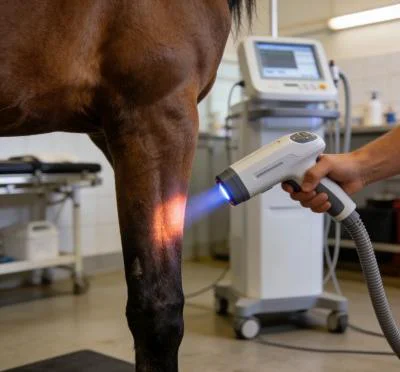
The following clinical case details this multi-wavelength protocol in an elite competition horse suffering from chronic, non-responsive sacroiliac joint dysfunction.
Case Record: Equine Chronic Bilateral Sacroiliac Desmopathy
- رقم القضية: EQUINE-2026-SPORTS-0648
- الملف الشخصي للمريض: 8-year-old Irish Sport Horse gelding, eventing competitor
- كتلة الجسم: 560 كجم
- التشخيص: Chronic bilateral dorsal sacroiliac ligament desmopathy, secondary sacroiliac joint osteoarthritis, marked gluteal muscle hypertonicity and asymmetry; Grade 3 hindlimb lameness on the AAEP scale, bilateral stiffness during canter strike-offs, and painful lumbar extension during physical examination
- العلاج المحافظ السابق: Ultrasound-guided peri-articular corticosteroid injections (two occasions), systemic phenylbutazone at 2.2 mg/kg orally every 12 hours for ten days, and targeted core exercises; temporary pain relief followed by complete relapse of lameness and bucking behavior upon re-entering training
معايير بروتوكول العلاج الشامل
| رقم الجلسة | Phase of Joint Rehabilitation | طاقة الخرج (واط) | وضع التشغيل ودورة العمل | التوزيع الطيفي المستهدف | التردد (هرتز) | إجمالي الطاقة (جول) | التوهج (جول/سم²) |
| 01 | Acute Nociceptive Dampening | 12.0 واط | نبضي (دورة تشغيل 35%) | أقصى طول موجي 980 نانومتر / تركيز شعري | 3,000 هرتز | 3,600 J | 9,0 جول/سم² |
| 02 | Interstitial Edema Clearance | 15.0 واط | نبضي (دورة تشغيل 40%) | أقصى طول موجي 1470 نانومتر / تركيز على الماء | 2,000 هرتز | 4,800 جول | 12,0 جول/سم² |
| 03 | Gluteal Myofascial Release | 18.0 واط | نبضي (دورة تشغيل 45%) | مزيج متوازن من 980 نانومتر / 1064 نانومتر | 1,000 هرتز | 6,000 J | 15,0 جول/سم² |
| 04 | Desmocyte Energy Saturation | 22.0 واط | فائقة النبض (دورة تشغيل 50%) | الامتصاص السائد (1064 نانومتر) | 500 هرتز | 7,200 J | 18,0 جول/سم² |
| 05 | Extracellular Matrix Synthesis | 25.0 واط | نابض (دورة العمل 50%) | Multi-spectral balanced array | 200 هرتز | 8,000 J | 20,0 جول/سم² |
| 06 | Collagen Realignment Induction | 25.0 واط | نابض (دورة العمل 50%) | Deep Structural Remodeling Mix | 100 هرتز | 8,000 J | 20,0 جول/سم² |
| 07 | Functional Kinetic Mobilization | 22.0 واط | المسح الديناميكي المستمر | Broad Spectrum Regenerative Mix | CW / ديناميكي | 7,000 J | 17.5 J/cm² |
| 08 | Biomechanical Stabilization | 18.0 واط | نبضي (دورة تشغيل 40%) | ملف الصيانة المتوازن | 30 هرتز | 5,500 ج | 13.7 J/cm² |
Pelvic Symmetry and Lameness Recovery Trajectory
AAEP Lameness Grade (0 to 5 Scale):
Pre-Treatment: [==============================] Grade 3
Session 03:    [====================] Grade 2
Session 06:    [==========] Grade 1
Session 08:    [] Grade 0 (Sound under saddle)

Pelvic Tuber Sacrale Height Asymmetry (mm on kinematic sensor):
Pre-Treatment: [==============================] 18 mm
Session 03:    [==================] 11 mm
Session 06:    [========] 5 mm
Session 08:    [=] 1 mm (Normal symmetrical pelvic motion)
By the third session, the horse tolerated firm downward pressure on the tuber sacrale without arching or kicking, standing quietly in the treatment stall. Kinematic analysis at session six revealed a reduction in pelvic movement asymmetry from eighteen millimeters down to five millimeters, with free forward canter transitions on both reins. At the end of eight treatments over four weeks, the horse demonstrated sound movement across all gaits, gluteal muscle hypertonicity resolved completely, and ridden training resumed without further joint injections.
Practical Advantages Over Repeated Joint Injections
Managing chronic sacroiliac injuries in sport horses often traps trainers and veterinarians in frustrating cycles. Corticosteroid injections provide rapid pain relief, but repeated administration risks cartilage thinning, subchondral bone weakening, and secondary joint degeneration. Long-term non-steroidal anti-inflammatory drugs simply mask symptoms while creating gastric ulcers and renal stress, leaving underlying hypovascular ligament damage unaddressed.
Implementing high-power Class IV photomedicine offers clear clinical and operational benefits:
1. Direct Non-Invasive Stimulation of Deep Connective Tissue
Rather than masking pain chemically, multi-wavelength light addresses the root mechanical and cellular issues: resolving microvascular stasis, clearing trapped edema, and stimulating collagen realignment within the deep sacroiliac ligaments.
2. High Procedural Efficiency for Equine Ambulatory Calls
Ambulatory practitioners working on tight farm-call schedules cannot afford to spend forty minutes holding an underpowered probe against a restless horse. A high-output platform delivers complete, deep therapeutic doses in eight to ten minutes of continuous sweeping application, allowing clinicians to maintain tight mobile schedules while providing high-standard care.
3. Clear Functional Recovery That Reassures Owners and Trainers
Equine trainers and owners closely track hindlimb engagement, back flexibility, and jumping willingness. Achieving tangible reductions in palpation soreness and visible improvements in gait symmetry within the first three treatments gives clients confidence in the recovery plan, improving compliance with controlled exercise schedules.
High-power Class IV photomedicine provides a reliable, high-throughput solution for chronic, performance-limiting pelvic conditions in sport horses. By projecting targeted multi-wavelength photon energy past dense anatomical barriers directly into deep connective tissue lesions, equine practitioners can resolve chronic lameness, accelerate return to competition, and keep equine athletes performing at their best.