 فوتون ميديكس













Reaching 15cm Deep Hip Capsules Without Overheating Skin
Five-wavelength synchronization bypasses dense gluteal adipose layers, 30W peak output saturates deep intra-articular synovium, and pulsed duty-cycle gating eliminates superficial thermal burns.
Step into any high-volume orthopedic sports clinic on a Thursday afternoon, and you will watch a frustrated physical therapist wrestling with an anatomical wall. A fifty-four-year-old marathon runner sits grimacing on the treatment table with deep anterior groin pain and a stiff, restricted hip capsule caused by advanced labral degeneration and iliopsoas tendinopathy. Unlike a superficial wrist tendon or an ankle ligament sitting millimeters beneath the skin, the human hip joint lies buried beneath thick layers of gluteal musculature, dense fascia lata, and subcutaneous adipose tissue. Conventional low-power units barely warm the dermal surface before scattering completely, while cranking up continuous power on a single-wavelength unit scorches the epidermis long before therapeutic photons ever touch the acetabular rim. This stubborn anatomical standoff—delivering enough photonic energy to reach ten to fifteen centimeters deep without burning the patient’s skin—is the exact clinical bottleneck that forces too many active adults toward premature joint injections or hip arthroscopy.
When rehabilitation clinics upgrade to a high-intensity Class 4 آلة العلاج بالليزر, that depth barrier stops dictating treatment outcomes. Rather than settling for superficial heat packs or systemic anti-inflammatory pills that dull pain receptors while leaving deep intra-articular hypoxia untouched, high-power photobiomodulation drives concentrated light energy directly through dense gluteal and femoral muscle bellies. Selecting the أفضل جهاز علاج بالليزر for deep joint pathology means prioritizing multi-wavelength synchronization and peak penetration depth maintaining technology—capabilities engineered directly into the LaserMedix-Max 30W platform to saturate deep hip structures in under nine minutes without triggering epidermal pain receptors.
How Sub-Dermal Photon Attenuation Blocks Conventional Devices
To understand why standard therapy units fail in deep pelvic and hip conditions, clinicians must examine what happens to light energy as it traverses thick human tissue layers. Biological tissue acts as an optically turbid barrier filled with competing chromophores. Melanin in the epidermis, hemoglobin circulating through dense gluteal capillary beds, and interstitial water molecules continuously scatter and absorb incoming photons. Following the exponential decay curve described by the Beer-Lambert law in biological media, a low-power Class 3B unit emitting half a watt loses more than ninety-five percent of its energy within the first two centimeters of skin and fat.
Overcoming this exponential drop-off requires matching the emission spectrum to the optical transmission window of human tissue while deploying sufficient surface irradiance to push an active photon flux down to fifteen centimeters. A five-wavelength Class 4 configuration (combining 650nm, 810nm, 915nm, 940nm, and 980nm) divides the workload across distinct anatomical depths and cellular photoacceptors:
- 650nm (Superficial Micro-Vascular Priming): Absorbed within the upper dermal layers by melanin and superficial fibroblasts, stimulating localized micro-circulation and epidermal tissue turnover without wasting energy on deep transmission.
- 810nm (Mitochondrial Cytochrome C Oxidase Resonance): Sits directly on the peak absorption band of cytochrome c oxidase inside damaged chondrocytes, tenocytes, and deep peri-articular nerve endings. Photons at 810nm displace inhibitory nitric oxide from the respiratory chain, accelerating adenosine triphosphate (ATP) synthesis and driving cellular repair inside hypoxic joint capsules.
- 915nm and 940nm (Adipose Bypass and Hemoglobin Oxygen Unloading): Positioned beyond the steepest melanin and hemoglobin absorption cliffs, these wavelengths traverse subcutaneous adipose layers with minimal scattering while promoting oxygen dissociation from oxyhemoglobin into ischemic hip musculature.
- 980nm (Water Affinity and Deep Lymphatic Drainage): Exhibits targeted absorption by interstitial water molecules, creating controlled micro-thermal gradients that lower synovial fluid viscosity, accelerate lymphatic clearance of pro-inflammatory cytokines, and desensitize nociceptive C-fibers.
Clinical investigations published in الطب الضوئي والجراحة بالليزر by Bjordal and colleagues confirmed that deep joint and tendinous structures require a strict minimum energy density at the target depth to trigger anti-inflammatory prostaglandin E2 suppression. If surface wattage is too low or scattered by single-wavelength hemoglobin trapping, the deep acetabular labrum receives sub-threshold stimulation—explaining why low-wattage treatments frequently produce zero functional improvement in hip osteoarthritis or deep gluteal syndrome.
Regulating Epidermal Heat via Duty Cycle and Scanning Geometry
Delivering thirty watts of optical power over the lateral hip or groin requires strict thermal management. Holding a continuous 30W beam stationary over pigmented skin or dense subcutaneous fat will rapidly push epidermal temperatures past the forty-three-degree Celsius nociceptive threshold, causing immediate patient discomfort. Experienced practitioners eliminate this risk not by dialing down the power—which would collapse penetration depth—but by modulating pulse frequency, duty cycle, and handpiece contact compression.
خلال دراسة سريرية العلاج بالليزر للأنسجة العميقة بالليزر, alternating between super-pulsed, pulsed, and continuous wave scanning modes allows peak power bursts to reach fifteen centimeters deep while granting superficial skin layers millisecond thermal relaxation windows.
| وضع الانبعاثات | Output Power Range | دورة التشغيل والديناميكيات الحرارية | الآلية الفسيولوجية الأساسية | Target Anatomical Depth |
| وضع النبضات الفائقة | 30W peak bursts | Low average heat (25%–35% duty) | High peak photon momentum without epidermal heat accumulation | Deep hip capsules (10–15 cm), acute bursitis, compressed sciatic roots |
| الوضع النبضي | 18W – 26W | تشغيل وإيقاف متوازن (نسبة تشغيل 50٪) | Potent analgesia, prostaglandin suppression, and synovial edema drainage | Iliopsoas tendon insertion, gluteus medius tendinopathy, sub-acute joint synovitis |
| الموجة المستمرة (CW) | 15 واط – 30 واط | Steady output (100% duty with brisk scanning) | Deep myofascial relaxation and sustained microcirculatory vasodilation | Hypertonic gluteus maximus, piriformis, tensor fasciae latae |
Integrating a convex massage-ball optical handpiece adds a critical physical advantage. Pressing the quartz lens firmly into the lateral hip and femoral triangle compresses the superficial adipose layer by up to two centimeters and blanches dermal capillaries. Removing competing blood volume directly beneath the lens reduces superficial hemoglobin absorption and increases deep photon delivery to the hip joint capsule by nearly thirty percent, while therapeutic temperature indication sensors monitor skin warmth in real time.
Clinical Case Study: Moderate Hip Osteoarthritis with Iliopsoas Tendinopathy
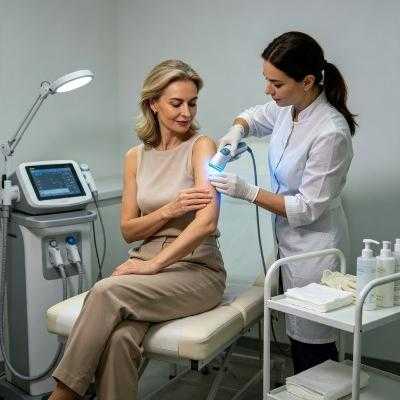
To demonstrate how multi-wavelength Class 4 dosimetry restores joint mobility and eliminates deep groin pain without intra-articular corticosteroid injections, review the documented clinical record of an endurance athlete treated in an outpatient sports rehabilitation center using the LaserMedix-Max protocol.
Patient Presentation and Baseline Assessment
- رقم مرجع القضية: ORTHO-HIP-2026-0917-OA
- التركيبة السكانية للمرضى: 54-year-old female, amateur marathon runner and corporate architect
- التشخيص: Radiographically confirmed Kellgren-Lawrence Grade II right hip osteoarthritis with anterior labral fraying and secondary iliopsoas tendinopathy confirmed via diagnostic musculoskeletal ultrasound
- التصنيف المرضي: Harris Hip Score (HHS) baseline at 52/100 (Poor functional status); Visual Analog Scale (VAS) weight-bearing groin pain at 8.0/10; FABER (Flexion, Abduction, External Rotation) test strongly positive with internal rotation restricted to 12 degrees
- التدخلات السابقة: Six weeks of oral meloxicam (15mg/day), home stretching, and conventional therapeutic ultrasound with minimal reduction in nocturnal hip aching and persistent inability to run beyond 500 meters
جدول قياس الجرعات المرحلية والتعافي الوظيفي
Because the hip joint requires high cumulative joules distributed across anterior, lateral, and posterior anatomical portals, the clinician structured a ten-session protocol over four weeks, progressively shifting from high-frequency Super-Pulsed analgesia to high-fluence continuous scanning for cartilage and tendon remodeling.
| رقم الجلسة | مرحلة العلاج | تكوين نسبة الطول الموجي | طاقة الخرج (واط) | تردد النبض (هرتز) | دورة التشغيل / الوضع | إجمالي الطاقة المُزودة (جول) | مدة الجلسة | Clinical & Biomechanical Outcomes |
| الجلسة 1 | Deep Capsular Analgesia | 810 نانومتر (30٪) + 915 نانومتر (25٪) + 940 نانومتر (20٪) + 980 نانومتر (25٪) | 20W | 5000 هرتز | النبض الفائق (نسبة تشغيل 30٪) | 6,000 J | 10 دقائق | Immediate post-session VAS groin pain dropped from 8.0 to 5.5/10; patient reported noticeably smoother stride walking out of clinic. |
| الجلسة 2 | Deep Capsular Analgesia | 810 نانومتر (30٪) + 915 نانومتر (25٪) + 940 نانومتر (20٪) + 980 نانومتر (25٪) | 22 واط | 4000 Hz | Super-Pulse (35% Duty) | 6,600 جول | 10 دقائق | Nocturnal lateral hip throbbing resolved; patient slept six consecutive hours without waking to reposition. |
| الجلسة 4 | Synovial Edema & Tendon Relief | 650 نانومتر (5٪) + 810 نانومتر (35٪) + 915 نانومتر (25٪) + 940 نانومتر (15٪) + 980 نانومتر (20٪) | 25W | 1500 Hz | Pulsed (50% Duty) | 7,500 J | 10 دقائق | Hip internal rotation improved from 12 degrees to 22 degrees; patient discontinued oral meloxicam completely. |
| الجلسة 6 | Myofascial Release & ATP Priming | 650nm (5%) + 810nm (40%) + 915nm (20%) + 940nm (15%) + 980nm (20%) | 28 واط | 800 هرتز | Pulsed (60% Duty) | 8,400 جول | 10 دقائق | Ultrasound follow-up showed marked reduction in iliopsoas peritendinous effusion; VAS pain down to 2.5/10 during stairs. |
| الجلسة 8 | Collagen & Chondrocyte Remodeling | 650nm (10%) + 810nm (40%) + 915nm (25%) + 940nm (15%) + 980nm (10%) | 30W | CW / 250 Hz Hybrid | دورة تشغيل بنسبة 75% | 9,000 J | 10 دقائق | Completed a pain-free 3-kilometer test jog on flat track; hip internal rotation reached 28 degrees. |
| الجلسة 10 | الدمج الوظيفي | 650nm (10%) + 810nm (40%) + 915nm (25%) + 940nm (15%) + 980nm (10%) | 30W | CW (المسح المستمر) | مسح بنسبة 100٪ باستخدام الموجة المستمرة (CW) | 9,600 جول | 10 دقائق | Harris Hip Score surged from 52/100 to 89/100; VAS pain at 0.5/10; cleared for progressive half-marathon training at Week 6. |
Three-Portal Anatomical Delivery Technique
To ensure complete saturation of the acetabular joint space without missing deep posterior structures, the clinician divided each ten-minute session across three distinct anatomical portals. Forty percent of the energy was delivered anteriorly over the femoral triangle lateral to the femoral artery pulse with the hip slightly externally rotated to expose the anterior capsule and iliopsoas tendon. Thirty-five percent was applied laterally over the greater trochanter and gluteus medius insertion using firm contact compression, and the final twenty-five percent was scanned across the posterior piriformis and quadratus femoris musculature to eliminate secondary pelvic guarding.
Extending Wavelength Precision Across Surgical and Veterinary Fields
The exact optical principles governing deep human joint penetration also anchor clinical breakthroughs across minimally invasive surgery and animal rehabilitation. In surgical suites where thermal precision protects delicate nerves and mucosal walls, dual-wavelength systems combining 1470nm and 980nm—such as the SurgMedix-Max—exploit the massive absorption peak of 1470nm in intracellular water. Because 1470nm is absorbed forty times more intensely by water than 980nm, surgeons performing endovenous saphenous ablation or proctological tract closure achieve instant, bloodless tissue contraction at low wattage with less than one millimeter of lateral heat spread.
In veterinary medicine, penetrating thick fur coats and dense equine muscle groups requires high peak wattage paired with intelligent thermal gating. Companion animal hospitals deploy the 38-watt VetMedix-Max to resolve canine hip dysplasia, cruciate ligament tears, and feline chronic gingivostomatitis without shaving dark coats or risking superficial singeing. Similarly, equine sports medicine specialists rely on the battery-powered Theralux-Max 38W platform to treat deep sacroiliac strain, suspensory desmitis, and dorsal spinous process impingement right at the barn, accelerating recovery without prohibited medications. Across human clinics, operating rooms, and veterinary facilities, matching wavelength physics to target tissue depth delivers predictable, repeatable clinical outcomes.
Why High-Intensity Class 4 Lasers Outperform Traditional Hip Therapies
For rehabilitation clinic owners, orthopedic medical directors, and equipment distributors evaluating capital purchases, comparing a thirty-watt multi-wavelength آلة العلاج بالليزر against conventional hip pain modalities highlights decisive clinical and operational advantages.
| بُعد التقييم | High-Intensity Class 4 Laser (30W Multi-Wavelength) | Conventional Class 3B Low-Level Laser (less than 0.5W) | Therapeutic Ultrasound (1MHz Acoustic) | Intra-Articular Corticosteroid & Hyaluronic Injections |
| Deep Hip Capsule Penetration | Reaches 10cm to 15cm into acetabular joint space via 30W peak output | Blocked at 1cm to 2cm by subcutaneous gluteal fat and fascia | Attenuates rapidly; reflects sharply off femoral neck bone surface | Direct needle entry into joint capsule under ultrasound or fluoroscopy |
| Time to Deliver 8,000 Joules | 4.5 to 9 minutes per session | Over 260 minutes (clinically impossible in outpatient care) | Cannot induce mitochondrial photochemical ATP synthesis | Single injection visit, but requires sterile prep and post-injection rest |
| Biological Impact on Joint Tissue | Stimulates chondrocyte ATP, collagen synthesis, and synovial drainage | Negligible photon density at hip depth; purely superficial effect | Temporary mechanical tissue warming without cellular regeneration | Steroids suppress inflammation temporarily but accelerate cartilage thinning |
| Complication & Side-Effect Profile | Zero systemic toxicity; epidermal warmth controlled via pulse gating | Safe, but high patient dropout due to lack of deep pain relief | Risk of painful periosteal overheating over greater trochanter | Risk of septic joint infection, steroid flare, and tendon weakening |
| Clinic Economics & Throughput | High-value cash-pay packages; 5 to 6 patients treated per hour | Low clinical retention; tied up treatment rooms for minimal reimbursement | Low insurance reimbursement; high therapist wrist fatigue | High procedural overhead; limited to physician-only administration |
Conventional ultrasound bounces off the bony contours of the greater trochanter and femoral neck, frequently causing uncomfortable periosteal aching while failing to stimulate cellular repair inside the joint capsule. Low-level Class 3B devices lack the raw photon density required to cross thick gluteal layers within a standard appointment slot. Meanwhile, repeated intra-articular corticosteroid injections mask joint pain temporarily while accelerating articular cartilage breakdown—leaving active patients worse off twelve months later.
الاستثمار في أفضل جهاز علاج بالليزر equipped with synchronized multi-wavelength output and intelligent duty-cycle control empowers clinics to resolve deep musculoskeletal pathology non-invasively. Patients experience rapid mobility gains and lasting relief without surgery or daily pharmaceuticals, while rehabilitation practices build a scalable, high-retention clinical service line.