 فوتون ميديكس




علاج اعتلال اللفافة الأخمصية المستعصي لدى العدائين النخبة في سباقات المسافات الطويلة
High peak power overcomes plantar aponeurotic scatter, calibrated water and hemoglobin absorption bands clear calcaneal marrow edema, and microsecond duty cycle modulation protects thin heel pads from thermal damage.
The training room of an elite marathon program routinely encounters a debilitating clinical barrier. A distance runner limps in at dawn, wincing as their calcaneus strikes the floor during the first post-waking steps. Palpation over the medial calcaneal tubercle triggers sharp, localized guarding. Diagnostic sonography demonstrates marked fascial thickening exceeding 6.5 millimeters alongside localized hypoechogenicity and calcaneal enthesopathy. Conservative management has hit a standstill: custom orthotics, night splints, manual plantar release, and iontophoresis offer brief symptomatic cushioning, yet the patient cannot endure transition into high-tempo training blocks. Superficial modalities, including low-level therapeutic arrays and ultrasound, waste their acoustic and optical energy in the dense plantar skin and calcaneal fat pad. Overcoming deep collagenous resistance and microvascular stasis within the degenerative fascial enthesis requires driving sufficient photon flux through the tough plantar architecture to trigger metabolic repair at the bone-fascia junction.
Plantar Tissue Optical Barriers and Near-Infrared Attenuation Gradients
Delivering photon flux into the proximal origin of the plantar fascia presents one of the most demanding physical challenges in sports podiatry. The target tissue—the degenerative enthesis of the central plantar aponeurotic band at the anteromedial calcaneus—lies beneath unique biological layers. In high-mileage road racers, incident photons must traverse a hyperkeratotic epidermis, dense dermis, and the specialized fibroelastic calcaneal fat pad, which ranges from 15 to 25 millimeters in thickness.
The calcaneal fat pad is composed of closed hydraulic micro-chambers separated by tough spiraling internal fibrous septa. This anatomical arrangement serves as an exceptional optical diffuser. Photons passing through these alternating lipid-water-collagen boundaries undergo extreme Mie scattering. Forward collimation degrades rapidly into an isotropic scattering field, resulting in an exponential loss of forward irradiance. Underpowered therapeutic devices operating below 1 Watt of continuous output dissipate within the superficial adipose lobules. High-intensity Class 4 therapeutic laser machines generate the incident irradiance required to saturate superficial optical scattering centers and deliver meaningful photon density to the deep enthesis.
Heel Strike Tissue Strata and Photonic Extinction Curves:
[Hyperkeratotic Epidermis]  ===> Incident High-Density Flux (100% Incident Irradiance)
              |
[Fibroelastic Fat Pad]      ---> Strong Mie Scattering across Hydraulic Chambers (40% Attenuation)
              |
[Dense Plantar Aponeurosis] ---> Extreme Collagen Fibril Scatter & Fiber Reflection (45% Attenuation)
              |
[Calcaneal Enthesis & Bone] ---> Forward Residual Effective Photonic Dose (Target: 6-10 J/cm2)
Selecting appropriate wavelengths dictates energy distribution across target chromophores. In chronic plantar fasciopathy, water, hemoglobin, and mitochondrial enzymes act as the primary biological absorbers:
- 1470nm Hydro-Targeted Fluid Clearance: Degenerative enthesopathy frequently presents with perifascial fluid collections and localized subcalcaneal bursitis. The 1470nm wavelength interacts directly with free water molecules. Its high water absorption profile allows targeted heating and mobilization of trapped interstitial edema, decompressing the calcaneal fat pad and relieving tension on irritated branches of the lateral plantar nerve.
- رنين الهيموجلوبين عند 980 نانومتر: The proximal plantar fascia is notoriously avascular, relying on marginal perfusion from the medial plantar artery. The 980nm band matches the optical absorption curve of hemoglobin, promoting localized photothermal vasodilation, stimulating nitric oxide release, and enhancing microvascular circulation to wash away inflammatory byproducts.
- 810nm Mitochondrial Activation: Matching the peak absorption band of Cytochrome c oxidase, this wavelength stimulates the mitochondrial respiratory chain to accelerate cellular adenosine triphosphate synthesis.
Irradiating the heel pad requires careful thermal management. The tight fibrous septa of the calcaneal pad trap heat easily, and if cutaneous temperatures climb above 42 degrees Celsius, thermal nociceptors activate and patient tolerance drops.
Pulsed Temporal Emission Dynamics:
Laser Emission (Pulse ON) : |=========== High Irradiance Pulse Window ===========|
                            [------- Active Pulse Duration (t_on) --------]
Tissue Cooling (Pulse OFF): [ . . . . Cutaneous Thermal Relaxation (t_off) . . . . ]
                            Net Outcome: Deep enthesis saturation with zero epidermal burns
Microsecond duty cycle gating provides the necessary safety margin. By pulsing emissions from 100Hz to 12,000Hz, the system delivers high peak power to penetrate the fibrous aponeurosis while incorporating rest intervals matching the thermal relaxation time of the skin. Cutaneous microcirculation dissipates heat during the off window, protecting the skin while photons penetrate to the injured enthesis.
Mitochondrial Bioenergetics and Plantar Fascial Matrix Regeneration
Applying advanced laser therapy for athletes treats the cellular pathology of fasciopathy rather than merely numbing local pain. Histological models by Lemont and colleagues demonstrate that chronic plantar heel pain is not an active inflammatory condition, but rather a degenerative fasciosis marked by fibroblastic hypercellularity, mucoid ground substance accumulation, and collagen fiber disorientation.
Under repetitive micro-tearing and chronic mechanical tensile loading, local fibroblasts and chondroblasts suffer metabolic exhaustion. Mitochondrial membrane potentials drop, leading to decreased intracellular adenosine triphosphate synthesis. Lacking energy, local fibroblasts fail to maintain the surrounding extracellular matrix, producing fragile type III collagen that cannot tolerate mechanical stress during heel strike and push-off.
Near-infrared photons directly target the primary mitochondrial photoacceptor, Cytochrome c oxidase (Complex IV). Under ischemic conditions caused by microvascular compression, nitric oxide binds to the enzyme’s catalytic sites, halting mitochondrial respiration. Irradiating this tissue dislodges nitric oxide through targeted photolysis, allowing oxygen to bind and restoring the proton gradient across the inner mitochondrial membrane.
Biological Progression of Fascial Photobiomodulation:
[Photonic Absorption]   --> Complex IV Photolysis of Inhibitory Nitric Oxide
         |
[Mitochondrial ATP]     --> Restores Fibroblast Extracellular Matrix Secretion
         |
[Procollagen Synthesis] --> Transitions Repair Matrix from Type III to Type I Collagen
         |
[Vascular Normalization]--> Downregulates Unmyelinated Sensory C-Fibers & Substance P
This reactivation triggers several therapeutic cascades:
- زيادة إنتاج البروكولاجين من النوع الأول: Restoring mitochondrial ATP production provides the energy required for local fibroblasts to transcribe type I collagen, replacing weak type III collagen with dense, parallel fibrils that withstand tensile loading.
- تنظيم إنزيمات الميتالوبروتيناز المصفوفية: Photonic stimulation balances the expression of matrix metalloproteinases and their tissue inhibitors, clearing disordered proteoglycans and realigning the aponeurotic matrix along functional biomechanical lines.
- نضوب وسطاء الألم المحليين: يؤدي تدفق الفوتونات عالي الكثافة إلى خفض مستوى التعبير الجيني للمادة «P» والببتيد المرتبط بجين الكالسيتونين داخل النهايات العصبية الحسية، مما يقلل من الألم الميكانيكي أثناء تحمل الوزن.
- Resolution of Subcalcaneal Edema: Selective photothermal absorption by water accelerates lymphatic drainage, decompressing the surrounding fat pad and easing pressure on the first branch of the lateral plantar nerve.
Through these combined pathways, targeted Class 4 laser therapy addresses the structural and metabolic factors that drive chronic plantar fasciopathy.
Clinical Stratification and Laser Therapy Indications in Sports Podiatry
Accurate clinical and sonographic assessment ensures energy is applied to correct tissue targets. Establishing a valid indication of laser therapy requires differentiating between degenerative fasciosis, structural tears, and neurological entrapments:
- Complete Fascial Ruptures and High-Grade Retraction: Complete architectural ruptures of the central aponeurotic band with structural retraction require immobilization, orthotic stabilization, or surgical evaluation. Photobiomodulation cannot bridge complete structural separations.
- Degenerative Plantar Fasciosis with Enthesopathy: The optimal indication for deep multi-wavelength intervention. Patients present with focal pain at the medial calcaneal tubercle, morning pain during the first few steps, and sonographic confirmation of fascial thickening beyond 4.5 millimeters.
- Baxter’s Nerve Entrapment (First Branch of the Lateral Plantar Nerve): Chronic heel pain often involves entrapment of the inferior calcaneal nerve beneath the abductor hallucis muscle, producing radiating, burning heel pain. High-intensity laser therapy softens surrounding fibrotic adhesions and reduces local perineural edema.
- Posterior Kinetic Chain Dysfunction: Treating the heel pad in isolation often leads to symptom relapse. Protocols must address tightness within the gastrocnemius, soleus, and Achilles tendon complex, which transfers excessive tensile stress into the plantar aponeurosis via the calcaneal paratenon.
Calculating the correct therapeutic dose requires accounting for tissue scatter and absorption. Because the thick plantar skin and fat pad attenuate up to 96 percent of surface photons, delivering an effective target dose of 6 to 9 Joules per square centimeter to an enthesis 20 millimeters deep requires surface-applied doses ranging from 100 to 140 Joules per square centimeter.
Detailed Clinical Case History: Sports Medicine Outpatient Center
The following case record illustrates the diagnostic baseline, energy delivery matrix, and recovery trajectory seen during structured high-intensity laser intervention.
الملف الشخصي للمريض والتشخيصات الأساسية
- رقم القضية الخاص بالقسم: FTM-POD-2026-5521
- عمر المريض: 29 years
- الجنس البيولوجي: ذكر
- الرياضة / الفعاليات: Elite Long-Distance Road Runner (Marathon PR: 2:18:42; weekly training volume: 140 to 160 km)
- الحالة الحالية: Severe, chronic right proximal plantar fasciopathy localized to the medial calcaneal insertion, preventing running training.
- مدة استمرار الأعراض: 24 weeks of persistent heel pain; unresponsive to custom rigid orthotics, nighttime dorsiflexion splints, six weeks of high-load eccentric heel raises, and a diagnostic lidocaine injection.
- الخط الأساسي الوظيفي:
- Visual Analog Scale for First Steps in the Morning: 8.5 / 10
- Visual Analog Scale during Normal Walking: 5.0 / 10
- Foot and Ankle Ability Measure (Sports Subscale): 34% (severe limitation)
- Active Ankle Dorsiflexion (Knee Extended): Restricted to 4 degrees (contralateral: 14 degrees) due to gastrocnemius tightness.
- الفحص باللمس: Severe, sharp focal tenderness over the medial process of the calcaneal tuberosity; palpable thickening of the central aponeurotic band.
- High-Resolution Diagnostic Musculoskeletal Ultrasound:
- Severe proximal plantar fascia thickening measuring 6.8mm in sagittal diameter at the calcaneal insertion (contralateral normal fascia: 3.2mm).
- Marked hypoechoic architecture with loss of normal fibrillar alignment at the deep bone-fascia junction.
- Power Doppler revealed focal neovascularization within the enthesis. Intramuscular edema noted adjacent to the abductor hallucis muscle belly. No full-thickness tears.
بروتوكول العلاج الموحد ومصفوفة الطاقة الحركية
The athlete completed 10 clinical sessions over a 3.5-week period (three sessions weekly during weeks 1 through 3, concluding with one session in week 4). Treatments were delivered using a multi-wavelength Class 4 clinical laser platform utilizing synchronized 810nm, 980nm, and 1470nm emissions, administered with an optical quartz contact handpiece with real-time epidermal thermal tracking.
| الأسبوع | الجلسة | نسبة الطول الموجي | الطاقة (واط) | التردد (هرتز) | دورة العمل | الطاقة (J) | المساحة (سم²) |
| الأسبوع الأول | S-01 | 810 نانومتر (60%) 980 (40%) | 10.0 واط، موجة مستمرة | مستمر | 100% | 4,000 J | 50 cm2 |
| الأسبوع الأول | S-02 | 810/980/1470 (5:3:2) | 12.0 واط P | 250 هرتز | 60% | 5,400 J | 50 cm2 |
| الأسبوع الأول | S-03 | 810/980/1470 (4:3:3) | 15.0 واط P | 500 هرتز | 50% | 6,300 جول | 60 سم² |
| الأسبوع الثاني | S-04 | 810/980/1470 (4:3:3) | 16.0 واط P | 1,000 هرتز | 50% | 6,720 ج | 60 سم² |
| الأسبوع الثاني | S-05 | 810/980/1470 (4:3:3) | 18.0 واط P | 2,500 هرتز | 45% | 7,290 ج | 70 cm2 |
| الأسبوع الثاني | S-06 | 810/980/1470 (3:3:4) | 20.0 واط P | 4,000 هرتز | 40% | 7,680 ج | 70 cm2 |
| الأسبوع الثالث | S-07 | 810/980/1470 (3:3:4) | 22.0 واط P | 6,000 هرتز | 40% | 8,448 ج | 80 سم² |
| الأسبوع الثالث | S-08 | 810/980/1470 (3:3:4) | 22.0 واط P | 6,000 هرتز | 40% | 8,448 ج | 80 سم² |
| الأسبوع الثالث | S-09 | 810/980/1470 (4:3:3) | 18.0 واط P | 2,000 هرتز | 50% | 7,560 جول | 80 سم² |
| الأسبوع الرابع | S-10 | 810/980 (50% : 50%) | 12.0 واط في الوضع المستمر (CW) | مستمر | 100% | 5,400 J | 50 cm2 |
التطور السريري التراكمي
| مرحلة التقييم | Morning Steps VAS | مقياس VAS أثناء المشي | FAAM Sports Score | سماكة اللفافة (بالسنتيمتر) | نشاط دوبلر الأوعية الدموية الجديدة |
| المعالجة المسبقة | 8.5 / 10 | 5.0 / 10 | 34% | 6.8 ملم | Grade 3+ (Severe hypervascularity) |
| ما بعد S-03 | 5.5 / 10 | 2.5 / 10 | 52% | 6.4 mm | Grade 3+ (Persistent flow) |
| ما بعد S-06 | 2.5 / 10 | 1.0 / 10 | 76% | 5.1 ملم | الدرجة 1+ (تدفق بؤري) |
| ما بعد S-08 | 1.0 / 10 | 0.0 / 10 | 88% | 4.2 mm | غائب / مُعَدَّل |
| ما بعد S-10 | 0.0 / 10 | 0.0 / 10 | 96% | 3.5 ملم | غائب / مُعَدَّل |
| متابعة لمدة 60 يومًا | 0.0 / 10 | 0.0 / 10 | 100% | 3.3 mm | غائب / مُعَدَّل |
تعليق سريري على مراحل التقدم
During Sessions 1 through 3, treatment focused on relaxing the posterior kinetic chain and introducing the 1470nm wavelength to mobilize inflammatory fluid within the calcaneal fat pad. Continuous delivery at 10.0 Watts across the gastrocnemius and soleus reduced passive tension along the Achilles tendon. By Session 3, adding pulsed multi-wavelength energy directly to the plantar enthesis decreased morning pain scores from 8.5 to 5.5, with the athlete able to stand out of bed without severe limping.
Sessions 4 through 8 transitioned to higher peak outputs, reaching 22.0 Watts. Operating at frequencies between 1,000Hz and 6,000Hz with 40 to 45 percent duty cycles delivered high photon flux to the deep bone-fascia junction while keeping skin temperatures below 40.8 degrees Celsius. By Session 6, follow-up ultrasound showed fascial thickness had reduced from 6.8mm to 5.1mm, while neovascular Doppler flow decreased from Grade 3+ to minor focal signals. The athlete began light treadmill running and unweighted functional drills without symptom flares.
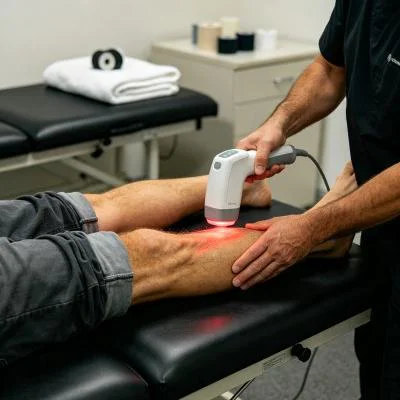
Sessions 9 and 10 focused on consolidating collagen remodeling. Running frequencies at 2,000Hz and transitioning to continuous-wave delivery stimulated deep fibroblast activity and matrix reorganization. By Session 10, the Foot and Ankle Ability Measure sports score reached 96 percent, and pain during morning weight-bearing dropped to zero. Follow-up sonography confirmed fascial thickness had reduced to 3.5mm, with restored parallel fibrillar alignment. The athlete returned to structured marathon training, increasing mileage to 120 km weekly by week 6. At the 60-day follow-up, the fascia measured a normal 3.3mm on ultrasound, and the athlete resumed full competitive workouts without symptom recurrence.
سرعة المسح الضوئي للمقبض والتحكم الحراري في السطح
Administering high-power Class 4 laser therapy over the plantar surface requires strict delivery technique. Because the plantar skin is densely innervated and the underlying calcaneal fat pad contains high water and lipid content, leaving the handpiece static will rapidly elevate skin temperatures beyond safe thresholds.
Handpiece Movement Architecture across the Plantar Surface:
[Zone 1: Gastrocnemius-Achilles Complex] <---> Longitudinal Sweeping Strokes (5 cm/s, CW)
[Zone 2: Medial Calcaneal Tubercle]      <---> Focused Overlapping Spirals with Quartz Pressure (3 cm/s)
[Zone 3: Central Aponeurotic Band]       <---> Cross-Hatch Transverse Sweeps along the Arch (4 cm/s)
[Zone 4: Medial Malleolar Tunnel]        <---> Continuous Unweighted Scanning across Baxter's Pathway
تحدد المعايير الفنية الرئيسية نطاق التطبيق السريري:
- سرعة المسح الحركي: The treatment optic must maintain continuous movement across the tissue at speeds between 3 and 5 centimeters per second. This maintains forward photon penetration to deep target structures while preventing localized heat spikes on the skin surface.
- الضغط الميكانيكي للكوارتز: Over the medial calcaneal tuberosity, the clinician applies firm manual pressure (1.5 to 2.0 kg) using a convex quartz massage head. This displaces superficial venous and capillary blood, decreasing competitive light absorption by hemoglobin and increasing direct photon penetration into the avascular enthesis.
- Real-Time Thermal Feedback: The handpiece uses an integrated infrared pyrometer to measure skin surface temperature in real time, keeping tissue within the safe therapeutic window of 39.0 to 41.5 degrees Celsius. If surface temperatures near 42.0 degrees Celsius, the operator accelerates scanning speed or reduces the pulse duty cycle, preserving total energy delivery while protecting superficial tissues.
High Intensity Laser Integration in Sports Podiatry
Treating chronic plantar fasciopathy highlights the trade-offs inherent in conventional podiatric and physical therapy interventions. High-intensity Class 4 laser therapy provides a targeted, non-invasive alternative across several common treatment approaches:
| الطريقة / النهج | عمق الاختراق | الآلية الأساسية | القيود السريرية |
| العلاج بالضوء منخفض الشدة | من 2 ملم إلى 6 ملم | الكيمياء الضوئية السطحية | Cannot penetrate through thick heel pad |
| حقن الكورتيكوستيرويدات القشرية | Direct Infiltration | تأثير قوي مضاد للالتهابات | High risk of fat pad atrophy & fascial rupture |
| الموجات الصدمية خارج الجسم | متغير (صوتي) | التجويف الميكانيكي والصدمات | Significant procedure pain; micro-hematomas |
| البلازما الغنية بالصفائح الدموية | التسلل المحلي | إفراز عوامل النمو الذاتية | التكلفة المرتفعة؛ فترة التعطل الطويلة بعد الحقن |
| Plantar Fasciotomy | Direct Surgical Release | Partial Mechanical Transection | Loss of medial arch stability; prolonged recovery |
| ليزر عالي الطاقة من الفئة 4 | 20 mm to 40 mm | التعديل الضوئي الحيوي والتروية | يتطلب معدات ذات جودة طبية |
Low-Level Light Therapy operates in the milliwatt range. While it can aid superficial digital tenosynovitis, its low energy cannot overcome the optical scattering barriers of the thick calcaneal fat pad. High-power systems deliver the incident irradiance needed to maintain an effective forward-propagating photon field that reaches the degenerative enthesis.
Corticosteroid injections provide rapid temporary pain relief by suppressing localized inflammation, but repeated injections inhibit fibroblast collagen synthesis, carry a documented risk of permanent calcaneal fat pad atrophy, and significantly increase the hazard of complete fascial rupture under explosive athletic loading. Extracorporeal shockwave therapy stimulates revascularization through high-energy acoustic pulses, but treatment can be painful and often leaves residual soreness that halts running regimens.
Platelet-rich plasma therapy introduces concentrated autologous growth factors directly into the degenerative fascia, but the resulting post-injection inflammatory response requires several weeks of mandatory non-weight-bearing or restricted loading. Surgical plantar fasciotomy mechanically releases fascial tension, but partial or total transection weakens the medial longitudinal arch, alters foot biomechanics, and requires lengthy postoperative rehabilitation.
High-power multi-wavelength Class 4 laser therapy bridges the gap between passive podiatric interventions and invasive procedures. By combining deep tissue penetration, targeted wavelength absorption, and real-time surface thermal monitoring, this modality accelerates fibroblast collagen synthesis, mobilizes trapped perifascial edema, and restores structural aponeurotic integrity without the mechanical risks or prolonged downtime of invasive interventions.