 فوتون ميديكس












لماذا يفشل العلاج بالليزر للحيوانات الأليفة دون التحكم في الجرعة والأنسجة
المرونة في استخدام أطوال موجية متعددة، التحكم في الحمل الحراري، توزيع الضوء على مساحة واسعة
الكلب الذي ينهض ببطء، ويتجنب السلالم، ويتردد قبل القفز على الأريكة، لا يهمه ما إذا كانت العيادة البيطرية تمتلك جهاز ليزر بقوة 15 واط أو 30 واط أو 38 واط.
ما يهم المالك هو أمر أبسط بكثير.
هل يتحرك الكلب براحة أكبر؟
هل يمكنها أن تمشي مسافة أطول؟
هل الاستيقاظ أسهل؟
هل يمكن تقليل جرعة مسكنات الألم؟
أما بالنسبة للخيول، فإن المشكلة أكثر وضوحًا.
قد يبدو الحصان الرياضي طبيعيًّا أثناء المشي، ومع ذلك يعاني من تصلب في الظهر، أو انخفاض في الدفع، أو قصر في الخطوة، أو تردد أثناء التجميع. وقد لا تظهر على الحصان أي إصابة واضحة للعيان، ومع ذلك ينخفض أداؤه لأن مشكلة كامنة في العضلات أو اللفافة أو المفاصل قد غيّرت طريقة حركته.
وهنا تكمن الصعوبة في العلاج بالليزر عالي الكثافة في الطب البيطري.
لا يستطيع الحيوان إخبار المعالج عندما تصبح منطقة العلاج دافئة أكثر من اللازم.
يتعين على الطبيب تقييم استجابة الأنسجة، والعمق التشريحي، ومنطقة العلاج، والحركة، وتوصيل الطاقة.
ولهذا السبب فإن العبارة العلاج بالليزر للحيوانات الأليفة فهي مصطلح واسع جدًّا بحيث لا يمكنه وصف العملية السريرية الفعلية.
فورك كلب صغير، ومرفق كلب من فصيلة لابرادور، ورك بعد الجراحة، وعضلات أسفل الظهر للحصان، كلها أهداف علاجية مختلفة تمامًا.
لا يمكن، من الناحية المنطقية، نقل نفس إعداد الطاقة بينهما.
كما أنه لا يمكن نقل نفس إجمالي الجول تلقائيًا أيضًا.
ومن الأمثلة المفيدة في هذا الصدد تجربة عشوائية محكومة شملت 20 كلبًا يعانون من هشاشة العظام في مفاصل الورك في كلا الجانبين. وبلغ متوسط عمر الكلاب 8.3 ± 1.9 سنة، ومتوسط وزنها 65.7 ± 12.1 رطلاً. وصُنفت حالة هشاشة العظام لديهم على أنها متوسطة في 26 مفصلاً وشديدة في 14 مفصلاً. وقد ارتبط العلاج بالتعديل الحيوي الضوئي من الفئة الرابعة بنتائج أفضل من حيث تخفيف الألم وتحسين الوظائف مقارنةً بالعلاج الضابط في عدة مراحل من المتابعة، مع استمرار التحسن في نطاق حركة المفاصل من اليوم 15 وحتى اليوم 90. :contentReference[oaicite:0]{index=0}
وقد أظهرت دراسة عشوائية منفصلة خاضعة للرقابة بالغفل شملت 20 كلبًا يعانون من التهاب المفاصل العظمي في الكوع الناجم عن أسباب طبيعية أن العلاج بالتعديل الحيوي الضوئي لمدة ستة أسابيع بجرعة 10–20 جول/سم² أدى إلى تحسن في درجات العرج والألم، كما قلل من الحاجة إلى مضادات الالتهاب غير الستيرويدية لدى 9 من أصل 11 كلبًا خضعوا للعلاج، مقارنةً بعدم حدوث أي تحسن لدى أي من الكلاب التسعة التي تلقت الغفل. :contentReference[oaicite:1]{index=1}
لا تعني هذه الدراسات أن كل بروتوكول من بروتوكولات العلاج بالليزر البيطري سيكون فعالاً مع كل حيوان.
إنها تُظهر شيئًا أكثر فائدة.
يجب أن تتطابق الجرعة ومنطقة العلاج وطول الموجة وعمق النسيج والتشخيص السريري.
لماذا لا يُعد العلاج بالليزر البيطري علاجًا واحدًا
يمكن أن تستقبل غرفة إعادة التأهيل البيطرية مرضى يعانون من مشاكل مختلفة تمامًا.
قد يعاني كلب واحد من التهاب المفاصل العظمي في الورك.
وقد يكون شخص آخر في طور التعافي من جراحة الرباط الصليبي في الجمجمة.
وقد يعاني شخص آخر من ألم مزمن في الكوع.
وقد يعاني شخص آخر من إصابة في الأنسجة الرخوة.
قد يعاني الحصان من إجهاد عضلي بعد انتهاء المنافسة.
وقد يعاني شخص آخر من ألم مزمن في منطقة الصدر والقطني.
وقد يكون آخرون يخضعون لبرنامج إعادة التأهيل بعد إصابة في الأوتار.
الليزر ينتمي إلى نفس فئة المعدات.
العلاج ليس هو نفسه.
ولهذا السبب فإن أي أفضل جهاز علاج بالليزر للكلاب لا ينبغي اختيارها بمجرد النظر إلى القوة الكهربائية القصوى.
يحتاج الطبيب إلى التحكم.
المشكلة الحقيقية المتعلقة باستخدام الليزر عالي الكثافة في الحيوانات
تجعل الحيوانات إدارة الحرارة أكثر تعقيدًا مقارنةً بالبشر.
يمكن للمريض البشري أن يقول:
“الوضع في تلك المنطقة يزداد سخونةً بشكل مفرط.”
قد يبتعد الكلب ببساطة.
قد يصاب الحصان بالقلق.
قد تقاوم القطة أن يلمسها أحد.
لذلك، يتعين على الطبيب مراقبة سير العلاج بدلاً من الاعتماد كليًّا على التعليقات الشفوية.
وهذا أحد الأسباب التي تجعل جهاز «FotonMedix VetMedix-MAX» مزودًا بتقنية قياس درجة الحرارة العلاجية وثلاثة أوضاع للإشعاع.
توفر التكوينات المنشورة خمسة أطوال موجية:
650 نانومتر
810 نانومتر
915 نانومتر
940 نانومتر
980 نانومتر
يتميز الجهاز بقدرة خرج قصوى تبلغ 38 واط، كما يتضمن أوضاع «Super Pulse» و«Pulse» و«Continuous Wave». تصف شركة FotonMedix وضع «Pulse» بأنه انبعاث متقطع يهدف إلى المساعدة في تجنب ارتفاع درجة الحرارة بشكل مفرط، في حين أن وضع «Continuous Wave» مخصص للحيوانات الكبيرة أو الحالات التي تتطلب طاقة عالية خلال فترة زمنية قصيرة. :contentReference[oaicite:2]{index=2}
في مجال الممارسة البيطرية، يُعد هذا التمييز عمليًّا أكثر منه شكليًّا.
حالات العلاج البيطري المنشورة
يجمع الجدول التالي بين المعايير السريرية البيطرية المنشورة وخصائص المعدات الخاصة بكل شركة مصنعة.
أرقام الحالات الافتراضية هي رموز عرض على الموقع الإلكتروني وليست أرقامًا حقيقية من السجلات الطبية.
في الحالات التي لم تورد فيها دراسة منشورة معلمة ما، مثل التكرار، يتم الإشارة إليها على أنها «لم تُذكر» بدلاً من اختلاق قيمة لها.
| رقم الحالة الافتراضية | القسم | عمر المريض | الجنس | علم الأمراض / الدرجة | الطول الموجي | نسبة الطول الموجي | الطاقة | التردد | الطاقة في جلسة واحدة | مسار العلاج | التغيير السريري |
|---|---|---|---|---|---|---|---|---|---|---|---|
| VET-ORTHO-PBM-2022-020 | جراحة العظام البيطرية | 8.3 ± 1.9 سنة في المتوسط | مختلط الجنسين | التهاب المفاصل العظمي في الورك: 26 حالة متوسطة و14 حالة شديدة | بروتوكول PBM من الفئة الرابعة، كثافة الطاقة المعلنة 14–20 جول/سم² | البروتوكول المنشور | ليزر علاجي من الفئة الرابعة، لم يُذكر في الملخص القوة الدقيقة | لم يتم الإبلاغ عن ذلك | 14–20 جول/سم² بدلاً من قيمة ثابتة بالجول | 3 أسابيع | تحسن في شدة الألم والوظيفة ونتائج مؤشر تأثير الألم (COI) في الأيام من 8 إلى 30؛ وتحسن في نطاق الحركة (ROM) في الأيام من 15 إلى 90 |
| VET-ELBOW-PBM-2018-020 | إعادة التأهيل البيطري | الكلاب البالغة | مختلط الجنسين | التهاب المفاصل العظمي في الكوع الذي يحدث بشكل طبيعي | بروتوكول PBMT | بروتوكول منشور قائم على الجرعة | لم يتم الإبلاغ عن ذلك | لم يتم الإبلاغ عن ذلك | 10–20 جول/سم² لكل وصلة | 6 أسابيع | انخفضت جرعة مضادات الالتهاب غير الستيرويدية (NSAID) لدى الكلاب التي خضعت لعملية زرع نخاع العظم بعد 9/11؛ وتحسنت حالة العرج بشكل ملحوظ |
| VET-TPLO-CLASS4-2018-095 | جراحة العظام البيطرية | الكلاب البالغة | مختلط الجنسين | مرض الرباط الصليبي القحفي الذي يتطلب إجراء عملية TPLO | 660 نانومتر + 800 نانومتر + 905 نانومتر + 970 نانومتر | العلاج المتزامن متعدد الأطوال الموجية | مكون أحمر بقوة 100 ميلي واط؛ بحد أقصى 15 واط في الوضع المستمر (CW) و20 واط في ذروة النبضات | 10 مراحل بدءًا من التردد المستمر (CW) مرورًا بـ 2 و10 و50 و100 و200 و500 و1000 و5000 هرتز قبل العودة إلى التردد المستمر (CW) | 252–2,280 جول عبر بروتوكولات العلاج المُبلغ عنها | 3 جلسات علاجية في الفترة المحيطة بالجراحة خلال 4 أيام؛ مع إمكانية إجراء جلسة رابعة اختيارية | تحسن أكبر في درجة المشي وفقًا لمؤشر جراحة العظام الكلبية المعدل، ولكن لم يظهر أي فرق ذي دلالة إحصائية في النتائج الأخرى التي تم قياسها أو في التئام العظام |
| VET-TPLO-PBM-2016-027 | إعادة التأهيل البيطري | 6.6 ± 1.6 سنة في مجموعة PBM | مختلط الجنسين | التعافي من مرض TPLO | طول موجي مزدوج 800–900 نانومتر | طول موجي مزدوج | 6 واط | لم يتم الإبلاغ عن ذلك | 3.5 جول/سم² على مساحة 100 سم² | علاج واحد قبل الجراحة | ارتفاع أقصى للقوة الرأسية في الأسبوع الثامن؛ ولم تُسجَّل أي فروق ذات دلالة إحصائية أخرى |
| EQUINE-BACK-2020-061 | طب الرياضة الخاص بالخيول | 8.7 ± 3.7 سنة | 3 فحول، 45 حصانًا مخصيًّا، 13 فرسًا | آلام منطقة الصدر والقطني واختلال وظائف العمود الفقري | 810 نانومتر | 100% 810 نانومتر وفقًا للبروتوكول المنشور | 3 واط إجماليًّا | لم يتم الإبلاغ عن ذلك | 94 ج/سم² | يُطبق العلاج على 5–10 مواقع بناءً على النتائج السريرية | انخفاض ملحوظ في آلام الظهر، وفرط توتر العضلات الظهرية، وتصلب الجذع |
| منصة «إيكوين-ثيرالوكس» | إعادة تأهيل الخيول | لا ينطبق | لا ينطبق | إعادة تأهيل العضلات واللفافة والعظام والمفاصل | 650 نانومتر + 810 نانومتر + 915 نانومتر + 940 نانومتر + 980 نانومتر | منصة ذات خمسة أطوال موجية | 38 واط في الذروة | "سوبر بالس" و"بالس" و"CW" | يعتمد على البروتوكول | يعتمد على البروتوكول | منصة مصممة للتعافي من الإجهاد، وتحسين الأداء العضلي، والوقاية من الإصابات الدقيقة، وعلاج الجهاز العضلي الهيكلي للخيول |
أوردت تجربة عام 2022 الخاصة بالتهاب المفاصل العظمي في الورك لدى الكلاب النتائج السريرية في الأيام +8 و+15 و+30 و+60 و+90. وأظهرت المجموعة التي خضعت للعلاج بالضوء الحيوي من الفئة الرابعة (PBM) نتائج أفضل من حيث الألم والأداء الوظيفي في عدة مراحل متابعة مبكرة ومتوسطة، كما تحسّن نطاق حركة المفصل من اليوم 15 وحتى اليوم 90. :contentReference[oaicite:3]{index=3}
تُعد دراسة TPLO لعام 2018 مثيرة للاهتمام بشكل خاص لأنها توضح مدى التعقيد الذي يمكن أن يصل إليه بروتوكول الفئة الرابعة. استخدم العلاج ضوءًا أحمر متزامنًا بطول موجي 660 نانومتر وضوءًا تحت أحمر بطول موجي 800 و905 و970 نانومتر، مع طاقة موجة مستمرة قصوى تبلغ 15 واط وطاقة نبضية قصوى تبلغ 20 واط. تضمن البروتوكول عشر مراحل مختلفة لتردد النبضات تتراوح من الإشعاع المستمر مرورًا بـ 2، 10، و50، و100، و200، و500، و1,000، و5,000 هرتز قبل العودة إلى الإشعاع المستمر. وتراوحت الطاقة الإجمالية للعلاج عبر البروتوكولات المذكورة بين 252 و2,280 جول. :contentReference[oaicite:4]{index=4}
وهذا مفهوم يختلف تمامًا عن مجرد القول إن الليزر البيطري تبلغ قوته “20 واط”.”
لماذا تتطلب ورك الكلب وظهر الحصان منطقًا علاجيًّا مختلفًا
تُعد فخذ الكلب المسن هدفًا تشريحيًّا صغير الحجم نسبيًّا.
تعد المنطقة الصدرية القطنية في الحصان أكبر بكثير.
يختلف سمك النسيج.
تختلف الكتلة العضلية.
تختلف منطقة العلاج.
يختلف مستوى تحمل الحيوان.
قد تختلف درجة الحركة أثناء العلاج.
لذلك، يحتاج المعالج إلى استراتيجية مختلفة في التعامل مع الطاقة.
ولهذا السبب، تقوم شركة «فوتون ميديكس» بفصل «فيت ميديكس» و«ثيرالوكس» إلى منصتين مخصصتين للطب البيطري وطب الخيول على التوالي، بدلاً من التعامل مع جميع تطبيقات الليزر الخاصة بالحيوانات كفئة واحدة.
لماذا لا يُعد أفضل جهاز للعلاج بالليزر للكلاب هو ببساطة الجهاز الأقوى
قد يحتاج الكلب إلى كثافة طاقة معتدلة نسبيًا حول أحد المفاصل.
قد يظل الحد الأقصى العالي للإخراج مفيدًا لأنه يوفر هامشًا من المرونة للطبيب.
لكن الطاقة القصوى تختلف عن الجرعة المُقدَّمة.
قد يستخدم المعالج مستوى إخراج متوسطًا أقل في حالة المفاصل الصغيرة المؤلمة، واستراتيجية علاجية مختلفة في حالة المناطق العضلية الكبيرة.
ولذلك، فإن القدرة على ضبط مستوى الصوت أمر مهم.
كما أن القدرة على تغيير وضع الانبعاثات أمر مهم أيضًا.
تُضيف مراقبة درجة الحرارة مستوىً إضافيًا من التحكم.
يمكن أن يكون النظام الذي تبلغ قوته القصوى 38 واط مفيدًا دون الحاجة إلى تشغيله باستمرار عند 38 واط.
لماذا يستخدم جهاز VetMedix-MAX خمسة أطوال موجية؟
يوفر VetMedix-MAX ما يلي:
- 650 نانومتر
- 810 نانومتر
- 915 نانومتر
- 940 نانومتر
- 980 نانومتر
تحدد شركة FotonMedix الطاقة القصوى بـ 38 واط، بالإضافة إلى أوضاع التشغيل «Super Pulse» و«Pulse» و«Continuous Wave»، وتقنية الحفاظ على عمق الاختراق الأقصى، ومؤشر درجة الحرارة العلاجية، ووظيفة الليزر المزدوجة للساخن والبارد. :contentReference[oaicite:5]{index=5}
والغرض من استخدام أطوال موجية متعددة ليس إضفاء مزيد من الإثارة على ورقة المواصفات.
وهذا يوفر للطبيب البيطري المزيد من الخيارات لاستهداف مناطق تشريحية مختلفة.
الجرح السطحي لا يخضع لنفس المتطلبات البصرية التي يخضع لها مفصل الورك العميق.
لا تتمتع الأوتار بنفس البيئة البصرية التي تتمتع بها العضلات الكبيرة.
لا يُعد الركبة بعد الجراحة حالة ذات هدف سريري مماثل لحالة آلام الظهر المزمنة.
وبالتالي، يمكن أن يصبح اختيار الطول الموجي جزءًا من تصميم العلاج.
لماذا يُعد التوهين البصري عاملاً مهمًا في الأنسجة الحيوانية
يتعرض الضوء الذي يدخل الأنسجة لعمليات الامتصاص والتشتت.
يتم امتصاص بعض الطاقة بالقرب من السطح.
يتم إعادة توجيه بعضها.
وبعضها يمتد إلى أعماق أكبر.
تتناقص الطاقة الضوئية المتبقية مع زيادة العمق.
يعتمد شكل منحنى التوهين هذا على تكوين النسيج وطول الموجة.
وهذا الأمر مهم في حالة الحيوانات لأن المسافة بين الجلد والهدف قد تكون كبيرة.
قد يتطلب الجرح السطحي في الأنياب نهجًا بصريًّا مختلفًا تمامًا عن ذلك المتبع في حالة الجرح العميق في مفصل الورك.
يحتوي ظهر الحصان على كتلة عضلية كبيرة تقع بين الجلد والهياكل الأعمق.
لذلك، يحتاج الطبيب إلى قدرة إخراج كافية لتعويض التوهين مع تجنب التسخين غير الضروري للسطح.
لماذا يُعد طول الموجة 980 نانومتر مهمًا من الناحية الحرارية
عند طول موجة 980 نانومتر، يسهم امتصاص الماء بشكل كبير في التأثيرات الحرارية.
كما تؤثر الأنسجة التي تحتوي على دم على عملية الامتصاص.
وقد يؤدي ذلك إلى حدوث تسخين محلي كبير بكثافة عالية.
قد يكون ذلك مفيدًا.
يمكن للحرارة الخاضعة للتحكم أن تؤثر على الدورة الدموية واستجابة الأنسجة.
قد تؤدي الحرارة غير المنضبطة إلى الشعور بعدم الراحة أو إلى حدوث أضرار.
ولهذا السبب تضم «فوتون ميديكس» ميزة عرض درجة الحرارة العلاجية في جهازي «فيت ميديكس-ماكس» و«ثيرالوكس-ماكس». :contentReference[oaicite:6]{index=6}
مؤشر درجة الحرارة لا يحل محل التقييم السريري.
وهو يوفر للمشغل قراءة قياسية أخرى أثناء تقديم العلاج.
لماذا لا يُعتبر الطول الموجي 1470 نانومتر مجرد طول موجي أقوى في العلاج البيطري
يتميز الطول الموجي 1470 نانومتر بامتصاص أقوى بكثير من قبل الماء مقارنةً بالطول الموجي 980 نانومتر.
وهذا يجعله مفيدًا بشكل خاص في التفاعل الجراحي مع الأنسجة.
يوفر جهاز FotonMedix SurgMedix-MAX طول موجي يبلغ 1470 نانومتر بقوة 20 واط وطول موجي يبلغ 980 نانومتر بقوة 40 واط، وهو مصمم لإجراء العمليات الجراحية التي تتضمن التخثر والتبخير والقطع والشق والاستئصال.
وهذا أمر مهم لأن العيادات البيطرية غالبًا ما تحتاج إلى خدمات إعادة التأهيل والجراحة على حد سواء.
لا ينبغي الخلط بين النظام الجراحي ومنصة العلاج غير الجراحي.
الهدف السريري مختلف.
يختلف تأثير الأنسجة.
تختلف طريقة التسليم.
تختلف متطلبات السلامة.
لماذا لا ينبغي استبدال الطولين الموجيين 980 نانومتر و1470 نانومتر ببعضهما البعض
يمكن أن يوفر الطول الموجي 980 نانومتر تفاعلًا حراريًّا فعالًا عبر الماء والأنسجة التي تحتوي على الدم.
يتم امتصاص الطول الموجي 1470 نانومتر بقوة أكبر بكثير بواسطة الماء.
وإذا تم نقل نفس الطاقة ووقت التعرض من طول موجي إلى آخر، فلن تظل استجابة الأنسجة بالضرورة كما هي.
يتغير شكل منحنى الامتصاص الضوئي.
لذلك، يجب إعادة تصميم العلاج بحيث يتناسب مع الطول الموجي المختار.
وهذا أمر مهم بشكل خاص في التطبيقات الجراحية.
لماذا يُعد امتصاص الدم أمرًا مهمًا في الأنسجة البيطرية
يُعد الدم عامل امتصاص مهم في النسيج الوعائي.
عندما تمتص الهياكل التي تحتوي على الدم الطاقة الضوئية، قد ترتفع درجة الحرارة المحلية.
ويمكن أن يسهم ذلك في عملية التخثر وإعادة تشكيل الأوعية الدموية.
في مجال الجراحة البيطرية، يمكن أن يكون هذا التفاعل مفيدًا.
أما بالنسبة لإعادة التأهيل غير الجراحي، فإن الهدف يختلف.
قد يفضل الطبيب الحصول على استجابة حرارية واستجابة ضوئية بيولوجية خاضعة للسيطرة بدلاً من إزالة الأنسجة.
وبالتالي، يمكن أن تدعم فئة الطاقة العالية هذه تطبيقات متنوعة للغاية.
لماذا يُعد دورة العمل عاملاً مهمًا في علاج الحيوانات
لا تستطيع الحيوانات وصف الانزعاج الحراري بدقة.
وهذا ما يجعل التحكم في الطاقة الزمنية مفيدًا بشكل خاص.
يوفر نظام الموجة المستمرة الطاقة دون انقطاع.
يُحدث وضع النبض فترات توقف.
تتيح تقنية «سوبر بالس» تحقيق خرج ذروي عالٍ خلال فترات إشعاع قصيرة.
يتلقى النسيج نمطًا زمنيًا مختلفًا للطاقة في كل وضع.
تصف شركة «فوتون ميديكس» وضعي «VetMedix» و«Theralux Super Pulse» بأنهما يوفران خرجًا أقصى يصل إلى 38 واط مع إحساس حراري قابل للتعديل، وتصف وضع «Pulse» بأنه انبعاث متقطع يهدف إلى الحد من ارتفاع درجة الحرارة بشكل مفرط. :contentReference[oaicite:7]{index=7}
وهذا لا يعني أن العلاج بالنبضات أكثر أمانًا أو أفضل تلقائيًّا.
وهذا يعني أن الطبيب لديه طريقة أخرى للتحكم في توصيل الطاقة.
لماذا لا تكفي الترددات وحدها لتوضيح الصورة الكاملة
يصف التردد عدد النبضات التي تحدث في الثانية الواحدة.
لا يوضح لنا المدة التي تظل فيها كل نبضة قيد التشغيل.
يختلف دورة التشغيل للعلاج بتردد 100 هرتز ومدة النبضة القصيرة عن دورة التشغيل للعلاج بتردد 100 هرتز ومدة النبضة الأطول.
وبالتالي، يمكن أن يختلف متوسط الطاقة المُقدَّمة حتى عندما يكون التردد متطابقًا.
ويكتسب هذا الأمر أهمية خاصة عند معالجة منطقة تشريحية صغيرة.
قد يرغب الطبيب في الحصول على طاقة بصرية قصوى عالية دون الحفاظ على نفس الحمل الحراري المتوسط.
ويوفر توقيت النبض هذا التحكم الإضافي.
لماذا تُعد دراسة TPLO مثالاً جيداً
تُعد تجربة TPLO العشوائية الخاضعة للرقابة بالغفل لعام 2018 مفيدة بشكل غير عادي لأنها أوردت عدة مراحل لتردد النبض.
تضمن العلاج بالليزر ما يلي:
الموجة المستمرة
2 هرتز
10 هرتز
50 هرتز
100 هرتز
200 هرتز
500 هرتز
1,000 هرتز
5,000 هرتز
ثم «الموجة المستمرة» مرة أخرى.
استخدم النظام ضوءًا أحمر بطول موجي 660 نانومتر وبقدرة 100 ميلي واط، بالإضافة إلى أطوال موجية للأشعة تحت الحمراء تبلغ 800 و905 و970 نانومتر، مع قدرة قصوى للموجة المستمرة تبلغ 15 واط وقدرة قصوى للنبضات تبلغ 20 واط. :contentReference[oaicite:8]{index=8}
وبالتالي، لم يكن البروتوكول إعدادًا ثابتًا واحدًا.
كان ذلك تسلسلاً زمنياً منظماً للطاقة.
وهذا هو بالضبط السبب الذي يجعل من الضروري تقييم منصة بيطرية احترافية من الفئة الرابعة من حيث التحكم في المعلمات، وليس فقط من حيث القوة الكهربائية القصوى.
لماذا لم تكن نتائج عملية TPLO ناجحة تمامًا
شملت الدراسة 95 كلبًا.
تلقى 51 شخصًا علاجًا بالليزر.
تلقى 44 شخصًا دواءً وهميًا.
أظهرت المجموعة التي خضعت للعلاج بالليزر تحسناً أكبر في قسم «المشي» من «مؤشر جراحة العظام الكلبية» المعدل.
لكن الباحثين لم يجدوا فروقًا ذات دلالة إحصائية في درجات القياسات السريرية الأخرى، أو في التئام العظام، أو في العديد من النتائج الأخرى. :contentReference[oaicite:9]{index=9}
هذا أمر مهم.
وهو يمنع المبالغة.
قد يساعد الليزر من الفئة الرابعة في بعض جوانب التعافي بعد الجراحة.
وهذا لا يعني أن الليزر يعمل تلقائيًّا على تسريع كل جوانب عملية الشفاء الجراحي.
لا يزال برنامج إعادة التأهيل البيطري يحتاج إلى تمارين مناسبة، وإدارة الألم، والمتابعة الجراحية، والمراقبة السريرية.
لماذا توصلت دراسة أخرى حول عملية TPLO إلى نتيجة مختلفة
أجريت دراسة منفصلة شملت 27 كلبًا لتقييم العلاج بالضوء الحيوي (PBM) قبل الجراحة، باستخدام علاج ثنائي الطول الموجي يتراوح بين 800 و900 نانومتر، بقدرة 6 واط و3.5 جول/سم² على مساحة 100 سم².
أظهرت المجموعة التي خضعت لبرنامج PBM قوة رأسية قصوى أكبر في الأسبوع الثامن، لكن لم تُلاحظ أي اختلافات ذات دلالة إحصائية أخرى في النتائج التي تم قياسها. :contentReference[oaicite:10]{index=10}
مرة أخرى، لا يُعتبر هذا تأييدًا شاملاً.
وهذا يدل على أن معايير العلاج والمؤشرات السريرية النهائية لها أهمية.
لذلك، ينبغي اعتبار الليزر البيطري وسيلة مساعدة وليس بديلاً عن برنامج إعادة التأهيل الكامل بعد الجراحة.
لماذا تعتبر تجربة علاج هشاشة العظام في الورك أكثر صلة بالعلاج بالليزر للحيوانات الأليفة المصابة بأمراض مزمنة؟
ركزت الدراسة العشوائية المزدوجة التعمية التي أُجريت عام 2022 بشكل خاص على الكلاب المصابة بالتهاب المفاصل العظمي في الوركين.
كان لدى العشرين كلبًا ما مجموعه 40 مفصلاً مصابًا.
تلقى المرضى في مجموعة المقارنة دورة علاجية من الميلوكسيكام لمدة 21 يومًا.
خضعت مفاصل PBMT لعلاج بالليزر من الفئة الرابعة على مدار ثلاثة أسابيع.
قام الباحثون بقياس ما يلي:
- نطاق حركة المفصل
- محيط الفخذ
- مقياس الألم الموجز للكلاب
- مقياس هدسون البصري التناظري
- ليفربول: التهاب المفاصل العظمي لدى الكلاب
- فهرس جراحة العظام للكلاب
- الوظيفة
- المشية
- الصلابة
- جودة الحياة
استمرت المتابعة حتى 90 يومًا.
أظهرت مجموعة PBMT نتائج أفضل في عدة نقاط متابعة، كما سجلت فترات أطول من النتائج الإيجابية في تحليل كابلان-ماير. :contentReference[oaicite:11]{index=11}
هذا نموذج سريري مفيد لـ العلاج بالليزر للحيوانات الأليفة لأنه يتجاوز الألم المباشر.
وهي تدرس الوظيفة والحركة عبر الزمن.
لماذا لا يكفي تخفيف الألم وحده؟
قد يبدو الكلب المسن أقل تألمًا رغم أنه لا يزال يتحرك بصعوبة.
قد يستمر الكلب في تجنب السلالم.
قد يواجه صعوبة في الارتفاع.
قد يؤدي ذلك إلى تحويل الوزن بعيدًا عن أحد الأطراف.
قد يفقد كتلة العضلات.
ولهذا السبب ينبغي أن يشمل تقييم إعادة التأهيل الجانب الوظيفي.
قامت دراسة عام مفصل الورك لدى الكلاب لعام 2022 بقياس كل من الألم والوظيفة.
تحسّن نطاق حركة المفاصل في مجموعة العلاج بالموجات النبضية (PBMT) بدءًا من اليوم الخامس عشر وحتى اليوم التسعين. :contentReference[oaicite:12]{index=12}
وهذا يجعل النتيجة أكثر دلالة من مجرد القول إن الكلب “شعر بتحسن”.”
لماذا يُعد هشاشة العظام في المرفق مثالاً قوياً آخر
شملت الدراسة العشوائية التي أُجريت عام 2018، والتي كانت خاضعة لمراقبة باستخدام الدواء الوهمي، 20 كلبًا يعانون من التهاب المفاصل العظمي في المرفق الذي حدث بشكل طبيعي.
تلقَّت المجموعة التي خضعت للعلاج بالإشعاع الموضعي (PBMT) جرعة تتراوح بين 10 و20 جول/سم² لكل مفصل على مدار ستة أسابيع.
تلقَّت مجموعة الدواء الوهمي علاجًا وهميًّا.
بعد العلاج:
انخفضت احتياجات 9 من أصل 11 كلبًا خضعوا لعلاج PBMT من مضادات الالتهاب غير الستيرويدية.
لم ينخفض احتياج أي من الكلاب التسعة التي تلقت الدواء الوهمي إلى مضادات الالتهاب غير الستيرويدية.
كما حققت المجموعة التي خضعت لعلاج PBMT تحسناً أكبر في درجات تقييم العرج.
أفاد الباحثون بحدوث تحسن ملحوظ في العديد من المقاييس المتعلقة بالألم. :contentReference[oaicite:13]{index=13}
هذا هو النوع من الأدلة التي تدعم استخدام الليزر كعلاج مساعد في إعادة التأهيل البيطري.
لماذا لا تُعتبر الجرعة التي تتراوح بين 10 و20 جول/سم² جرعةً موحدةً للكلاب
استخدمت دراسة الكوع جرعة تتراوح بين 10 و20 جول/سم² لكل مفصل.
وهذا لا يعني أن كل كلب يجب أن يتلقى جرعة تتراوح بين 10 و20 جول/سم².
كان الهدف هو هشاشة العظام في المرفق.
تم تحديد منطقة العلاج.
تم تحديد العينة التي شملتها الدراسة.
تم تحديد نظام الليزر.
تم تحديد وتيرة العلاج.
الكلب المصاب بالتهاب المفاصل العظمي في الورك لديه منطقة مستهدفة تشريحية مختلفة.
الكلب المصاب بجرح ما يعاني من جرح آخر.
أما الركبة بعد الجراحة، فلديها حالة أخرى.
ولهذا السبب لا يمكن نقل الجرعات السريرية من مؤشر علاجي إلى آخر دون تعديل.
لماذا تُحدث الكلاب الكبيرة تغييرًا في مشكلة العلاج
الكلب الذي يزن 7 كيلوغرامات والكلب الذي يزن 60 كيلوغرامات لا يمثلان نفس التحدي التشريحي.
يتغير عمق المعالجة.
تتغير المنطقة.
تتغير كتلة العضلات.
قد يحتاج الطبيب إلى مزيد من الطاقة لتغطية المنطقة المستهدفة.
لكن مجرد زيادة الطاقة قد يؤدي أيضًا إلى زيادة تسخين السطح.
وهنا تكمن فائدة النظام متعدد الأوضاع.
يمكن للمشغل ضبط معدل الإنتاج ووضع الانبعاث ومدة المعالجة، بدلاً من استخدام إعداد واحد ثابت.
لماذا يُعتبر الحصان مريضاً مختلفاً تماماً
يؤدي شكل جسم الحصان إلى تغيير جذري في هندسة العلاج.
يمكن أن تحتوي منطقة أسفل الظهر على كمية كبيرة من العضلات.
قد تمتد منطقة العلاج لتشمل جزءًا كبيرًا من الظهر.
قد يقوم الطبيب بمعالجة:
- العضلات الظهارية
- اللفافة الصدرية القطنية
- المنطقة العجزية الحرقفية
- عضلات الألوية
- الأوتار
- المفاصل
- ألم العضلات بعد التمرين
قد يتعين أن يشمل العلاج مساحة أكبر بكثير من مفصل الكلب.
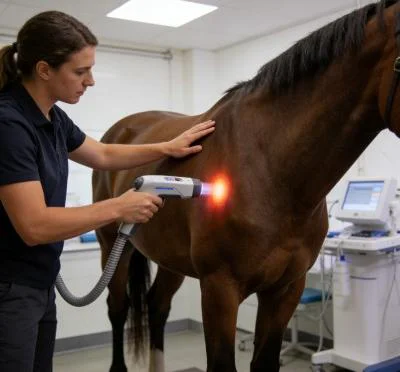
هذا هو المكان العلاج بالليزر للخيول يتطلب ذلك سير عمل مخصصًا.
The 61-Horse Clinical Trial
A randomized clinical trial published in the مجلة العلوم البيطرية الخاصة بالخيول evaluated 61 Quarter Horses actively competing in national Western performance events.
The horses had back pain or poor performance associated with spinal dysfunction.
The mean age was 8.7 ± 3.7 years.
The group consisted of 3 stallions, 45 geldings and 13 mares.
The horses were assigned to laser therapy, chiropractic treatment or combined laser and chiropractic treatment.
The laser protocol used four 810 nm lasers with 3 W total power and a radiant exposure of 94 J/cm², applied to 5–10 sites according to clinical findings. :contentReference[oaicite:14]{index=14}
The laser group showed significant reductions in:
آلام الظهر
Epaxial muscle hypertonicity
Trunk stiffness
The combined laser and chiropractic group also showed additive effects for some measures.
Chiropractic treatment alone did not significantly change back pain, muscle hypertonicity or trunk stiffness in the same way. :contentReference[oaicite:15]{index=15}
This is a useful example of multimodal equine rehabilitation.
Why the Horse Study Matters for Modern High-Intensity Equipment
The 61-horse study used a lower-power laser protocol.
It does not prove that a 38 W Class IV platform should be used with the same 94 J/cm² dose.
It demonstrates something else.
The treatment target was large.
The protocol was based on energy density.
The treatment sites were selected according to clinical findings.
The horse was evaluated for pain and movement rather than simply being treated according to a fixed timer.
This is exactly the mindset needed when using modern high-energy equipment.
Why Theralux-Max Is Designed for Equine Applications
FotonMedix Theralux-Max is specified with:
650 نانومتر
810 نانومتر
915 نانومتر
940 نانومتر
980 نانومتر
38 W peak power
سوبر بولس
النبض
الموجة المستمرة
مؤشر درجة الحرارة العلاجية
تقنية الحفاظ على أقصى عمق للاختراق
Dual hot-and-cold functionality
بطارية ليثيوم مدمجة
The manufacturer positions the system for fatigue recovery, muscular performance improvement, microtrauma prevention and repair, and treatment of muscle, bone, fascia, joint injuries and pain. :contentReference[oaicite:16]{index=16}
The battery is not merely a convenience.
Equine rehabilitation does not always happen inside a conventional treatment room.
A horse may be treated at a stable, training facility or competition environment.
Mobility can therefore have practical value.
Why Equine Laser Therapy Needs Large-Area Energy Control
A horse’s back cannot be treated like a small canine elbow.
The clinician may need to move across a broad muscle group.
The treatment area changes continuously.
The energy needs to be distributed evenly.
The handpiece needs to remain at a controlled distance or contact position.
The clinician needs to avoid creating isolated hot spots.
This makes output control and thermal feedback particularly useful.
Why Continuous Wave Has a Different Role in Horses
FotonMedix describes Continuous Wave as suitable for large animals or situations requiring high energy over a short period. :contentReference[oaicite:17]{index=17}
That makes practical sense for large treatment areas.
Continuous emission can deliver energy rapidly.
But the clinician still has to control movement and exposure.
A slow hand movement can concentrate energy.
A fast movement can distribute it more broadly.
The machine cannot compensate for poor application technique.
Why Pulse Mode Can Be Useful After Hard Exercise
A performance horse may have muscular fatigue after competition.
The objective may be to support recovery rather than create a strong thermal treatment.
Pulse mode provides intermittent emission.
The off periods reduce continuous thermal accumulation.
The therapist can therefore use a different energy-delivery pattern.
FotonMedix describes Pulse mode as intermittent emission intended to help avoid overheating. :contentReference[oaicite:18]{index=18}
Again, this does not mean pulse mode is automatically superior.
It gives the clinician another option.
لماذا يُعد «سوبر بولس» مختلفًا؟
Super Pulse allows high peak power during short emission intervals.
FotonMedix specifies up to 38 W peak power for VetMedix-MAX and Theralux-Max.
The purpose is to provide deeper treatment capacity while allowing thermal sensation to be adjusted.
For a large animal, that can be useful when the target lies beneath substantial tissue thickness.
The key is that peak power is not the same as average power.
وهنا تبرز أهمية دورة التشغيل.
Why Duty Cycle Changes the Thermal Profile
Imagine a system operating at a high peak output.
If the laser is continuously active, the tissue receives uninterrupted optical energy.
If the same peak output is delivered only during a fraction of each cycle, the average thermal input is lower.
The tissue has intervals without additional optical energy.
خلال تلك الفترات، يمكن أن تتوزع الحرارة من جديد.
This is the basic reason pulsed treatment can be useful for thermal control.
The exact tissue temperature depends on many variables.
Blood flow.
Tissue thickness.
Absorption.
منطقة العلاج.
Applicator movement.
Initial tissue temperature.
Exposure duration.
Therefore, duty cycle should be treated as one control variable rather than a guarantee of safety.
Why Animals Make Temperature Monitoring More Valuable
A human can communicate discomfort immediately.
An animal cannot.
Some animals tolerate heat well.
Others become uncomfortable quickly.
Coat thickness can also affect the treatment experience.
A thick coat changes the optical path before energy reaches the skin.
Clipping may or may not be appropriate depending on the indication.
The clinician therefore needs objective feedback where possible.
Therapeutic temperature indication is useful because it gives the operator information beyond subjective animal behavior.
Why “Deep Penetration” Needs a More Careful Explanation
Manufacturers often describe a treatment system as having deep penetration.
That phrase should not be interpreted as uniform energy at a fixed depth.
Optical energy attenuates as it travels through tissue.
The amount reaching deeper structures is lower than the amount entering the body.
The purpose of higher output is to compensate for attenuation and deliver enough energy to the intended target.
FotonMedix specifies a penetration depth of up to 15 cm for VetMedix-MAX and Theralux-Max. :contentReference[oaicite:19]{index=19}
Clinically, this should be interpreted as the system’s stated treatment capability rather than a claim that the same optical intensity exists unchanged throughout 15 cm of tissue.
Why More Power Can Become Less Useful
If the target is superficial, excessive output may mainly increase surface heating.
If the target is deep, higher output may help compensate for attenuation.
The clinician therefore needs to match power to target depth.
This is one reason the phrase “best laser therapy device for dogs” cannot have a single answer.
The best device depends on what the veterinary clinic actually treats.
Why a Rehabilitation Clinic May Prefer a Five-Wavelength System
A veterinary rehabilitation clinic may treat:
الفصال العظمي المفصلي
إصابة الأوتار
إصابة عضلية
Postoperative pain
الألم المزمن
Wounds
الوذمة
Neuropathic conditions
الإصابات الرياضية
The optical requirements differ.
يوفر النظام ذو الأطوال الموجية الخمسة المزيد من الخيارات للطبيب.
It also means the clinic may not need several separate laser systems for different applications.
This can make a multi-wavelength platform commercially attractive.
Why VetMedix-MAX Is More Than a Therapy Device
VetMedix-MAX is positioned as a combination of laser therapy and جراحة الليزر.
The manufacturer lists applications including:
الجراحة العامة
جراحة الجلوكوما (المياه الزرقاء)
إجراءات طب الأنف والأذن والحنجرة
الإجراءات السنية
طب الأمراض الجلدية
Endoscopic surgery
Soft-tissue vaporization
استئصال الورم
الاستئصال
The same system therefore has a broader clinical role than a therapy-only device. :contentReference[oaicite:20]{index=20}
For a veterinary hospital that performs both rehabilitation and surgical procedures, this can change the equipment purchasing calculation.
Why Surgical Use Requires a Different Wavelength Strategy
A surgical procedure has a different objective.
The clinician may want:
التخثر
الشق الجراحي
التبخر
الاستئصال
الاستئصال
That requires more localized tissue interaction than non-invasive rehabilitation.
This is where 980 nm and 1470 nm become relevant.
1470 nm’s strong water absorption allows localized thermal interaction.
980 nm can provide significant coagulation and thermal effects.
The delivery system and fiber also become important.
This is not the same as scanning a laser across a dog’s back for photobiomodulation.
Why Pet Laser Therapy Should Not Be Sold as a Replacement for Medication
The strongest clinical positioning is adjunctive.
The 2018 canine elbow study found that PBMT reduced NSAID requirements in 9 of 11 treated dogs, but that does not mean laser should replace medication in every dog. :contentReference[oaicite:21]{index=21}
قد يظل تناول الدواء خياراً مناسباً.
Weight management may be appropriate.
Exercise may be appropriate.
Joint support may be appropriate.
Surgery may be appropriate.
The laser becomes one component of the treatment plan.
Why the 2025 Evidence Review Is More Cautious
A 2025 evidence review asked whether concurrent laser treatment is more effective than NSAIDs alone for canine osteoarthritis.
The authors found only one randomized controlled trial meeting the review criteria and rated the strength of evidence as weak.
The review reported that laser treatment improved pain-related measures and lameness in the included study, but the authors emphasized the limited strength of the available evidence. :contentReference[oaicite:22]{index=22}
This is important for responsible veterinary marketing.
There is promising evidence.
There is also uncertainty.
A professional manufacturer should communicate both.
Why the Clinical Endpoint Matters
A dog may improve in one measure but not another.
A horse may show less back pain but no measurable change in performance.
A postoperative dog may walk better without radiographic evidence of faster bone healing.
The 2018 TPLO study illustrates this clearly.
The laser group improved in the gait component of the adjusted Canine Orthopedic Index.
But other clinical measurements and bone healing did not significantly differ. :contentReference[oaicite:23]{index=23}
Therefore, the veterinarian needs multiple outcome measures.
Why a Good Veterinary Protocol Includes More Than Joules
A complete treatment record should ideally include:
Patient species
السلالة
العمر
الجنس
الوزن
التشخيص
Anatomical region
Pathology severity
الطول الموجي
طاقة الخرج
وضع الانبعاثات
التردد
Pulse duration where applicable
Duty cycle where applicable
منطقة العلاج
كثافة الطاقة
إجمالي الجول
مدة العلاج
عدد الجلسات
Clinical response
Follow-up findings
This is how a treatment becomes reproducible.
Why the Case Number Matters in a Veterinary Hospital
A simulated case identifier such as:
VET-ORTHO-PBM-2026-020
can help organize internal treatment records.
It can link:
التشخيص
بروتوكول العلاج
Animal profile
Session number
النتيجة
المتابعة
The case number should not be presented as if it were a published patient identifier.
It is a practical documentation structure.
Why Clinical Documentation Helps With Equipment Evaluation
Suppose a veterinary clinic treats 100 osteoarthritis patients in one year.
If each patient’s treatment is documented consistently, the clinic can see:
ما هي التشخيصات التي تستجيب بشكل أفضل؟
Which protocols require more sessions
Which treatment areas require more energy
Which animals tolerate heat poorly
Which wavelengths are used most often
Which treatment modes are most practical
This creates a feedback loop between equipment use and clinical practice.
The machine becomes part of a measurable rehabilitation program.
Why This Matters for a Distributor
For a B2B veterinary equipment distributor, the buyer often asks:
“What can this machine treat?”
A better answer is:
“What are your main animal cases?”
Then the conversation can move to:
Dogs with hip osteoarthritis
Dogs recovering from TPLO
Dogs with elbow osteoarthritis
Horses with thoracolumbar pain
Performance horses requiring recovery
إصابات الأنسجة الرخوة
علاج الجروح
The product becomes easier to understand when connected to real cases.
Why the Five-Wavelength Platform Can Make Commercial Sense
A veterinary hospital does not necessarily want several machines.
It may want one platform that can handle:
Small animals
Large animals
إعادة التأهيل
إدارة الألم
العناية بالجروح
Selected surgical applications
The VetMedix-MAX configuration is designed around that broader use.
The five wavelengths provide optical flexibility.
The 38 W peak output provides energy capacity.
Super Pulse, Pulse and CW provide temporal control.
Temperature indication provides thermal feedback.
The surgical kit expands the range of applications. :contentReference[oaicite:24]{index=24}
Why Equine Laser Therapy Needs Mobility
A horse is rarely treated like a human patient sitting on a rehabilitation table.
The treatment may happen:
In a stable
In a barn
At a training center
At a competition
In a rehabilitation facility
Near a paddock
Mobility therefore matters.
Theralux-Max includes a built-in lithium battery according to FotonMedix’s published specification. :contentReference[oaicite:25]{index=25}
For an equine practitioner, that can make the system easier to bring to the animal rather than forcing the animal into a fixed treatment environment.
Why Large-Area Treatment Makes Output Capacity More Relevant
If a therapist needs to treat a horse’s lumbar muscles, the treatment area may be much larger than a dog’s elbow.
Energy must be distributed across the area.
Treatment time becomes longer.
A high-output platform can reduce the time required to deliver an appropriate energy dose.
But the operator still has to control movement and temperature.
The machine creates capacity.
The clinician creates the treatment.
Why the Horse Study Supports Multimodal Care
The 61-horse trial compared laser therapy, chiropractic therapy and combined treatment.
Laser therapy significantly reduced back pain, epaxial muscle hypertonicity and trunk stiffness.
The combination of laser and chiropractic treatment produced additional improvements in some measures.
Chiropractic treatment alone did not produce the same changes in back pain and muscle hypertonicity. :contentReference[oaicite:26]{index=26}
The lesson is practical.
Laser does not need to replace other rehabilitation methods to be useful.
It can complement them.
Why Laser Can Fit Into a Performance Horse’s Recovery Program
A performance horse may be treated before exercise, after exercise or during rehabilitation.
The goal may differ each time.
Before strenuous work, the clinician may be interested in muscle preparation.
After exercise, the focus may be recovery.
During injury rehabilitation, the focus may be pain and tissue recovery.
The same machine can support different treatment strategies because the energy delivery can be changed.
Why the Treatment Should Follow the Horse’s Condition
A healthy horse recovering from competition is not the same as a horse with an active tendon injury.
The treatment dose should not be identical.
The anatomical target is different.
The risk profile is different.
The clinical endpoint is different.
This is why a high-energy laser should not be used according to a generic “horse protocol” without clinical assessment.
Why Traditional Veterinary Rehabilitation Still Matters
Laser therapy does not replace exercise.
It does not rebuild muscle by itself.
It does not restore joint mechanics.
It does not teach a horse to move correctly.
It does not correct poor training loads.
The strongest clinical model is multimodal.
Laser can help manage pain and tissue response.
يمكن للتمارين الرياضية أن تعيد الوظيفة الطبيعية.
يمكن للعلاج اليدوي أن يعالج مشاكل الحركة.
يمكن أن تقلل إدارة الوزن من الحمل على المفاصل.
Surgical treatment can correct structural problems when necessary.
The laser fits into the larger plan.
What the Owner Actually Wants
For the dog owner, the meaningful outcome may be:
The dog gets up without hesitation.
The dog walks farther.
The dog sleeps more comfortably.
The dog uses the affected limb more naturally.
The dog needs less rescue medication.
For the horse owner, it may be:
A longer stride.
Better willingness to work.
Less back sensitivity.
Improved muscular recovery.
Better performance consistency.
These are the practical endpoints behind العلاج بالليزر البيطري.
Why the Equipment Should Be Selected Around These Outcomes
A veterinary clinic should ask:
Can the system deliver enough energy to the target?
Can the clinician adjust the wavelength?
Can the output be reduced?
Can pulse mode be used?
هل يمكن مراقبة الاستجابة الحرارية؟
هل يمكن التعامل مع المساحات الكبيرة المراد معالجتها بكفاءة؟
Can the system be used on different animal sizes?
Can it support rehabilitation and surgery if needed?
The answer to these questions is more useful than a simple power rating.
Why “Best” Depends on the Veterinary Practice
There is no universal best laser therapy device for every dog.
A small general veterinary clinic may prioritize simplicity.
A rehabilitation center may prioritize multiple wavelengths and high output.
A referral orthopedic hospital may prioritize postoperative protocols and reproducibility.
A mixed veterinary hospital may value therapy plus surgical capability.
An equine sports medicine practice may prioritize large-area delivery, mobility and high peak output.
The best equipment is therefore the system that matches the workload.
Why FotonMedix’s Animal Platforms Are Structured Around Different Workloads
VetMedix-MAX is designed around veterinary therapy and surgery.
Theralux-Max is designed around equine therapy.
LaserMedix-MAX is designed around human physiotherapy.
SurgMedix-MAX is designed around human surgery.
The separation is logical.
The same high-energy laser principle does not mean the same machine should be used for every patient species.
Why Tissue Specificity Is More Important Than Maximum Output
The treatment target should determine the energy strategy.
For a deep joint, the clinician must consider optical attenuation.
For a superficial wound, unnecessary thermal loading should be avoided.
For a large horse muscle, energy must be distributed across a broad area.
For a postoperative stifle, the treatment needs to account for the surgical environment.
For a surgical procedure, the wavelength must match the desired tissue interaction.
This is why the best high-energy system is the one that gives the clinician enough control.
Why 980 nm Can Be Useful for Vascular and Thermal Effects
980 nm’s interaction with water and blood-containing tissue can make it useful when thermal effects are desired.
At controlled doses, the energy can influence circulation and tissue temperature.
At higher concentrations, it can produce coagulation.
That makes 980 nm relevant to both therapeutic and surgical contexts.
The treatment objective determines how it should be used.
Why 1470 nm Is More Specialized
1470 nm’s stronger water absorption makes it particularly relevant to surgical tissue interaction.
It can provide localized energy deposition in water-rich tissue.
That can be useful when the surgeon needs controlled coagulation or ablation.
It is not necessarily the best wavelength for non-invasive rehabilitation.
Again, the treatment target determines the technology.
Why Thermal Control Is the Common Thread
Whether the patient is a dog or horse, high-intensity treatment requires thermal awareness.
The operator needs to know:
How much energy is being delivered
How quickly it is being delivered
Where it is being delivered
How much tissue is absorbing it
How much heat is accumulating
When the treatment should move to another region
Pulse and duty-cycle control help manage this temporal problem.
Temperature indication adds another measurement.
Together, they make high-energy treatment more controllable.
Why More Joules Can Be the Wrong Answer
If a dog does not improve after several sessions, simply increasing the energy may not solve the problem.
The diagnosis may need to be reconsidered.
قد تكون منطقة العلاج غير صحيحة.
The target tissue may not be the primary pain generator.
The animal may need exercise modification.
Weight management may be necessary.
The joint may require a different medical intervention.
The same applies to horses.
Persistent back pain may have multiple causes.
Laser cannot correct every structural or biomechanical problem.
Why Clinical Judgment Still Controls the Machine
The machine does not diagnose.
The machine does not decide the treatment area.
The machine does not know whether the dog has improved.
The veterinarian does.
The laser is a tool.
A sophisticated tool, but still a tool.
That is why clinical training remains important even with automated protocols.
Why a Multi-Wavelength Device Can Reduce Equipment Fragmentation
A veterinary clinic may otherwise need:
One low-level laser
One high-output therapy laser
One surgical laser
One equine-specific system
A multi-purpose veterinary platform can reduce some of that fragmentation.
VetMedix-MAX combines five therapeutic wavelengths with therapy and surgical capabilities.
Theralux-Max provides a dedicated equine platform with the same five-wavelength architecture and 38 W peak output.
This allows the buyer to build equipment around actual patient volume.
Why the Clinical Evidence Should Be Read With Some Restraint
The evidence for veterinary PBM is encouraging but not uniform.
The canine hip study showed meaningful improvements.
The canine elbow study showed improvements in pain, lameness and NSAID requirements.
The TPLO Class IV study showed improvement in gait but not in several other endpoints.
The horse study showed reductions in back pain and stiffness.
These results are useful.
They do not justify saying laser treatment cures osteoarthritis, accelerates every surgical procedure or replaces medication.
The strongest position is that veterinary laser therapy can be a useful adjunct for selected patients when an appropriate protocol is used.
Why This Is Better for the Veterinary Buyer
A veterinarian purchasing a high-energy laser does not need exaggerated claims.
They need:
Reliable output
Appropriate wavelengths
Treatment flexibility
التحكم الحراري
بروتوكولات قابلة للتكرار
Good documentation
التدريب
الخدمة
The machine should help the veterinarian work more precisely.
That is the real commercial value.
الخاتمة
العبارة العلاج بالليزر للحيوانات الأليفة sounds simple.
The actual treatment is not.
A dog with hip osteoarthritis is not the same as a dog recovering from TPLO.
A dog with elbow osteoarthritis is not the same as a horse with thoracolumbar pain.
A performance horse recovering from strenuous exercise is not the same as an injured horse undergoing rehabilitation.
The treatment target changes.
The tissue depth changes.
تتغير منطقة العلاج.
The energy density changes.
The thermal response changes.
The clinical endpoint changes.
This is why the أفضل جهاز علاج بالليزر للكلاب is not necessarily the machine with the largest maximum output.
The better system is the one that gives the veterinarian enough control over wavelength, power, emission mode, treatment area, total energy and thermal response.
The clinical evidence supports this approach.
A randomized double-blind study of 20 dogs with bilateral hip osteoarthritis found better pain and functional outcomes following Class IV photobiomodulation, with joint range of motion improvements continuing through 90 days. The dogs had a mean age of 8.3 years, and their osteoarthritis ranged from moderate to severe. :contentReference[oaicite:27]{index=27}
A separate randomized placebo-controlled trial of 20 dogs with elbow osteoarthritis found that six weeks of PBMT at 10–20 J/cm² improved lameness and pain scores, while NSAID requirements decreased in 9 of 11 treated dogs and none of the placebo dogs. :contentReference[oaicite:28]{index=28}
The evidence is not universally positive.
The 95-dog TPLO study using 660 nm, 800 nm, 905 nm and 970 nm found improvement in the gait section of the adjusted Canine Orthopedic Index but did not demonstrate significant improvement in other major outcomes or bone healing. :contentReference[oaicite:29]{index=29}
That is a valuable result because it shows the proper role of veterinary laser.
It is an adjunct.
It is not a replacement for surgery, exercise, medication or rehabilitation.
The equine evidence tells a similar story.
The randomized trial of 61 Quarter Horses with back pain found that 810 nm laser therapy using 3 W total power and 94 J/cm² over 5–10 clinical sites significantly reduced back pain, epaxial muscle hypertonicity and trunk stiffness. Combined laser and chiropractic treatment produced additional improvements in some measures. :contentReference[oaicite:30]{index=30}
For an equine practice, this makes العلاج بالليزر للخيول particularly interesting as part of a multimodal rehabilitation program.
FotonMedix Theralux-Max is designed around that type of workflow.
It provides five wavelengths at 650 nm, 810 nm, 915 nm, 940 nm and 980 nm, 38 W peak power, Super Pulse, Pulse and Continuous Wave modes, therapeutic temperature indication, peak penetration-depth maintaining technology and a built-in lithium battery. :contentReference[oaicite:31]{index=31}
For canine and veterinary practice, VetMedix-MAX provides the same five-wavelength architecture with 38 W peak output, Super Pulse, Pulse and Continuous Wave modes, therapeutic temperature indication and both therapy and selected surgical functions. :contentReference[oaicite:32]{index=32}
The optical physics behind these systems matters.
As light travels through tissue, absorption and scattering reduce the available energy with depth.
980 nm has meaningful interaction with water and blood-containing tissue and can produce substantial thermal effects at high intensity.
1470 nm has much stronger water absorption and is therefore more specialized for surgical tissue interaction.
Pulse frequency and duty cycle influence how quickly heat accumulates.
Continuous Wave provides uninterrupted energy.
Pulse mode creates emission and cooling intervals.
Super Pulse allows high peak output without requiring the same continuous thermal load.
These are not simply technical specifications.
They determine how the energy behaves in tissue.
That difference becomes especially important in animals because the patient cannot describe heat or discomfort in the same way a human can.
A professional veterinary laser should therefore provide the clinician with control rather than simply maximum output.
The machine should allow the veterinarian to choose the treatment strategy according to the patient.
For a small dog with hip osteoarthritis, the priority may be controlled energy delivery around the joint.
For a postoperative TPLO patient, the protocol may focus on perioperative pain and functional recovery.
For an elbow osteoarthritis case, energy density and repeated treatment may matter more.
For a performance horse, large-area muscle treatment and thermal management become central.
For a surgical procedure, 980 nm or 1470 nm may be more appropriate depending on the intended tissue effect.
This is why high-energy veterinary laser should be viewed as a clinical platform rather than a single treatment.
Traditional veterinary care still has an important role.
Exercise builds function.
تقلل إدارة الوزن من الحمل الميكانيكي.
Medication controls symptoms when indicated.
Surgery corrects structural problems when necessary.
يمكن للعلاج اليدوي أن يعالج مشاكل الحركة.
Laser can become another tool inside that treatment pathway.
The best result is not created by the machine alone.
It comes from matching the right energy to the right tissue, using the right protocol, at the right stage of rehabilitation.
That is the practical difference between owning a high-power laser and actually using high-energy laser therapy well.
المراجع السريرية
Alves JC, Santos A, Jorge P, Carreira LM. A randomized double-blinded controlled trial on the effects of photobiomodulation therapy in dogs with osteoarthritis. American Journal of Veterinary Research. 2022;83(8). The study included 20 dogs and 40 hip joints, with moderate and severe osteoarthritis represented in the treatment population.
Looney AL, Huntingford JL, Blaeser LL, Mann S. A randomized blind placebo-controlled trial investigating the effects of photobiomodulation therapy on canine elbow osteoarthritis. Canadian Veterinary Journal. 2018;59(9):959–966.
Renwick SM, et al. Influence of class IV laser therapy on the outcomes of tibial plateau leveling osteotomy in dogs. Veterinary Surgery. 2018;47:507–515.
Haussler KK, Manchon PT, Donnell JR, Frisbie DD. Effects of Low-Level Laser Therapy and Chiropractic Care on Back Pain in Quarter Horses. Journal of Equine Veterinary Science. 2020;86:102891.
Alvarez LX, et al. Systematic review of postoperative rehabilitation interventions after cranial cruciate ligament surgery in dogs. Veterinary Surgery. 2022.
FotonMedix VetMedix-MAX product documentation specifies five wavelengths at 650 nm, 810 nm, 915 nm, 940 nm and 980 nm, 38 W peak output, Super Pulse, Pulse and Continuous Wave modes, therapeutic temperature indication, peak penetration-depth maintaining technology and veterinary therapy and surgical applications.
FotonMedix Theralux-Max product documentation specifies five wavelengths at 650 nm, 810 nm, 915 nm, 940 nm and 980 nm, 38 W peak output, Super Pulse, Pulse and Continuous Wave modes, therapeutic temperature indication, built-in lithium battery and equine applications including fatigue recovery, muscular performance improvement, microtrauma prevention and treatment of muscle, bone, fascia and joint injuries.
FotonMedix SurgMedix-MAX documentation specifies 1470 nm at 20 W, 980 nm at 40 W and 635 nm at 0.5 W for surgical applications involving coagulation, evaporation, cutting, incision and excision.
Clinical parameters reported in veterinary studies should not be treated as universal treatment prescriptions. Wavelength, power, treatment area, energy density, total Joules, frequency, duty cycle and treatment duration should be selected by appropriately trained veterinary professionals according to species, anatomy, diagnosis, tissue response, device specifications and applicable clinical standards.