 FotonMedix












El tratamiento de tejido profundo fracasa cuando predomina el calor superficial
Dosificación en función de la profundidad, absorción específica por longitud de onda, exposición térmica controlada
Un paciente puede terminar una sesión de láser con la piel notablemente caliente, mientras que el tendón, el músculo o la cápsula articular, situados a mayor profundidad, han recibido una dosis óptica mucho menos eficaz de lo que el terapeuta pretendía.
Ese es uno de los problemas más prácticos que plantea el tratamiento de alto rendimiento.
El terapeuta sabe que la estructura patológica es profunda. El aparato tiene potencia suficiente para aplicar una cantidad considerable de energía. Sin embargo, al cabo de unos minutos, el paciente empieza a referir una sensación de calor excesivo en la superficie. El terapeuta reduce la intensidad, cambia la zona de tratamiento o interrumpe la sesión.
La máquina tiene suficiente potencia.
El problema es dónde se absorbe la energía.
Por eso es importante elegir un máquina de terapia láser La elección de un equipo para un departamento de rehabilitación debería ir mucho más allá de la simple comparación de los vatios máximos. Una plataforma clínicamente útil debe permitir al terapeuta controlar la longitud de onda, la potencia, la estructura del pulso, el movimiento del tratamiento, la energía total y la respuesta térmica.
Para tratamiento con láser de tejido profundo, el reto resulta especialmente evidente. La energía óptica se atenúa progresivamente a medida que atraviesa el tejido biológico. Al aumentar la potencia incidente, aumenta la energía disponible en profundidad, pero también aumenta la energía absorbida por las capas superficiales.
Por lo tanto, el objetivo no es simplemente administrar más energía al paciente.
El objetivo es suministrar suficiente energía útil al tejido deseado sin que el calentamiento superficial se convierta en el factor limitante.
El objetivo está en lo profundo, pero lo primero es la piel
Pensemos en un paciente con dolor crónico de rodilla asociado a la artrosis.
El terapeuta puede centrarse en el tejido periarticular, la cápsula articular, los músculos circundantes o estructuras inflamadas más profundas.
Sin embargo, el cabezal de tratamiento se apoya sobre la piel.
Entre el aplicador y el objetivo hay varias capas de tejido.
La piel absorbe y difunde la luz.
El tejido subcutáneo dispersa la luz.
El músculo absorbe y dispersa la luz.
La sangre y el agua contribuyen a la absorción dependiente de la longitud de onda.
Los fotones que sobreviven a estas interacciones continúan adentrándose, pero su distribución ya no es idéntica a la del campo óptico original.
Esto da lugar a una curva de energía que depende de la profundidad.
En la superficie, la densidad de energía óptica puede ser relativamente alta.
A medida que aumenta la profundidad, la energía disponible disminuye.
Al mismo tiempo, parte de la energía absorbida se convierte en calor.
Esto significa que un profesional sanitario que intente aumentar la exposición profunda simplemente incrementando la potencia continua puede, sin quererlo, aumentar al mismo tiempo la carga térmica superficial.
Ese es el principal problema técnico que plantea el tratamiento con láser externo de alta intensidad.
A láser para terapia debe ser capaz de suministrar la energía suficiente al objetivo, permitiendo al mismo tiempo que el profesional sanitario controle la rapidez con la que se acumula dicha energía.
Por qué la longitud de onda es más importante que la potencia en vatios
La longitud de onda determina cómo interactúan los fotones con el tejido.
Este es uno de los principios más importantes que hay que tener en cuenta a la hora de evaluar un láser médico de alta potencia.
Las diferentes longitudes de onda se enfrentan a distintas condiciones de absorción y dispersión.
La región de 650 nm se ve, por lo general, más afectada por la absorción y la dispersión en los tejidos superficiales que las longitudes de onda del infrarrojo cercano que se utilizan habitualmente.
La región de 810 nm presenta una absorción de agua relativamente baja, lo que la hace útil cuando es importante lograr una exposición de los tejidos más profundos.
Las regiones de 915 nm y 940 nm ofrecen diferentes equilibrios entre la absorción y la interacción con los tejidos.
Alrededor de los 980 nm, la absorción del agua se hace más significativa, mientras que los cromóforos de la sangre también contribuyen a la absorción.
El resultado práctico es que dos tratamientos que utilicen la misma potencia de salida pueden comportarse de forma diferente dentro del tejido si sus longitudes de onda son distintas.
Por eso, una plataforma de cinco longitudes de onda puede ofrecer mayor flexibilidad clínica que un dispositivo diseñado en torno a un único comportamiento óptico.
El LaserMedix-MAX de FotonMedix utiliza longitudes de onda de 650 nm, 810 nm, 915 nm, 940 nm y 980 nm, con una configuración de potencia máxima de 30 W. La plataforma está diseñada para tratamientos no invasivos de alta energía e incluye indicación de temperatura y funciones de tratamiento con calor y frío.
Lo importante no es simplemente el número cinco.
Se trata de la capacidad de elegir una estrategia óptica en función del tejido y del objetivo del tratamiento.
La curva de atenuación óptica es la variable oculta
Los profesionales sanitarios suelen pensar en términos de potencia de tratamiento y joules totales.
Esos son importantes.
Sin embargo, no describen con detalle lo que ocurre en el interior del tejido.
Un modelo conceptual útil consiste en imaginar que la energía óptica disminuye de forma continua con la profundidad.
La curva exacta depende de las propiedades ópticas del tejido.
La grasa, el músculo, la sangre, los líquidos y el tejido conjuntivo influyen de forma diferente en el transporte de fotones.
La dispersión puede desviar los fotones de su dirección original.
La absorción elimina los fotones del campo óptico y convierte su energía en interacciones locales.
Por lo tanto, la energía que llega a un punto de destino situado varios centímetros por debajo de la piel no es simplemente la potencia que indica el aparato multiplicada por el tiempo de tratamiento.
Es la energía útil que queda tras la interacción con todo lo que se encuentra por encima del objetivo.
Por eso, el tratamiento de los tejidos profundos se vuelve cada vez más exigente a medida que aumenta la profundidad a la que se actúa.
El profesional sanitario debe aplicar una energía incidente suficiente para compensar la atenuación sin provocar una respuesta superficial inaceptable.
Es en ese equilibrio donde el diseño del tratamiento cobra más importancia que el rendimiento bruto de la máquina.
Por qué a menudo se opta por la longitud de onda de 810 nm para objetivos más profundos
Las longitudes de onda del infrarrojo cercano, en torno a los 810 nm, han sido objeto de numerosos estudios en el ámbito de la fotobiomodulación.
Una de las razones es su absorción relativamente baja por el agua en comparación con las longitudes de onda más largas.
El agua abunda en los tejidos biológicos.
Si el agua absorbe en gran medida una longitud de onda, una mayor parte de su energía puede depositarse relativamente cerca del punto en el que penetra en el tejido.
Si la absorción de agua es menor, una mayor proporción puede recorrer una distancia mayor antes de ser absorbida.
Esto no significa que la luz de 810 nm atraviese el tejido sin sufrir atenuación.
No es así.
La dispersión sigue siendo significativa.
El campo de tratamiento real también puede ampliarse con la profundidad, ya que los fotones cambian de dirección.
Por lo tanto, el concepto de “penetración profunda” no debe interpretarse como un haz fijo que alcanza una profundidad anatómica precisa sin variación alguna.
Un concepto clínico más preciso es que la longitud de onda de 810 nm puede constituir un punto de partida óptico favorable para la exposición de tejidos más profundos, en comparación con longitudes de onda que son absorbidas con mucha mayor intensidad por el agua.
Esto resulta especialmente relevante en el tratamiento de articulaciones grandes, compartimentos musculares y tejido periarticular profundo.
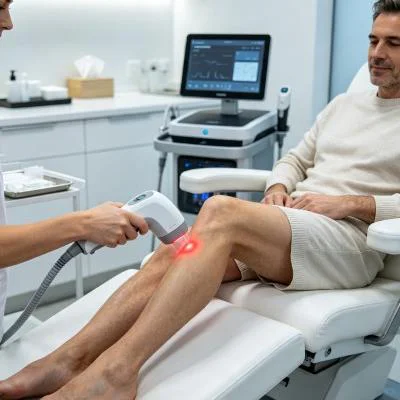
Por qué la longitud de onda de 980 nm requiere un mejor control térmico
La longitud de onda de 980 nm ofrece una experiencia de tratamiento diferente.
La absorción de agua es mayor que a 810 nm.
La absorción de la hemoglobina también cobra importancia.
La interacción con los tejidos resultante puede provocar un calentamiento más rápido.
El calentamiento controlado puede resultar útil en determinadas estrategias de tratamiento.
Sin embargo, un calentamiento local excesivo puede convertirse en el factor que ponga fin al tratamiento antes de que se haya administrado la energía suficiente al objetivo más profundo.
Imagina a un fisioterapeuta tratando la parte medial de la rodilla.
El cabezal de tratamiento permanece sobre una zona pequeña.
La salida es alta.
El láser está funcionando de forma continua.
El tejido superficial acumula calor.
El paciente nota que la temperatura va subiendo y refiere molestias.
El terapeuta tiene dos opciones.
Reduzca la potencia o interrumpa el tratamiento.
Ninguna de las dos resuelve necesariamente el problema inicial de una exposición profunda insuficiente.
Una estrategia más adecuada puede consistir en modificar la distribución temporal de la energía.
El ciclo de trabajo distingue entre la potencia máxima y la carga térmica media
El funcionamiento por pulsos permite al profesional sanitario utilizar una potencia instantánea elevada sin necesidad de aplicar la misma potencia media de forma continua.
El ciclo de trabajo describe la proporción de tiempo durante la cual el láser emite activamente dentro de un ciclo repetitivo.
Un ciclo de trabajo de 25% significa que el periodo de emisión ocupa aproximadamente una cuarta parte del ciclo.
La potencia máxima puede mantenerse alta durante la fase activa.
Sin embargo, el tejido recibe una tasa media de energía inferior a la que recibiría en caso de emisión continua con la misma potencia máxima.
Esto da lugar a períodos en los que el calor puede redistribuirse.
Esto no elimina los efectos térmicos.
Les hace cambiar el ritmo.
En el caso de los tratamientos de alta intensidad, esa distinción puede resultar útil desde el punto de vista clínico.
Por lo tanto, se puede diseñar un protocolo de tratamiento en torno a:
- Potencia máxima
- Frecuencia del pulso
- Ciclo de trabajo
- Duración del tratamiento
- Área de tratamiento
- Movimiento del cabezal de tratamiento
- Energía total
Estas variables deben tenerse en cuenta en su conjunto.
Una máquina que solo proporciona una potencia continua elevada puede ofrecer menos flexibilidad que una plataforma que permita al profesional sanitario controlar tanto la potencia máxima como la media.
Un caso clínico simulado en un servicio de rehabilitación
El siguiente caso es una situación clínica simulada creada para mostrar cómo se puede estructurar un protocolo de tratamiento de alta intensidad. No se trata de un historial clínico real y no debe interpretarse como una prescripción terapéutica universal.
Identificación del caso
| Parámetro clínico | Registro simulado |
|---|---|
| Departamento | Medicina Física y Rehabilitación |
| N.º de caso simulado | PMR-LT-2026-0714 |
| Paciente | Hombre de 66 años |
| Diagnóstico | Artrosis de rodilla con dolor periarticular crónico |
| Clasificación patológica | Grado III según la clasificación de Kellgren-Lawrence |
| Lado del tratamiento primario | Rodilla derecha |
| Duración de los síntomas | 3 años |
| NPRS de referencia | 7/10 |
| WOMAC inicial | 61/96 |
| Flexión activa inicial | 105° |
| Prueba «Timed Up-and-Go» de referencia | 13,8 segundos |
| Motivo principal de la consulta | Dolor al bajar escaleras y al levantarse de una silla |
| Plataforma de tratamiento primario | LaserMedix-MAX |
| Estrategia inicial de longitud de onda | 810 nm dominante |
| Estrategia de longitud de onda secundaria | 915 nm, 940 nm y aportación controlada de 980 nm |
| Contribución a 650 nm | Bajo componente superficial |
| Potencia máxima inicial | 12 W |
| Potencia máxima de pico consumida | 24 W |
| Frecuencia inicial | 15 Hz |
| Frecuencia posterior | 20 Hz |
| Ciclo de trabajo inicial | 25% |
| Ciclo de trabajo posterior | 30% |
| Sesión 1: Energía total | 900 J |
| Sesión 2: Energía total | 1.100 J |
| Sesión 3: Energía total | 1.300 J |
| Sesión 4: Energía total | 1,500 J |
| Sesión 5: Energía total | 1.600 J |
| Sesión 6: Energía total | 1.700 J |
| Sesión 7: Energía total | 1,800 J |
| Sesión 8: Energía total | 1.900 J |
| Frecuencia de tratamiento | Tres sesiones a la semana |
| Rehabilitación complementaria | Fortalecimiento de los cuádriceps y entrenamiento funcional de la marcha |
| Semana 1 del NPRS | 6/10 |
| Semana 2 del NPRS | 5/10 |
| Semana 3 del NPRS | 3–4/10 |
| Semana 4 del NPRS | 2–3/10 |
| Semana 4: WOMAC | 40/96 |
| Semana 4: Flexión activa | 119° |
| Semana 4: Prueba «Up-and-Go» cronometrada | 10,6 segundos |
| Respuesta térmica | Calor moderado sin irritación persistente |
| Modificación del protocolo | Reducción del tiempo de permanencia en la línea articular medial y mantenimiento de la administración pulsada |
¿Por qué el primer tratamiento no fue el más potente?
La máquina era capaz de alcanzar un rendimiento considerablemente superior al establecido en la primera sesión.
Eso no significaba que la primera sesión tuviera que utilizarlo.
El paciente presentaba una enfermedad crónica, un tejido periarticular considerable y una zona de tratamiento relativamente profunda.
El primer objetivo era determinar el nivel de tolerancia.
El terapeuta comenzó con una potencia máxima de 12 W y un ciclo de trabajo de 25%.
El cabezal de tratamiento se desplazó de forma continua por la región periarticular.
En la primera sesión se generaron 900 J.
El paciente refirió una sensación moderada de calor, pero no sintió ardor ni molestias agudas.
Esa información se utilizó para diseñar la siguiente sesión.
Esta distinción resulta útil para cualquiera que vaya a comprar un máquina de terapia láser.
Una potencia máxima elevada proporciona capacidad al profesional sanitario.
No establece cuál es el protocolo de inicio correcto.
La capacidad de funcionar por debajo de la potencia máxima, al tiempo que se controlan la longitud de onda, la estructura del pulso y la distribución del tratamiento, es igual de importante.
Evolución de la energía de tratamiento
En la segunda sesión, la energía total aumentó hasta los 1.100 J.
El tercero alcanzó los 1.300 J.
En la cuarta sesión, el terapeuta aumentó la potencia máxima a aproximadamente 18 W durante las pasadas de tratamiento más profundas.
La energía total alcanzó los 1.500 J.
En la quinta y la sexta sesión, la exposición total aumentó hasta 1.600 y 1.700 J, respectivamente.
Durante estas sesiones, el paciente señaló que la parte medial de la rodilla se calentaba más que la parte lateral.
El terapeuta no se limitó a reducir la duración total del tratamiento.
En cambio, el tiempo de permanencia local se redujo en la zona más cálida.
El cabezal de tratamiento siguió desplazándose por el tejido circundante.
Esto ilustra por qué la respuesta térmica debe analizarse desde una perspectiva espacial.
No es necesario que toda la rodilla responda térmicamente de la misma manera.
El grosor del tejido, la vascularización, la inflamación local y el movimiento del cabezal de tratamiento pueden influir en la respuesta térmica.
Por qué se controló el componente de 980 nm
El protocolo simulado incluía la longitud de onda de 980 nm como componente secundario, en lugar de convertirla en la exposición dominante.
El motivo fue la gestión térmica.
La longitud de onda de 980 nm interactúa más intensamente con el agua que la de 810 nm y puede producir un mayor calentamiento local.
Eso puede resultar útil, pero hay que controlarlo cuando el objetivo está a gran profundidad.
Por lo tanto, el terapeuta utilizó la longitud de onda como parte de una estrategia combinada.
El componente de 810 nm constituyó el principal método de tratamiento en capas más profundas.
Los componentes de 915 nm y 940 nm ampliaron el perfil óptico.
El componente de 980 nm contribuyó a una interacción térmica y vascular controlada.
El tratamiento no se basaba en la hipótesis de que todas las longitudes de onda debieran contribuir por igual.
Un dispositivo de múltiples longitudes de onda resulta más útil cuando el médico puede elegir la importancia relativa de cada longitud de onda.
Lo que realmente sintió el paciente
Durante la primera sesión, el paciente describió la sensación como “cálida, pero agradable”.”
Durante la cuarta sesión, la parte medial de la rodilla se calentó notablemente.
No se produjo ningún dolor agudo, sensación de ardor ni irritación cutánea persistente.
El terapeuta respondió aumentando la velocidad de movimiento en esa zona.
Se trata de un pequeño ajuste, pero ilustra una cuestión importante.
Un protocolo de tratamiento de alta intensidad no siempre es estático.
Es posible que la máquina tenga la misma potencia.
La energía total podría ser similar.
Sin embargo, la distribución de esa energía por toda la zona de tratamiento puede variar en función de la respuesta del paciente.
Por eso, la técnica del profesional sanitario sigue siendo importante incluso cuando la máquina cuenta con sofisticados ajustes automáticos.
¿Por qué aumentó la energía total en lugar de maximizarse la potencia?
El objetivo del tratamiento era la exposición acumulada, no una sensación instantánea intensa.
Por lo tanto, el terapeuta fue aumentando progresivamente la energía total.
Este enfoque aportó varias ventajas.
El paciente podría mostrar tolerancia.
Se pudo observar el comportamiento térmico.
Se podrían realizar un seguimiento de los cambios funcionales.
El terapeuta podría determinar si el aumento de la exposición estaba produciendo un beneficio clínico significativo antes de pasar a una intensidad mayor.
Esto es más razonable que empezar con la potencia máxima y dar por sentado que una mayor cantidad de energía debe producir un mejor resultado.
Resultados tras cuatro semanas
La puntuación inicial del dolor del paciente era de 7/10.
Al final de la primera semana, había bajado hasta aproximadamente 6/10.
En la segunda semana, el paciente refería un dolor de 5 sobre 10.
Durante la tercera semana, la puntuación alcanzó aproximadamente un 3-4 sobre 10.
En la octava sesión, el dolor se situaba, en general, entre 2 y 3 sobre 10.
La puntuación en la escala WOMAC mejoró de 61/96 a 40/96.
La flexión activa de la rodilla aumentó de 105° a 119°.
El tiempo en la prueba «Up-and-Go» mejoró de 13,8 segundos a 10,6 segundos.
El paciente también señaló que le resultaba más fácil bajar las escaleras y que levantarse de una silla le exigía un menor esfuerzo de las extremidades superiores.
Estos resultados se presentan como la evolución simulada de un caso.
No deben interpretarse como una prueba de que esa combinación concreta de parámetros vaya a dar lugar al mismo resultado en otro paciente.
La lección importante es la estructura del caso.
Se midió el dolor.
Se midió la función.
Se documentaron los parámetros del tratamiento.
Se registró la respuesta térmica.
El protocolo se adaptó en función del paciente.
Por qué no se debe juzgar el tratamiento con láser únicamente por el alivio inmediato del dolor
Un error habitual a la hora de evaluar un tratamiento con láser es preguntar si el dolor del paciente desapareció inmediatamente después de la sesión.
Un cambio inmediato en los síntomas puede ser una información útil, pero no es suficiente.
Un paciente puede sentirse mejor temporalmente tras someterse a varios tipos de tratamiento.
La cuestión clínica más relevante es si el tratamiento contribuye a una mejora de la función con el paso del tiempo.
¿Puede el paciente caminar más lejos?
¿Pueden subir escaleras?
¿Pueden hacer ejercicios de fortalecimiento?
¿Ha mejorado la amplitud de movimiento?
¿Está disminuyendo el dolor al realizar una actividad funcional concreta?
Estos resultados resultan más útiles a la hora de evaluar si un láser para terapia desempeña un papel práctico en el proceso de rehabilitación.
Cómo se integra el tratamiento de alta intensidad en la rehabilitación
El protocolo clínico más sólido no plantea el tratamiento con láser como una alternativa al ejercicio.
Integra las modalidades.
Un paciente puede acudir con un dolor que le limite el movimiento activo.
El terapeuta lleva a cabo la evaluación clínica.
El tratamiento con láser se aplica en la zona anatómica seleccionada.
Se controla la respuesta térmica del paciente.
A continuación, la sesión pasa a la fase de rehabilitación activa.
El paciente realiza ejercicios de fortalecimiento, movilidad o control motor dentro de los límites establecidos por el diagnóstico.
En las visitas posteriores, se vuelven a evaluar tanto los síntomas como la función.
Esto crea una secuencia lógica.
No se pretende que el láser sustituya a la rehabilitación.
Se está utilizando como uno de los componentes de un plan de tratamiento más amplio.
Esa distinción también tiene importancia desde el punto de vista comercial.
Es más probable que una clínica de rehabilitación valore un dispositivo que se integre de forma natural en su flujo de trabajo actual que una máquina que requiera una filosofía de tratamiento completamente distinta.
¿Qué hace que un aparato de terapia láser resulte útil en una clínica real?
Una especificación de alto rendimiento es solo uno de los factores que influyen en la decisión de compra.
Una evaluación práctica debería tener en cuenta varios factores.
Flexibilidad en la longitud de onda
¿Puede el sistema ofrecer múltiples longitudes de onda adecuadas para diferentes profundidades de tejido y objetivos clínicos?
Un sistema de múltiples longitudes de onda puede resultar más adaptable que una plataforma de una sola longitud de onda cuando un servicio trata una amplia variedad de afecciones musculoesqueléticas.
Control de salida
¿Puede el terapeuta ajustar la intensidad de forma progresiva?
La posibilidad de comenzar con una dosis baja y aumentarla en función de la tolerancia del paciente resulta clínicamente útil.
Modos pulsado y continuo
¿Puede el sistema funcionar en diferentes modos temporales?
Esto cobra especial relevancia cuando el control térmico es importante.
Área de tratamiento
¿Es capaz el dispositivo de tratar de forma eficaz una articulación grande, un grupo muscular o una región anatómica?
La eficacia del tratamiento es fundamental en un servicio de rehabilitación con mucha actividad.
Monitorización térmica
¿Puede el terapeuta controlar la respuesta térmica del paciente?
Ni siquiera una máquina sofisticada puede prescindir de la información que aporta el paciente, pero unos controles térmicos adecuados pueden facilitar el tratamiento.
Reproducibilidad del protocolo
¿Pueden los profesionales clínicos documentar los ajustes con la suficiente claridad como para que otro terapeuta pueda entender lo que se ha hecho?
Esto es especialmente importante cuando en una clínica hay varios terapeutas que utilizan el mismo equipo.
Por qué una plataforma de 30 W es diferente de un sistema de baja potencia
La diferencia práctica entre los sistemas de bajo rendimiento y los de alto rendimiento no se reduce simplemente a que una cifra sea mayor.
Una plataforma de alto rendimiento ofrece una mayor capacidad de suministro de energía.
Esto puede hacer que el tratamiento de regiones anatómicas más extensas resulte más práctico.
Por ejemplo, un terapeuta que trate una zona amplia del cuádriceps puede necesitar aplicar una energía total considerable.
A una potencia muy baja, el tratamiento puede tardar más tiempo.
A mayor potencia, se puede suministrar la misma energía acumulada en un plazo más razonable.
Sin embargo, el aumento de la capacidad de suministro de energía plantea una nueva exigencia.
El terapeuta debe controlar la acumulación de calor.
Por eso, el tratamiento de alto rendimiento es, en esencia, un problema de control.
La máquina necesita suficiente potencia.
El terapeuta debe tener el control suficiente.
La diferencia entre 980 nm y 1470 nm cobra una importancia fundamental en cirugía
Estos mismos principios de longitud de onda resultan aún más evidentes al comparar las aplicaciones de rehabilitación con las quirúrgicas.
A 1470 nm, la absorción del agua es considerablemente mayor que a 980 nm.
Esto significa que la energía de 1470 nm se absorbe con mayor intensidad en los tejidos con alto contenido en agua y en una distancia óptica más corta.
Esto lo hace útil para la interacción controlada entre el tejido y la cirugía.
El SurgMedix-MAX de FotonMedix combina longitudes de onda de 1470 nm y 980 nm con un componente de 635 nm para aplicaciones quirúrgicas.
La plataforma está diseñada para funciones como el corte, la incisión, la extirpación, la coagulación y la evaporación.
Esto difiere fundamentalmente de la rehabilitación externa.
Para un procedimiento no invasivo láser para terapia, el profesional sanitario suele intentar aplicar energía sin dañar el tejido.
En cirugía, la destrucción o la coagulación de los tejidos pueden ser el objetivo previsto.
Por lo tanto, este mismo concepto de absorción dependiente de la longitud de onda da lugar a aplicaciones clínicas muy diferentes.
Por qué 1470 nm no es un atajo para la terapia externa profunda
Dado que la longitud de onda de 1470 nm presenta una fuerte absorción por parte del agua, no debe darse por sentado que sea la longitud de onda ideal para llegar a las estructuras musculoesqueléticas profundas a través de la piel intacta.
Una absorción intensa implica un gran aporte de energía.
Esto puede resultar útil cuando el objetivo se encuentra lo suficientemente cerca de la superficie de tratamiento y se desea una interacción controlada con el tejido.
Para objetivos más profundos y no invasivos, pueden resultar más adecuadas las longitudes de onda con características de penetración más favorables.
Por eso, cualquier debate clínico serio sobre la longitud de onda del láser debe tener en cuenta la profundidad objetivo.
No se puede calificar una longitud de onda como “la mejor” sin determinar dónde debe aplicarse el tratamiento.
El papel de la longitud de onda de 980 nm en la interacción vascular
La longitud de onda de 980 nm también ilustra por qué la elección de la longitud de onda no puede reducirse únicamente a la penetración.
Los cromóforos de la sangre contribuyen a la absorción en esta región.
Esto hace que la longitud de onda de 980 nm sea relevante para las interacciones vasculares y térmicas.
En un contexto de rehabilitación no invasiva, esto puede contribuir al entorno biológico y térmico general del tratamiento.
En cirugía, esas mismas características de absorción pueden contribuir a la coagulación.
Por lo tanto, el efecto deseado depende de la aplicación clínica.
Esta es otra razón por la que las plataformas multilongitud de onda pueden resultar muy útiles.
Permiten a los profesionales clínicos seleccionar diferentes comportamientos ópticos, en lugar de esperar que una sola longitud de onda desempeñe todas las funciones.
Por qué es importante la frecuencia del pulso
El ciclo de trabajo describe la proporción del tiempo de emisión activa.
La frecuencia describe la periodicidad con la que se repiten los impulsos.
Estas variables están relacionadas, pero no son idénticas.
Dos protocolos pueden tener el mismo ciclo de trabajo, pero frecuencias de pulso diferentes.
Por lo tanto, la distribución temporal de la energía será diferente.
En los tratamientos de alta potencia, la frecuencia de los pulsos cobra importancia, ya que el tejido responde tanto a la cantidad de energía aplicada como a la velocidad a la que se deposita.
Un protocolo que utilice pulsos repetidos más cortos puede comportarse de forma diferente a uno que utilice intervalos de emisión más largos, incluso cuando la energía total sea similar.
Por lo tanto, el profesional sanitario debería registrar la frecuencia, en lugar de considerar el “modo pulsado” como una descripción completa.
Cómo es un buen registro clínico
Un registro útil de un tratamiento de alta intensidad puede ser sencillo.
Debe indicar:
- Diagnóstico
- Área de tratamiento
- Profundidad objetivo
- Longitud de onda
- Potencia máxima
- Frecuencia
- Ciclo de trabajo
- Duración del tratamiento
- Energía total
- Área de tratamiento
- Técnica de movimiento
- Respuesta térmica del paciente
- Dolor antes del tratamiento
- Dolor tras el tratamiento
- Resultado funcional
- Cambios en el protocolo
De este modo se crea un historial de tratamientos.
Además, proporciona a la clínica una base para la mejora interna de la calidad.
Si varios pacientes reciben un tratamiento similar, pero los resultados varían considerablemente, el departamento puede analizar si las diferencias en la longitud de onda, la energía, la zona de tratamiento o la participación en la rehabilitación explican dicha variación.
Sin registros estructurados, ese análisis resulta complicado.
Por qué una plataforma multilongitud de onda puede ayudar a los compradores B2B
Para un distribuidor internacional o un comprador de equipos de rehabilitación, la versatilidad del producto puede ser tan importante como su rendimiento.
Una clínica puede tratar:
- Osteoartritis
- Tendinopatía
- Lesión muscular
- Lesiones deportivas
- Dolor crónico
- Rehabilitación posoperatoria
- Afecciones de los tejidos blandos
Las zonas anatómicas a las que se dirigen son diferentes.
Las profundidades de los tejidos son diferentes.
La respuesta térmica deseada puede variar.
Por lo tanto, una plataforma de múltiples longitudes de onda puede ofrecer un conjunto de herramientas clínicas más amplio.
El LaserMedix-MAX de FotonMedix combina cinco longitudes de onda con una configuración de potencia máxima de 30 W y cuenta con características diseñadas para tratamientos no invasivos de alta energía.
Sus plataformas veterinarias y equinas amplían ese mismo concepto de alta energía y múltiples longitudes de onda al ámbito de la rehabilitación animal.
Este tipo de familia de productos también puede resultar interesante para los distribuidores B2B que buscan equipos que abarquen varios segmentos de mercado, en lugar de una indicación concreta.
La diferencia práctica entre ser propietario de una máquina y utilizar un sistema
Una máquina láser es un equipo.
Un sistema de tratamiento se compone de hardware y protocolo.
Esa distinción parece sencilla, pero influye en las decisiones de compra.
Una máquina con un alto rendimiento pero con un control limitado puede resultar difícil de integrar en un flujo de trabajo clínico estandarizado.
Un sistema con múltiples longitudes de onda, potencia de salida ajustable, control de pulsos y monitorización térmica ofrece a los profesionales sanitarios más opciones para adaptar el tratamiento.
La diferencia cobra especial importancia cuando un departamento cuenta con varios terapeutas.
Es posible que un terapeuta prefiera una técnica de exploración más lenta.
Otro puede utilizar un patrón de movimiento más rápido.
Sin la documentación del protocolo, el tratamiento deja de ser coherente.
Al disponer de datos documentados sobre la longitud de onda, la energía, la potencia, la frecuencia y el ciclo de trabajo, el departamento puede crear flujos de trabajo repetibles y formar al nuevo personal de forma más eficaz.
El verdadero significado del tratamiento con láser para los tejidos profundos
Tratamiento con láser de tejidos profundos No se trata simplemente de aumentar la potencia hasta que el tejido diana “sienta” el láser.
Cuanto más profundo se encuentra el objetivo, mayor es la energía que se pierde por absorción y dispersión antes de que la energía llegue a él.
Los tejidos superficiales permanecen expuestos a la energía que incide sobre ellos.
Eso da lugar al conflicto central de la trama.
El profesional sanitario debe compensar la atenuación sin permitir que la acumulación térmica superficial domine la sesión.
La solución consiste en una combinación de control óptico y temporal.
La longitud de onda determina el entorno de absorción.
La potencia determina la cantidad de energía disponible.
La frecuencia de los impulsos y el ciclo de trabajo determinan cómo se distribuye esa energía a lo largo del tiempo.
El movimiento determina el grado de concentración de la exposición en la zona de tratamiento.
Los julios totales representan la energía acumulada.
Las opiniones de los pacientes aportan información real sobre la respuesta térmica.
Los resultados funcionales permiten al médico saber si la estrategia terapéutica general está dando lugar a cambios positivos.
No hay ninguna variable que por sí sola explique todo el panorama.
Por qué una mayor potencia no siempre es mejor
Un láser de alta potencia puede resultar extremadamente útil cuando se controla adecuadamente.
Puede agilizar el tratamiento de superficies extensas.
Puede proporcionar la energía incidente suficiente para tratar regiones anatómicas más profundas.
Esto puede ofrecer al terapeuta una mayor flexibilidad a la hora de seleccionar los parámetros del tratamiento.
Pero la potencia máxima no es más que una capacidad.
Si el terapeuta aplica demasiada potencia en una zona demasiado pequeña, la piel se convierte en el factor limitante.
Si el ciclo de trabajo no es el adecuado, la acumulación de calor puede aumentar demasiado rápido.
Si la longitud de onda no se adapta bien al objetivo, es posible que gran parte de la energía sea absorbida antes de llegar al tejido deseado.
Si el tratamiento no se integra con la rehabilitación, es posible que la mejora de los síntomas no se traduzca en una mejora de la función.
Por lo tanto, el mejor enfoque no es alcanzar el máximo rendimiento.
Se trata de una salida controlada.
Preguntas prácticas sobre compras para un departamento de rehabilitación
Antes de elegir un máquina de terapia láser, un departamento debería preguntarse:
¿Es capaz el sistema de tratar las profundidades de tejido con las que nos encontramos realmente?
¿Puede el profesional sanitario elegir entre varias longitudes de onda?
¿Se puede ajustar la potencia de forma progresiva?
¿Puede el sistema funcionar en modo pulsado y continuo?
¿Se pueden controlar la frecuencia de los pulsos y el ciclo de trabajo?
¿Se puede documentar la energía aplicada durante el tratamiento?
¿Puede el terapeuta controlar la respuesta térmica?
¿Es posible cubrir la zona de tratamiento de forma eficaz?
¿Pueden varios terapeutas aplicar el mismo protocolo?
¿Se adapta el dispositivo al flujo de trabajo de rehabilitación actual de la clínica?
Estas preguntas son más útiles que preguntarse qué máquina tiene la potencia más alta.
Un sistema de alta potencia adquiere valor clínico cuando el terapeuta puede controlar la energía, en lugar de limitarse a recibir una mayor cantidad de la misma.
La lección final del caso simulado
El paciente simulado de 66 años con artrosis de rodilla no obtuvo el máximo rendimiento en la primera sesión.
El protocolo comenzó con una energía controlada.
La estrategia de longitud de onda se seleccionó en función de la profundidad objetivo.
El tratamiento fue por pulsos.
El cabezal de tratamiento siguió moviéndose.
La energía total aumentó gradualmente.
Se controló la respuesta térmica del paciente.
El protocolo se modificó cuando una zona se calentó.
Se evaluaron el dolor y la función a lo largo de las cuatro semanas que duró el estudio.
Eso es lo que hace que el caso sea clínicamente realista.
El láser no funcionaba de forma independiente del paciente.
El tratamiento variaba en función del paciente.
Para un departamento de rehabilitación, ese es el verdadero valor de un equipo moderno de alto rendimiento láser para terapia.
Proporciona la energía suficiente para que el tratamiento profundo y de gran superficie resulte viable, al tiempo que ofrece al profesional sanitario el control necesario para gestionar cómo llega esa energía al tejido biológico.
Un útil máquina de terapia láser Por lo tanto, no debería juzgarse únicamente por su potencia máxima.
Se debe evaluar en función de su eficacia a la hora de convertir la potencia óptica disponible en un tratamiento clínico controlado.
Y para tratamiento con láser de tejido profundo, esa distinción lo es todo.
El objetivo no es que la superficie se caliente más.
El objetivo es gestionar la atenuación, la absorción, la transmisión de energía y la respuesta térmica de tal manera que el tejido al que va dirigido reciba una exposición terapéutica significativa.
Esa es la diferencia entre limitarse a encender un dispositivo de alta potencia y aplicar un tratamiento médico con láser cuidadosamente controlado.