 FotonMedix












Obstacles à la microcirculation de la moelle épinière chez les chiens atteints d'IVDD
Dual spectral absorption peaks trigger capillary reperfusion while gated microsecond pulses prevent spinal thermal build-up.
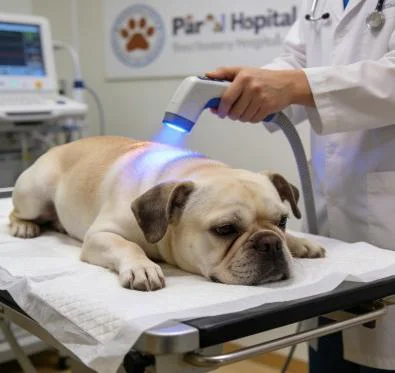
A seven-year-old French Bulldog arrives on an emergency gurney, forelimbs bracing while dragging paralyzed pelvic limbs in a flaccid crawl. The diagnosis is familiar across veterinary neurology suites: Hansen Type I intervertebral disc herniation at the thoracolumbar junction with acute spinal cord compression and lost superficial nociception. Corticosteroids spike blood glucose and induce severe gastrointestinal distress, surgical decompression carries anesthesia and financial risks that push owners toward euthanasia, and low-power surface units cannot deliver photons through the dorsal fascia, deep epaxial musculature, and thick vertebral laminar bone. The nervous tissue sits choked in ischemic hypoxia, running out of metabolic time while inflammation compounds ischemic neural death.
Reaching ischemic spinal neurons requires addressing the physics of photon attenuation across osseous structures. Bone minerals and compact hydroxyapatite crystals disperse standard light beams, scattering photons before they cross the vertebral canal. To trigger axonal regeneration and relieve neuropathic inflammation, the photon density reaching the ventral epidural space must remain above the biological repair threshold after navigating thick skin, dense fascial planes, heavy epaxial muscles, and calcified vertebrae.
Overcoming Bone And Fascia Barriers In Spinal Trauma
Spinal photobiomodulation faces unique physical limits compared to peripheral joint therapy. Dorsal cortical bone acts as a strong optical barrier, with Rayleigh scattering in bone crystals rapidly reducing superficial light beams. Soft tissue overlying the spine further reduces photon flux, with dermal melanin and muscle tissue stripping light before it touches the periosteum.
[Incident Beam Over Paraspinal Skin]
          │
          ▼ (Melanin & Epidermal Scatter)
[Thick Thoracolumbar Fascia]
          │
          ▼ (Hemoglobin Stripping in Epaxial Muscle Beds)
[Longissimus & Spinalis Muscle Masses]
          │
          ▼ (Hydroxyapatite Scattering in Cortical Bone)
[Dorsal Vertebral Arch & Lamina]
          │
          ▼ (Target Delivered Photon Flux > Biological Threshold)
[Ischemic Spinal Cord & Edematous Nerve Roots]
Reaching therapeutic thresholds within the spinal cord requires precise wavelength selection and power management. Photons must pass through hard bone without heating the dense overlying muscle. Operating a specialized pet laser therapy device requires managing beam energy and timing so that sufficient Joules reach compressed spinal roots without creating hot spots in superficial tissues.
Dual-wavelength delivery overcomes depth barriers by targeting complementary cellular receptors. Combining distinct absorption peaks delivers focused biological stimulation across deep spinal structures.
Target Tissue Stratum         Primary Wavelength          Physiological Target Mechanism
-----------------------------------------------------------------------------------------
Epaxial Spasm Bed             980 nm                      Microvascular dilation, waste clearing
Spinal Edema & Dura           1470 nm                     Fluid mobilization, decompression
Dorsal Horn Neurons           980 nm / 1470 nm Blend      Mitochondrial ATP production
The 980nm Hemoglobin Profile And Ischemic Reperfusion
The 980nm spectrum matches the absorption bands of both oxygenated and deoxygenated hemoglobin, making it effective for treating spinal ischemia. Disc herniation compresses local capillary loops, starving motor neurons of oxygen and halting adenosine triphosphate synthesis.
Delivering this wavelength causes localized photothermal dilation of collateral vascular pathways. Hemoglobin absorbs 980nm energy, generating nitric oxide that relaxes constricted microvascular sphincters. Fresh oxygenated blood enters the hypoxic cord, re-energizing cytochrome c oxidase within neuronal mitochondria. Delivering calibrated class 4 laser therapy for dogs accelerates cellular recovery, clearing acidic metabolites and providing the energy injured axons need to restore action potential conduction.
The 1470nm Water Absorption Dynamic In Acute Cord Edema
Spinal cord trauma triggers rapid water accumulation inside the confined vertebral canal. Secondary cord edema increases intraspinal pressure, crushing capillary beds and causing ischemia-induced necrosis. The 1470nm wavelength targets free and bound water molecules within this swollen spinal tissue.
High absorption at 1470nm targets interstitial fluid trapped inside damaged tissues. Photons alter extracellular matrix permeability, speeding the clearance of protein-rich fluid through paraspinal lymphatic vessels. Relieving hydrostatic pressure within the dural sheath reduces mechanical pressure on descending motor tracts. Integrating 1470nm into class 4 laser therapy pets protocols addresses edema and neuropathic pain directly, helping preserve nervous tissue during the post-injury window.
Duty Cycle Engineering To Prevent Spinal Hyperthermia
Spinal applications require higher average power to penetrate dense bone, but continuous beam emission presents serious risks over canine vertebrae. Bone absorbs energy rapidly, creating hot spots that can irritate the periosteum and damage neural tissue. Dynamic duty cycle control avoids these thermal spikes.
Interrupting the continuous beam creates thermal relaxation gaps where heat disperses between pulses. Bone and muscle dissipate heat faster than they absorb peak energy pulses, allowing clinicians to use high peak power to penetrate the spine while keeping skin and periosteum temperatures well within safe limits.
Continuous Wave (Vertebral Hyperthermia Risk):
Power ───────────────────────────────────────── (Periosteal Thermal Risk)

Gated Dynamic Duty Cycle (Bone Thermal Dissipation):
Power ┌──┐    ┌──┐    ┌──┐    ┌──┐    ┌──┐
      │  │    │  │    │  │    │  │    │  │   (Deep Neural Penetration / No Heat)
Base  ┘  └────┘  └────┘  └────┘  └────┘  └────
      | Ton |   Toff   |
A 40 percent duty cycle lowers surface heat buildup while maintaining the photon density needed to reach the spinal canal. Adjusting frequencies between 10 Hertz and 500 Hertz helps target specific tissues: low frequencies reduce sensory nerve irritation, while higher frequencies speed fibroblast repair in torn fibrous rings.
Shifting pulse shapes prevents cells from adapting to the light signal. Varying modulation over the treatment protocol ensures mitochondrial enzymes remain responsive, maximizing cumulative adenosine triphosphate production across the rehabilitation program.
Rapport de cas clinique sur le terrain
The following data comes from Veterinary Emergency and Neurology Care unit records, documenting functional motor recovery in a canine patient with severe neurological deficits.
Profil du patient et stadification diagnostique
Case File Number: VNC-2026-9104
Subject: Canine, French Bulldog
Age: 7 Years 2 Months
Sexe : Femelle (stérilisée)
Weight: 12.8 Kilograms
Presenting Complaint: Acute inability to bear weight on pelvic limbs, sudden vocalization after jumping, hunched thoracolumbar spine, flaccid paraparesis.
Neurological Examination: Grade 3 Paraparesis with intact deep pain perception; absent conscious proprioception in both hind paws; hyperreflexive patellar reflexes; severe hyperesthesia from T12 to L2.
Imaging Diagnosis: Spinal MRI reveals Hansen Type I intervertebral disc herniation at T13-L1 with 40 percent canal cross-sectional compression and localized intramedullary hyperintensity on T2-weighted images indicating edema. Pre-treatment Modified Frankel Score: 2 (Non-ambulatory paraparesis).
| Identifiant de session | Jour | Zone cible | Séparation des longueurs d'onde | Puissance de crête (W) | Facteur de marche (%) | Fréquence (Hz) | Énergie totale (J) | Observations cliniques |
| S-01 | D-01 | T11-L3 Spine | 80% 980 nm / 20% 1 470 nm | 8.0 | 35% | 15 | 1,800 | Guarded spinal palpation; slow contact scanning used; no skin heat buildup. |
| S-02 | D-02 | T11-L3 Spine | 75% 980 nm / 25% 1 470 nm | 9.0 | 40% | 20 | 2,200 | Muscle guarding down along epaxial zone; dog relaxes spinal posture during treatment. |
| S-03 | D-04 | T11-L3 Spine | 70% 980 nm / 30% 1 470 nm | 10.0 | 40% | 50 | 2,600 | Superficial nociception returns to left hind digit; voluntary tail wag observed. |
| S-04 | D-06 | T11-L3 & Gluteals | 65% 980 nm / 35% 1 470 nm | 12.0 | 45% | 100 | 3,200 | Assisted stance sustained for 10 seconds; proprioceptive knuckling delay drops. |
| S-05 | D-08 | T11-L3 & Limbs | 60% 980 nm / 40% 1 470 nm | 14.0 | 50% | 250 | 3,800 | Voluntary motor control returns to right hind leg; assisted walking initiated. |
| S-06 | J-11 | T11-L3 Spine | 50% 980 nm / 50% 1 470 nm | 15.0 | 50% | 500 | 4,200 | Independent rising achieved; dog walks 5 meters on slip-resistant flooring. |
| S-07 | D-15 | T11-L3 Paraspinal | 50% 980 nm / 50% 1 470 nm | 15.0 | 45% | Dynamique | 4,000 | Normal urinary control restored; postural correction response under 2 seconds. |
| S-08 | D-20 | Biomechanical Arc | 50% 980 nm / 50% 1 470 nm | 12.0 | 40% | Dynamique | 3,500 | Unassisted steady gait across open surfaces; minimal residual ataxia present. |
Objective Neurological Progression Metrics
Day 1 (Admission)
[Frankel Score: 2]   ████░░░░░░░░░░░░░░░░
[Hind Leg Reflexes]  Absent Proprioception

Day 6 (Mid-Course)
[Frankel Score: 3]   ████████░░░░░░░░░░░░
[Hind Leg Reflexes]  Delayed Proprioception

Day 20 (Discharge)
[Frankel Score: 5]   ████████████████████
[Hind Leg Reflexes]  Full Bilateral Sensation
By session eight on Day 20, the patient completed a full neurological recovery. The Modified Frankel Score rose from an initial non-ambulatory Grade 2 to a functional, ambulatory Grade 5. Conscious proprioception returned to normal across both pelvic limbs, with paw placement response times dropping below one second.
Palpation confirmed complete resolution of spinal hyperesthesia between T12 and L2. The dog regained independent urinary continence, eliminating secondary bladder infection risks and allowing the patient to return home on a safe, conservative rehabilitation plan.
Practical Advantages Over Traditional Neurological Care
Standard medical care for acute canine spinal trauma presents difficult clinical choices. High-dose corticosteroid regimes carry risks of gastric perforation, pancreatitis, and immunosuppression, while providing limited direct benefit for microvascular perfusion in the spinal cord. Spinal decompressive surgery remains expensive and carries risks of post-operative scarring, prolonged recovery, or surgical site complications. Meanwhile, basic low-level light therapy cannot deliver enough photons through thick paraspinal muscles and vertebrae to treat the injured spinal cord.
Adopting high-power Class 4 dual-wavelength protocols offers a safer, reliable alternative for handling spinal trauma. Short, eight-minute sessions allow clinics to deliver deep therapeutic doses without stressing unstable patients. Gated pulse timing keeps temperatures safe over spinal bone while penetrating deep into the canal to target swollen nerves.
Combining 980nm microvascular stimulation with 1470nm water absorption reduces cord edema while reoxygenating ischemic neural tissues. Paralyzed dogs regain motor control faster, pet owners avoid invasive surgery and costly medications, and veterinary practices gain an effective, reproducible protocol for challenging neurological cases.