 FotonMedix












Élimination de la raideur capsulaire récidivante dans la capsulite adhésive réfractaire
Deliver deep optical flux across multi-layered glenohumeral capsules with dual-wavelength precision. Target bound interstitial water and microvascular congestion without epidermal thermal saturation. Regulate cutaneous heat dissipation via microsecond-gated duty cycles.
A sports medicine or physical therapy consultation room sees this exact scenario weekly: a 52-year-old executive sits forward on the examination plinth, their shoulder pinned tightly against their ribs, unable to reach their back pocket or lift their arm to comb their hair. The clinical intake confirms Stage II freezing adhesive capsulitis. The patient has already spent eight months cycling through passive pendulum exercises, painful manual joint mobilizations, and uncalibrated cold light treatments that barely warmed the skin. They are frustrated by the ballooning deep tissue laser therapy cost from previous clinics where low-power units dragged out care over thirty inconclusive visits. Under the therapist’s thumb, the anterior axillary pouch and coracohumeral ligament feel like dense, scarred wood. When previous practitioners dialed up power on uncalibrated continuous systems to force light through the dense deltoid, the patient pulled away from sharp surface stinging long before photons reached the thickened joint capsule.
Basic low-intensity modalities fail because optical energy attenuates inside superficial skin and deltoid fibers. Trying to push past this barrier with standard continuous emitters triggers rapid epidermal heat buildup. The patient feels unbearable skin burning, forcing the therapist to terminate the session well below the threshold needed to trigger capsular remodeling.
Solving this clinical impasse requires driving therapeutic photonic flux through thick periarticular collagen directly into the ischemic capsule while keeping the overlying skin cool and pain-free.
Optical Attenuation Across the Glenohumeral Envelope
Reaching the glenohumeral joint space presents an anatomical barrier. Photons must pass through stratified epidermis, subcutaneous adipose, the bulky acromial deltoid, subdeltoid bursa, and finally the thick, fibrotic joint capsule itself. According to the Kubelka-Munk optical transport model, forward-directed light scatters across cellular interfaces, creating an exponential energy drop-off before reaching intra-articular structures.
In biological tissues, three primary endogenous absorbers dictate photon pathways: cutaneous melanin, vascular hemoglobin, and interstitial water.
In chronic adhesive capsulitis, the primary pathology involves dense fibroblast proliferation and excessive type I and type III collagen cross-linking within the coracohumeral ligament and axillary fold, lying 4 to 6 centimeters beneath the surface. Low-power Class III equipment cannot clear this depth; over 95% of its light scatters into shallow dermal and muscular layers. The deeper capsular tissue receives almost zero photons, leaving chronic inflammatory contractures locked in hypoperfusion.
Overcoming this steep decay curve demands a multi-wavelength deep tissue laser therapy machine capable of delivering high peak power without exceeding surface thermal thresholds.
Stratum Corneum & Melanin Barrier (Surface Interface)
         │ (Forward Light Scattering)
         ▼
Deltoid Muscle & Subdeltoid Bursa (Adipose & Fibrous Sheaths)
         │ (980nm Hemoglobin Deoxygenation Targeting)
         ▼
Periarticular Interstitial Water Matrix (Synovial Fluid & Capsule)
         │ (1470nm Aqueous Cleaving & Softening)
         ▼
Dense Coracohumeral Ligament & Axillary Fold (Mitochondrial Activation)
Targeting hemoglobin and water chromophores in tandem breaks the cycle of capsular fibrosis:
At 980nm, photon capture aligns with absorption peaks for oxygenated and deoxygenated hemoglobin. In adhesive capsulitis, compressed microvessels choke the capsule, trapping inflammatory cytokines like interleukin-1-beta and transforming growth factor-beta. The 980nm wavelength triggers localized vasodilation, prompting circulating red blood cells to release bound nitric oxide, flushing stagnant metabolites and improving tissue oxygenation.
At 1470nm, photon absorption shifts toward bound water molecules within the thickened capsular matrix. Interstitial water absorbs 1470nm light at rates significantly higher than in the 800nm zone. This absorption produces controlled micro-thermal fields that break down rigid, polymerized hyaluronic acid complexes, softening dense collagen sheets and restoring flexibility to the joint envelope.
Delivering this combined optical power into deep joint structures without scorching surface skin requires precise pulse modulation.
Duty Cycle Mechanics and Cutaneous Thermal Relaxation
Continuous-wave light delivery faces a hard biological limit: superficial skin layers heat up much faster than passive capillary circulation can clear the energy. The thermal relaxation time of the human epidermis is short, meaning continuous delivery quickly overwhelms cutaneous cooling, firing sensory heat receptors.
Precision micro-pulse gating overcomes this limitation. Slicing high-output beams into microsecond pulses separated by controlled dark intervals allows deep tissues to receive high peak irradiance while surface layers shed heat safely between bursts.
$$\text{Cycle de service (\%)} = \left( \frac{\tau_{\text{actif}}}{\tau_{\text{actif}} + \tau_{\text{repos}}} \right) \times 100$$
Where $\tau_{\text{active}}$ represents active emission time and $\tau_{\text{rest}}$ represents the thermal dissipation pause.
Applying 20W of continuous laser energy over the anterior joint line causes uncomfortable skin heating within 4 seconds. In contrast, running that same power through a 25% duty cycle delivers intense peak pulses that penetrate deep into the dense capsule, while the 75% dark phase lets surface tissues cool down.
Perfusion clears heat from the skin surface, while hypoperfused capsular contractures absorb the required photon density, initiating tissue remodeling without surface discomfort.
Multi-Wavelength Synergies in Periarticular Connective Tissue
Targeting complex shoulder contractures with a single wavelength leaves therapeutic gaps. Frozen shoulder involves skin, adipose layers, deltoid fibers, subacromial bursal walls, and thick fibrous capsular tissue. Each anatomical layer holds different water volumes, microvascular densities, and optical scattering coefficients.
Combining coordinated wavelengths creates a steady therapeutic gradient through each anatomical layer:
[ Periarticular Absorption Dynamics ]

810nm  ──► Mitochondrial Cytochrome c Oxidase (ATP Synthesis Surge)
980nm  ──► Axillary Capillary Perfusion & NO Release (Decongesting Edema)
1064nm ──► Deep Muscular Fascia (Forward Directional Penetration)
1470nm ──► Capsular Hydration Shells (Cleaving Cross-Linked Collagen)
Pairing 980nm and 1470nm produces immediate biomechanical and circulatory improvements. The 980nm beam opens compressed microvascular beds, delivering fresh oxygen to ischemic tissue. Concurrently, 1470nm targets bound water molecules inside the stiff capsular matrix, softening rigid collagen cross-links.
Clinicians use this dual-action delivery to soften guarded, frozen joints, making subsequent passive stretching and end-range manual mobilization far more productive.
Clinical Efficiency and Practice Economics
High-power Class IV platforms streamline clinical workflows and patient progression in busy orthopedic centers.
Therapists managing chronic frozen shoulder, complex regional pain, or severe post-surgical joint contractures often spend extensive time on slow, painful manual interventions. Low-intensity Class III modalities require 35 to 45 minutes of tedious scanning just to deliver minimal joules through the deltoid, leading to long treatment courses that raise the overall deep tissue laser therapy cost for patients. A high-output deep tissue laser therapy machine cuts treatment times to under nine minutes while delivering meaningful, therapeutic energy directly to the injury site.
Private practices and sports rehabilitation centers evaluating a deep tissue laser therapy treatment platform realize clear clinical and economic advantages:
First, practitioners deliver target therapeutic doses in 7 to 10 minutes, optimizing daily patient throughput and eliminating physical strain from aggressive manual friction.
Second, rapid pain relief breaks the patient’s protective joint guarding, allowing active range-of-motion work earlier in the care plan.
Troisièmement, une réparation cellulaire fiable des tissus profonds réduit les délais de récupération, ce qui permet de garantir la prévisibilité des résultats cliniques et d'améliorer la fidélisation des patients.
Documentation des cas cliniques
The following case record details the clinical application of multi-wavelength high-intensity laser therapy for severe, treatment-resistant adhesive capsulitis that had failed to respond to corticosteroid injections, oral NSAIDs, and extended conventional physical therapy.
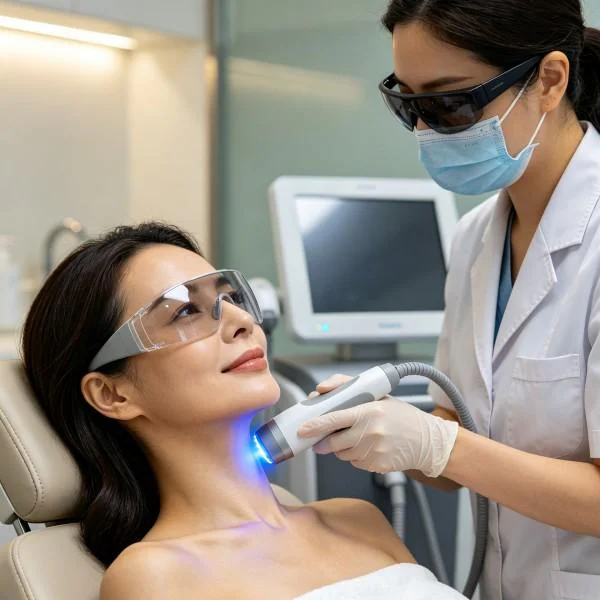
Détails du dossier
Case Identification: REHAB-2026-S7734
Patient Demographics: 52-year-old female, corporate legal counsel
Primary Diagnosis: Refractory Adhesive Capsulitis of the Left Glenohumeral Joint (Neviaser Classification: Stage II Freezing Phase, Severe Fibrotic Thickening of the Coracohumeral Ligament and Axillary Fold)
Chronicity: 34 weeks of worsening pain and restriction; failed two ultrasound-guided intra-articular corticosteroid injections, failed 24 sessions of conventional physical therapy involving heat packs and low-intensity light
Clinical Assessment: Marked loss of passive and active glenohumeral movement. Active forward flexion limited to 82°, passive external rotation at neutral restricted to 14°, active abduction limited to 68° with pronounced scapular hiking (Numeric Pain Rating Scale: 8/10 during active motion, 6/10 constant dull ache at rest). Severe sleep disruption caused by inability to lie on the left side.
| Identifiant de session | Protocole de phase | Configuration de la longueur d'onde | Puissance moyenne (W) | Fréquence d'impulsion et rapport cyclique | Surface de numérisation (cm²) | Durée du traitement | Énergie totale (Joules) | Indicateur de réponse clinique |
| Séance 01 | Désensibilisation neurovasculaire | 980 nm (70%) + 1 470 nm (30%) | 12,0 W | 150 Hz à un rapport cyclique de 30% | 160 | 06:40 | 4 800 J | Resting NPRS drops from 6/10 to 4/10; night pain softens |
| Séance 03 | Capsular Matrix Softening | 980 nm (40%) + 1 470 nm (60%) | 16,0 W | 300 Hz à un rapport cyclique de 40% | 130 | 08:20 | 8,000 J | External rotation increases to 26°; anterior capsule supple |
| Séance n° 6 | Biostimulation cellulaire en profondeur | 810 nm (30%) + 980 nm (40%) + 1 470 nm (30%) | 20,0 W | 1 000 Hz avec un rapport cyclique de 50% | 180 | 08:20 | 10,000 J | Abduction reaches 112°; scapular hiking noticeably reduced |
| Séance n° 09 | Axillary Fold Remodeling | 980 nm (40%) + 1 470 nm (60%) | 18,0 W | 20 Hz @ 35% Duty Cycle (Deep Impact Mode) | 120 | 07:25 | 8,000 J | Forward flexion hits 154°; end-range capsular block clears |
| Séance n° 12 | Functional Stabilization | 980 nm (50%) + 1 470 nm (50%) | 15,0 W | Onde continue (balayage dynamique) | 200 | 08:00 | 7,200 J | Zero resting pain; full 178° pain-free forward flexion |
Notes sur l'évolution du dossier
Sessions 01 through 03 focused on relieving periarticular inflammation, reducing subacromial bursal congestion, and calming axillary nerve sensitivity. The 980nm and 1470nm combination cleared inflammatory fluid around the joint line, allowing the patient to sleep through the night without throbbing pain by the end of the first week.
Sessions 04 through 08 targeted the thick, fibrotic scar tissue within the coracohumeral ligament and axillary recess. High water absorption at 1470nm softened the cross-linked collagen matrix, while 980nm stimulated capillary blood flow to flush out metabolic waste. Passive external rotation opened from 14° to 48° without sharp catching.
By Session 12, diagnostic musculoskeletal ultrasound showed that the axillary pouch thickness had dropped from an initial 4.2mm down to 2.1mm, matching healthy contralateral values. The patient completed full overhead reaching tests and daily activities without compensatory shoulder hiking or post-treatment soreness.
Biochemical Pathways in Capsular Remodeling
High-intensity deep tissue laser treatment stimulates healing through integrated cellular and extracellular mechanisms:
Photonic Absorption (Mitochondria & Capsular Hydration Matrix)
         │
         ├──► Photodissociation of Nitric Oxide ──► Accelerated Mitochondrial ATP Output
         │
         ├──► Interstitial Hydration Cleaving ───► Softening of Cross-Linked Collagen
         │
         └──► Fibroblast Phenotype Modulation ───► Normalized Capsular Remodeling
When photons hit cytochrome c oxidase inside stressed capsular fibroblasts and synoviocytes, they displace inhibitory nitric oxide molecules. This allows oxygen to bind efficiently, speeding up the mitochondrial electron transport chain and driving a surge in adenosine triphosphate (ATP) production. Chronically fatigued cells regain the energy needed to initiate healthy tissue remodeling.
Simultaneously, 1470nm photons excite water molecules bound within the stiff collagen matrix. The resulting micro-thermal fields break down rigid, cross-linked hyaluronic acid and proteoglycan chains, converting stiff, gelatinous capsular tissue into a hydrated matrix that glides smoothly during arm elevation.
Downstream gene signaling shifts rapidly. Inflammatory cytokines like interleukin-1-beta, tumor necrosis factor-alpha, and transforming growth factor-beta decrease, while matrix metalloproteinases rise to healthy baselines to break down excess scar tissue.
These biochemical shifts prompt fibroblasts to lay down organized, elastic collagen fibers instead of thick, disorganized scar tissue, restoring normal joint volume and capsular compliance.
A Focused Alternative to Conventional Shoulder Interventions
Traditional management for refractory frozen shoulder relies heavily on oral NSAIDs, repeated cortisone injections, and aggressive manipulation under anesthesia.
Systemic anti-inflammatory medications cause gastrointestinal and renal stress while doing nothing to resolve the mechanical contracture of a frozen capsule. Repeated cortisone injections offer short-term pain relief, but they weaken local collagen architecture and increase the long-term risk of rotator cuff tears. Manipulation under anesthesia tears the tight capsule mechanically, often causing intra-articular bleeding, labral damage, and prolonged post-procedure recovery.
High-power Class IV deep tissue laser therapy provides a focused, non-invasive alternative. It avoids systemic drug side effects, preserves the structural integrity of joint tissues, and eliminates procedural trauma. Clinicians can deliver thousands of therapeutic joules deep into contracted capsular folds and inflamed bursal spaces within minutes.
Targeting tissue with high-intensity multi-wavelength phototherapy resolves joint stiffness at its underlying cellular source. Rigid capsular adhesions soften, microvascular circulation rebounds, and inflamed synovial tissues heal cleanly. It turns months of agonizing shoulder immobility into an efficient, predictable return to pain-free function.