 FotonMedix




Surmonter les appréhensions liées à la chaleur lors des interventions chirurgicales du genou chez le chien
Multi-wavelength Class IV photon deposition balances tissue absorption peaks, evacuates inflammatory synovial fluid through selective water affinity, and eliminates periosteal thermal accumulation via microsecond duty cycle regulation.
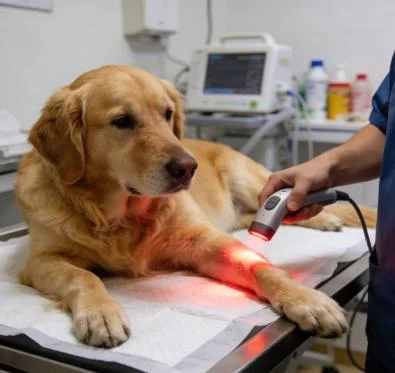
An anxious technician steps back from the prep table, hesitating with the therapy handpiece while a 36 kg black Labrador tenses under physical restraint. The dog underwent surgical repair for a torn cranial cruciate ligament four weeks ago, but the joint remains visibly swollen, warm, and stiff. Dark-coated, thick-furred limbs like this represent a daily operational roadblock: the nursing team worries that continuous high-power photonic delivery will create painful thermal hotspots on dark melanin-rich skin or trigger sudden periosteal burning near surgical implants. Because of past experiences with underpowered wands or poorly regulated hardware that sparked patient flinching, the treatment is delivered timidly, waving the probe inches too far from the skin. The joint capsule receives barely a fraction of the necessary photon density, the dog stays on high-dose non-steroidal anti-inflammatory drugs, and postoperative rehabilitation stalls entirely.
This scenario exemplifies the core operational friction behind veterinary clinics hesitation laser therapy devices. Practice managers invest in capital equipment expecting rapid clinical turnover, only to watch clinicians sideline the unit out of fear of thermal injury or frustration with unpredictable biological responses. When postoperative scar tissue, surgical metallic plates, and dense synovial effusions combine, timid low-power treatments cannot overcome exponential photonic scattering. Safely driving therapeutic fluence through dense joint capsules requires deploying the safest class of veterinary laser therapy equipment, combining synchronized multi-wavelength targeting with dynamic pulse timing to protect surface skin while thoroughly saturating deep joint structures.
Photonic Attenuation Curves and Multi-Spectrum Biological Targeting
Delivering photon energy into an operated stifle requires navigating distinct tissue layers: dense dark fur, pigmented dermis, fibrous scar tissue along the arthrotomy incision, and viscous, inflamed synovial fluid. Low-output therapy devices lose over eighty percent of their beam intensity within the first four millimeters of biological depth because uncalibrated single wavelengths scatter indiscriminately off dermal collagen and epidermal melanin.
Achieving meaningful mitochondrial activation within hypoxic chondrocytes and deep collateral ligaments demands a coordinated multi-spectral array operating inside the near-infrared optical therapeutic window:
- 980 nm Hemoglobin Resonance and Capillary Recanalization: Surgical trauma disrupts local microvasculature, leaving stagnant venous pools that prolong tissue acidosis. Light at 980 nm aligns with the absorption peaks of deoxygenated and oxygenated hemoglobin. This triggers mild, localized microvascular expansion, clears trapped inflammatory byproducts, and accelerates retrograde lymphatic drainage without systemic hemodynamic stress.
- Pénétration profonde dans le fibrocartilage à 1 064 nm : Demonstrating minimal affinity for melanin and cutaneous water, the 1064 nm wavelength penetrates straight through thick fibrous scars and dense quadriceps fascial planes. It deposits photon energy directly into deep subchondral bone layers, providing the cellular stimulation needed to accelerate osteoblast and chondrocyte repair.
- Modulation de l'eau à haute affinité à 1 470 nm : Persistent postoperative joint effusion consists of trapped serosanguinous exudate that distends the capsule and compresses sensory nerve endings. The strong absorption profile of 1470 nm light in water targets free fluid pockets directly, breaking up intra-articular hydrostatic tension and facilitating rapid fluid reabsorption through local capsular lymphatics.
Understanding these biological mechanics highlights the real-world veterinary practices laser therapy equipment benefits. Instead of spending half an hour hovering an ineffective wand over a restless patient, clinicians can saturate the entire joint volume in an eight-minute workflow, transforming an uncertain therapy session into a predictable, repeatable recovery protocol.
Eliminating Thermal Injury Risks Through Microsecond Duty Cycle Modulation
The primary technical barrier in high-wattage Class IV therapy is balancing high energy delivery with surface tissue safety. Continuous-wave high-power emission over heavily pigmented coats rapidly heats the epidermal-dermal junction, causing sharp pain responses, patient distress, and real thermal burn risks. When surgical implants lie just beneath the skin, unpulsed beams can elevate periosteal temperatures to uncomfortable levels.
Microsecond duty cycle regulation eliminates this issue by dividing continuous photon streams into precisely timed bursts separated by thermal relaxation periods:
Continuous Wave: [================ Continuous Heat Accumulation ================] -> Epidermal Hotspot Risk
Pulsed 50% Duty: [== Pulse ON ==] [ Thermal Relaxation ] [== Pulse ON ==]      -> Deep Synovial Saturation
During the active pulse phase, high peak wattage drives photons past dense dermal barriers straight into the stifle joint capsule. During the brief inactive phase, active microcapillary blood flow in the skin whisks away surface thermal energy. Because the deep joint capsule retains photonic stimulation while vascularized dermis dissipates heat rapidly, the target receives full therapeutic fluence while the skin surface remains completely cool and comfortable.
This reliable thermal safety profile frees nursing teams from operational anxiety. Clinicians can confidently treat dark-coated, heavily muscled breeds without fearing cutaneous burns, ensuring high compliance and consistent patient throughput throughout the day.
Objective Clinical Protocol and Kinetic Gait Recovery
According to clinical photobiology principles established by Karu and confirmed in peer-reviewed veterinary orthopedic literature by the American College of Veterinary Sports Medicine and Rehabilitation, near-infrared photobiomodulation downregulates matrix metalloproteinases and pro-inflammatory cytokines such as interleukin-1 beta, while upregulating vascular endothelial growth factor to support capillary regrowth in damaged connective tissue.
The following case record details this multi-wavelength protocol in a large-breed working dog recovering from persistent postoperative stifle synovitis and peri-articular fibrosis.
Case Record: Canine Post-Surgical Stifle Synovitis and Fibrosis
- Référence du dossier : REHAB-2026-CANINE-1402
- Profil du patient : 5-year-old male neutered Labrador Retriever, active search and rescue dog
- Masse corporelle : 36.2 kg, dense black coat
- Diagnostic : Chronic persistent post-surgical synovitis and peri-incisional capsular fibrosis of the right stifle following extracapsular cruciate stabilization four weeks prior; Grade 3 weight-bearing lameness; passive stifle flexion limited to 85 degrees (contralateral normal: 42 degrees); marked joint effusion with 2.8 cm thigh circumference atrophy
- Traitement conservateur antérieur : Meloxicam at 0.1 mg/kg orally once daily for four weeks, gabapentin at 10 mg/kg every 8 hours, and passive range-of-motion therapy; plateaued progress with acute vocalization during stifle flexion and persistent joint heat
Paramètres du protocole de traitement complet
| Numéro de session | Phase de rééducation articulaire | Puissance de sortie (W) | Mode de fonctionnement et rapport cyclique | Distribution spectrale ciblée | Fréquence (Hz) | Énergie totale (Joules) | Fluence (J/cm²) |
| 01 | Acute Capsular Desensitization | 10,0 W | En mode pulsé (rapport cyclique 35%) | High 980 nm / Microvascular Focus | 3 000 Hz | 3,200 J | 8,0 J/cm² |
| 02 | Synovial Effusion Clearance | 12,0 W | En mode pulsé (rapport cyclique 40%) | Haute fréquence 1 470 nm / Focalisation sur l'eau | 1,800 Hz | 4,200 J | 10,5 J/cm² |
| 03 | Peri-Incisional Scar Softening | 15,0 W | En mode pulsé (rapport cyclique 45%) | Mélange équilibré 980 nm / 1064 nm | 1 000 Hz | 5,400 J | 13,5 J/cm² |
| 04 | Chondral Metabolic Stimulation | 18,0 W | Superpulsé (cycle de service 50%) | Pénétration dominante (1 064 nm) | 500 Hz | 6,500 J | 16.2 J/cm² |
| 05 | Deep Collagen Matrix Remodeling | 20,0 W | Impulsionnel (cycle de service 50%) | Réseau équilibré multispectral | 200 Hz | 7,200 J | 18,0 J/cm² |
| 06 | Fibrous Adhesion Breakdown | 22,0 W | Impulsionnel (cycle de service 50%) | Focus sur la matrice extracellulaire profonde | 100 Hz | 7 800 J | 19.5 J/cm² |
| 07 | Mobilisation cinétique fonctionnelle | 20,0 W | Balayage dynamique continu | Broad Regenerative Profile | CW / Dynamique | 6,000 J | 15,0 J/cm² |
| 08 | Stabilisation biomécanique | 16,0 W | En mode pulsé (rapport cyclique 40%) | Mixed Maintenance Profile | 30 Hz | 4 800 J | 12,0 J/cm² |
Stifle Flexion Angle and Thigh Circumference Evolution
Passive Stifle Flexion (Degrees, Lower Angle = Greater Mobility):
Pre-Treatment: [==================================] 85° (Marked joint block)
Session 03:    [==========================] 66°
Session 06:    [==================] 48°
Session 08:    [===============] 43° (Contralateral baseline: 42°)

Thigh Circumference Difference (cm deficit compared to healthy left limb):
Pre-Treatment: [================] -2.8 cm
Session 03:    [============] -2.0 cm
Session 06:    [=====] -0.9 cm
Session 08:    [] -0.2 cm (Symmetrical muscle mass restored)
By the third session, joint effusion subsided markedly, and the dog relaxed comfortably on the treatment mat without needing physical restraint. By session six, passive stifle flexion improved from eighty-five degrees down to forty-eight degrees, allowing the dog to begin active underwater treadmill rehabilitation without post-exercise swelling. At the conclusion of eight treatments, the limb displayed normal range of motion, thigh muscle mass returned to symmetrical baseline, and daily meloxicam was discontinued.
Clinical Workflow Reliability Versus Pharmacological Management
Relying strictly on long-term systemic drugs for post-surgical recovery leaves veterinary clinics vulnerable to common clinical pitfalls. Prolonged use of non-steroidal anti-inflammatories risks gastric ulceration and renal strain, while simply masking joint discomfort without correcting capsular fibrosis or circulatory stasis. On the other hand, revision arthrotomy to break down scar tissue introduces new surgical trauma, risks joint infection, and extends convalescence periods that frustrate pet owners.
Integrating high-power Class IV technology delivers direct, practical benefits across the hospital:
1. Eliminating Staff Operational Apprehension
Preset pulse profiles and automated duty cycle management remove the guesswork from treating dark-furred, sensitive patients. Veterinary technicians can execute high-power rehabilitation protocols safely and comfortably, eliminating treatment hesitancy and ensuring the equipment remains an active, daily revenue driver.
2. Streamlined Treatment Schedules
Underpowered units demand twenty to thirty minutes of tedious manual application per joint. A high-output platform delivers complete, deep therapeutic doses in six to eight minutes of continuous, sweeping motion, allowing a single rehabilitation nurse to manage multiple recovery patients per shift.
3. Clear Visible Progress for Pet Owners
Pet owners track concrete signs of recovery: whether their dog can stand without shaking, climb stairs comfortably, and run without a limp. Demonstrating tangible reductions in joint swelling and improved limb extension within the first three treatments gives owners immediate confidence, strengthening their commitment to comprehensive rehabilitation plans.
High-power Class IV photomedicine offers a reliable, predictable solution for stubborn post-surgical joint complications. By delivering calibrated multi-wavelength photon energy past dense tissue barriers without surface heat accumulation, veterinary practices can resolve persistent joint stiffness, eliminate operational treatment fears, and return recovering patients to active, healthy lives.