 FotonMedix



Healing Recalcitrant Feline Eosinophilic Granuloma
Quad-wavelength Class IV photon deposition accelerates indolent ulcer re-epithelialization, halts mast cell degranulation, and prevents oral mucosal thermal injury through microsecond duty cycle modulation.
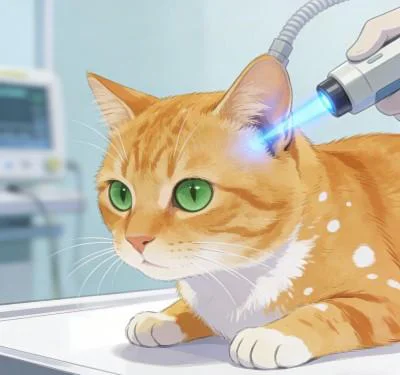
A 7-year-old Domestic Longhair cat sits quietly on the clinic table with prominent submandibular lymphadenopathy and thick saliva pooling at the labial commissure. On elevating the upper lip, an extensive, raised, ulcerated yellow-pink plaque stretches along the upper philtrum and right maxillary gingiva. The diagnosis of an indolent rodent ulcer, part of the chronic feline eosinophilic granuloma complex, was confirmed via biopsy four months prior. The cat has received multiple repository methylprednisolone acetate injections and systemic cyclosporine, yet the ulcerated crater continues to expand, producing secondary bacterial colonization, bloody saliva, and marked hyporexia. The client is reluctant to continue systemic immunosuppression due to developing borderline glycemic values and ongoing vomiting episodes.
Chronic refractory eosinophilic plaques in felines represent a stubborn therapeutic challenge due to their fragile, highly reactive tissue composition. The lesion features dense eosinophilic and mast cell degranulation nestled within friable granulation tissue, severe submucosal edema, and secondary microvascular thrombosis. Low-output therapeutic equipment fails in this scenario because of physical limitations: low-wattage devices require prolonged contact that stressed feline patients will not tolerate, while minimal photon counts scatter across dense fibrotic margins without triggering cellular repair. Resolving non-healing oral ulcers requires migrating to high-density, most used veterinary laser therapy equipment capable of delivering targeted fluence to the ulcerative base in brief, well-tolerated treatment windows.
Optical Penetration Physics and Wavelength Synergies in Oral Granulomas
Photons directed at chronic eosinophilic ulcerations encounter marked optical attenuation. Surface crusting, serosanguinous exudate, dense mast cell infiltration, and high vascularity reflect or absorb incoming light rapidly. Low-power continuous emitters lose over eighty percent of their photon density within the first two millimeters of ulcerative tissue, never reaching the deep submucosal beds where chronic mast cell degranulation perpetuates local tissue necrosis.
Achieving therapeutic stimulation across friable feline oral tissue requires calibrated wavelength interaction across specific biological chromophores:
- 980 nm Hemoglobin Resonance and Microvascular Cleansing: Feline eosinophilic ulcers exhibit irregular, leaky capillary loops and microvascular thrombosis. Light at 980 nm targets oxygenated and deoxygenated hemoglobin, generating gentle, non-ablative photothermal expansion within microcapillaries. This process clears venous congestion, reduces persistent bloody ooze, and enhances local delivery of systemic nutrients to the ulcer bed.
- 1064 nm Deep Fibroblast Stimulation: With minimal absorption by water and melanin, the 1064 nm wavelength penetrates straight through friable granulation tissue into the submucosal stroma. It delivers targeted photon density to fibroblasts, stimulating collagen synthesis and triggering mitochondrial adenosine triphosphate production to support rapid re-epithelialization.
- 1470 nm High-Affinity Water Modulation: Severe eosinophilic plaques harbor heavy extracellular fluid accumulation, causing tissue swelling and painful nerve compression. The high absorption coefficient of 1470 nm light in water mobilizes stagnant interstitial fluid, accelerating mucosal lymphatic drainage and reducing lesion thickness.
Delivering this broad photobiological response quickly is why feline practitioners depend on the most used veterinary laser therapy equipment for small animals. Rather than struggling with an agitated cat for twenty minutes with an underpowered device, clinicians can sweep high-density photon energy across the lesion in three minutes, delivering thorough therapeutic coverage under gentle, stress-free handling.
Duty Cycle Modulation to Protect Fragile Mucocutaneous Junctions
Applying high-intensity Class IV photomedicine to feline lips and oral mucosa carries a clear thermal safety consideration: feline facial skin is thin, unkeratinized at the ulcer margins, and rich in sensory receptors. Continuous wave emission at high wattage can rapidly heat superficial layers, risking mucosal blanching, discomfort, or sudden patient head-flinching.
Microsecond duty cycle regulation eliminates this risk by interleaving high-intensity bursts with thermal relaxation intervals:
Continuous Wave: [================ Cumulative Thermal Buildup ================] -> Mucosal Blanching Risk
Pulsed 35% Duty: [== Pulse ON ==] [ Thermal Relaxation ] [== Pulse ON ==]      -> Deep Granuloma Saturation
During the active pulse phase, high peak power drives photons deep into the submucosal inflammatory beds. During the dark phase, local microvascular perfusion dissipates surface thermal energy. Because deep inflammatory tissue cools more slowly than vascularized skin, therapeutic energy accumulates at the base of the ulcer while surface tissues remain cool and comfortable.
This precise thermal management is why ambulatory practitioners favor the best veterinary laser therapy unit for mobile vets. Portable, battery-ready systems allow clinicians to provide advanced Class IV care during low-stress home visits, avoiding stressful clinic transport for sensitive feline patients.
Clinical Protocol and Objective Healing Metrics
According to photobiological frameworks documented by Hamblin and substantiated across veterinary dermatology trials, near-infrared photobiomodulation modulates mast cell behavior, reducing histamine release and downregulating pro-inflammatory mediators such as interleukin-5 and tumor necrosis factor-alpha. The resulting reduction in eosinophilic infiltration allows keratinocytes to migrate across the wound bed, closing the ulcer.
The following clinical case details this multi-wavelength protocol in a severe case of refractory feline indolent ulcer managed without further systemic steroid administration.
Case Record: Refractory Feline Eosinophilic Rodent Ulcer
- Case Identifier: DERM-2026-FELINE-0538
- Patient Profile: 7-year-old female spayed Domestic Longhair
- Body Mass: 3.8 kg
- Diagnosis: Chronic refractory eosinophilic indolent ulcer of the upper right philtrum and labial mucosa measuring 22 mm by 14 mm, persistent for four months; marked lip thickening, secondary bacterial colonization, and submandibular lymphadenopathy; moderate dysphagia
- Prior Conservative Therapy: Two repository methylprednisolone acetate injections (20 mg subcutaneously) spaced four weeks apart, oral cyclosporine at 7 mg/kg once daily for six weeks; incomplete response with rapid recurrence, secondary vomiting, and borderline elevated serum fructosamine levels
Comprehensive Treatment Protocol Parameters
| Session Number | Clinical Phase | Output Power (W) | Operating Mode & Duty Cycle | Targeted Spectral Distribution | Frequency (Hz) | Total Energy (Joules) | Fluence (J/cm²) |
| 01 | Acute Hemostasis & Pain Relief | 4.0 W | Pulsed (30% Duty Cycle) | High 980 nm / Capillary Focus | 3,500 Hz | 400 J | 3.5 J/cm² |
| 02 | Interstitial Edema Clearance | 5.0 W | Pulsed (35% Duty Cycle) | High 1470 nm / Water Focus | 2,000 Hz | 600 J | 5.2 J/cm² |
| 03 | Mast Cell Stabilization | 6.0 W | Pulsed (35% Duty Cycle) | Balanced 980 nm / 1064 nm Mix | 1,200 Hz | 800 J | 7.0 J/cm² |
| 04 | Granulation Bed Stimulation | 7.0 W | Superpulsed (40% Duty Cycle) | Penetration Dominant (1064 nm) | 500 Hz | 1,000 J | 8.7 J/cm² |
| 05 | Keratinocyte Migration Trigger | 7.5 W | Pulsed (40% Duty Cycle) | Quad-wavelength balanced array | 200 Hz | 1,100 J | 9.6 J/cm² |
| 06 | Fibromucosal Remodeling | 7.0 W | Pulsed (40% Duty Cycle) | Deep Collagen Matrix Focus | 100 Hz | 1,000 J | 8.7 J/cm² |
| 07 | Re-epithelialization Closure | 6.0 W | Continuous Dynamic Sweep | Multi-spectral Regenerative Mix | CW / Dynamic | 900 J | 7.8 J/cm² |
| 08 | Epithelial Maturation | 4.5 W | Pulsed (30% Duty Cycle) | Balanced Maintenance Profile | 30 Hz | 600 J | 5.2 J/cm² |
Longitudinal Lesion Dimensions and Clinical Scoring
Ulcer Surface Area (mm²):
Pre-Treatment: [==============================] 308 mm²
Session 03:    [====================] 190 mm²
Session 05:    [==========] 85 mm²
Session 08:    [=] 8 mm² (Complete epithelial closure)

Feline Facial Pain Score (0 to 12 Scale, Lower = Comfortable):
Pre-Treatment: [==============================] 9 (Severe lip sensitivity)
Session 03:    [================] 5 (Permits gentle facial petting)
Session 05:    [=======] 2 (Normal grooming resumed)
Session 08:    [] 0 (Pain-free, eating dry kibble normally)
By the third session, the persistent serosanguinous weeping dried up completely, and the cat resumed normal grooming habits without face-pawing. By session five, the thickened fibrotic borders of the ulcer softened, with pink, healthy epithelium advancing inward from the margins. At the conclusion of eight treatments over four weeks, the ulcer achieved full mucosal closure, the lip margin regained its normal contour, and all systemic immunosuppressive medications were discontinued.
Clinical Workflow Advantages Over Long-Term Immunosuppressants
Treating feline eosinophilic granuloma complex with repetitive steroid injections and immunosuppressants carries significant health risks. Chronic steroid therapy frequently induces feline diabetes mellitus, latent viral recrudescence, and progressive renal strain. Cyclosporine administration often triggers severe gastrointestinal upset, making oral dosing stressful for both the cat and the owner.
Integrating high-power Class IV photomedicine offers clear clinical and operational advantages:
1. Drug-Free Resolution of Refractory Lesions
Rather than continually suppressing the entire immune system, multi-wavelength light addresses the local inflammatory environment directly: stabilizing mast cells, resolving microvascular stasis, and stimulating local epithelial regeneration.
2. High Procedural Efficiency for Feline Practice
Low-power therapy units require lengthy application times that feline patients resist, increasing fear and anxiety. High-output platforms deliver complete therapeutic doses in under three minutes of gentle sweeping application, making treatments simple to perform in standard clinic rooms or home environments.
3. Clear Visual Progress for Cat Owners
Owners of cats with oral ulcers closely monitor eating habits, drooling, and grooming. Seeing the raw, bleeding crater dry up and shrink within the first two weeks provides reassuring evidence of recovery, reinforcing owner commitment to ongoing care plans.
High-power Class IV photomedicine provides an effective, high-throughput solution for refractory dermatological and oral conditions in felines. By delivering balanced multi-wavelength energy directly into deep inflammatory tissue beds, veterinarians can resolve persistent ulcers, eliminate dependence on long-term medications, and restore comfortable quality of life for their patients.