 FotonMedix












Penetrazione nei doppi strati di tessuto denso nell’artrite dell’anca nei cani anziani
38W super-pulsed multi-wavelength beams bypass thick fur coats, peak penetration depth maintaining reaches deep acetabular capsules, and duty-cycle gating prevents skin scorching.
Walk into any small-animal veterinary practice on a cold Monday morning, and you will watch a heartbreaking routine unfold in the examination room. A nine-year-old Golden Retriever struggles to lift its hindquarters off the rubber floor mat, trembling from bilateral hip osteoarthritis and lumbosacral spondylosis. The owner is desperate because daily non-steroidal anti-inflammatory drugs (NSAIDs) have begun elevating the dog’s liver enzymes, yet stopping the pills leaves their loyal companion whining through the night. When the clinic tries using a conventional low-wattage therapy unit, dense golden guard hairs and thick undercoat scatter almost every photon before it touches the skin. Cranking up continuous power on an older single-wavelength machine scorches the pigmented dermis within seconds, turning a comforting session into a stressful struggle.
When veterinary hospitals upgrade to high-intensity Class 4 Laserterapia per cani, that optical and clinical barrier disappears. Rather than shaving ugly bald patches over a show-quality coat or forcing geriatric kidneys and livers to metabolize daily analgesics, high-power multi-wavelength photobiomodulation drives concentrated photonic energy straight through thick double coats into the deep hip capsule. Using a 38-watt veterinary platform like the VetMedix-Max, veterinary technicians and clinicians can suppress intra-articular inflammatory cytokines and stimulate chondrocyte energy production in under eight minutes without triggering thermal distress.
Overcoming Fur Density and Melanin Attenuation Curves in Canine Joints
Human physical therapy deals with bare skin, whereas canine rehabilitation must conquer a multi-layered biological barrier of guard hairs, insulating undercoat, pigmented epidermis, and heavy pelvic musculature. According to optical transport modeling in mammalian skin and hair follicles, dense canine coats scatter and reflect up to seventy percent of incident light before photons even reach the stratum corneum. Once inside the dermis, melanin and superficial capillary hemoglobin absorb another twenty percent, creating an exponential energy decay curve described by the Beer-Lambert law. A conventional Class 3B unit emitting less than half a watt loses virtually all therapeutic photon flux within the first centimeter—never coming close to a canine coxofemoral joint buried six to ten centimeters beneath the gluteal muscles.
Efficace laserterapia per cani requires navigating the near-infrared optical window with enough peak surface irradiance to maintain an active photon density all the way down to fifteen centimeters. Synchronizing five distinct wavelengths (650nm, 810nm, 915nm, 940nm, and 980nm) at peak outputs up to 38 watts ensures simultaneous biological engagement from the skin surface down to the subchondral bone:
- 650 nm (preparazione del derma superficiale e dei microvasi): Absorbed within upper epidermal layers to boost localized capillary perfusion and support healthy skin barrier turnover without wasting energy on deep joint transmission.
- 810nm (Mitochondrial Cytochrome C Oxidase Activation): Aligns directly with the peak absorption spectrum of cytochrome c oxidase inside stressed articular chondrocytes and peri-articular tenocytes. Photons at 810nm displace inhibitory nitric oxide from the mitochondrial respiratory chain, restoring electron transport and accelerating adenosine triphosphate (ATP) synthesis required for cartilage matrix maintenance.
- 915 nm e 940 nm (bypass della melanina e rilascio dell'ossigeno dall'emoglobina): Positioned beyond the steepest melanin absorption curve, these wavelengths traverse pigmented skin and subcutaneous adipose tissue cleanly while enhancing oxygen dissociation from oxyhemoglobin into hypoxic, osteoarthritic joint capsules.
- 980nm (Synovial Fluid Viscosity Reduction & Analgesic Drainage): Exhibits targeted affinity for interstitial water molecules, establishing gentle micro-thermal gradients that reduce thick inflammatory synovial viscosity, accelerate lymphatic clearance of bradykinin and substance P, and slow pain signal conduction along C-fibers.
Peer-reviewed studies published in Veterinary Therapeutics e il Rivista americana di ricerca veterinaria confirm that delivering high-fluence near-infrared light to osteoarthritic canine joints significantly lowers synovial prostaglandin E2 and interleukin-1 beta levels while improving peak vertical force on pressure-sensing gait walkways.
Super-Pulsed Duty Cycle Gating for Unclipped Canine Coats
Pushing thirty-eight watts of optical power through a thick double coat would rapidly singe hair shafts and overheat pigmented skin if fired as an uninterrupted continuous wave. Modern veterinary Class 4 systems solve this thermodynamic bottleneck through Super-Pulse emission architecture and therapeutic temperature indication technology.
Nel corso di un processo strutturato Terapia laser per l'artrite dei cani session, Super-Pulse modulation fires ultra-short, high-intensity bursts at 38W peak power—providing the photon momentum required to penetrate fifteen centimeters deep—separated by calibrated millisecond dark intervals matching the thermal relaxation time of canine hair follicles and epidermis.
| Modalità di emissione | Potenza di picco in uscita | Duty Cycle & Thermal Profile | Meccanismo fisiologico primario | Target Canine Orthopedic Condition |
| Modalità Super-Pulse | Fino a 38 W di potenza di picco | Carico termico medio ridotto (carico di lavoro del 25%–35%) | Deepest intra-articular penetration without coat or skin heating | Deep hip dysplasia, chronic coxofemoral osteoarthritis, lumbosacral stenosis |
| Modalità pulsata | 18 W – 30 W | Balanced intermittent bursts (50% duty) | Potent synovial analgesia and peri-articular edema drainage | Stifle osteoarthritis, elbow dysplasia, cranial cruciate strain |
| Onda continua (CW) | 12 W – 25 W | Emissione costante (ciclo di lavoro al 100% con scansione rapida) | Deep myofascial spasm release and localized vasodilation | Compensatory lumbar and gluteal muscle guarding, iliopsoas tightness |
Combining Super-Pulse gating with a smooth massage-ball optical handpiece allows the clinician to part dense guard hairs and apply gentle tissue compression directly over the greater trochanter. Pressing the quartz lens into the lateral hip blanches superficial dermal capillaries, eliminating competing hemoglobin absorption and increasing deep joint photon delivery by up to thirty percent while keeping the coat completely unclipped.
Clinical Case Study: Severe Bilateral Hip Osteoarthritis in a Senior Golden Retriever
To illustrate how 38-watt multi-wavelength dosimetry restores mobility and eliminates NSAID dependency in geriatric dogs, examine the documented progression of a patient treated at a veterinary rehabilitation hospital using the VetMedix-Max protocol.
Quadro clinico del paziente e dati ortopedici di base
- Codice di riferimento del caso: VET-REHAB-2026-1053-HOA
- Dati demografici dei pazienti: 9-year-old neutered male Golden Retriever, weighing 36.8 kg
- Diagnosi: Radiographically confirmed severe bilateral coxofemoral osteoarthritis secondary to chronic hip dysplasia, featuring marked acetabular remodeling, femoral head osteophytes, and secondary lumbosacral myofascial guarding
- Classificazione patologica: Canine Brief Pain Inventory (CBPI) Pain Severity Score of 8.2/10 and Pain Interference Score of 8.6/10; Orthopedic Lameness Grade 4/5 (extreme difficulty rising from sternal recumbency, bunny-hopping gait after ten meters, and refusal to climb stairs); hip extension restricted to 118 degrees bilaterally
- Interventi precedenti: Eighteen months of daily oral carprofen (4.4 mg/kg) and gabapentin; recent serum biochemistry revealed elevated alkaline phosphatase (ALP) and alanine aminotransferase (ALT), forcing immediate discontinuation of oral NSAIDs
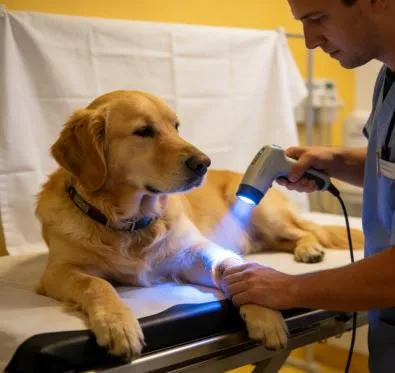
Staged Dosimetry and Clinical Progression Table
Because treating bilateral hip joints plus compensatory lumbar paraspinal muscles through a dense golden coat requires high cumulative energy delivered safely, the veterinarian structured a twelve-session protocol over five weeks, shifting from high-frequency Super-Pulsed analgesia to high-fluence continuous scanning.
| Numero di sessione | Fase del trattamento | Configurazione del rapporto tra lunghezze d'onda | Potenza di picco (W) | Frequenza d'impulso (Hz) | Ciclo di funzionamento / Modalità | Energia totale erogata (joule) | Durata della sessione | Traguardi funzionali e ortopedici |
| Sessione 1 | Acute Joint Analgesia | 810 nm (30%) + 915 nm (25%) + 940 nm (20%) + 980 nm (25%) | 22 W | 6000 Hz | Super-Pulse (ciclo di lavoro del 25%) | 5,400 J (2,700 J/hip) | 9.0 min | Dog settled into relaxed lateral recumbency within 90 seconds; stood up smoothly on rubber mat immediately post-session without trembling. |
| Sessione 2 | Acute Joint Analgesia | 810 nm (30%) + 915 nm (25%) + 940 nm (20%) + 980 nm (25%) | 25W | 5000 Hz | Super-Pulse (ciclo di lavoro del 30%) | 6,000 J (3,000 J/hip) | 9.0 min | Owner reported uninterrupted overnight sleep for the first time in three months; CBPI Pain Severity Score dropped from 8.2 to 5.8/10. |
| Sessione 4 | Synovial Edema & Spasm Release | 650 nm (5%) + 810 nm (35%) + 915 nm (25%) + 940 nm (15%) + 980 nm (20%) | 28 W | 2500 Hz | A impulsi (ciclo di lavoro del 45%) | 7,200 J (3,600 J/hip) | 9.5 min | Lameness improved to Grade 2/5 at a walk; bunny-hopping replaced by alternating hind-limb stride during 10-minute morning walks. |
| Sessione 6 | Chondrocyte ATP & Myofascial Recovery | 650 nm (5%) + 810 nm (40%) + 915 nm (25%) + 940 nm (15%) + 980 nm (15%) | 32 W | 1200 Hz | A impulsi (ciclo di lavoro del 55%) | 8,400 J (4,200 J/hip) | 9.5 min | Bilateral hip extension improved from 118 degrees to 136 degrees; gabapentin dosage tapered by fifty percent with zero pain rebound. |
| Sessione 9 | Intra-Articular Remodeling | 650 nm (10%) + 810 nm (40%) + 915 nm (20%) + 940 nm (15%) + 980 nm (15%) | 36 W | CW / 300 Hz ibrido | Ciclo di lavoro del 75% | 9,600 J (4,800 J/hip) | 9.0 min | Dog voluntarily climbed six porch steps without hesitation; CBPI Pain Interference Score fell from 8.6 to 2.4/10. |
| Sessione 12 | Consolidamento funzionale | 650 nm (10%) + 810 nm (40%) + 915 nm (20%) + 940 nm (15%) + 980 nm (15%) | 38 W | CW (scansione continua) | Scansione al 100% in CW | 10,800 J (5,400 J/hip) | 9.0 min | Lameness Grade 1/5 only after vigorous play; repeat bloodwork confirmed normalized liver enzymes; transitioned to single monthly maintenance sessions. |
Three-Portal Anatomical Scanning Protocol
To bathe the entire coxofemoral joint capsule and surrounding pelvic stabilizers without overheating the thick coat, the technician divided the dosage per hip across three distinct zones. Fifty percent of the joules were delivered over the lateral greater trochanter and cranial joint margin using firm circular massage-ball passes at 3 centimeters per second. Thirty percent was directed caudally into the deep gluteal and piriformis bellies to release chronic trigger points, while the remaining twenty percent was swept across the L6-S1 lumbosacral junction to relieve secondary spinal compensation.
Adeguamento della precisione della lunghezza d'onda nelle discipline equine, umane e chirurgiche
The exact optical engineering that allows a 38-watt veterinary laser to restore comfort to an arthritic senior dog translates directly across equine sports medicine, human outpatient rehabilitation, and minimally invasive surgery. In equine practices, veterinarians deploy the battery-powered Theralux-Max 38W platform to penetrate dense metacarpal fascia and heavy gluteal muscles, treating proximal suspensory desmitis and sacroiliac strain trackside without sedation or prohibited competition medications.
In human physical therapy clinics, the LaserMedix-Max 30W applies identical five-wavelength synchronization and peak penetration depth maintaining technology to resolve deep lumbar disc herniations and hip osteoarthritis in under ten minutes. Meanwhile, in minimally invasive operating rooms, dual-wavelength systems combining 1470nm and 980nm—such as the SurgMedix-Max—exploit the forty-fold higher water absorption of 1470nm to perform bloodless endovenous saphenous ablation, sphincter-sparing anal fistula closure, and precision veterinary oral surgery without collateral nerve damage. Across every clinical specialty, matching multi-wavelength physics to target tissue biology replaces systemic drug toxicity and invasive trauma with targeted cellular regeneration.
Comparing Class 4 Canine Photobiomodulation Against Traditional Arthritis Care
For veterinary practice owners, medical directors, and equipment distributors evaluating capital investments, comparing a 38-watt multi-wavelength system for laserterapia per cani against traditional pharmaceutical and low-power modalities demonstrates compelling clinical and operational returns.
| Parametri di valutazione veterinaria | Laser veterinario di classe 4 ad alta intensità (38 W, a lunghezze d'onda multiple) | Laser a freddo convenzionale di classe 3B (meno di 0,5 W) | Daily Oral NSAIDs (Carprofen / Meloxicam / Grapiprant) | Monthly Monoclonal Antibody Injections (Bedinvetmab) |
| Double-Coat Penetration Capability | Penetrates dense, unclipped fur directly down to 15cm via 38W bursts | Scattered and blocked within 1cm by thick guard hairs and undercoat | Assorbimento sistemico per via orale; non influenzato dallo spessore del mantello | Subcutaneous systemic injection; unaffected by coat thickness |
| Time to Deliver 5,000 Joules per Hip | 4 to 4.5 minutes per joint | Over 165 minutes (clinically impossible in veterinary workflows) | Daily owner pill administration; frequent missed doses | 10-minute nurse visit once every 28 days |
| Mechanism of Action on Joint Health | Stimulates chondrocyte ATP, reduces synovial PGE2, and relaxes muscle spasm | Negligible deep intra-articular energy; primarily superficial warmth | Blocks COX inflammatory enzymes only; does not support cellular metabolism | Blocks Nerve Growth Factor (NGF) pain signaling without anti-inflammatory repair |
| Organ & Systemic Safety Profile | Zero hepatic or renal toxicity; thermal safety maintained via Super-Pulse | Safe, but high rate of clinical non-response in deep hip arthritis | Risk of gastrointestinal ulceration, hepatotoxicity, and renal strain in seniors | Generally safe, but masks pain while joint inflammation and stiffness persist |
| Clinic Economics & Client Loyalty | High-margin 6-to-12 session packages run efficiently by trained technicians | Low owner satisfaction due to slow or imperceptible gait improvement | Low-margin pharmacy refills easily lost to online pet pharmacies | Ongoing monthly recurring revenue, though vulnerable to supply shortages |
Oral NSAIDs remain a helpful short-term tool, yet relying on them year after year in geriatric dogs inevitably threatens liver and kidney function while leaving deep paraspinal muscle spasms untreated. Low-wattage Class 3B devices lack the photon density to cross dense canine coats within a practical appointment slot, leaving owners discouraged after weeks of visits.
Attuazione della Classe 4 ad alta intensità Laserterapia per cani gives veterinary clinics a safe, drug-free solution that genuinely restores comfort and mobility to arthritic pets. Senior dogs regain the joy of pain-free walks and stair climbing within weeks, while veterinary hospitals build a compassionate, high-retention rehabilitation service line trusted by devoted pet owners.