 フォトンメディックス












深部組織の筋肉回復におけるサーマルロックアウトの克服
Deliver therapeutic photobiomodulation past the superficial dermal threshold using high-peak targeted wavelengths. Balance deep water targeting with peak vascular perfusion. Eliminate cutaneous thermal risks using dynamic pulsed thermal relaxation intervals.
Orthopedic rehabilitation rooms smell of menthol rubs, heat packs, and sweat. Every physical therapist knows the dread of treating an elite athlete or manual laborer stuck in chronic muscular hypertonicity with entrenched trigger points. You set up a standard physical therapy regimen, grab an ultrasound wand or an entry-level infrared emitter, and press into dense tissue. Ten minutes later, the patient’s skin feels hot, yet the deep myofascial junction remains as rigid as cured leather.
Superficial heating dilates capillary beds right beneath the skin, causing sudden tissue saturation that halts photons before they reach the motor endplates. When you dial up manual power on an entry-level laser therapy device for pain relief, epidermal discomfort spikes immediately. The patient pulls away from burning sensations long before deep tissue receives an adequate photobiomodulation dose.
True clinical resolution demands overcoming this basic biophysical bottleneck: getting therapeutic energy past the skin and dermal melanin barrier into the target tissue without cooking superficial nerve endings.
The Photophysical Barrier in Musculoskeletal Rehabilitation
Musculoskeletal pain clinics face energy loss at the tissue interface. Human skin reflects, refracts, and scatters optical radiation at every cellular boundary. When photons hit the stratum corneum, non-linear scattering spreads the beam rapidly, reducing forward irradiance.
A biological window exists between 650nm and 1200nm, extending outward to 1470nm for localized hydration matrices. Inside this operational channel, three endogenous chromophores dictate where incoming photons end up: melanin, oxygenated and deoxygenated hemoglobin, and intracellular water.
When treating a gluteal spasm or lumbar paraspinal contracture, target tissues sit 4 to 7 centimeters below adipose layers. Standard low-level units fail here because photons dissipate into surface heat. The target site receives almost zero energy.
To bypass this surface decay, a modern Class IV laser therapy machine must deliver precise photonic flux to specific chromophores without exceeding local thermal clearance thresholds.
Superficial Epidermis (Melanin Window)
         │
         ▼
Vascular Microcirculation (980nm Hemoglobin Surge)
         │
         ▼
Intercellular Interstitial Matrix (1470nm Water Absorption)
         │
         ▼
Deep Myofascial Target / Motor Endplate (Cellular Recovery)
Targeting hemoglobin and water simultaneously unlocks clinical photobiology:
980nm aligns directly with an absorption peak of oxygenated and deoxygenated hemoglobin. At this band, photons interact with circulating blood cells within congested capillary networks. This interaction releases nitric oxide, widening blood vessels and flushing out trapped inflammatory mediators like bradykinin and substance P.
1470nm shifts focus toward water molecules in interstitial fluid and collagenous fascial sheaths. Water displays a sharply higher absorption coefficient at 1470nm than in the near-infrared 800nm zone. Targeting this peak allows controlled photothermal pacing within swollen extracellular matrices, loosening cross-linked collagen bonds and softening stubborn muscle spasms.
Operating high continuous energy risks burning surface tissue. Advanced phototherapy solves this through calculated thermal relaxation intervals, matching energy bursts to tissue cooling rates.
Dynamic Pulse Gating and Thermal Relaxation Times
Tissue heats up and cools down at set physical rates. Thermal relaxation time defines how long a targeted cellular layer takes to dissipate half of its absorbed heat to surrounding areas.
Continuous-wave energy pumps heat into surface layers faster than passive blood flow can pull it away. Epidermal nociceptors fire within seconds, forcing practitioners to pull back or drop power levels below therapeutic thresholds.
Gated pulse modes resolve this trade-off. By cycling laser energy through disciplined duty cycles, the system delivers high peak power within microseconds, shutting off briefly before adjacent baseline tissue overheats.
$$\text{Duty Cycle (\%)} = \left( \frac{\text{Pulse Width}}{\text{Pulse Width} + \text{Pulse Interval}} \right) \times 100$$
A 20W continuous delivery at 980nm causes distinct skin heating within 4 seconds over dense myofascial areas. Dividing that energy into micro-pulsed trains at a 30% duty cycle allows peak power bursts to penetrate dense connective barriers while keeping epidermal temperatures steady.
Surface heat disperses during dark cycles, preserving cellular structure. Deeper, hypoperfused myofascial knots receive targeted energy surges that prompt mitochondrial cytochrome c oxidase activation without scorching superficial tissue.
Multi-Wavelength Delivery Across Myofascial Architecture
Treating deep musculoskeletal dysfunction with a single wavelength leaves therapeutic gaps. Skeletal muscle sits beneath skin, adipose layers, and deep fascia. Each anatomical layer holds different hydration levels, blood volume, and structural densities.
Combining specific, cooperative wavelengths creates an optimal photonic cascade through layered tissue:
[ Wavelength Interaction Matrix ]

650nm  ──► Superficial Capillaries & Keratinocytes (Fibroblast repair)
810nm  ──► Cytochrome c Oxidase Saturation (Direct ATP Synthesis)
980nm  ──► Microvascular Perfusion & Vasodilation (Oxygen Exchange)
1064nm ──► Deep Structural Pigmentation (Low-Scattering Penetration)
1470nm ──► Collagen Hydration Shells (Fascial De-densification)
Combining 980nm and 1470nm simultaneously shifts tissue response. The 980nm beam triggers local vasodilation, while 1470nm targets interstitial water molecules within tight fascial wrappings.
Clinicians using this dual-delivery approach report rapid release of chronic contractures. Dense fibrous bands soften under the handpiece, turning long manual trigger-point releases into rapid, comfortable sessions.
High-Power Class IV Platforms in Sports and Orthopedics
High-power platforms fundamentally change patient throughput and treatment outcomes in busy sports physical therapy and clinical pain practices.
An athletic trainer treating hamstring avulsions, quad contusions, or piriformis syndrome often faces tight deadlines. Low-power therapy takes 40 minutes of continuous scanning just to deliver minimal therapeutic joules to deep tissue. A high-intensity Class IV laser muscle therapy machine cuts that time down to six or eight minutes, driving substantial therapeutic energy into targeted muscle groups.
Treatment teams see practical gains across their daily workflow:
First, high power cuts treatment durations while keeping total delivered energy high.
Second, fast pain relief allows patients to tackle active rehab, dynamic stretching, and loading exercises earlier in their care plans.
Third, deep cellular biomodulation shortens recovery windows for high-demand athletic programs and active patient rosters.
臨床症例記録
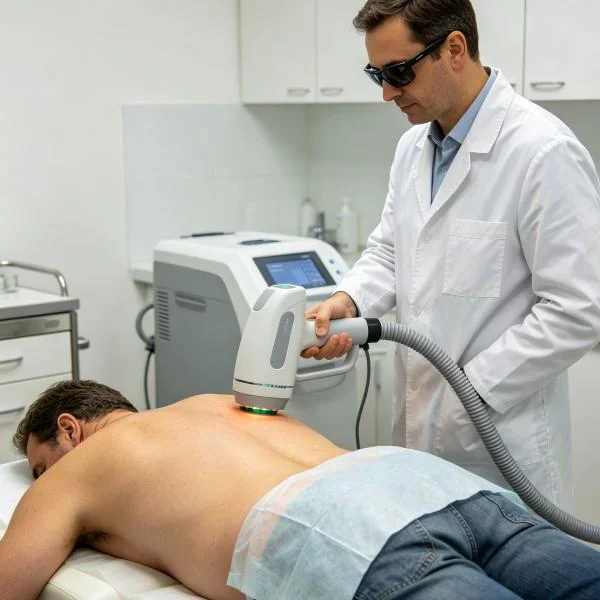
The following case record comes from a specialized orthopedic therapy and rehabilitation setting, evaluating multi-wavelength high-intensity laser intervention for severe, treatment-resistant hamstring hypertonicity and sciatic nerve interface entrapment.
事件記録の詳細
Case Identification: ORTHO-2026-B8821
Patient Demographics: 38-year-old male, semi-professional decathlete
Primary Diagnosis: Chronic Grade II Biceps Femoris Strain with Secondary Myofascial Contracture and Sciatic Nerve Mechanical Entrapment
Chronicity: 14 weeks post-injury; unresponsive to dry needling, active release, and passive heating
Clinical Assessment: Palpable fibrous adhesion measuring roughly 4cm by 2cm at the proximal-to-middle muscle-tendon junction. Active knee flexion range of motion limited by acute pain (Numeric Pain Rating Scale: 8/10 during active concentric contraction). Significant hypertonicity and restricted mobility across the posterior fascial plane.
| セッションID | フェーズ・プロトコル | 波長構成 | 平均出力 (W) | パルス周波数とデューティサイクル | スキャン領域(cm²) | 治療期間 | 総エネルギー(ジュール) | 臨床反応指標 |
| セッション01 | Acute Desensitization | 980nm (70%) + 1470nm (30%) | 12.0W | 200 Hz @ 40% Duty Cycle | 150 | 06:15 | 4,500 J | NPRS drops from 8/10 to 6/10; skin temp rise: +1.8°C |
| セッション03 | Deep Myofascial Release | 980nm (50%) + 1470nm (50%) | 16.0W | 500 Hz @ 50% Duty Cycle | 120 | 07:30 | 7,200 J | Palpable knot soft; Active Straight Leg Raise: +14° |
| セッション06 | Vascular Hyperemia & Biostim | 810nm (30%) + 980nm (50%) + 1470nm (20%) | 20.0W | 1000 Hz @ 60% Duty Cycle | 180 | 08:20 | 10,000 J | NPRS during exertion: 2/10; minimal tenderness |
| セッション09 | Functional Remodeling | 980nm (40%) + 1470nm (60%) | 18.0W | 20 Hz @ 30% Duty Cycle (Deep Shock Mode) | 100 | 06:40 | 7,200 J | Full ROM achieved; eccentric loading tolerated |
| 第12回 | Maintenance Consolidation | 980nm (50%) + 1470nm (50%) | 15.0W | 連続波(ダイナミックスキャン) | 200 | 08:00 | 7,200 J | Zero resting pain; dynamic sprinting resumed |
症例の経過に関する記録
During Sessions 01 to 03, the dual 980nm/1470nm configuration relaxed the acute guarding reflex. Interstitial fluid buildup around the sciatic interface cleared within three days, evidenced by a drop in passive straight-leg stretch pain.
Sessions 04 through 08 targeted the dense, cross-linked scar tissue within the biceps femoris belly. Combining water absorption at 1470nm with microvascular recruitment at 980nm loosened dense collagen cross-links, clearing the way for focused manual eccentric loading.
By Session 12, diagnostic ultrasound showed aligned muscle fibers without the hyperechoic, disorganized scar tissue seen during initial intake. The patient logged complete sprint cycles at maximum exertion without compensatory gait changes.
Biological Mechanisms Behind Real World Pain Relief
Deep tissue repair relies on coordinated cellular mechanisms:
Photonic Uptake (Mitochondria / Interstitial Water)
         │
         ├──► Cytochrome c Oxidase Activation ──► ATP Synthesis Explosion
         │
         ├──► Transient ROS Generation ──────────► Anti-Inflammatory Gene Signaling
         │
         └──► Thermal Gradients via Water ──────► Rapid Softening of Dense Fascia
Photons hitting cytochrome c oxidase prompt the enzyme to shed inhibitory nitric oxide, clearing the path for oxygen binding. This shift accelerates the mitochondrial electron transport chain, boosting adenosine triphosphate (ATP) production across stressed muscle cells.
Outside the cell, 1470nm photons interact with bound water molecules within tight, dehydrated fascia. This absorption creates gentle micro-thermal fields that loosen stiff hyaluronic acid matrices, rehydrating the tissue layer and restoring normal sliding between muscle sheaths.
Downstream gene signaling shifts quickly. Inflammatory markers like cyclooxygenase-2, tumor necrosis factor-alpha, and interleukin-1-beta fall, while vascular endothelial growth factor and basic fibroblast growth factor rise.
Tissue heals cleanly from within. Muscle recovery moves forward naturally instead of stalling out in chronic, low-grade inflammatory cycles.
Rethinking Musculoskeletal Recovery Strategies
Conventional musculoskeletal recovery leans heavily on passive rest, high-dose NSAIDs, cortisone injections, and standard surface heating.
Ice packs and oral pain medications simply dull sensory input. Prolonged NSAID usage irritates gastric linings and suppresses native tenocyte proliferation, blunting the natural healing cycle. Steroid injections can weaken structural collagen, raising the risk of tendon tears down the line.
Surface heat pads and entry-level therapeutic wands feel warm on the skin, but that superficial heat does little for deep, contracted tissue.
Class IV multi-wavelength laser therapy takes a fundamentally different path. It bypasses systemic digestion, skips structural tissue compromise, and sidesteps superficial skin burns. Practitioners can drive focused, biostimulative energy centimeters deep into injured muscle bellies and tight fascial layers within minutes.
High-power photobiomodulation targets chronic, stubborn pain at the cellular level. Tight contractures relax, local circulation rebounds, and injured tissue repairs cleanly. It turns persistent, season-ending soft tissue injuries into predictable, efficient recoveries.