 フォトンメディックス












慢性肋軟骨炎および胸郭の可動性低下の緩和
Project therapeutic photons past dense chondral matrices and pectoralis major sheaths with dual-wavelength precision. Target microvascular congestion while liquefying stagnant intercostal proteoglycans. Prevent anterior chest wall thermal saturation using precision microsecond-gated duty cycles.
A specialized cardiopulmonary and thoracic rehabilitation clinic frequently deals with the intense anxiety of costochondritis and Tietze syndrome: a 39-year-old former competitive rower sits curled forward on the examination plinth, holding her breath shallowly to avoid the sharp, stabbing chest pain that mimics a myocardial infarction. Her diagnostic workup rules out acute coronary events, confirming severe, treatment-resistant inflammation across the second, third, and fourth sternocostal junctions with palpable nodular chondral swelling. Over nine agonizing months, she has tried high-dose oral celecoxib that irritated her stomach lining, local lidocaine patches that provided only superficial skin numbness, and multiple attempts with an over-the-counter laser pain relief device that barely delivered enough warmth to penetrate the epidermis. Her chest wall remains hypertonic, guarded, and locked in chronic hypomobility. When past clinicians attempted to dial up continuous output on low-tier optical wands to drive light into the thick costochondral junctions, the patient pulled away from sharp, stinging dermal heat over the thin sternal skin long before therapeutic photons reached the inflamed cartilaginous core.
Low-power modalities fail because optical energy attenuates inside superficial dermal layers, subcutaneous fat, and the dense aponeurosis of the pectoralis major. Forcing continuous power through this fragile anterior chest barrier triggers rapid surface heat accumulation. The patient pulls away from dermal burning, ending the session well before the deep costosternal synchondroses receive an adequate photobiomodulation dose.
Overcoming this clinical bottleneck requires delivering concentrated, high-irradiance photonic flux deep into the cartilaginous rib articulations while keeping the thin, nerve-dense sternal skin cool and protected.
Optical Scattering Across Sternal Dermis and Costochondral Articulations
Delivering light into inflamed sternocostal synchondroses presents an intricate optical challenge. Photons must pass through an ultra-thin sternal epidermis, traverse subcutaneous adipose tissue, penetrate the dense fibrous fascia of the pectoralis major, and penetrate the avascular hyaline cartilage matrix of the ribs. Under the Kubelka-Munk optical scattering model, light experiences severe multi-directional scattering across these layered fibrous boundaries, causing an exponential decay in forward irradiance.
ヒトの生体構造の内部では、3つの主要な内因性吸収体が光子の経路を決定しています。それは、皮膚のメラニン、微小血管のヘモグロビン、および組織間液です。.
In chronic costochondritis, the primary pathology involves chondrocyte hypertrophy, localized microvascular congestion along the perichondrium, and excessive proteoglycan cross-linking within the dense cartilage matrix, located 1.5 to 3.0 centimeters beneath the sternal border. Low-intensity Class III devices cannot penetrate this physical depth; over 92% of their light scatters into shallow dermal and fascial tissues. The inflamed costal cartilage receives virtually zero energy, leaving the swollen rib attachments trapped in chronic, ischemic mechanical friction.
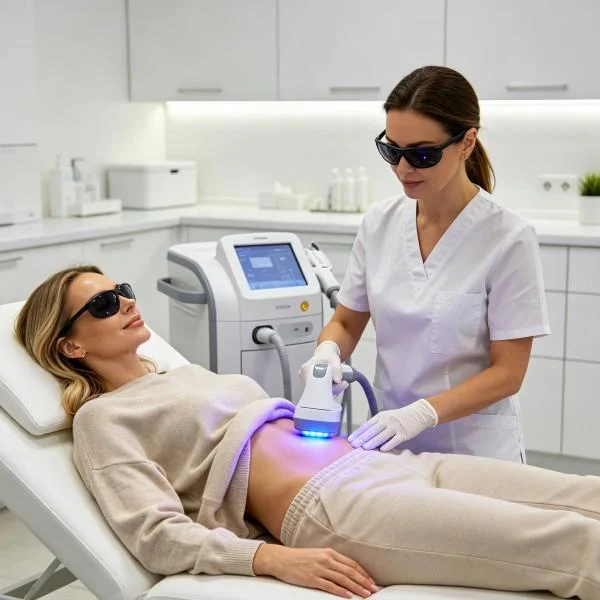
Overcoming this steep decay curve requires a high-irradiance platform that demonstrates true class 4 laser therapy benefits by delivering high peak power without exceeding surface thermal thresholds.
Anterior Sternal Dermis & Subdermal Fascia (Scattering Interface)
         │
         ▼
Pectoralis Major Sheath & Intercostal Muscles (Dense Muscular Barrier)
         │ (1470nm Interstitial Water Absorption & Fluidization)
         ▼
Perichondrial Capillary Loops (Ischemic Microvascular Congestion)
         │ (980nm Hemoglobin Hyperemia & NO Offloading)
         ▼
Inflamed Hyaline Cartilage Matrix & Chondrocytes (Cellular ATP Surge)
Targeting hemoglobin and water chromophores in tandem transforms how inflamed costal cartilage responds:
At 980nm, photon capture aligns with absorption peaks for oxygenated and deoxygenated hemoglobin. In costochondral inflammation, chronic mechanical tension chokes perichondrial microcirculation, creating localized hypoxia and trapping inflammatory cytokines like interleukin-1-beta, tumor necrosis factor-alpha, and bradykinin. The 980nm wavelength triggers localized vasodilation, prompting circulating red blood cells to offload bound nitric oxide, clearing sluggish microcirculation and restoring oxygen delivery to starving chondrocytes.
At 1470nm, photon absorption shifts toward bound water molecules within the swollen perichondrial sheath and thick proteoglycan ground substance. Interstitial water absorbs 1470nm light at rates significantly higher than in the 800nm zone. This controlled absorption creates micro-thermal fields that break down rigid, polymerized proteoglycan matrices, clearing chronic inflammatory exudate around the sternocostal articulation and restoring rib cage expansion during deep breathing.
Delivering this combined optical power into compact, nerve-dense chest wall spaces without scorching the skin requires precise pulse gating.
Duty Cycle Mechanics and Sternal Thermal Dissipation
Continuous-wave light delivery encounters a hard biological limit over the sternum: the thin, tightly stretched skin overlying the sternal bone absorbs surface heat quickly, but damaged local autonomic tone prevents adequate microvascular flushing of that thermal load. When continuous photons strike the costal margin, surface temperatures spike within seconds, setting off intense burning sensations.
マイクロ秒単位の精密なパルスゲーティングにより、この表面の熱蓄積が解消されます。高強度の光を、制御された暗期間で区切られたマイクロ秒単位のバーストに分割することで、深部の軟骨構造には高いピーク照度が照射される一方、敏感な皮膚はパルス間の間に安全に冷却されます。.
$$\text{デューティサイクル (\%)} = \left( \frac{\tau_{\text{パルス}}}{\tau_{\text{パルス}} + \tau_{\text{冷却}}} \right) \times 100\text{$$}
ここで、$\tau_{\text{pulse}}$ はアクティブ光送達を表し、$\tau_{\text{cooling}}$ は熱緩和休止を表す。.
Applying 18W of continuous laser energy over the anterior costochondral joints triggers uncomfortable skin heating within 3 seconds over the sternal plate. In contrast, running that same power through a 20% duty cycle delivers powerful peak bursts that penetrate through the thick pectoral fascia, while the 80% dark phase allows surface tissues to shed heat safely into the room and the moving handpiece.
Blood flow in the vascular layers carries away surface heat, while the hypoperfused, inflamed costal cartilage absorbs high photon density, initiating cellular healing without epidermal irritation.
Multi-Wavelength Synergies in Costochondral Rehabilitation
Treating severe chest wall inflammation with a single wavelength leaves critical parts of the pathology unaddressed. Costochondritis involves skin, subcutaneous fat, pectoral fascia, intercostal muscle bellies, and thick avascular hyaline cartilage. Each distinct anatomical layer features unique water content, vascular density, and optical scattering properties.
波長を調整して組み合わせることで、組織のあらゆる深さにわたって途切れることのない治療用濃度勾配が形成されます:
[ Anterior Chest Wall Tissue Interaction Matrix ]

810nm  ──► Mitochondrial Cytochrome c Oxidase (Surge in Chondrocyte ATP Synthesis)
980nm  ──► Perichondrial Capillary Perfusion & NO Release (Flushing Inflammatory Fluid)
1064nm ──► Deep Pectoralis Major Fascial Sheets (Forward Directional Penetration)
1470nm ──► Cartilage Hydration Shells (Fluidizing Rigid Proteoglycan Chains)
Pairing 980nm with 1470nm produces immediate biomechanical and circulatory improvements. The 980nm beam opens compressed microvascular beds around the perichondrium, delivering fresh oxygen to ischemic cartilage cells. At the same time, 1470nm targets bound water molecules inside the swollen costochondral matrix, softening rigid collagen cross-links and draining localized fluid.
Clinicians use this dual-action delivery to loosen tight, guarded anterior chest structures, making subsequent manual rib mobilization, diaphragmatic breathing retraining, and thoracic spine extension exercises far more productive.
Clinical Protocol Deployment for Anterior Thoracic Stasis
High-power platforms have transformed how specialized physical therapy practices and cardiopulmonary rehabilitation centers manage persistent costosternal chest pain.
Therapists managing chronic costochondritis, sternoclavicular arthritis, or post-sternotomy chest wall pain often spend extensive time on slow, painful manual interventions. Low-power Class III modalities require 35 to 45 minutes of scanning to deliver minimal joules through the pectoral muscle, producing negligible clinical improvements. Applying targeted class 4 laser therapy for pulmonary fibrosis and associated chest wall contracture cuts treatment times to under eight minutes while driving meaningful, therapeutic energy directly into stiffened chondral junctions.
Specialized rehabilitation departments utilizing high-output platforms experience distinct operational and clinical advantages:
まず、施術者は6~8分で適切な治療用エネルギー量を照射することができ、これにより1日あたりの患者処理数を最適化するとともに、激しい手動摩擦による施術者の身体的疲労を解消します。.
Second, rapid pain relief breaks the patient’s antalgic chest guarding, restoring normal thoracic ribcage excursion and easing breathing mechanics.
Third, reliable deep-tissue cellular repair restores microvascular blood flow, clearing sharp shooting pain and supporting long-term cartilage remodeling.
臨床症例記録
The following case record details the clinical application of multi-wavelength high-intensity laser therapy for severe, treatment-resistant costochondritis and Tietze syndrome that had failed to respond to oral NSAIDs, intercostal nerve blocks, and conventional physical therapy.
事件記録の詳細
Case Identification: THOR-2026-T4019
Patient Demographics: 39-year-old female, competitive rowing coach
Primary Diagnosis: Chronic Recalcitrant Costochondritis with Tietze Syndrome Overlap (Severe Nodular Swelling and Tenderness Across the Left 2nd, 3rd, and 4th Costochondral Junctions)
Chronicity: 9 months of debilitating anterior chest pain; failed high-dose celecoxib (400mg/day) due to severe gastritis, failed two ultrasound-guided intercostal nerve blocks with local anesthetics and triamcinolone
Clinical Assessment: Marked enlargement and localized swelling over the left 3rd and 4th costochondral junctions, exquisite focal tenderness to light palpation (Crowing Rooster Maneuver positive with excruciating anterior chest stabbing). Restricted thoracic wall expansion (1.2cm excursion measured at the nipple line during maximal inhalation). Inability to perform rowing stroke mechanics or bear weight through the left upper extremity (Numeric Pain Rating Scale: 9/10 on deep inhalation or trunk rotation, 6/10 constant dull resting ache). Severe sleep disruption caused by inability to lie prone or on the left side.
| セッションID | フェーズ・プロトコル | 波長構成 | 平均出力 (W) | パルス周波数とデューティサイクル | スキャン領域(cm²) | 治療期間 | 総エネルギー(ジュール) | 臨床反応指標 |
| セッション01 | 神経血管脱感作 | 980nm (75%) + 1470nm (25%) | 10.0W | 100 Hz(デューティサイクル 20%) | 100 | 05:45 | 3,450 J | Resting NPRS drops from 6/10 to 4/10; deep breath easier |
| セッション03 | Perichondrial Decongestion | 980nm (45%) + 1470nm (55%) | 14.0W | 250 Hz、デューティサイクル 25% | 80 | 06:40 | 5,600 J | Chest excursion increases from 1.2cm to 2.1cm; swelling softens |
| セッション06 | Chondral Biostimulation | 810nm (30%) + 980nm (45%) + 1470nm (25%) | 16.0W | 800 Hz、デューティサイクル 35% | 110 | 07:25 | 7,120 J | Palpation tenderness drops; Crowing Rooster Maneuver mild |
| セッション09 | ディープ・マトリックス・リモデリング | 980nm (40%) + 1470nm (60%) | 15.0W | 20 Hz、25% デューティサイクル(ディープインパクトモード) | 70 | 06:40 | 6,000 J | Deep inhalation NPRS down to 2/10; full thoracic rotation |
| 第12回 | 動的締固め | 980nm (50%) + 1470nm (50%) | 12.0W | 連続波(ダイナミックスウィーピング) | 120 | 07:00 | 5,040 J | Zero resting or exertion pain; full rowing drills resumed |
症例の経過に関する記録
Sessions 01 through 03 focused on clearing perichondrial vascular congestion, reducing local tissue acidosis, and dampening unmyelinated nociceptive firing around the anterior cutaneous branches of the intercostal nerves. The combination of 980nm and 1470nm cleared inflammatory edema around the 3rd and 4th rib junctions, reducing nighttime throbbing and allowing the patient to take full inspiratory breaths without sharp stabbing pain by the end of the first week.
Sessions 04 through 08 targeted the thick, fibrotic scar tissue within the costosternal ligaments and the swollen hyaline cartilage. High water absorption at 1470nm softened the rigid proteoglycan gel, while 980nm and 810nm stimulated capillary blood flow to flush out metabolic waste and recruit reparative chondrocytes. Chest wall excursion expanded from 1.2cm to 2.8cm, and the visible prominence of the chondral nodules receded visibly.
By Session 12, palpation along the left sternocostal border elicited zero sharp tenderness. The patient completed maximum-effort ergometer rowing trials and heavy overhead pull-ups without anterior chest pain, splinting, or post-activity inflammatory relapse.
Cellular Pathways in Costochondral Matrix Regeneration
High-intensity deep tissue laser therapy stimulates cartilaginous healing through integrated cellular and extracellular mechanisms:
Photonic Absorption (Chondrocytes & Perichondrial Water Matrix)
         │
         ├──► Photodissociation of Nitric Oxide ──► Accelerated Chondrocyte ATP Output
         │
         ├──► Interstitial Hydration Cleaving ───► Softening of Cross-Linked Matrix
         │
         └──► Endothelial Cell Activation ────────► Perichondrial Reperfusion
When photons hit cytochrome c oxidase inside stressed chondrocytes and perichondrial fibroblasts, they displace inhibitory nitric oxide molecules. This allows oxygen to bind unimpeded, accelerating the mitochondrial respiratory chain and producing a dramatic surge in adenosine triphosphate (ATP). Starving chondrocytes regain the metabolic energy needed to maintain extracellular matrix balance and synthesize healthy aggrecan molecules.
Simultaneously, 1470nm photons excite water molecules bound within the dense proteoglycan gel surrounding the costochondral junction. The resulting micro-thermal fields break down rigid collagen cross-links, converting viscous ground substance into a fluid state and clearing chronic inflammatory exudates.
Downstream gene signaling shifts rapidly. Inflammatory cytokines like interleukin-1-beta, tumor necrosis factor-alpha, and cyclooxygenase-2 drop steadily, while transforming growth factor-beta and basic fibroblast growth factor rise.
These biochemical shifts prompt chondrocytes to remodel disorganized cartilaginous scar tissue into aligned, elastic hyaline cartilage, restoring normal compliance and painless movement to the thoracic cage.
Moving Beyond Pharmacological Masking in Chest Wall Pain
Conventional management for severe costochondritis and Tietze syndrome relies heavily on oral NSAIDs, repeated local steroid injections, and passive rest.
Systemic anti-inflammatory medications cause gastrointestinal bleeding and kidney strain while doing nothing to resolve the underlying mechanical stiffness or microvascular ischemia of the inflamed rib cartilage. Repeated cortisone injections directly into the costochondral synchondrosis provide only temporary relief, carrying severe risks of permanent cartilage atrophy, skin depigmentation, and even accidental pleural puncture. Passive rest simply allows the surrounding intercostal and pectoral muscles to shorten, locking the chest wall in chronic, painful restriction.
High-power Class IV deep laser therapy provides a focused, non-invasive alternative. It avoids systemic drug toxicity, preserves native cartilaginous architecture, and eliminates procedural trauma. Clinicians can deliver thousands of therapeutic joules deep into inflamed costosternal articulations and tight pectoral sheaths within minutes.
Applying high-intensity multi-wavelength phototherapy targets costochondral inflammation at its biological and vascular source. Swollen chondral nodules soften, microvascular circulation rebounds, and inflamed perichondrial tissues heal cleanly. It turns agonizing, breath-limiting chest wall pain into a predictable, lasting return to full respiratory expansion and high-level athletic performance.