 フォトンメディックス












慢性難治性猫口内炎への取り組み
Targeted Class IV photon delivery penetrates deep submucosal lymphoid infiltration, accelerating epithelial closure and eradicating lingering oral pain without mucosal thermal ablation via duty cycle control.
A 9-year-old Domestic Shorthair cowers in the examination carrier, hypersalivating blood-tinged mucoid fluid with matted forepaws from frantic face-pawing. On attempt to inspect the oral cavity, the cat vocalizes sharply and recoils. Sedated oral examination exposes vivid, cobblestone-textured ulceroproliferative inflammation spanning both glossopalatine arches, the caudal pharynx, and alveolar margins. The feline patient had full-mouth extractions six months prior, yet this severe refractory caudal stomatitis persists. High-dose oral prednisolone, buprenorphine, and pulsed antibiotics have stalled; the cat has lost 1.4 kg, refuses hard food, and the client is emotionally drained and contemplating euthanasia.
Caudal feline chronic gingivostomatitis represents one of the most agonizing, refractory conditions in feline veterinary practice. The lesion is dense, intensely vascularized, and dominated by intense lymphoplasmacytic inflammatory infiltrates nestled deep beneath friable, hyperplastic ulcer margins. Reaching these subepithelial lymphoid follicles with low-output handheld veterinary cold laser equipment fails due to low photonic delivery: milliwatt emitters lack the energy throughput needed to saturate mucosal beds quickly before the animal resists, while beam scatter dissipates superficial photons across saliva and surface discharge. Managing refractory oral lesions requires migrating to an adaptable, high-density class 4 veterinary laser capable of reaching deep into submucosal microvascular loops to halt inflammatory cascade pathways.
Submucosal Attenuation Gradients and Oral Tissue Photobiology
The oral mucosa of the feline oropharynx exhibits severe optical barriers when inflamed. Lingual secretions, active microhemorrhage, and hyperemic capillary beds form an immediate optical filter. Superficial wavelengths under 700 nm encounter immediate extinction against blood and oral secretions, never reaching the deep submucosal basement membrane where plasma cells proliferate and secrete destructive antibodies.
Penetrating this vascularized and inflamed oral tissue layer requires selective wavelength selection:
- 980 nm Hemoglobin Targeting and Capillary Decongest: Chronic stomatitis involves profound venous pooling and microcapillary leakage. Light at 980 nm exhibits strong absorption by oxyhemoglobin and deoxyhemoglobin. This interaction creates subtle, non-ablative photothermal gradients within hyperemic capillary loops, halting local microhemorrhage, inducing rapid vaso-constriction of engorged fragile vessels, and enhancing lymphatic evacuation of local pro-inflammatory mediators.
- 1064 nm Deep Lymphoplasmacytic Infiltration Penetration: The 1064 nm wavelength encounters minimal absorption in superficial water and pigment, allowing light to travel through friable granulation tissue. It delivers targeted photon density directly to the subepithelial cellular infiltrates, downregulating interleukin-6 and reducing local production of destructive matrix metalloproteinases that degrade alveolar bone and palatine arches.
- 1470 nm Superficial Edema Mobilization: Hyperplastic mucosal cobblestones harbor heavy interstitial fluid accumulation that stretches local nociceptive nerve endings. The high affinity of 1470 nm light for water targets interstitial fluid pockets directly, accelerating fluid reabsorption through mucosal lymphatics and producing rapid reduction in mechanical tissue swelling.
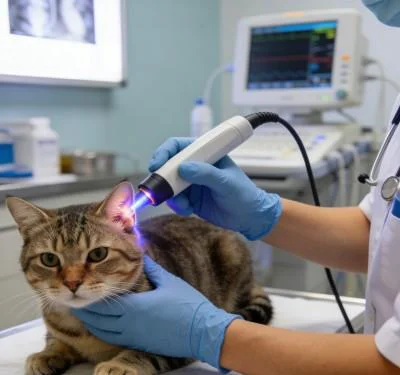
Achieving deep therapeutic saturation inside the small feline oral cavity cannot be done with underpowered tools that require prolonged stationary exposure. A dedicated class 4 laser veterinary system enables clinicians to sweep non-contact optical handpieces across the caudal pharynx, delivering hundreds of joules into inflamed arches in under three minutes while the patient is comfortably maintained under light sedation or calm handling.
Duty Cycle Mechanics for Sensitive Mucosal Preservation
Applying high-intensity photon flux to the delicate, unkeratinized oral mucosa presents a direct thermal risk: inflamed oral tissue contains limited superficial stratum corneum, meaning excessive continuous heat can cause superficial blanching, tissue sloughing, or acute coagulation necrosis.
Duty cycle modulation prevents tissue overheating while preserving high peak power. By utilizing pulsed modes where peak power delivers deep-penetrating photons followed by an immediate off-cycle, the oral tissue undergoes rapid thermal relaxation.
Continuous Wave: [================ Continuous Thermal Buildup ================] -> Mucosal Blanching Risk
Pulsed 40% Duty: [== Pulse ON ==] [ Thermal Dissipation ] [== Pulse ON ==]      -> Deep Infiltration Target
During the active pulse, high instantaneous irradiance drives photons deep past the superficial mucosal exudate. During the inactive dark phase, mucosal perfusion carries away thermal energy, preventing the tissue surface from exceeding forty-one degrees Celsius.
This dynamic control enables clinicians to deliver robust biological doses into inflamed palatoglossal folds without creating superficial thermal damage, allowing even friable, bleeding ulcer beds to heal uneventfully.
Clinical Protocol and Objective Mucosal Scoring
Clinical studies investigating photobiomodulation in chronic feline stomatitis confirm that coherent near-infrared light alters macrophage polarity, shifting local tissue macrophages from an inflammatory M1 state to a reparative M2 phenotype. This promotes healthy angiogenesis, accelerates mucosal wound re-epithelialization, and markedly decreases substance P and nerve growth factor secretion from peripheral trigeminal nerve endings.
The following case record details the clinical application of high-power Class IV therapy in a severe, refractory post-extraction feline stomatitis patient.
Case Record: Refractory Feline Caudal Stomatitis
- ケース識別子: DENT-2026-FELINE-0752
- 患者のプロフィール 9-year-old female spayed Domestic Shorthair
- 体重: 3.1 kg (down from historical baseline of 4.5 kg)
- 診断 Chronic refractory caudal gingivostomatitis (FCGS), severe bilateral cobblestone proliferative lesions on glossopalatine folds and caudal pharynx, persistent for six months following full-mouth dental extractions; Stomatitis Disease Activity Index (SDAI) score: 26/30
- これまでの保存的治療: Prednisolone at 2 mg/kg orally every 24 hours for four months; Buprenorphine at 0.02 mg/kg transmucosally every 8 hours; persistent ptyalism, severe dysphagia, active vocalization upon swallowing attempt, completely intolerant to dry or unblended canned food
包括的治療プロトコルのパラメータ
| セッション番号 | Clinical Healing Phase | 出力(W) | 動作モードとデューティサイクル | 対象スペクトル分布 | 周波数 (Hz) | 総エネルギー(ジュール) | フルエンス (J/cm²) |
| 01 | Acute Hemodynamic Stabilizing | 4.0 W | パルス式(30% デューティサイクル) | High 980 nm / Hemostasis Focus | 4,000 Hz | 600 J | 4.0 J/cm² |
| 02 | Edema & Capillary Decongestion | 5.0 W | パルス式(35% デューティサイクル) | High 1470 nm / Fluid Mobilization | 2,500 Hz | 850 J | 5.6 J/cm² |
| 03 | Submucosal Infiltration Targeting | 6.0 W | パルス式(40% デューティサイクル) | 980 nm / 1064 nm のバランスが取れた混合光 | 1,200 Hz | 1,100 J | 7.3 J/cm² |
| 04 | Epithelial Proliferation Trigger | 7.0 W | パルス式(40% デューティサイクル) | Deep Penetration Dominant (1064 nm) | 600 Hz | 1,300 J | 8.6 J/cm² |
| 05 | Granulation Tissue Remodeling | 7.5 W | パルス式(50%デューティサイクル) | Multi-wavelength balanced array | 300 Hz | 1,500 J | 10.0 J/cm² |
| 06 | Deep Fibrotic Softening | 8.0 W | Superpulsed (50% Duty Cycle) | High 1064 nm / Deep Matrix Focus | 150 Hz | 1,600 J | 10.6 J/cm² |
| 07 | Mucosal Re-epithelialization | 6.5 W | パルス式(40% デューティサイクル) | Regenerative Mixed Array | 80 Hz | 1,400 J | 9.3 J/cm² |
| 08 | Maintenance Consolidation | 5.0 W | パルス式(35% デューティサイクル) | Anti-inflammatory spectrum | 25 Hz | 1,000 J | 6.6 J/cm² |
Stomatitis Disease Activity Index and Body Weight Trajectory
SDAI Score (0 to 30 Scale, Higher = Severe Inflammation & Pain):
Pre-Treatment: [==========================] 26
Session 02:    [====================] 20
Session 04:    [============] 12
Session 06:    [======] 6
Session 08:    [==] 2 (Near-complete mucosal healing)

Body Weight Recovery (kg):
Pre-Treatment: [================] 3.1 kg
Session 04:    [==================] 3.4 kg
Session 08:    [======================] 3.9 kg
Day 60 Review: [========================] 4.2 kg
By the third treatment, blood-tinged drooling stopped entirely, and the cat voluntarily consumed moist canned food without crying. Oral inspection at session six revealed that the hyperplastic, cobblestone mucosal proliferations had flattened into smooth, pink, non-hemorrhagic mucosa. At the end of the eight-session course, oral prednisolone was weaned down to a low-dose alternate-day regimen (0.5 mg/kg every 48 hours), and buprenorphine was discontinued entirely.
Practical Advantages Over Extended Medical Management
Refractory feline stomatitis carries severe emotional and economic burdens for clients and veterinarians. Prolonged steroid therapy inevitably brings risks of iatrogenic diabetes mellitus, opportunistic bacterial infections, and renal compromise. Immunosuppressants such as oral cyclosporine are expensive, difficult to administer orally to a cat with oral pain, and often induce severe gastrointestinal upset that worsens weight loss.
Implementing high-power Class IV technology creates major clinical and procedural advantages:
1. Rapid Elimination of Oral Nociceptive Feedback
Systemic analgesics blunt central pain processing but leave raw, inflamed peripheral nerve terminals exposed to physical irritation whenever the cat swallows. Multi-wavelength phototherapy desensitizes peripheral nociceptors and reduces mucosal swelling within forty-eight hours, restoring natural swallowing behavior and breaking the cycle of nutritional starvation.
2. High Procedural Efficiency
Low-energy modalities require extended contact times that agitate stressed feline patients. A high-output platform delivers therapeutic doses in under three minutes of non-contact sweeping. This reduces sedation requirements or allows gentle swaddled handling, minimizing stress for both staff and patients.
3. Broad Practice Versatility
A Class IV multi-wavelength platform expands beyond oropharyngeal medicine. The same device transitions to treating post-operative spay incisions, acute aural hematomas, feline lower urinary tract inflammation, intervertebral disc disease, and chronic arthritis simply by adjusting beam optics and software presets.
Class IV photomedicine offers a practical path forward for chronic oral pathologies that have exhausted conventional drugs. By driving photons through inflamed mucosal barriers directly into subepithelial inflammatory cascades, veterinarians can eliminate chronic pain, reduce drug reliance, and save patients from euthanasia.