 포톤메딕스




태양광을 이용한 흑색종 절제술이 재발성 섬유화성 궤양을 억제한다
Targeted dual-wavelength photo-vaporization achieves bloodless cut margins while pulsed duty cycles protect underlying cartilage plates during standing perineal mass ablation.
Grey thoroughbreds and older performance horses frequently present with aggressive dermal melanomatosis around the perianal, vulvar, or parotid regions. What begins as small, discrete nodules rapidly coalesces into confluent, ulcerated masses that obstruct defecation, foul tail movements, and bleed profusely whenever the horse exerts effort. Field veterinarians routinely encounter the nightmare of traditional sharp excision: massive venous oozing from highly vascularized perineal beds, incomplete margins due to obscured surgical planes, and aggressive post-operative wound dehiscence caused by continuous fecal contamination and local motion. Standard scalpel debulking often leaves open granulating cavities that fail to epithelialise, forming persistent exudative sinus tracts that shorten the athletic and reproductive lifespan of valuable breeding stock.
Equine practitioners face a severe anatomical dilemma in this region. Perineal and peri-rectal musculature must remain functionally intact to prevent fecal incontinence, while adjacent cartilage and neurovascular bundles cannot tolerate uncontrolled heat dispersion. Chemical cautery and cryotherapy produce unpredictable zones of necrosis, resulting in massive sloughing, localized fistulae, and horse agitation. The clinical imperative requires a surgical solution capable of standing, bloodless photo-ablation with microscopic precision, followed immediately by photonic biostimulation to close deep surgical beds without contracture or chronic fistulation.
Tissue Scatter and Extinction Coefficients in Dense Pigmented Masses
Operating on deeply pigmented melanocytic tumors demands a precise understanding of photon-tissue interaction within high-melanin biological matrices. Melanin acts as an intense optical filter, exhibiting broadband absorption across the entire visible and near-infrared spectrum. When standard non-focused surgical beams strike a dense melanoma, the high concentration of intracellular melanosomes causes immediate optical absorption within the initial 100 to 200 micrometers, generating rapid micro-explosions and chaotic surface carbonization if peak energy is not tightly modulated.
Employing focused Class IV equine laser surgery overcomes this superficial absorption trap. By utilizing specialized contact quartz surgical tips with high power densities, the incident photon flux delivers instantaneous cellular vaporization at the exact point of incision rather than broad lateral dissipation. The laser beam vaporizes melanin-rich neoplastic cells cleanly along the resection margin without tearing adjacent healthy subcutaneous tissue. Outside the ablation crater, the attenuated photon wave transitions from destructive vaporization to deep photobiomodulation, penetrating deep fascial planes to stimulate dormant cellular defense mechanisms and clear microscopic peritumoral edema.
Chromophore Affinity Balancing Between 980nm and 1470nm
Selecting dual-wavelength emission profiles provides surgeons with absolute mastery over both hemostasis and clean tissue ablation. Dense melanoma beds are permeated by fragile, high-flow cavernous blood vessels that bleed instantly upon mechanical touch.
The 980nm emission exhibits pronounced absorption in both deoxygenated and oxygenated hemoglobin. As the surgical fiber traces the tumor margin, 980nm light penetrates microvessels ahead of the mechanical cut, coagulating luminal blood and sealing vessels up to two millimeters in diameter without physical ligation. This immediate coagulation prevents systemic dissemination of dislodged neoplastic cells through opened venous sinuses, a frequent complication of blunt surgical dissection.
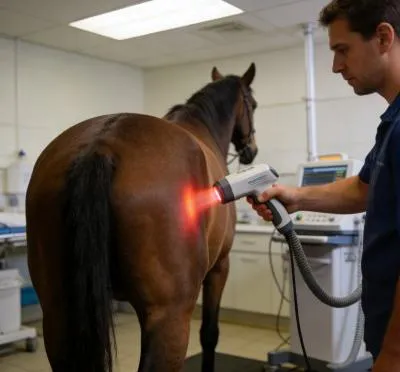
Simultaneously, the 1470nm wavelength targets the high water content of intracellular and interstitial tumor fluid. Because the absorption coefficient of water at 1470nm is roughly an order of magnitude higher than conventional 980nm or 810nm bands, energy deposition remains tightly localized within the aqueous cellular matrix. The intracellular water boils instantaneously, bursting the malignant cell membranes and turning tumor mass into vapor with minimal collateral damage. By coupling both wavelengths in a dedicated equine laser therapy device, the clinician can dynamically blend coagulative vascular control with clean, non-charring water vapor excision, maintaining a spotless surgical field even in highly vascular perianal anatomy.
+-----------------------------------------------------------------------------+
| Tissue Zone           | Dominant Target     | Surgical & Cellular Effect    |
+=======================+=====================+===============================+
| Tumor Core (Pigment)  | Melanin / Water     | Instantaneous Micro-Ablation  |
+-----------------------+---------------------+-------------------------------+
| Margin Microvessels   | Hemoglobin (980nm)  | Pre-emptive Hemostasis        |
+-----------------------+---------------------+-------------------------------+
| Interstitial Fluid    | Free Water (1470nm) | Clean Vaporization, No Char   |
+-----------------------+---------------------+-------------------------------+
| Surgical Bed Subcutis | Cytochrome C Ox.    | Granulation & Primary Closure |
+-----------------------+---------------------+-------------------------------+
Thermal Dissipation Control via Precise Duty Cycle Gating
Operating on standing horses requires absolute suppression of collateral thermal spread. The perineal dermis and anal sphincter possess high sensory innervation; any sudden heat propagation into deep muscle plates triggers explosive avoidance reactions, kicking, and unsafe conditions for the surgical crew. Furthermore, heat trapped within dense collagenous fascial beds causes delayed collateral necrosis, leading to tissue breakdown weeks post-operation.
Pulse gating prevents this thermal damage. By segmenting continuous power into high-peak micro-pulsed duty cycles—utilizing 15% to 35% duty cycles with repetition rates between 1,000 Hz and 8,000 Hz—the tissue receives brief bursts of peak energy that cleanly ablate the target cells, immediately followed by an extended thermal relaxation interval. During the off-cycle, heat dissipates into the surrounding air and physiological fluids before it can conduct into the delicate external anal sphincter or deep pelvic fascia. Veterinary surgeons sourcing an equine laser therapy machine for sale must prioritize high-frequency temporal gating controls, ensuring the handpiece performs razor-sharp surgical cutting while keeping adjacent healthy margins completely cool to the touch.
Equine Surgical Oncology and Wound Healing Clinical Case Record
The following surgical ablation and subsequent photobiomodulation protocol was performed at the Regional Equine Referral Hospital, tracking an elite broodmare through complete tumor eradication and primary wound closure.
Case Identifier: EQ-ONC-2026-0924
Subject: 12-year-old Grey Thoroughbred Broodmare
Clinical Diagnosis: Confluent Ulcerated Perineal Melanomatosis, Grade 3 clinical staging with three coalescing nodules (largest measuring 6.5 cm x 4.2 cm) directly impinging on the left ventral anal sphincter margin and causing secondary tenesmus
Baseline Metrics: Persistent bloody discharge, localized foul odor, pain reaction on tail elevation, moderate dyschezia; histopathology confirmed atypical melanocytic neoplasia with clean subcutaneous boundary
| 치료 단계 | 수술 후 당일 | 광학 블렌드 | 피크 전력(W) | 변조 모드 | 듀티 사이클 | 유량(J/cm²) | 누적 에너지 |
| Surgical: Ablation Stage | 0일차 | 1470nm 70% / 980nm 30% | 24 W | Contact Quartz Tip | 35% | 절제형 | 3,600 줄 |
| Surgical: Margin Hemostasis | 0일차 | 1470nm 30% / 980nm 70% | 15 W | Non-contact Defocused | 25% | 응고성 | 1,400 Joules |
| Post-Surg Rehab: Phase 1 | Day 3 to Day 8 | 980nm 60% / 1470nm 40% | 10 W | 600 Hz Pulsed | 20% | 5.0 J/cm² | 2,000 줄 |
| Post-Surg Rehab: Phase 2 | Day 11 to Day 21 | 980nm 50% / 1470nm 50% | 16 W | 2,000 Hz Pulsed | 30% | 8.5 J/cm² | 3,400 Joules |
| Post-Surg Rehab: Phase 3 | Day 25 to Day 40 | 980nm 35% / 1470nm 65% | 20 W | 4,500 Hz Pulsed | 40% | 11.0 J/cm² | 4,400 Joules |
Clinical assessment on day 10 revealed healthy, pink wound bed granulation without excessive exudate or secondary infection despite continuous exposure to the perineal environment. By day 28, re-epithelialization covered 85% of the surgical excision pocket with no contracture of the anal margin. Dyschezia fully resolved by the end of week two. An evaluation at day 60 confirmed complete wound closure with supple, non-pigmented scar tissue, normal anal sphincter tone, and zero recurrence of tumor tissue.
Coherent Light Delivery Outmatches Outdated Ablation Protocols
Standard interventions for equine cutaneous tumors present immense management hurdles in field conditions. Wide-margin surgical excision with a scalpel creates large deficits under tension, almost always leading to complete suture breakdown, chronic wound discharge, and secondary bacterial infections. Cryosurgical ablation lacks depth control; the freezing wave penetrates unpredictably into adjacent muscle, causing prolonged sloughing, offensive necrotic odor, and significant post-operative pain that leaves the horse difficult to handle. Topical chemotherapeutic ointments, like cisplatin or fluorouracil emulsions, pose severe toxic contamination risks to barn personnel and foals while failing to eliminate deep tumor roots.
Applying structured laser therapy for horses fundamentally redefines surgical oncology in veterinary medicine. Using flexible fiber delivery on a sedated, standing horse eliminates the severe cardiovascular and recovery hazards associated with general anesthesia in large animals. Immediate photothermal sealing of small blood vessels and lymphatic channels provides a dry, sterile surgical cavity that naturally repels bacterial colonization without requiring bulky bandages in unmanageable anatomical locations. Following surgical excision, adjusting the platform to broad-beam therapeutic photobiomodulation energizes healthy fibroblast migration, prevents hypertrophic fibrous scabbing, and guarantees rapid, clean re-epithelialization. Equine practitioners and breeding managers gain a clean, low-stress standing procedure, minimal post-operative maintenance, and a lasting clinical resolution that preserves the value and comfort of equine patients.