 FotonMedix












A emissão profunda de classe IV resolve a tenossinovite do bíceps canino
Targeted multi-wavelength delivery drives rapid intra-tendinous photon saturation, pairs deep collateral microvascular reperfusion with localized synovial sheath fluid evacuation, and prevents cutaneous thermal spikes through gated duty cycle modulation.
Small animal orthopedic specialists and canine sports rehabilitation clinicians face an uphill battle when managing chronic supraspinatus tendinopathy and secondary biceps tenosynovitis in active canine breeds. A six-year-old Border Collie competing in flyball enters the consultation room displaying Grade 3 unilateral forelimb lameness, marked shoulder extension pain, and localized hyperpathia upon direct digital pressure across the bicipital groove. Diagnostic musculoskeletal ultrasound reveals severe hypoechoic thickening of the biceps tendon sheath, disorganized collagen bundle architecture, and marked localized synovial effusion. Repeated injections of systemic anti-inflammatory agents have failed to yield long-term functional recovery, instead causing persistent gastrointestinal upset and elevated liver transaminases. When clinicians resort to a conventional low-power cold laser therapy machine for dogs, light scatters rapidly across the dense brachiocephalic musculature and heavy fibrous tendon sheath, delivering virtually zero measurable energy to the chronically inflamed tendon core. Technicians spend thirty minutes holding low-fluence probes that produce no clinical progress, leaving the dog in chronic pain.
Optical Penetration Physics Through Dense Shoulder Soft Tissue Envelopes
Photobiomodulation of the canine shoulder joint requires delivering sufficient energy through complex biological layers. The tendon of the biceps brachii passes through the intertubercular groove, buried beneath skin, subcutaneous adipose tissue, and thick cranial shoulder musculature. Photons directed at this region undergo strong biological attenuation driven by Rayleigh scattering from microscopic extracellular matrix fibrils and Mie scattering from larger cellular organelles.
In dense fibrous tendinous structures, scattering coefficients far outweigh absorption coefficients across shallow visible wavelengths. Milliamperage devices deliver inadequate photon flux to penetrate these dense structures. Light dissipates within the first few millimeters of superficial dermis, failing to reach the biological threshold of four to eight Joules per square centimeter required to initiate cellular repair at depths of three to five centimeters. Delivering therapeutic doses to the deep bicipital groove demands high initial irradiance.
Biological dose-response behavior governed by the Arndt-Schulz law dictates that sub-therapeutic photon densities fail to stimulate cellular pathways, while unmodulated continuous energy risks photothermal damage. High-power Class IV systems deliver the exact photon density required to break through dense tendon envelopes while keeping surface tissues well within safe biological limits.
When high-fluence photons reach diseased tenocytes and synovial fibroblasts, cytochrome c oxidase within mitochondrial respiratory chain complex IV absorbs the radiation. This stimulates the immediate dissociation of inhibitory nitric oxide, restoring electron transport and elevating mitochondrial proton gradients. The resulting surge in adenosine triphosphate production provides the cellular energy necessary to synthesize parallel collagen bundles while downregulating degenerative enzymes, including interleukin-one beta and matrix metalloproteinases.
Sincronização de dois cromóforos nos espectros de 980 nm e 1470 nm
Chronic bicipital tenosynovitis presents two opposing tissue challenges: microvascular ischemia within the dense hypovascular tendon core, and stagnant, water-rich chronic synovial swelling within the surrounding tendon sheath. Monochromatic systems cannot treat both conditions effectively. Restoring connective tissue function requires coordinating complementary wavelengths targeting distinct biological chromophores.
The 980nm wavelength demonstrates peak absorption in deoxygenated and oxygenated hemoglobin, alongside moderate water interaction. Tendon insertion zones are naturally hypovascular and become micro-ischemic under chronic mechanical compression. Irradiating the bicipital groove with 980nm energy induces localized photothermal vasodilation within compressed periarticular capillary networks, washing out acidic metabolic byproducts and driving oxygenated blood into hypoxic connective tissue. This vascular stimulus triggers macrophage shifting from pro-inflammatory M1 phenotypes to pro-resolving M2 phenotypes, accelerating tissue repair.
The 1470nm wavelength interacts directly with intracellular and interstitial water molecules. Its absorption coefficient in water is forty times higher than that of wavelengths in the 800nm to 900nm window. Chronic tenosynovitis is characterized by heavy synovial fluid effusion and peri-tendinous edema that elevate internal compartment pressure and restrict gliding motion. Direct application of 1470nm energy interacts with this fluid volume, improving cell membrane permeability and accelerating lymphatic clearance to relieve intra-sheath pressure without invasive needle drainage.
Coordinating 980nm and 1470nm emissions within a synchronized delivery beam creates targeted clinical synergy. The 980nm wavelength restores microvascular circulation and cellular respiration, while the 1470nm wavelength disperses dense fluid pockets that would otherwise scatter therapeutic light. Clinicians evaluating an animal laser therapy machine require this dual-action capability to break down fibrous barriers and deliver restorative photon energy directly into damaged tendons.
Tempo de relaxamento térmico e modulação dinâmica do ciclo de funcionamento
Directing high average power into dense canine shoulder musculature carries a clear clinical danger: thermal skin damage. Canine coats and pigmented dermal structures absorb photon energy rapidly, converting radiant power into thermal heat. Without precise temporal control, surface temperatures quickly exceed forty-three degrees Celsius, risking thermal discomfort, structural protein denaturation, and dermal burns.
Preventing thermal buildup requires aligning delivery with the thermal relaxation time of animal tissue. Thermal relaxation time represents the duration needed for a biological tissue layer to lose fifty percent of its accumulated heat through natural microvascular conduction. Canine dermis exhibits thermal relaxation constants in the millisecond domain. Continuous-wave laser output dumps heat into superficial layers faster than capillary blood flow can clear it, creating painful thermal spikes.
Pulsed duty cycles solve this problem by converting continuous photon delivery into rapid micro-pulses separated by true thermal relaxation pauses. Operating at duty cycles between twenty and forty percent allows high peak powers to drive through thick shoulder musculature, while the intermediate zero-emission pauses allow superficial tissues to cool naturally.
O ajuste das frequências de pulsação desencadeia efeitos biológicos distintos:
As frequências entre dez e cem hertz estabilizam as fibras nervosas nociceptivas periféricas, atenuando a transmissão da dor ao longo das fibras C não mielinizadas.
As frequências entre quinhentos e mil hertz estimulam contrações linfáticas localizadas, eliminando derrames inflamatórios persistentes.
As frequências entre dois mil e dez mil hertz maximizam a absorção da citocromo c oxidase pelos tenócitos, acelerando a reparação da matriz extracelular e a remodelação paralela do colagénio.
A implementação de um sistema de controlo de impulsos equilibrado num aparelho moderno de terapia a laser para cães, disponível para venda, permite aos clínicos administrar doses volumétricas profundas através de estruturas musculares densas, sem causar queimaduras na pele nem agitação no animal.
Arquitetura comparativa entre plataformas veterinárias de Classe IV
Evaluating therapeutic equipment requires analyzing clear engineering distinctions. Low-power pens, superficial mats, and continuous surgical units lack the beam dynamics, optical depth, and thermal management needed to treat deep tendon pathologies and chronic canine joint disease. Selecting the right high-power system demands a direct comparison of physical specifications.
| Métrica operacional | Unidades de refrigeração de baixo nível | Unidades de Classe IV de onda única contínua | Sistemas dinâmicos de Classe IV com múltiplas ondas |
| Potência de saída ótica máxima | 0,2 W – 0,5 W | 10 W – 15 W contínuos | 15 W – 30 W (pico com modulação) |
| Comprimentos de onda de emissão | 635 nm – 810 nm Único | Exclusivo de 810 nm ou 980 nm | 980 nm + 1470 nm sincronizados |
| Profundidade de penetração cutânea | 5 mm a 10 mm | 25 mm a 35 mm | De 50 mm a 80 mm de profundidade nos espaços das juntas |
| Risco de acumulação de calor na pele | Ausente | Elevado com movimento lento da peça de mão | Regulado através de arrefecimento com ciclo de trabalho controlado por porta |
| Foco clínico | Feridas superficiais na pele, otite | Distensões musculares superficiais generalizadas | Chronic bicipital tenosynovitis, deep joint disease |
| Canine Shoulder Treatment Time | 40 a 50 minutos | 15 a 20 minutos | 5 to 7 minutes per shoulder |
| Cromóforos celulares-alvo | Apenas a citocromo c oxidase | Citocromo c oxidase ou hemoglobina | Citocromo c oxidase, hemoglobina e água |
Equipar uma clínica de reabilitação veterinária com equipamento que combine uma elevada potência de pico com opções distintas de múltiplos comprimentos de onda garante uma penetração adequada em profundidade, tanto em casos clínicos de pequenos animais como de grandes animais.
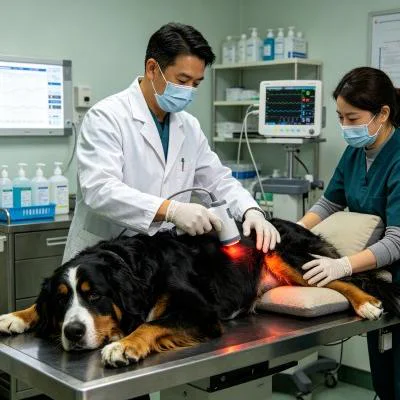
Protocolo de Caso Clínico Documentado
The following documented case outlines deep-tendon photobiomodulation in a small animal sports medicine clinical practice.
Case File Reference: VET-ORTHO-2026-9043
Subject: Canine, Border Collie, Intact Male
Idade: 6 anos e 5 meses
Weight: 21.4 kg
Confirmed Diagnosis: Severe Chronic Right Biceps Brachii Tenosynovitis with marked secondary infraspinatus contracture and intra-sheath effusion. Musculoskeletal diagnostic ultrasound revealed a 32% increase in tendon sheath diameter with extensive hypoechoic fluid halos and fiber disorganization along the cranial humeral groove.
Prior Therapy: Oral carprofen at 2.2 mg/kg twice daily for twelve weeks; suspended after recurring bouts of hematochezia. Local intra-articular corticosteroid injection produced two weeks of relief followed by an acute relapse of severe lameness during agility training.
Clinical Presentation: Grade 3/5 right forelimb lameness during walk, worsening to Grade 4 at trot. Severe pain vocalization during the shoulder biceps stretch test (simultaneous shoulder extension and elbow flexion). Circumference of the right thoracic limb musculature measured 24.1 cm compared to 27.6 cm on the left, demonstrating progressive supraspinatus and deltoid muscle atrophy.
Protocolo Completo de Tratamento Clínico
| Índice das sessões | Cronograma decorrido | Equilíbrio do comprimento de onda (980 nm / 1470 nm) | Potência máxima de funcionamento (W) | Frequência de impulsos e ciclo de trabalho | Energia total fornecida (joules) | Fluence na superfície da pele (J/cm²) | Observações clínicas e marcos biomecânicos |
| Sessão 1 | Dia 1 | 75% / 25% | 12,0 W | 50 Hz, ciclo de trabalho 30% | 2,800 J | 18 J/cm² | Severe muscle guarding; slow overlapping sweeps across the cranial and lateral shoulder; patient tolerated treatment well. |
| Sessão 2 | Dia 3 | 70% / 30% | 14,0 W | 50 Hz, ciclo de trabalho 35% | 3 200 J | 21 J/cm² | Periarticular muscle tension relaxed; passive shoulder extension resistance decreased by fifteen degrees. |
| Sessão 3 | Dia 6 | 65% / 35% | 15,0 W | 100 Hz, ciclo de trabalho 40% | 3,600 J | 24 J/cm² | Tendon sheath fluid halo reduced by twenty percent; patient initiates light weight-bearing during slow walking. |
| Sessão 4 | Dia 9 | 60% / 40% | 16,0 W | 250 Hz, ciclo de trabalho 40% | 4,000 J | 26 J/cm² | Lameness score reduced to Grade 2/5; head bobbing during straight-line trot significantly diminished. |
| Sessão 5 | Dia 13 | 50% / 50% | 18,0 W | 500 Hz, ciclo de trabalho 45% | 4 400 J | 29 J/cm² | Diagnostic ultrasound confirms significant fluid resorption; bicipital stretch test produces zero pain response. |
| Sessão 6 | Dia 17 | 50% / 50% | 18,0 W | 1 000 Hz, ciclo de trabalho 45% | 4 600 J | 30 J/cm² | Symmetrical weight-bearing confirmed on pressure plate; patient trotting comfortably on leash walks. |
| Sessão 7 | Dia 22 | 40% / 60% | 20,0 W | 2 500 Hz, ciclo de trabalho 50% | 5,000 J | 33 J/cm² | Right shoulder muscle circumference recovered to 26.2 cm; agility foundation flatwork re-introduced. |
| Sessão 8 | Dia 28 | 40% / 60% | 20,0 W | 5 000 Hz, ciclo de trabalho 50% | 5,000 J | 33 J/cm² | Follow-up ultrasound demonstrates tight linear collagen re-alignment and total resolution of intra-sheath effusion. |
| Sessão 9 | Dia 38 | 50% / 50% | 16,0 W | 1 000 Hz, ciclo de trabalho 40% | 3,800 J | 25 J/cm² | Maintenance phase entry; dog clears low practice jumps without hesitation or post-exercise soreness. |
| Sessão 10 | Dia 52 | 50% / 50% | 14,0 W | 500 Hz, ciclo de trabalho 35% | 3 400 J | 22 J/cm² | Full clinical recovery; cleared for competitive return to sport; gastrointestinal health fully stable. |
Therapy was delivered using a wide-angle divergent contact handpiece moving in continuous overlapping longitudinal strokes across the cranial bicipital groove, supraspinatus insertion, and scapulohumeral joint margin. The total treated surface covered approximately one hundred and fifty square centimeters over the right shoulder region.
Resultados clínicos e integração na prática clínica
Relying solely on non-steroidal anti-inflammatory medications for chronic canine tendon disorders carries substantial clinical risks. Suppressing systemic cyclooxygenase pathways masks mechanical pain without addressing localized tendon ischemia or disorganized collagen matrices. Prolonged pharmaceutical use often causes gastric mucosal ulceration and renal damage, leaving clinicians with few options once drug toxicity forces treatment withdrawal. Furthermore, invasive surgical procedures such as biceps tenodesis or tenotomy permanently alter shoulder kinematics, carry substantial anesthetic risks, and require lengthy rehabilitation periods that often end an athletic dog’s sporting career.
High-power Class IV multi-wavelength laser therapy provides a non-invasive, drug-free alternative that targets the biological roots of tendon breakdown. Coordinating 980nm microvascular stimulation with 1470nm water absorption delivers therapeutic photons through dense muscular envelopes directly into the damaged tendon sheath. Cellular ATP production increases, micro-ischemia clears, and chronic inflammatory effusions drain through stimulated lymphatic routes without requiring surgical intervention.
Integrating an advanced veterinary laser therapy platform into daily clinical workflows improves treatment efficiency and elevates patient care standards. Rehabilitation protocols wrap up in under seven minutes per joint, and measurable biomechanical improvements appear within four treatments. Patients regain natural limb loading without systemic organ toxicity, sparing pet owners the financial and emotional stress of complicated surgical procedures. Adopting high-performance laser technology equips modern veterinary facilities with a reliable, evidence-backed treatment foundation that preserves long-term mobility and enhances patient quality of life.