 FotonMedix












Excelência Neuro-Reabilitativa: Fotobiomodulação avançada para patologias veterinárias da coluna vertebral
A evolução da neurologia veterinária atingiu um ponto fulcral em que a intervenção cirúrgica deixou de ser o único pilar da recuperação. À medida que nos aprofundamos nas complexidades do sistema nervoso central (SNC) em pequenos animais, a integração do tratamento com laser em fisioterapia surgiu como um componente fundamental da reabilitação multimodal. Para o especialista clínico, o desafio não é apenas tratar um sintoma, mas navegar na delicada paisagem biológica da medula espinal, onde a isquémia, a inflamação e as cicatrizes gliais impedem frequentemente o processo regenerativo natural.
Embora os donos de animais de estimação perguntem frequentemente o que é a terapia laser para cães no contexto de uma simples artrite, a aplicação clínica a lesões da espinal medula - como a doença do disco intervertebral (DDIV) ou a embolia fibrocartilaginosa (FCE) - exige uma compreensão muito mais sofisticada das curvas dose-resposta e da física dos fotões. Do mesmo modo, ao discutir terapia laser fria para gatos, Para além disso, temos de ter em conta a neuro-sensibilidade única da espécie felina. Este artigo explora a aplicação de alto nível da Terapia Laser de Alta Intensidade (HILT) e a terapia veterinária Fotobiomodulação (PBM) na gestão de casos complexos da coluna vertebral e neurológicos.
A bioenergética da reparação da espinal medula
A nível celular, a lesão da espinal medula desencadeia uma cascata de eventos devastadores. Após o trauma mecânico primário, inicia-se uma fase de lesão secundária, caracterizada por stress oxidativo, influxo de iões de cálcio e libertação de neurotransmissores excitatórios que conduzem à apoptose neuronal. É aqui que a fotobiomodulação veterinária (PBM) tem o seu impacto clínico mais significativo.
O alvo principal são as mitocôndrias nos neurónios danificados e nas células gliais de suporte. Ao fornecer comprimentos de onda específicos de luz, estimulamos a citocromo c oxidase, que facilita a produção de trifosfato de adenosina (ATP). No contexto da medula espinal, este aumento da energia celular é desviado para a manutenção da bomba de sódio-potássio, reduzindo o edema celular e apoiando as exigências metabólicas do transporte axonal. Além disso, foi demonstrado que o PBM modula a expressão do Fator Neurotrófico Derivado do Cérebro (BDNF), uma proteína fundamental que apoia a sobrevivência dos neurónios existentes e incentiva o crescimento de novas sinapses.
Ultrapassar o Escudo Vertebral: A Física da Profundidade
Um dos principais obstáculos no tratamento das doenças da coluna vertebral é a estrutura anatómica das vértebras. A medula espinal está envolta em osso, que actua como uma barreira significativa à penetração da luz. Os sistemas tradicionais de baixa potência, muitas vezes referidos sob a designação de aparelho de terapia a laser frio, A maioria dos dispositivos de proteção contra radiações, como a lâmpada de incandescência, tem dificuldade em fornecer a densidade de potência necessária para atingir o espaço subaracnoideu.
Para obter um resultado terapêutico, o clínico deve compreender a “dose volumétrica”. Não basta calcular simplesmente a energia fornecida à superfície da pele; é necessário calcular a energia residual que chega aos cornos dorsal e ventral da medula espinal. É aqui que um dispositivo de Classe IV laser veterinário torna-se indispensável. Utilizando níveis de potência que vão de 10 a 25 Watts, podemos ultrapassar a dispersão e a absorção inerentes aos músculos e ao osso epaxiais sobrejacentes, assegurando que o “limiar terapêutico” de fotões é atingido no local da lesão.
Intenção clínica: Mudança de paliativo para regenerativo
O foco deste discurso é a intenção específica de restauração neurológica. No passado, a terapia com laser era frequentemente vista como uma ferramenta paliativa - algo para fazer com que o doente se sentisse “mais confortável” enquanto recuperava por si próprio. Dados clínicos modernos sugerem que a terapia a laser de alta intensidade fisioterapia tratamento a laser influencia ativamente a taxa de degeneração Walleriana e a subsequente regeneração das fibras nervosas.
Ao suprimir a formação da cicatriz glial inibitória - uma densa malha de matriz extracelular que impede o crescimento axonal - o laser cria um ambiente “pró-regenerativo”. Isto é particularmente importante nas primeiras 72 horas após a cirurgia ou após a lesão. O objetivo é ir para além do mero controlo da dor e avançar para o restabelecimento funcional da propriocepção e do controlo motor.
Dinâmica comparativa do comprimento de onda em aplicações da coluna vertebral
Na reabilitação veterinária da coluna vertebral, a sinergia de vários comprimentos de onda é essencial para tratar as várias camadas de tecido envolvidas na lesão.
- 810nm (O motor celular): Este comprimento de onda tem a taxa de absorção mais elevada pela citocromo c oxidase. É o principal motor da produção de ATP e é essencial para a recuperação metabólica dos neurónios dormentes.
- 980nm (otimização da circulação): As lesões da coluna vertebral são frequentemente acompanhadas de isquemia localizada. O comprimento de onda de 980 nm tem como alvo a água e a hemoglobina, induzindo um efeito térmico controlado que melhora a micro-circulação e a drenagem linfática, o que é crucial para reduzir o edema da medula espinal.
- 1064nm (A unidade profunda): Dada a profundidade do canal espinal em cães de raças grandes, o comprimento de onda de 1064 nm proporciona a menor quantidade de dispersão, permitindo que a energia penetre na lâmina vertebral e atinja o parênquima espinal.
Ao utilizar estes comprimentos de onda de forma coordenada, o médico pode tratar a incisão cirúrgica, os espasmos musculares compensatórios e a lesão profunda da coluna vertebral numa única sessão abrangente.
Estudo de caso: Reabilitação intensiva de DDD pós-cirúrgica
Para demonstrar a eficácia da terapia laser de alta intensidade num contexto neurológico, examinamos um caso pós-operatório complexo tratado num centro de referência veterinário especializado.
Antecedentes do doente:
“Max”, um macho de 5 anos, castrado, da raça Teckel, pesando 8,5 kg. Max apresentou um quadro de paraplegia de início agudo e perda de perceção da dor profunda (DPP) nos membros pélvicos. Uma ressonância magnética confirmou uma extrusão discal grave de tipo I em L3-L4 com compressão significativa da medula espinal.
Diagnóstico preliminar:
Doença aguda do disco intervertebral de grau 5 (IVDD). Max foi submetido a uma hemilaminectomia de emergência para descomprimir a medula espinal. Após a cirurgia, o prognóstico para a marcha era reservado devido à gravidade da compressão inicial e à presença de hematomas significativos na medula espinal (mielomalácia).
Estratégia de tratamento:
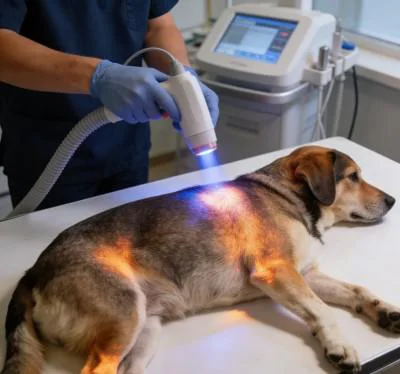
Foi iniciado um plano de reabilitação pós-cirúrgica 24 horas após a cirurgia. O objetivo principal era utilizar protocolos de laser veterinário de classe IV para reduzir a inflamação pós-cirúrgica, gerir a dor na coluna vertebral e estimular a neuro-regeneração. A área de tratamento estendeu-se de T13 a S1 para incluir toda a zona da “raiz nervosa”.
Parâmetros clínicos e tabela de definições:
| Fase | Duração | Comprimento de onda | Frequência | Potência | Energia total (Joules) |
| I: Cura aguda | Dias 1-7 | 810/980nm | 5000Hz (Pulso) | 10W | 1500 J (Zona Espinal) |
| II: Reparação de nervos | Dias 8-21 | 810/1064nm | 500Hz (Pulso) | 12W | 2500 J (Zona Espinal) |
| III: Recuperação funcional. | Dias 22-45 | 810/980/1064nm | CW (Contínuo) | 15W | 3500 J (Global) |
O processo de tratamento:
Durante a Fase I, o foco foi o local da cirurgia. O laser foi utilizado para gerir a resposta inflamatória e evitar lesões secundárias da medula. Na Fase II, à medida que a incisão cicatrizava, a intensidade foi aumentada para atingir as estruturas espinais mais profundas. O médico utilizou uma técnica de “contacto” com um acessório de bola de massagem especializado para ajudar a mobilizar os músculos paravertebrais enquanto emitia os fotões.
Recuperação pós-tratamento e resultados:
- Dia 10: Max recuperou a perceção da dor profunda em ambas as patas traseiras.
- Dia 21: A função motora voluntária regressou ao membro posterior esquerdo.
- Dia 45: Max foi capaz de fazer “marcha espinhal” e mostrou uma recuperação 80% da propriocepção consciente.
- Conclusão: A aplicação agressiva da terapia laser de alta intensidade encurtou significativamente o tempo de recuperação esperado e melhorou a pontuação neurológica final para além do prognóstico pós-cirúrgico inicial.
Conclusão final:
Este caso sublinha que, para a reabilitação da coluna vertebral, a terapia laser para cães não é apenas um tratamento secundário; é um fator primário do resultado neurológico. Ao fornecer a energia necessária para ultrapassar a barreira óssea e estimular o SNC, alteramos a trajetória de recuperação dos doentes paralisados.
Depuração glinfática e neuroprotecção em gatos
Ao considerar a terapia a laser frio para gatos com problemas de coluna, devemos também considerar o papel do sistema glinfático. Investigações recentes sugerem que o sistema nervoso central tem a sua própria via de eliminação de resíduos, que é particularmente ativa durante o sono e o período de repouso. Os traumatismos da coluna vertebral provocam frequentemente uma “obstrução” deste sistema com resíduos metabólicos e subprodutos inflamatórios.
Foi demonstrado que a PBM de alta intensidade melhora o fluxo glinfático através da modulação dos canais de água da aquaporina-4 (AQP4). Nos pacientes felinos, que são propensos a inflamação crónica e à “síndrome da hiperestesia felina”, a utilização da terapia laser pode ajudar a limpar a via neural destas toxinas. Este efeito neuroprotector é uma das principais razões pelas quais a terapia laser está a ser cada vez mais utilizada para doenças não cirúrgicas da coluna vertebral em gatos, como a espondilose deformante.
Integração com o tratamento da osteoartrite canina
É importante reconhecer que os problemas da coluna vertebral raramente existem no vácuo. Muitos cães com DIVD também sofrem de problemas compensatórios de gestão da osteoartrite canina. Ao deslocarem o seu peso para a frente para compensar a fraqueza dos membros posteriores, os membros anteriores e a coluna cervical sofrem uma tensão excessiva.
Um plano de tratamento completo de fisioterapia a laser deve ter em conta esta “cadeia biomecânica”. Tratar apenas o local da extrusão discal é uma abordagem limitada. O médico especialista trata a lesão primária, a dor articular compensatória secundária e a proteção muscular terciária. Esta abordagem holística assegura que, quando a função neurológica regressa, o sistema músculo-esquelético é capaz de suportar o movimento do animal.
O papel da onda pulsada versus onda contínua em neurologia
O debate entre pulsação (PW) e onda contínua (CW) é particularmente relevante no tratamento da coluna vertebral.
- Pulsação de alta frequência (por exemplo, 5000Hz): É utilizado principalmente para analgesia. Interfere com a transmissão dos sinais de dor ao longo das fibras A-delta e C (teoria do controlo da porta).
- Pulsação de baixa frequência (por exemplo, 10-100Hz): É utilizado para estimular a drenagem linfática e reduzir o edema.
- Onda contínua (CW): É o mais eficaz para fornecer uma “dose total” elevada de energia para fins regenerativos. No entanto, requer um movimento cuidadoso da mão para gerir o efeito térmico.
Numa sessão típica para um cão com traumatismo da coluna vertebral, podemos começar com pulsação de alta frequência para acalmar a dor do paciente e, em seguida, fazer a transição para um modo CW para fornecer a bioestimulação de tecidos profundos necessária para a reparação do nervo.
Segurança e controlo profissional
A utilização de lasers de alta potência em neurologia veterinária exige uma formação rigorosa. O clínico deve estar ciente da “janela biológica” e evitar estimular excessivamente o tecido, o que poderia levar a um aumento temporário da inflamação. Além disso, como os doentes com coluna vertebral estão frequentemente imóveis, não podem afastar-se se a área ficar demasiado quente. A monitorização constante da temperatura da pele e a utilização da velocidade adequada das mãos são normas de segurança não negociáveis.
FAQ: Terapia avançada com laser para a coluna vertebral
1. A terapia laser é eficaz para lesões “antigas” da coluna vertebral?
Embora os resultados mais dramáticos sejam observados em casos agudos, os problemas “crónicos” da coluna vertebral também podem beneficiar. O laser pode ajudar a gerir a dor compensatória crónica e a melhorar a função nervosa remanescente, embora a taxa de recuperação seja normalmente mais lenta.
2. Como é que o laser chega à medula espinal através do osso?
Utiliza o princípio da “dispersão e transmissão de fotões”. Embora alguma luz seja reflectida pelo osso, uma percentagem significativa de luz infravermelha próxima pode atravessar a lâmina vertebral, especialmente quando um Laser de classe IV com elevada densidade de potência.
3. A terapia laser pode substituir a cirurgia para a DIVD?
Para IVDD de grau 1-3 (em que o cão ainda consegue andar), a terapia laser é frequentemente o tratamento primário. Para os graus 4-5 (paralisia), a cirurgia é normalmente a primeira escolha, mas a terapia laser é essencial para a fase de recuperação pós-operatória para garantir o melhor resultado possível.
4. É seguro utilizar a terapia laser a frio em gatos com problemas renais?
Sim. De facto, como a terapia laser é localizada e não sistémica, é a opção mais segura para o tratamento da dor em gatos com insuficiência renal que não toleram AINEs ou outros medicamentos.
5. De quantos tratamentos precisará o meu cão após uma cirurgia às costas?
Um protocolo pós-cirúrgico típico envolve 2-3 sessões por semana durante as primeiras 3 semanas, diminuindo para uma vez por semana à medida que o doente recupera a função. A maioria dos pacientes vê uma mudança notável nas primeiras 6 sessões.