 FotonMedix












Superar os limites da cicatrização hipovascular em roturas fibrosas profundas
High irradiance dual-target photobiomodulation drives microvascular perfusion through precise water and hemoglobin absorption peaks, bypasses dense collagen scatter via gated pulse delivery, and accelerates type I collagen synthesis without thermal tissue collapse.
Chronic tendinopathies and severe desmitis routinely frustrate sports medicine physicians and orthopedic physical therapists. A competitive athlete presents with a recalcitrant mid-portion Achilles tendinopathy that has resisted months of eccentric loading and radial shockwave therapy. The tendon remains thickened, morning stiffness lasts over an hour, and passive dorsiflexion reproduces sharp, localized pain. Beneath the skin lies an anatomically hostile environment for standard healing: dense regular connective tissue with sparse cellularity and exceptionally low basal vascularity. In hypovascular structures like the Achilles tendon or the equine superficial digital flexor, resting oxygen consumption is roughly an order of magnitude lower than skeletal muscle. When microtears disrupt the tightly packed parallel collagen bundles, the local repair response stalls. Fibroblasts struggle within an energy-depleted, hypoxic niche, laying down disorganized type III collagen that forms weak, hypervascular scar tissue prone to recurrent rupture rather than functional mechanical restoration.
Deploying Class IV medical laser systems breaks this physiological bottleneck. Understanding the optical properties of target tissues dictates clinical success. Photons directed at dense biological targets do not travel along a straight path; they undergo significant Rayleigh and Mie scattering alongside absorption by primary endogenous chromophores: water, deoxygenated hemoglobin, and oxygenated hemoglobin. Traditional low-level devices fail primarily because superficial scatter dissipates their milliwatt output within the first few millimeters of the dermis, delivering negligible photonic density to the deep fascial planes where microtrauma resides. When applying terapia a laser para lesões nos tecidos moles, clinical operators must balance irradiance and wavelength selection to ensure sufficient photon fluence reaches target depths of three to five centimeters without causing epidermal surface burns.
Chromophore Affinity and Hemodynamic Activation
Optimizing biological responses in fibrous trauma requires simultaneous targeting of interstitial fluid dynamics and microvascular oxygen extraction. Multi-wavelength Class IV platforms solve this by synchronizing distinct near-infrared wavelengths within the tissue therapeutic window.
The 980 nm wavelength exhibits balanced absorption between hemoglobin and tissue water, acting as a potent hemodynamic driver. Absorption by oxygenated hemoglobin generates localized thermal micro-gradients within the terminal capillary network. This micro-thermal stimulus prompts smooth muscle relaxation within precapillary sphincters, triggering robust, sustained hyperemia. Enhanced local perfusion floods the ischemic injury zone with oxygen and systemic nutrients, reversing local tissue acidosis.
Concurrently, the 1470 nm wavelength possesses an absorption coefficient for water roughly sixty times higher than wavelengths in the 800 nm range. Interstitial edema and inflammatory exudate pool around damaged fascial sheaths, increasing extracellular fluid pressure and mechanically compressing surrounding healthy capillary loops. Because water heavily absorbs 1470 nm photons within the superficial extracellular matrix, this energy rapidly modifies local fluid viscosity and stimulates initial superficial lymph dynamic clearance. Fluid decompression relieves mechanical tension on exposed nociceptors, providing immediate analgesia while opening congested vascular conduits. Combining these spectral bands creates an optimized physiological landscape: 1470 nm reduces compressive edema, while 980 nm pumps arterial inflow directly into the hypovascular defect.
Subcellular Photochemistry and Collagen Realignment
Beyond macroscopic vascular enhancement, coherent infrared photons orchestrate precise mitochondrial repair pathways. The primary photoacceptor in deep connective tissue fibroblasts is Cytochrome c Oxidase, the terminal enzyme of the mitochondrial electron transport chain (Complex IV).
In chronically damaged or torn structures, oxidative stress causes excessive nitric oxide to bind competitively to the binuclear center of Cytochrome c Oxidase, displacing molecular oxygen and shutting down cellular respiration. Photons within targeted infrared bands deliver quantum energy that photodissociates this inhibitory nitric oxide. Relieved of nitric oxide blockade, the enzyme resumes normal electron transport, accelerating mitochondrial membrane potential and driving adenosine triphosphate (ATP) synthesis via ATP synthase rotary catalysis.
This sustained energetic surge alters the metabolic state of dormant tenocytes and ligamentous fibroblasts:
- ATP upregulation empowers cellular ion pumps, maintaining cellular homeostasis and mitigating degenerative structural swelling.
- Transient bursts of intracellular reactive oxygen species activate gene transcription factors, upregulating vascular endothelial growth factor (VEGF), basic fibroblast growth factor (bFGF), and transforming growth factor-beta (TGF-β).
- Cleared nitric oxide diffuses into local vascular walls, generating cyclic guanosine monophosphate (cGMP) cascades that sustain regional vasodilation.
- Activated fibroblasts transition from depositing random, friable type III reticular fibers to synthesizing high-tensile type I collagen fibrils aligned parallel to mechanical vectors.
Applying targeted terapia a laser para lesões nos tendões relies on this metabolic activation to bridge the gap between initial cellular proliferation and functional fiber maturation.
Managing Thermal Kinetics with Gated Pulse Dynamics
Delivering tens of thousands of Joules into deep structures presents a thermodynamic challenge. While photobiomodulation relies on photochemical and photophysical signaling rather than photothermal ablation, the absorption of high-power Class IV radiation inevitably generates heat within biological media. Continuous-wave delivery can rapidly cause epidermal heat accumulation, triggering patient discomfort, reflexive muscle guarding, or localized thermal necrosis of collagen fibers, which denature around 60 to 65 degrees Celsius.
To deliver high photon flux to deep-seated interfaces without crossing thermal damage thresholds, clinicians adjust pulse emission frequency and duty cycle. The duty cycle represents the fraction of time the laser beam is actively emitting photons relative to the total cycle time.
Operating in pulsed mode establishes thermal relaxation cycles within tissues:
- When the pulse fires, high instantaneous peak power propels photons deep into scattering tissues, satisfying the threshold fluence required for mitochondrial activation at target depths.
- During the pulse-off interval, tissues dissipate accumulated heat into the systemic microcirculation and adjacent tissue volumes.
- Lower duty cycles (such as 30% to 50%) permit higher peak power outputs to penetrate dense structures like the patellar tendon, plantar fascia, or equine suspensory apparatus while keeping baseline skin surface temperatures well below 42 degrees Celsius.
- Modulating pulse repetition rates from low frequencies (10 to 100 Hz) for acute inflammatory states to higher frequencies (1,000 to 5,000 Hz) for dense, organizing fibrous tissues modifies acoustic-mechanical signaling within the extracellular matrix, facilitating proteoglycan reorganization.
Clinical Protocol: Chronic Medial Collateral Ligament Desmopathy Case
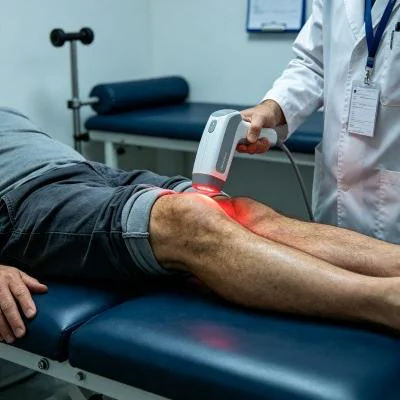
A clinical evaluation highlights the application of precise high-power photobiomodulation parameters in resolving chronic joint instability. Complete functional recovery requires strict parameter tracking, ensuring total energy density matches tissue volume and lesion geometry.
Clinical Profile and Baseline Presentation
- Case Identifier: MED-ORTHO-2026-0882
- Patient Profile: 38-year-old male, semi-professional trail runner
- Primary Diagnosis: Chronic Grade II Medial Collateral Ligament (MCL) Desmopathy (Right Knee)
- Chronicity: 14 weeks post-injury, recalcitrant to progressive physical therapy and oral nonsteroidal anti-inflammatory drugs
- Baseline Diagnostic Ultrasound: Significant hypoechoic thickening at the femoral insertion of the MCL measuring 7.8 mm (contralateral normal: 4.1 mm), loss of normal fibrillar architecture, and focal interstitial tearing without complete macroscopic avulsion. Color Doppler reveals low-level dysplastic neovascularization along the periligamentous margin.
- Baseline Functional Metrics: Visual Analog Scale (VAS) pain score during single-leg squat: 7/10. Lower Extremity Functional Scale (LEFS): 48/80. Passive valgus stress test at 30 degrees knee flexion demonstrates distinct joint laxity with a soft end-feel.
Treatment Course and Photobiomodulation Parameters
The patient underwent a course of 12 therapeutic laser sessions over six weeks, using a dual-wavelength high-power medical laser unit equipped with an optical spacer handpiece applied in continuous slow grid scanning perpendicular to the ligamentous axis.
| Metric / Parameter | Phase 1: Sessions 1–3 (Decongestion & Analgesia) | Phase 2: Sessions 4–8 (Fibroblast Proliferation) | Phase 3: Sessions 9–12 (Remodeling & Rematuation) |
| Primary Wavelength Allocation | 70% 1470 nm, 30% 980 nm | 50% 1470 nm, 50% 980 nm | 20% 1470 nm, 80% 980 nm |
| Modo de emissão | Pulsado | Pulsado | Continuous Wave & Superpulsed Mix |
| Potência de saída máxima | 15 W | 20 W | 12 W Average |
| Frequência de impulsos (Hz) | 50 Hz | 500 Hz | 2.500 Hz |
| Ciclo de trabalho (%) | 40% | 50% | 75% |
| Área de superfície de tratamento | 40 cm² (Periligamentous knee joint) | 25 cm² (Direct MCL anatomical track) | 20 cm² (local de inserção específico) |
| Fluence / Energy Density | 75 J/cm² | 144 J/cm² | 180 J/cm² |
| Total de joules por sessão | 3,000 J | 3,600 J | 3,600 J |
| Weekly Cadence | 3 sessões / semana | 2 sessões / semana | 1–2 sessions / week |
Executing targeted terapia a laser para lesões ligamentares requires this systematic progression. Initial sessions emphasize the 1470 nm band to drain periarticular swelling and inhibit localized C-fiber firing. As the intervention advances into intermediate and late remodeling phases, the parameter balance shifts heavily toward 980 nm at higher duty cycles, driving the deep localized hyperthermia and metabolic acceleration needed to reorganize parallel collagen matrices.
Treatment Progression and Objective Outcomes
The clinical trajectory documented steady, objective physiological improvements across all quantitative metrics:
Session 3 (End of Week 1)
VAS pain score dropped from 7/10 to 4/10 during functional loading. The patient reported a sharp decline in post-exertional aching. Resting knee circumference measured at the medial joint line decreased by 9 mm due to rapid interstitial fluid drainage.
Session 8 (End of Week 4)
Ultrasound imaging showed a reduction in medial collateral ligament thickness from 7.8 mm to 5.4 mm. Hypoechoic inflammatory patches cleared, replaced by reappearing linear fibrillar echoes. Neovascular Doppler signals diminished, confirming a transition from chaotic inflammatory hypervascularity to structured microcirculation. LEFS score increased from 48/80 to 66/80. Passive valgus stress testing revealed a firmer, more distinct mechanical end-feel.
Session 12 (Conclusion of Week 6)
Ultrasound examination confirmed structural restoration: ligament thickness stabilized at 4.4 mm, with unbroken, parallel hyperechoic fibrillar lines running from the femoral origin to the tibial insertion, mirroring the unaffected contralateral anatomy. The patient achieved a VAS score of 0/10 during repetitive unweighted single-leg squats and 1/10 during high-cadence incline treadmill running. LEFS score reached 76/80, indicating a complete return to advanced sporting activity without residual joint instability or compensatory gait alterations.
Comparing High-Power Laser Intervention and Conventional Care
Traditional clinical interventions for stubborn soft tissue, tendon, and ligament pathologies rely heavily on conservative management, pharmacological symptom suppression, or invasive surgery. Corticosteroid injections remain common for rapid pain relief; however, abundant clinical literature highlights their long-term risks. Corticosteroids arrest fibroblast protein synthesis, suppress endogenous tenocyte collagen production, and decrease local tissue shear strength, predisposing damaged tendons and ligaments to subsequent catastrophic rupture. Nonsteroidal anti-inflammatory medications systematically blunt early phase repair cascades, impairing long-term mechanical tissue integrity.
Conversely, manual therapies, dry needling, and shockwave systems deliver localized mechanical microtrauma designed to provoke an acute inflammatory reboot. While effective in select chronic cases, they carry limitations. Extracorporeal shockwave therapy imparts high-energy acoustic shear waves that cause severe patient discomfort, often requiring local anesthesia or reduced dosing schedules that diminish clinical yield. Furthermore, shockwave energy attenuates rapidly in dense, heterogeneous structures, making it difficult to deliver uniform energy along the entire length of deep ligaments.
High-power Class IV laser therapy functions without mechanical microtrauma or chemical suppression. Instead of artificially forcing an inflammatory response or halting cellular transcription, it fuels endogenous repair. The clinical advantages over conventional paths are distinct:
- Non-Invasive Energy Transfer: Coherent light traverses skin, adipose layers, and fascia to deliver therapeutic photon doses straight into hypovascular targets without disrupting overlying tissues.
- Multi-Targeted Physiological Effect: Clinicians simultaneously eliminate inflammatory fluid through water-targeted absorption bands, expand deep capillary beds via hemoglobin excitation, and drive cellular repair via Cytochrome c Oxidase activation.
- Absence of Structural Breakdown: Unlike corticosteroids, which degrade the extracellular matrix, Class IV photobiomodulation enhances fibroblast proliferation, stimulates tenocyte migration, and increases ultimate tensile breaking strength in remodeled soft tissues.
- Patient Tolerance and Treatment Precision: Operators manipulate pulse width and duty cycle to prevent thermal accumulation, allowing high photon fluence delivery with zero procedural pain and no post-treatment recovery downtime.
Integrating high-power laser therapy resolves the underlying cellular and vascular deficits that prolong chronic soft tissue trauma, providing orthopedic specialists, sports medicine clinics, and equine rehabilitation centers with a predictable, biologically grounded modality for structural healing.