 FotonMedix












Superação do bloqueio térmico na neuralgia do trigémino crónica
Direct concentrated photon flux into deep trigeminal foramina using dual-wavelength emission. Stimulate microvascular decompression while fluidizing perineural ground substance. Eliminate facial cutaneous burning using calibrated sub-millisecond gated duty cycles.
A cranial nerve and facial pain clinic sees this exact clinical nightmare every week: a 53-year-old high school literature teacher sits rigid in the exam chair, speaking out of only the left corner of her mouth to avoid triggering paroxysms of electric shock pain across her right jaw and cheek. Her clinical diagnosis confirms refractory classical trigeminal neuralgia involving the V2 maxillary and V3 mandibular divisions. She spent eleven months cycling through escalating doses of carbamazepine and baclofen that left her cognitively impaired, suffered through two rounds of microvascular decompression evaluations, and purchased multiple consumer gadgets marketed as a pain relief laser therapy device that did nothing beyond warming her cheeks. Under the neurologist’s gentle inspection, the tissue over the mental and infraorbital foramina is hypersensitive and allodynic, while the compressed nerve trunk 3 to 4 centimeters deep remains hypoxic, inflamed, and locked in chronic neurovascular compression. When past operators dialed up output on basic continuous light devices to push photons through the masseter and buccinator muscles, the patient screamed from excruciating, lancinating skin burns long before optical energy reached the inflamed trigeminal root.
Low-power modalities cannot overcome the steep optical scattering of thick facial muscles, dense parotid fascial envelopes, and zygomatic bone contours. Forcing continuous power through this sensitive, thin facial skin causes surface thermal energy to spike immediately. The patient pulls away from intense skin stinging, ending the session well before the deep perineurium receives a therapeutic photobiomodulation dose.
Overcoming this cranial nerve bottleneck requires projecting high-irradiance optical energy past the dense masticatory musculature directly into the pterygopalatine fossa and infraorbital canal while shielding the thin facial dermis from thermal saturation.
Optical Scattering Across Craniofacial Musculature and Foramina
Delivering light into deep cranial nerve branches presents an intricate biophysical challenge. Photons must pass through an ultra-thin, highly vascular facial epidermis, traverse subcutaneous fat, penetrate the dense fascia of the masseter and buccinator muscles, and pass through narrow bony apertures like the mental and infraorbital foramina. Under the Kubelka-Munk optical scattering model, light experiences severe multi-directional scattering across these complex boundaries, causing an exponential decay in forward irradiance.
Inside human craniofacial structures, three primary endogenous absorbers dictate photon pathways: cutaneous melanin, microvascular hemoglobin, and interstitial water.
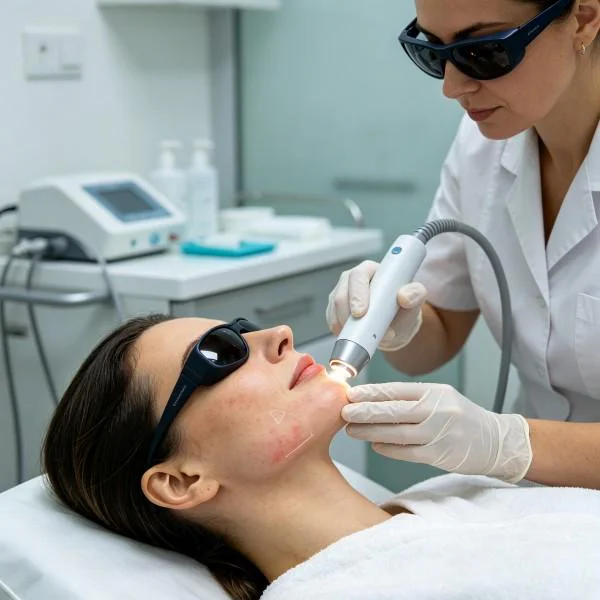
In chronic trigeminal neuralgia, the core pathology involves focal demyelination, microvascular contact with pulsatile aberrant arteries, and endoneurial ischemia, located 2.5 to 4.5 centimeters beneath the facial skin. Low-intensity Class III devices cannot penetrate this physical depth; over 94% of their light scatters into shallow epidermal and muscular tissues. The compressed nerve trunk receives virtually zero energy, leaving the demyelinated axon cylinders trapped in hypoperfusion and chronic paroxysmal firing.
Para superar esta curva de decaimento acentuada, é necessário um dispositivo de terapia a laser de alta irradiância para o alívio da dor, capaz de fornecer uma potência de pico elevada sem exceder os limiares térmicos superficiais.
Facial Epidermis & Dermal Nerve Endings (Allodynic Interface)
         │ (High Photon Scattering)
         ▼
Masseteric Fascia & Buccinator Muscle (Dense Mechanical Shield)
         │ (1470nm Aqueous Fluidization & Decongestion)
         ▼
Periradicular Microcapillary Loops (Vascular Compression Stasis)
         │ (980nm Hemoglobin Hyperemia & NO Release)
         ▼
Trigeminal Axons & Myelin Sheaths (Cellular ATP Restoration)
A ação conjunta sobre a hemoglobina e os cromóforos da água rompe o ciclo da isquemia neural:
At 980nm, photon capture aligns with absorption peaks for oxygenated and deoxygenated hemoglobin. In trigeminal neuralgia, pulsatile vascular compression chokes venous drainage, creating localized ischemia and trapping inflammatory cytokines like interleukin-1-beta, tumor necrosis factor-alpha, and calcitonin gene-related peptide. The 980nm wavelength triggers localized vasodilation, prompting circulating red blood cells to offload bound nitric oxide, clearing sluggish microcirculation and restoring oxygen delivery to starving Schwann cells.
At 1470nm, photon absorption shifts toward bound water molecules within swollen perineural sheaths and dense fascial planes. Interstitial water absorbs 1470nm light at rates significantly higher than in the 800nm zone. This controlled absorption creates micro-thermal fields that break down rigid, polymerized proteoglycan matrices, clearing stagnant inflammatory edema around the compressed infraorbital and mandibular canals and reducing mechanical pressure on the nerve.
Delivering this combined optical power into compact, nerve-dense facial spaces without scorching the skin requires precise pulse gating.
Duty Cycle Mechanics and Facial Cutaneous Thermal Clearance
Continuous-wave light delivery encounters a hard biological limit over the face: the thin, highly innervated facial skin absorbs surface heat quickly, but damaged local autonomic tone prevents adequate microvascular flushing of that thermal load. When continuous photons strike the zygomatic or mandibular region, surface temperatures spike within seconds, setting off intense burning sensations.
Precision microsecond pulse gating eliminates this surface thermal buildup. By slicing high-intensity light into microsecond bursts separated by controlled dark intervals, deep nerve structures receive high peak irradiance while the sensitive skin cools down safely between pulses.
$$\text{Ciclo de trabalho (\%)} = \left( \frac{\tau_{\text{pulso}}}{\tau_{\text{pulso}} + \tau_{\text{intervalo}}} \right) \times 100$$
Em que $\tau_{\text{pulse}}$ representa a transmissão ótica ativa e $\tau_{\text{interval}}$ representa a pausa de relaxamento térmico.
Applying 15W of continuous laser energy over the infraorbital canal triggers uncomfortable skin heating within 3 seconds over the cheekbone. In contrast, running that same power through a 15% duty cycle delivers powerful peak bursts that penetrate through dense masticatory muscles, while the 85% dark phase allows surface tissues to shed heat safely into the room and the moving handpiece.
Blood flow in viable facial vessels carries away residual surface heat, while the hypoperfused, compressed trigeminal branches absorb high photon density, initiating cellular healing without epidermal irritation.
Multi-Wavelength Synergies in Craniofacial Neurovascular Rehab
Treating complex facial nerve entrapment with a single wavelength leaves critical parts of the pathology unaddressed. Trigeminal neuralgia involves skin, delicate subcutaneous fat, thick masticatory fascia, deep facial muscle bellies, and inflamed neural tissue. Each distinct anatomical layer features unique water content, vascular density, and optical scattering properties.
A combinação de comprimentos de onda coordenados cria um gradiente terapêutico contínuo em todas as profundidades dos tecidos:
[ Craniofacial Tissue Interaction Matrix ]

810nm  ──► Mitochondrial Cytochrome c Oxidase (Surge in Axonal ATP Synthesis)
980nm  ──► Vasa Nervorum Perfusion & NO Release (Flushing Inflammatory Fluid)
1064nm ──► Deep Masseteric & Pterygoid Layers (Forward Directional Penetration)
1470nm ──► Perineural Water Matrices (Decongesting Bony Foramina Edema)
A combinação de 980 nm com 1470 nm produz melhorias biomecânicas e circulatórias imediatas. O feixe de 980 nm desobstrui os leitos microvasculares comprimidos, fornecendo oxigénio fresco às raízes nervosas isquémicas. Ao mesmo tempo, o feixe de 1470 nm atua sobre as moléculas de água retidas no interior da bainha nervosa inchada, amolecendo as ligações cruzadas rígidas do colagénio e drenando o líquido localizado.
Clinicians identify this high-irradiance approach as the best laser therapy device for pain in specialized cranial nerve rehabilitation, making subsequent gentle myofascial unwinding and oral desensitization far more productive.
Clinical Protocol Deployment in Craniofacial Neurology
High-power Class IV platforms have transformed how specialized headache centers and facial pain clinics manage refractory cranial neuralgias.
Neurologists and maxillofacial therapists managing chronic trigeminal neuralgia, persistent idiopathic facial pain, or post-herpetic trigeminal neuropathy often face slow patient progress. Low-intensity Class III modalities require 35 to 45 minutes of scanning to deliver minimal joules through deep masticatory musculature, producing negligible clinical improvements. A high-output Class IV platform cuts treatment times to under seven minutes while driving meaningful, therapeutic energy directly into compressed nerve pathways.
Specialized cranial rehabilitation practices utilizing high-output systems experience distinct operational and clinical advantages:
First, practitioners achieve meaningful therapeutic energy doses in 5 to 7 minutes, optimizing daily patient throughput and eliminating clinician physical fatigue from delicate manual procedures.
Second, rapid allodynia reduction allows patients to resume normal mastication, tooth brushing, and face washing without triggering incapacitating electric shocks.
Third, reliable deep-tissue cellular repair restores microvascular blood flow, stabilizing axonal membrane potentials and decreasing reliance on central nervous system depressants.
Documentação de casos clínicos
The following case record details the clinical application of multi-wavelength high-intensity laser therapy for severe, refractory classical trigeminal neuralgia that had failed to respond to anticonvulsants, nerve blocks, and low-level light therapy.
Detalhes do processo
Case Identification: NEURO-2026-T8812
Patient Demographics: 53-year-old female, secondary education literature teacher
Primary Diagnosis: Classical Trigeminal Neuralgia of the Right Trigeminal Nerve (Burchiel Classification: Type 1 Trigeminal Neuralgia, V2 Maxillary and V3 Mandibular Division Involvement with Severe Cutaneous Allodynia)
Chronicity: 14 months of progressively worsening paroxysms; failed maximum tolerated doses of carbamazepine (1200mg/day) due to severe ataxia and leukopenia, failed two ultrasound-guided peripheral nerve blocks at the mental and infraorbital foramina
Clinical Assessment: Severe, lancinating electric shocks triggered by speaking, chewing, or light wind touching the right nasolabial fold and chin (Numeric Pain Rating Scale: 10/10 during acute paroxysms, averaging 25-35 shock episodes daily; 6/10 constant dull background ache). Profound facial cutaneous allodynia to light touch with a cotton wisp. Inability to eat solid food, resulting in an 8-kilogram weight loss over four months.
| ID da sessão | Protocolo de Fases | Configuração do comprimento de onda | Potência média (W) | Frequência de impulsos e ciclo de trabalho | Área de digitalização (cm²) | Duração do tratamento | Energia total (Joules) | Métrica de resposta clínica |
| Sessão 01 | Trigger Zone Desensitization | 980 nm (80%) + 1470 nm (20%) | 8.0W | 80 Hz @ 15% Duty Cycle | 80 | 05:00 | 2,400 J | Paroxysm frequency drops from 30/day to 18/day; cheek relaxes |
| Sessão 03 | Descongestão foraminosa | 980 nm (50%) + 1470 nm (50%) | 10,0 W | 200 Hz @ 20% Duty Cycle | 60 | 06:00 | 3,600 J | Eating soft foods tolerated; shock intensity drops to 7/10 |
| Sessão 06 | Bioestimulação axonal | 810 nm (30%) + 980 nm (45%) + 1470 nm (25%) | 12,0 W | 600 Hz @ 30% Duty Cycle | 90 | 06:40 | 4 800 J | Cotton wisp touch tolerated without shock; NPRS down to 4/10 |
| Sessão 09 | Deep Pterygoid Remodeling | 980 nm (40%) + 1470 nm (60%) | 12,0 W | 15 Hz @ 20% Duty Cycle (Deep Impact Mode) | 50 | 05:35 | 4,020 J | Paroxysms drop to 2-3 mild episodes per day; normal chewing |
| Sessão 12 | Consolidação neurovascular | 980 nm (50%) + 1470 nm (50%) | 10,0 W | Onda contínua (varredura dinâmica) | 100 | 06:00 | 3,600 J | Zero paroxysms; complete cessation of background facial ache |
Notas sobre a evolução do processo
Sessions 01 through 03 focused on relieving extreme cutaneous allodynia, clearing vascular stasis around the infraorbital foramen, and dampening unmyelinated C-fiber and A-beta fiber ectopic pacemakers. The combination of 980nm and 1470nm cleared inflammatory edema around the peripheral trigeminal exits, reducing daily paroxysm spikes from over thirty down to under fifteen by the end of the first week.
Sessions 04 through 08 targeted the deep pterygomandibular space and masseteric trigger points. High water absorption at 1470nm softened the rigid fascial bands, while 980nm and 810nm stimulated capillary blood flow to flush out metabolic waste and recruit reparative Schwann cells. The patient was able to brush her teeth on the right side and chew soft solid foods without triggering electric shocks.
By Session 12, the patient experienced zero daily electric paroxysms, and light wind or cotton wisp touch elicited completely normal tactile sensation. The background burning ache disappeared, allowing the patient to taper carbamazepine down to complete discontinuation under neurological supervision and return to teaching literature full-time without speech impairment or facial guarding.
Biological Pathways in Cranial Axonal Membrane Stabilization
High-intensity deep tissue laser therapy influences neural recovery through integrated cellular and extracellular pathways:
Photonic Absorption (Mitochondrial Chromophores & Perineural Water Matrix)
         │
         ├──► Photodissociation of Nitric Oxide ──► Accelerated Schwann Cell ATP Synthesis
         │
         ├──► Interstitial Hydration Cleaving ───► Softening of Constricted Foraminal Tunnels
         │
         └──► Endothelial Cell Activation ────────► Microvascular Decompression Reperfusion
When photons hit cytochrome c oxidase inside stressed Schwann cells and sensory axons, they displace inhibitory nitric oxide molecules. This allows oxygen to bind unimpeded, accelerating the mitochondrial respiratory chain and producing a dramatic surge in adenosine triphosphate (ATP). Starving axons regain the metabolic energy needed to restore dysfunctional sodium-potassium ATPase pump mechanisms, preventing spontaneous ectopic axonal depolarizations.
Concurrently, 1470nm photons excite water molecules bound within the dense proteoglycan gel surrounding the cranial foramina. The resulting micro-thermal fields break down rigid collagen cross-links, converting viscous ground substance into a fluid state and draining chronic inflammatory exudates.
Downstream gene signaling shifts rapidly. Inflammatory cytokines like calcitonin gene-related peptide, substance P, and tumor necrosis factor-alpha drop steadily, while glial cell line-derived neurotrophic factor and nerve growth factor rise.
These biochemical changes prompt Schwann cells to remyelinate bare axonal segments, restoring normal saltatory conduction and eliminating the ectopic cross-talk responsible for lancinating facial shocks.
Moving Beyond Pharmacological Stasis and Destructive Procedures
Conventional management for refractory trigeminal neuralgia relies heavily on escalating antiepileptic medications, percutaneous glycerol rhizotomy, radiofrequency thermocoagulation, and invasive microvascular decompression craniotomies.
Systemic anticonvulsants act solely as central nervous system depressants, causing chronic dizziness, cognitive clouding, liver toxicity, and aplastic anemia without resolving the focal endoneurial ischemia or demyelination of the nerve. Destructive percutaneous procedures intentionally damage the Gasserian ganglion, frequently causing permanent facial anesthesia dolorosa, a severe condition worse than the original disease. Open microvascular craniotomy decompresses the root entry zone, but introduces severe neurosurgical risks including hearing loss, cerebrospinal fluid leaks, cerebellar stroke, and prolonged intensive care recovery.
High-power Class IV deep laser therapy offers a focused, non-invasive alternative. It avoids systemic drug toxicity, preserves facial sensation, and eliminates neurosurgical trauma. Clinicians can deliver thousands of therapeutic joules deep into compressed cranial foramina and ischemic pterygoid spaces within minutes.
Applying high-intensity multi-wavelength phototherapy targets trigeminal nerve dysfunction at its biological and vascular source. Foraminal edema drains, vasa nervorum microcirculation rebounds, and damaged myelin sheaths recover cleanly. It turns agonizing, life-altering facial pain into a predictable, lasting return to pain-free communication and functional independence.