 FotonMedix












При артрите у собак требуется более глубокое воздействие энергии без избыточного тепла
Подача энергии в глубокие слои тканей, поглощение в определённом диапазоне длин волн, контролируемое дозирование тепла
Собака с хроническим артритом не всегда выглядит как животное, испытывающее боль.
Некоторые собаки по-прежнему виляют хвостом, подходят к миске с едой и приветствуют хозяев как обычно. Изменения проявляются позже. Они задумываются, прежде чем подниматься по лестнице. Встают, сначала поднимая передние лапы. Останавливаются на полпути во время прогулки. После отдыха первые несколько шагов выглядят скованными и неудобными.
Именно на этом этапе лечение становится сложной задачей для команды ветеринарных реабилитологов.
Сустав болит, но он не находится непосредственно под кожей. Между лечебной головкой и патологической структурой расположены кожа, волосы, подкожная клетчатка, фасции, мышцы, кровеносные сосуды и соединительная ткань. Каждый слой изменяет количество и распределение оптической энергии, проходящей к цели.
Именно поэтому Лазерная терапия при артрите у собак к этому вопросу не следует подходить как к простой задаче увеличения мощности.
На самом деле клиническая проблема лежит гораздо глубже:
Как обеспечить поступление достаточного количества оптической энергии к болезненному суставу, при этом сохраняя комфорт для поверхностных тканей, необходимый для проведения повторных сеансов лечения?
Именно в этом заключается отличие высокоинтенсивной лазерной терапии IV класса от обычной тепловой терапии.
Врач должен управлять такими параметрами, как длина волны, поглощение тканями, оптическое ослабление, мощность, частота импульсов, коэффициент заполнения, область воздействия, движение насадки и общая энергия, рассматривая их как единую систему лечения.
Соединение — это не то место, откуда начинается лазер
Когда ветеринар прикладывает лечебную насадку к коленному, тазобедренному или локтевому суставу собаки, фотоны не попадают сразу в пораженный артритом сустав.
Сначала они сталкиваются с тканью.
Некоторые фотоны поглощаются.
Некоторые из них разбросаны.
Некоторые продвигаются дальше.
Таким образом, оставшаяся флюенс уменьшается с увеличением глубины.
Чтобы лучше понять это, полезно представить себе оптический путь в виде последовательности фильтров. Каждый слой удаляет или перенаправляет часть поступающей энергии. Толстый слой подкожной клетчатки может существенно изменить результаты лечения по сравнению с относительно поверхностным суставом.
Это приводит к важному различию между поверхностная доза и целевая доза.
Если система подает определённое количество энергии на лечебную насадку, это не означает, что такое же количество достигает суставной капсулы, синовиальной оболочки, околосуставных тканей или глубоко расположенных мышц.
Эта разница особенно заметна у крупных собак.
У йоркширского терьера весом 7 кг и лабрадора весом 38 кг путь света до тазобедренного сустава различается.
Поэтому стратегия лечения не должна основываться исключительно на диагнозе пациента.
При этом следует учитывать и анатомические особенности.
Изменения коэффициента ослабления сигнала в тканях в зависимости от глубины
Биологические ткани обладают двумя основными оптическими свойствами, имеющими значение в данном контексте: поглощением и рассеянием.
Поглощение определяет, какое количество оптической энергии поглощается компонентами ткани.
Рассеяние изменяет направление движения фотонов и, следовательно, влияет на распределение энергии в объеме облучения.
Оба параметра зависят от длины волны.
Обзор оптических свойств тканей, опубликованный в Журнал биомедицинской оптики описывает зависимость поглощения и рассеяния от длины волны в биологических тканях и показывает, почему невозможно рассматривать вопрос проникновения света без учета состава тканей.
Именно поэтому длина волны, которая выглядит привлекательной в технических характеристиках, не всегда является оптимальным выбором для каждой анатомической мишени.
На первом месте стоит клиническая цель.
Почему артрит у собак — сложная цель для лазерного лечения
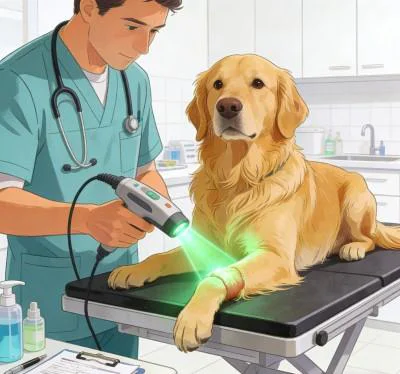
Остеоартроз — это не проблема, затрагивающая только одну ткань.
В суставе, поражённом хроническим артритом, могут наблюдаться дегенеративные изменения хряща, изменения синовиальной оболочки, утолщение капсулы, остеофиты, изменения в периартикулярных тканях и вторичная мышечная дисфункция.
Изменяется и поведение собаки.
Боль в коленном суставе может привести к тому, что собака перестанет опираться на одну заднюю лапу.
Боль в бедре может повлиять на подвижность таза.
Дискомфорт в локтевом суставе может повлиять на то, как собака ставит всю переднюю лапу.
В результате область облучения может выходить за пределы точного центра сустава.
Это одна из причин ветеринарная лазерная терапия даёт наилучшие результаты, когда она включена в план функциональной реабилитации.
Врач может проводить лечение области сустава, одновременно учитывая состояние окружающих мышц и мягких тканей.
От лазера не требуется “лечить артрит”.”
Этот метод применяется в качестве одного из компонентов более широкой стратегии, направленной на купирование боли, стимулирование реакции тканей и повышение активности пациентов в процессе реабилитации.
Почему длина волны 810 нм полезна в рамках стратегии использования нескольких длин волн
Область ближнего инфракрасного излучения около 800 нм уже давно играет важную роль в исследованиях в области фотобиомодуляции, поскольку характеристики рассеяния и поглощения обеспечивают оптимальный баланс для проникновения в более глубокие слои тканей.
В диапазоне около 810 нм фотоны проникают более эффективно, чем фотоны многих более коротких длин волн, хотя затухание всё же имеет место, а фактическая глубина проникновения значительно варьируется в зависимости от типа ткани.
Благодаря этому длина волны 810 нм оказывается полезной в тех случаях, когда врач планирует обследовать более глубоко расположенные структуры опорно-двигательного аппарата.
Это не означает, что излучение длиной волны 810 нм проходит прямо через тело собаки.
Нет.
Энергия по-прежнему рассеивается и поглощается.
Практическое преимущество заключается в том, что длина волны может служить полезной отправной точкой в тех случаях, когда область лечения находится ниже поверхностных тканей.
Платформа VetMedix-Max компании FotonMedix поддерживает длины волн 650, 810, 915, 940 и 980 нм, имеет заявленную пиковую мощность 38 Вт и поддерживает режимы работы: непрерывный, импульсный и суперимпульсный.
Значение этой конфигурации заключается не просто в количестве длин волн.
Это предоставляет врачу больше возможностей для работы с различными тканевыми средами.
Лечение поверхностных повреждений не всегда требует такого же оптического подхода, как при лечении глубоких повреждений тазобедренного сустава.
Лечение мышц не всегда требует такого же подхода, как лечение суставной капсулы.
Хроническое заболевание не всегда требует такой же схемы лечения, как острое послеоперационное состояние.
Длина волны 980 нм повышает важность терморегулирования
По мере приближения длины волны к 980 нм характер взаимодействия с тканями изменяется.
Восприятие воды приобретает всё большее значение, что означает, что по сравнению с более короткими длинами волн в ближнем инфракрасном диапазоне большая доля оптической энергии может способствовать возникновению локальных тепловых эффектов.
Само по себе это не является чем-то негативным.
Термические эффекты могут быть полезны с клинической точки зрения, если их удается контролировать.
Проблема возникает, когда оператор допускает накопление энергии быстрее, чем ткани способны её перераспределить и отвести.
Поверхность может нагреться до того, как более глубоко расположенный объект пройдет предусмотренную обработку.
В этом заключается основное противоречие высокоинтенсивной лазерной терапии:
Повышение интенсивности может повысить эффективность передачи энергии, однако чрезмерное длительное воздействие может привести к тому, что тепло станет ограничивающим фактором.
Именно поэтому для системы высокой мощности недостаточно одного лишь большого значения мощности в ваттах.
Здесь требуется временной контроль.
Рабочий цикл важнее, чем кажется
Рабочий цикл — это доля времени, в течение которой лазер активно излучает во время последовательности импульсов.
Рассмотрим случай, когда высокая пиковая мощность подается не непрерывно, а с перерывами.
Во время активной фазы ткани получают значительное количество оптической энергии.
В течение неактивной фазы тепло может диффундировать из непосредственной области поглощения, а перфузия тканей может способствовать перераспределению тепла.
Таким образом, средняя подаваемая мощность может быть ниже, чем при непрерывной работе с той же пиковой мощностью.
Это дает практическое преимущество при лечении.
Врач может поддерживать относительно сильный мгновенный оптический стимул, одновременно контролируя общую тепловую нагрузку.
Это не означает, что низкий рабочий цикл автоматически делает любую процедуру безопасной.
Размер пациента, анатомическое расположение, область лечения, особенности тканей, время воздействия и техника работы оператора по-прежнему имеют значение.
Рабочий цикл — это просто ещё одна управляющая переменная.
Устройство VetMedix-Max компании FotonMedix поддерживает режимы непрерывного, импульсного и суперимпульсного излучения и позволяет регулировать интенсивность теплового ощущения. Заявленная максимальная пиковая мощность составляет 38 Вт.
Для команды ветеринарных реабилитологов это означает, что систему можно использовать в качестве регулируемой платформы для подачи энергии, а не просто как источник непрерывного нагрева.
Почему длину волны 1470 нм не следует автоматически применять при лечении артрита
Характеристики излучения с длиной волны 1470 нм помогают понять, почему выбор длины волны должен определяться клинической целью.
Вода поглощает излучение с длиной волны 1470 нм гораздо сильнее, чем излучение с длиной волны 980 нм.
В результате взаимодействие становится гораздо более локализованным.
В хирургии это может оказаться чрезвычайно полезным.
Платформа SurgMedix компании FotonMedix использует конфигурации с длинами волн 1470 нм и 980 нм для высокоэнергетических хирургических процедур, при которых требуется контролируемое разрезание, коагуляция и абляция тканей.
Однако хирургическое лечение и неинвазивная реабилитация при артрите преследуют разные цели.
Хирургу может потребоваться сконцентрированное воздействие энергии на небольшой участок ткани.
Специалист по реабилитации, занимающийся лечением артрита тазобедренного сустава, как правило, стремится обеспечить контролируемое поле воздействия на глубокие ткани опорно-двигательного аппарата, не допуская при этом чрезмерного накопления тепла в поверхностных слоях.
Таким образом, один и тот же физический принцип может оказаться полезным в одном клиническом контексте и неуместным в другом.
Это чрезвычайно важное различие для лазерная терапия домашних животных.
Владелец домашнего питомца, услышав фразу “более эффективное всасывание”, может предположить, что более эффективное всасывание автоматически означает более эффективное лечение.
Нет.
Вопрос в том, где происходит поглощение энергии.
Вода, гемоглобин и область 980 нм
Оптические свойства в области около 980 нм также демонстрируют, почему простое обозначение длины волны может вводить в заблуждение.
Гемоглобин поглощает свет в зависимости от длины волны и степени насыщения кислородом. Вода также вносит значительный вклад в поглощение. Таким образом, ткань ведет себя как совокупность хромофоров, а не как единый поглотитель.
При длине волны 980 нм поглощение воды приобретает всё большее значение.
Кровь по-прежнему играет важную роль, поскольку васкуляризированная ткань влияет как на оптическое поглощение, так и на перенос тепла.
If energy is absorbed by tissue and converted to heat, blood flow can help move that heat away.
At the same time, local vascular characteristics can change the amount of energy absorbed.
For canine arthritis, this matters in muscle-rich areas surrounding the hip and stifle.
A clinician should therefore think about both optical delivery and thermal behavior.
The goal is not to maximize absorption everywhere.
The goal is to produce a controlled biological response in the intended treatment volume.
The Practical Difference Between Peak Power and Average Power
This is one of the easiest concepts to misunderstand.
Suppose a system can generate 30 W of peak output.
That does not mean the patient necessarily receives 30 W continuously.
If the system operates in a pulsed mode, peak output describes the intensity during the active portion of the pulse.
Average power depends on how long the laser is actually emitting.
Duty cycle therefore changes the relationship between the two.
This distinction matters because tissue responds not only to the instantaneous optical intensity but also to cumulative energy and thermal exposure.
A high peak with controlled duty cycle can produce a different thermal profile from continuous operation at the same peak value.
That is why a high-intensity Class IV system should be evaluated by its control architecture, not just its maximum output.
Simulated Clinical Case of Canine Hip Arthritis
Ниже приводится simulated veterinary rehabilitation case created for clinical training and SEO education. It is not presented as a published patient record, and the treatment parameters are not a universal prescription.
Идентификация дела
A 10-year-old female spayed Labrador Retriever weighing 36.5 kg presents with bilateral hip osteoarthritis.
The right side is clinically worse.
Radiographs demonstrate moderate-to-severe degenerative joint changes, classified as Grade III on the rehabilitation department’s four-level training scale.
The owner reports difficulty rising, reduced willingness to climb stairs and stiffness after prolonged rest.
The dog can still walk for approximately 15 minutes but begins shortening the hind-limb stride after several minutes.
The veterinary rehabilitation team decides to introduce high-intensity laser treatment alongside controlled exercise and veterinary pain management.
Имитированная карта лечения
| Клинический параметр | Карта лечения |
|---|---|
| Отдел | Реабилитация мелких животных |
| Номер дела | SAR-HILT-2026-052 |
| Пациент | Лабрадор ретривер |
| Возраст | 10 лет |
| Секс | Самка, стерилизована |
| Масса тела | 36,5 кг |
| Основной диагноз | Двусторонний остеоартроз тазобедренных суставов |
| Доминирующая сторона | Правый тазобедренный сустав |
| Степень патологического изменения | Grade III, moderate-to-severe |
| Baseline Pain Interference | 7/10 |
| Основная цель | Reduce pain interference and improve walking tolerance |
| Лазерный класс | Высокоинтенсивный класс IV |
| Длины волн | 810 нм + 915 нм + 940 нм + 980 нм |
| Начальная пиковая мощность | 24 Вт |
| Максимальная моделируемая пиковая мощность | 32 W |
| Частота | 15 Гц |
| Начальный рабочий цикл | 40% |
| Занятие 1. Энергия | 1,000 J |
| Занятие 3. Энергия | 1 250 Дж |
| Занятие 6. Энергия | 1,500 J |
| Sessions Per Week | 2 |
| Вводный курс | 3 недели |
| Зона обработки | Hip, periarticular tissue and surrounding musculature |
| Термомониторинг | Patient response and surface temperature assessment |
| Дополнительная реабилитация | Controlled walking and hip strengthening |
The protocol deliberately does not begin at the maximum available output.
The first session is partly a tolerance assessment.
A large dog with a deep hip target may need substantial energy, but the operator still needs to determine how rapidly the patient’s superficial tissue heats under the selected wavelength combination.
Сессия 1
The dog initially stands slowly.
The treatment begins with 24 W peak output, 15 Hz and a 40% duty cycle.
The handpiece is continuously moved across the hip and periarticular region.
The operator avoids parking the treatment head over a small point.
Total delivered energy is approximately 1,000 J.
The dog remains relaxed.
Mild warmth is observed, but there is no withdrawal response or behavioral sign of discomfort.
Immediately after treatment, the dog rises more quickly.
The gait remains abnormal.
That result is clinically plausible.
The purpose of the first treatment is not to produce a dramatic transformation.
It is to establish a reproducible and tolerated treatment condition.
Week 1 Shows Why Treatment Progression Matters
After two sessions, the owner reports that the dog is getting up faster after naps.
The dog still hesitates before stairs.
Pain interference is recorded at a simulated 6/10.
The treatment remains at the same frequency and duty cycle.
The total energy increases modestly to approximately 1,100 J.
The clinician does not increase everything simultaneously.
Это важно.
If power, frequency, duty cycle and treatment time all change at once, the team cannot determine what caused a change in patient response.
Controlled progression produces better clinical information.
Сессия 3
The dog now tolerates longer walking before shortening the stride.
The treatment energy is increased to approximately 1,250 J.
Peak output rises to 27 W.
Рабочий цикл остается на уровне 40%.
The treatment field includes the gluteal and periarticular muscles.
This broader treatment field is based on the dog’s altered movement pattern.
The clinician is not treating the radiographic image.
The clinician is treating the functional consequences of the painful joint.
Сессия 6
At the end of the initial three-week course, the simulated treatment energy reaches 1,500 J.
Peak output is increased to 32 W.
The duty cycle is increased only modestly to 45%.
The dog now stands with much less hesitation.
The owner reports improved willingness to walk.
The dog climbs several steps without stopping.
The simulated pain interference score falls from 7/10 to 3/10.
Simulated Outcome Table
| Результат | Базовый уровень | Неделя 1 | Неделя 3 |
|---|---|---|---|
| Влияние боли | 7/10 | 6/10 | 3/10 |
| Вставание из положения покоя | Заметно медленно | Умеренно медленно | Немного медленно |
| Толерантность к ходьбе | 15 мин | 20 мин | 30 мин |
| Допуск на лестнице | Избегает лестниц | 3 шага | 8 шагов |
| Длина шага задних конечностей | Явно сокращено | Умеренно укороченный | Слегка сокращено |
| Показатель активности владельца | 4/10 | 5/10 | 8/10 |
| Энергия сеанса | 1,000 J | 1 100 Дж | 1,500 J |
| Пиковая мощность | 24 Вт | 24 Вт | 32 W |
| Рабочий цикл | 40% | 40% | 45% |
| Частота | 15 Гц | 15 Гц | 15 Гц |
These results are simulated and should not be interpreted as expected clinical outcomes.
The important point is the structure of the protocol.
The clinician progressively adjusts energy while monitoring function and thermal tolerance rather than automatically applying maximum output.
Why the Laser Is Not Treated as a Standalone Cure
A dog with Grade III osteoarthritis still has degenerative joint disease after a successful treatment session.
The osteophytes do not disappear overnight.
Cartilage degeneration is not reversed by simply increasing the laser dose.
This is why the rehabilitation team continues controlled exercise.
As pain decreases, the dog can participate more comfortably in strengthening.
Improved muscle function can support joint stability.
Weight management can reduce mechanical loading.
Прием лекарств по-прежнему может быть целесообразным.
The laser therefore becomes one part of a larger treatment strategy.
This is a much more realistic role for лазерная терапия домашних животных.
What Published Canine Research Tells Us
Clinical evidence for laser therapy in canine osteoarthritis is encouraging but not uniform.
A randomized double-blinded controlled trial published in 2022 evaluated 20 dogs and 40 osteoarthritic joints. The investigators compared a three-week Class IV photobiomodulation protocol with meloxicam treatment and assessed pain, gait, function, stiffness and quality-of-life-related measures.
Several outcomes favored photobiomodulation at specific follow-up points, including days 8, 15 and 30.
That study is useful because it used multiple clinical measurements rather than relying on a single subjective endpoint.
Another study involving 23 dogs with naturally occurring osteoarthritis used accelerometers to measure activity during a six-week treatment period.
The investigators reported increased daily activity and step counts during treatment.
This is an important distinction.
The dog does not care whether the treatment produces a certain optical dose.
The owner cares whether the dog moves.
The veterinarian cares whether that movement improvement is clinically meaningful and sustainable.
The rehabilitation team therefore benefits from combining pain scores with functional measurements.
Why Evidence Quality Still Matters
The veterinary laser literature contains many different protocols.
Different wavelengths.
Различные значения плотности энергии.
Different treatment schedules.
Different disease states.
Different outcome measurements.
That makes it difficult to compare studies directly.
A systematic review of laser therapy in veterinary medicine has highlighted the heterogeneity of treatment parameters and the limited quality of evidence for several indications.
This should change how veterinary laser equipment is marketed.
The responsible claim is not:
“Every dog with arthritis will improve.”
A more defensible statement is:
“High-intensity laser therapy may be incorporated into multimodal rehabilitation, with treatment parameters adjusted according to the patient, tissue depth, clinical objective and response.”
That wording reflects the current evidence much better.
The Role of Veterinary Laser Therapy in a Real Rehabilitation Department
Профессионал ветеринарная лазерная терапия program should fit into the normal clinical workflow.
A typical patient may receive:
Diagnostic Assessment
The veterinarian identifies the underlying orthopedic or soft-tissue condition.
Baseline Functional Measurement
The team records gait, pain behavior, range of motion, activity tolerance or another measurable endpoint.
Лазерное лечение
The clinician selects wavelength, output, pulse mode, duty cycle and treatment field according to the target.
Rehabilitation Exercise
The patient performs controlled mobility or strengthening exercises when appropriate.
Переоценка
The team evaluates whether function is changing.
Корректировка протокола
Treatment is modified according to patient response rather than simply increasing energy at every visit.
This creates a repeatable clinical pathway.
It also gives a veterinary hospital something much more valuable than a machine sitting in a treatment room.
It creates a service.
Why Multi-Wavelength Systems Make Sense for Different Pets
A multi-wavelength platform is particularly useful because veterinary patients vary dramatically in anatomy.
A Chihuahua’s elbow is not a Great Dane’s hip.
A Labrador’s stifle is not a horse’s tendon.
A superficial wound is not a deep muscular target.
A chronic arthritic joint is not an acute surgical incision.
One wavelength cannot be expected to behave identically in all these situations.
VetMedix-Max provides five wavelengths: 650, 810, 915, 940 and 980 nm.
This allows clinicians to consider the optical properties of the target rather than treating wavelength as a fixed setting.
The lower near-infrared region can support deeper photon delivery.
The higher near-infrared wavelengths introduce different absorption behavior.
The operator can combine these characteristics with pulse control.
This is where the engineering becomes clinically useful.
Thermal Sensation Is a Clinical Feedback Signal
Dogs cannot tell the operator that the treatment feels too hot.
Their behavior becomes part of the feedback system.
A dog that repeatedly moves away, turns its head toward the treatment head, becomes restless or attempts to leave may be communicating that the treatment needs adjustment.
Surface temperature monitoring provides another layer of information.
But temperature alone is not enough.
A comfortable skin temperature does not prove that a deep target has received an optimal dose.
Conversely, a rapidly increasing surface temperature may indicate that energy is being absorbed too superficially.
The clinician therefore needs to combine:
- Patient behavior
- Surface temperature
- Время лечения
- Мощность
- Рабочий цикл
- Длина волны
- Глубина ткани
- Зона обработки
This is why thermal management should be considered part of treatment design rather than a secondary safety feature.
Why Continuous Maximum Power Is Usually the Wrong Mental Model
Представьте себе два метода лечения.
Treatment A uses moderate continuous output.
Treatment B uses a higher peak output but a controlled duty cycle and continuous handpiece movement.
The total energy can be similar while the instantaneous tissue behavior differs.
Treatment B may produce a stronger optical stimulus during the active portion while allowing more time for thermal redistribution during the inactive portion.
That is the reason pulse control matters.
The clinician is not simply choosing between “weak” and “strong.”
The clinician is shaping how energy enters tissue.
For deep canine arthritis, that distinction can be valuable because superficial tissues can become the limiting factor before the deeper target receives sufficient energy.
Where 1470 nm Belongs in the Broader Laser Ecosystem
A sophisticated veterinary buyer may encounter both rehabilitation and surgical laser platforms.
This is where wavelength specifications need to be interpreted correctly.
1470 nm has strong water absorption.
That makes it highly useful for controlled surgical tissue interaction.
980 nm has a different absorption profile and can provide a combination of penetration and thermal interaction.
The two wavelengths should therefore not be marketed as interchangeable.
FotonMedix’s SurgMedix system uses 1470 nm and 980 nm configurations for surgical applications.
VetMedix-Max, by contrast, uses a broader five-wavelength architecture intended for veterinary treatment and rehabilitation.
The distinction makes commercial sense.
A rehabilitation clinic generally needs a broad treatment envelope.
A surgical department may need precise tissue interaction.
The machine should match the workflow.
What a Clinic Should Record for Every Laser Session
A professional laser record should make the treatment reproducible.
The following information is especially useful.
Пациент
Species, breed, age, weight and diagnosis.
Цель
Joint, muscle, tendon, ligament, wound or anatomical region.
Длина волны
Exact wavelengths used.
Пиковая мощность
Maximum instantaneous output.
Средняя мощность
When available and relevant.
Частота
Pulse frequency.
Цикл работы
Percentage of active emission.
Время лечения
Duration of the session.
Общая энергия
Поставленные джоули.
Зона обработки
Approximate surface area treated.
Термическая реакция
Patient comfort and observed temperature behavior.
Functional Response
Pain score, gait, range of motion, activity tolerance or another objective measurement.
This information allows the veterinary team to identify patterns.
If a certain protocol consistently produces improved function without thermal discomfort, it becomes a useful starting point for similar patients.
If a protocol produces discomfort without functional improvement, the team has evidence for changing it.
The Business Case for Pet Laser Therapy
For a veterinary hospital, лазерная терапия домашних животных can become more than an additional treatment line.
It can support a broader rehabilitation service.
A clinic can incorporate laser treatment into:
- Canine osteoarthritis programs
- Послеоперационная реабилитация
- Sports injury management
- Muscle rehabilitation
- Wound care
- Программы лечения хронической боли
- Senior pet mobility services
The commercial value comes from repeatable clinical workflows.
A dog with chronic osteoarthritis may require multiple visits.
That gives the clinic an opportunity to combine laser treatment with reassessment, exercise therapy, mobility evaluation and owner education.
The treatment becomes part of a continuing-care relationship rather than a single machine-based procedure.
For B2B buyers, this is an important distinction.
The question is not only whether the equipment can produce high output.
The question is whether the equipment supports a service that clinicians can use repeatedly and document consistently.
Why Large Dogs Expose Weak Treatment Strategies
Small dogs can sometimes be easier to treat because the target tissue is relatively close to the skin.
Large dogs expose the limitations of shallow treatment strategies.
A deep hip joint may be surrounded by thick muscle.
A heavy dog may also have substantial subcutaneous tissue.
If the operator uses low-energy treatment simply because it feels comfortable at the skin, the deep target may receive an inadequate dose.
If the operator responds by dramatically increasing continuous power, the surface may become too warm.
That is the central contradiction.
High-intensity treatment solves part of the energy-delivery problem.
Pulse control solves part of the thermal-management problem.
Multi-wavelength selection solves part of the tissue-interaction problem.
Clinical monitoring connects all three.
Laser Therapy Compared With Conventional Treatment
Traditional veterinary care remains the foundation of canine arthritis management.
Anti-inflammatory medication can reduce pain.
Weight reduction can decrease joint loading.
Exercise can maintain muscle strength.
Hydrotherapy can provide low-impact conditioning.
Joint injections can be appropriate in selected cases.
Surgery may be indicated for specific structural conditions.
Laser therapy does not eliminate the need for these interventions.
Its value lies elsewhere.
It offers a non-invasive modality that can be repeated and integrated with rehabilitation.
For a dog that is reluctant to exercise because movement hurts, improving comfort may make rehabilitation easier.
For a postoperative patient, controlled treatment may become part of the recovery workflow.
For an older dog with chronic arthritis, repeated sessions can be incorporated into a broader mobility program.
The clinical advantage is therefore not “laser instead of medicine.”
Это laser as another controllable tool within multimodal care.
What the Owner Actually Notices
The technical specification may say 38 W.
The owner does not care.
The owner notices whether the dog gets off the bed.
They notice whether the dog wants to go outside.
They notice whether stairs become easier.
They notice whether the dog sleeps comfortably and moves more willingly the following day.
These functional changes should be part of the clinical conversation.
A veterinary team that documents these outcomes can explain treatment value much more effectively than one that reports only energy.
This is especially important for chronic osteoarthritis because radiographic disease may remain visible even when functional comfort improves.
The objective is not to make the X-ray look normal.
The objective is to improve the patient’s quality of movement within the limitations of the underlying disease.
Лучший подход к пониманию высокоинтенсивных лазеров
High-intensity Class IV treatment is sometimes described as simply “more powerful laser therapy.”
That description misses the important part.
The real advancement is controllability.
The system can deliver more energy when depth demands it.
The clinician can choose different wavelengths according to tissue characteristics.
Pulse modes can separate peak intensity from average thermal load.
Duty cycle can help control heat accumulation.
Treatment movement can distribute energy across the target.
Temperature monitoring can provide another feedback signal.
The result is a treatment process that can be adjusted rather than a fixed output applied to every patient.
That is particularly relevant to Лазерная терапия при артрите у собак because canine arthritis patients vary enormously in size, tissue depth, disease severity and treatment tolerance.
Заключительные клинические выводы
The strongest case for high-intensity veterinary laser treatment is not built around the biggest power number.
It is built around solving a real treatment problem.
A painful canine hip sits beneath several layers of tissue.
Оптическая энергия уменьшается по мере распространения.
Different wavelengths interact differently with water, blood and other tissue components.
980 nm produces stronger thermal interaction than many lower near-infrared wavelengths and therefore requires deliberate thermal management.
1470 nm has much stronger water absorption and demonstrates why highly absorbed wavelengths are particularly useful for localized surgical tissue effects rather than being automatically transferred into non-invasive arthritis treatment.
810 nm and other near-infrared wavelengths can provide useful deeper-tissue delivery characteristics.
Pulse frequency and duty cycle then determine how the energy is distributed over time.
That is the engineering behind modern ветеринарная лазерная терапия.
Для лазерная терапия домашних животных, the clinical opportunity is to turn that engineering into a repeatable rehabilitation service.
The dog should not be treated according to a generic number printed on a protocol sheet.
The clinician should consider the patient’s weight, anatomy, tissue depth, diagnosis, treatment area, thermal response and functional goals.
The same principle applies to every serious high-intensity laser application.
More power is useful when more power is needed.
More energy is useful when the target requires more energy.
But uncontrolled power is not a treatment strategy.
A well-designed protocol uses wavelength, intensity, pulse structure, duty cycle and treatment geometry together.
That allows the clinician to address the central contradiction of deep-tissue therapy:
Deliver enough energy to matter without allowing superficial heat to become the reason treatment has to stop.
For an older dog with chronic arthritis, that can mean the difference between a treatment that merely feels warm and a structured rehabilitation program designed around measurable functional improvement.
For a veterinary hospital, it can mean the difference between owning a laser and building a meaningful laser therapy service.
SEO
标题 Canine Arthritis Needs Deeper Energy Without Excess Heat
描述 High-intensity Class IV laser therapy for canine arthritis using wavelength selection, tissue absorption, duty cycle and thermal control.
中文总结:本案例是一只10岁雌性绝育拉布拉多犬的模拟三级髋关节骨关节炎康复病例,围绕 laser therapy for canine arthritis、pet laser therapy 和 veterinary laser therapy 生成的第3篇文章。