 FotonMedix




Преодоление послеоперационного фиброза мышц у собак
Quad-wavelength Class IV delivery penetrates deep dense surgical scar tissue, stimulates peri-articular vascular recanalization, and manages thermal accumulation via microsecond duty cycle control.
A 4-year-old female Golden Retriever enters the rehabilitation ward eight weeks following a tibial plateau leveling osteotomy (TPLO). Instead of smooth weight-bearing extension, the stifle remains locked at an extension angle of barely one hundred and ten degrees. Palpation over the medial surgical incision reveals a hard, cold, unyielding mass of dense fibrotic tissue anchoring the patellar tendon directly to the proximal tibia. The dog exhibits Grade 3 lameness, the quadriceps muscle group shows twenty-five percent circumferential atrophy compared to the contralateral limb, and manual physical therapy causes severe vocalization. Conservative warm compresses, massage, and therapeutic ultrasound have hit a dead end, leaving the referring surgeon concerned about permanent joint contracture and the pet owner frustrated by the lack of progress.
Treating severe post-surgical peri-articular fibrosis exposes the physical limitations of low-energy modalities. Dense, cross-linked type III collagen fibers within mature surgical scar tissue present an intense optical scattering barrier, reflecting superficial photons. Low-output units take twenty minutes to generate surface warmth without delivering meaningful energy to the fibrosed joint capsule four centimeters beneath the skin. Overcoming post-operative arthrofibrosis requires transitioning to a high-output class 4 veterinary therapeutic laser that can drive sufficient fluence through dense surgical scars into underlying joint structures.
Tissue Attenuation Profiles and Multi-Wavelength Synergies
Photons traveling through post-surgical tissues encounter severe attenuation. Dense collagen scar bundles, localized surgical hemosiderin deposits, and hypertonic compensatory muscle tissue create an optical roadblock. Under standard biological scattering models, light loses significant intensity per millimeter unless balanced across critical near-infrared bands.
Delivering targeted photon density to deep myofascial adhesions requires understanding tissue chromophore absorption characteristics:
- 980 nm Hemoglobin Resonance: Surgical incisions sever local microcapillaries, leaving behind stagnant, hypoxic fibrotic margins. Light at 980 nm targets oxygenated and deoxygenated hemoglobin, generating controlled, localized thermal gradients that promote active microvascular perfusion, relax compensatory muscle spasms, and clear inflammatory exudates.
- 1064 nm Deep Fibrous Tissue Penetration: With negligible melanin and water absorption, the 1064 nm wavelength penetrates straight through dense scar bundles. It deposits photon energy directly into deep peri-articular connective tissues to stimulate cellular adenosine triphosphate synthesis in exhausted tenocytes and fibroblasts.
- Модуляция воды с высокой аффинностью при 1470 нм: Fibrotic tissue often traps pockets of chronic interstitial fluid, increasing tissue pressure. The high absorption of 1470 nm light by water helps mobilize stagnant fluid, softens rigid collagen bands, and improves tissue elasticity.
Delivering these physiological effects quickly is why clinics rely on the best veterinary laser therapy equipment for rehabilitation. Instead of spending thirty minutes holding a stationary low-power probe with minimal patient benefit, clinicians can use a high-wattage system to treat the stifle, quadriceps, and hamstrings in under ten minutes, breaking the cycle of post-operative joint contracture.
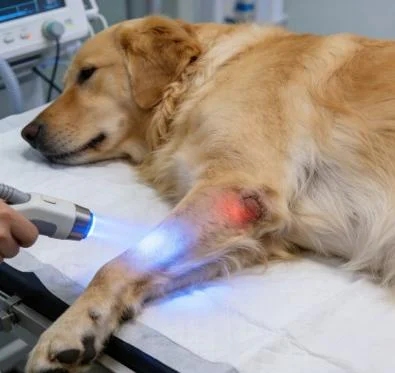
Preventing Epidermal Overheating with Duty Cycle Control
Delivering high therapeutic wattage over scarred or shaved skin introduces clinical risks if thermal energy is not managed properly. Surgical scars often have reduced sensation due to transected cutaneous nerve endings, meaning the patient cannot reliably signal when surface temperatures become excessive. Continuous wave high-power light over surgical plates or screws can also raise periosteal temperatures.
Modulating the pulse duty cycle resolves this technical challenge:
Continuous Wave: [================ Cumulative Thermal Buildup ================] -> Epidermal Hotspot Risk
Pulsed 50% Duty: [== Pulse ON ==] [ Thermal Relaxation ] [== Pulse ON ==]      -> Deep Target Saturation
During the active pulse, high peak power drives photons deep into the joint capsule and surrounding scar tissue. During the dark phase, capillary blood flow in the skin dissipates surface heat. Because the deep fibrotic joint dissipates heat more slowly than the vascularized dermis, therapeutic energy accumulates at the target without causing cutaneous burns.
This controlled approach is why these platforms rank among the most used veterinary laser therapy devices in modern surgical and rehabilitation facilities. Clinicians can safely switch between rapid desensitization frequencies and lower structural remodeling frequencies, ensuring patient comfort throughout the session.
Clinical Protocol and Range of Motion Recovery
According to connective tissue remodeling principles documented by Curcio and validated in veterinary orthopedic rehabilitation studies from the American College of Veterinary Surgeons, near-infrared phototherapy promotes the enzymatic breakdown of disorganized scar tissue while stimulating parallel collagen fibrillogenesis. The resulting reduction in pro-fibrotic cytokines, such as transforming growth factor beta 1, allows normal mechanical mobility to return.
The following clinical case demonstrates this multi-wavelength protocol in a post-surgical canine patient suffering from severe stifle contracture.
Case Record: Post-TPLO Arthrofibrosis and Quadriceps Contracture
- Идентификатор дела: REHAB-2026-CANINE-0914
- Профиль пациента: 4-year-old female spayed Golden Retriever
- Масса тела: 31.2 kg
- Диагноз: Post-surgical arthrofibrosis and severe peri-incisional adhesions of the left stifle following TPLO surgery; joint extension restricted to 110 degrees (normal contralateral extension: 165 degrees); Grade 3 lameness; left quadriceps muscle atrophy of 4.2 cm circumference compared to contralateral limb
- Предыдущее консервативное лечение: Oral meloxicam at 0.1 mg/kg once daily for four weeks, warm compresses, and passive range of motion exercises; minimal progress with severe pain upon passive flexion beyond 90 degrees
Параметры комплексного протокола лечения
| Номер сеанса | Rehabilitation Objective | Выходная мощность (Вт) | Режим работы и рабочий цикл | Целевое спектральное распределение | Частота (Гц) | Полная энергия (джоули) | Флюенс (Дж/см²) |
| 01 | Scar Tissue Desensitization | 10,0 Вт | Импульсный (коэффициент заполнения 40%) | Сбалансированная смесь 980 нм / 1064 нм | 3 000 Гц | 3,000 J | 7,5 Дж/см² |
| 02 | Capillary Decongestion | 12,0 Вт | Импульсный (рабочий цикл 45%) | High 980 nm / Perfusion Focus | 1 500 Гц | 4 200 Дж | 10,5 Дж/см² |
| 03 | Мобилизация интерстициальной жидкости | 15,0 Вт | Импульсный (рабочий цикл 50%) | Максимальная длина волны 1470 нм / Фокусировка на воде | 800 Гц | 5,400 J | 13,5 Дж/см² |
| 04 | Deep Adhesion Breakdown | 18,0 Вт | Сверхимпульсный (рабочий цикл 50%) | Преобладание проникающего излучения (1064 нм) | 400 Гц | 6,500 J | 16,2 Дж/см² |
| 05 | Extracellular Matrix Softening | 20,0 Вт | Импульсный (рабочий цикл 50%) | Сбалансированная решетка с четырьмя длинами волн | 200 Гц | 7,200 J | 18,0 Дж/см² |
| 06 | Collagen Fibril Realignment | 22,0 Вт | Импульсный (рабочий цикл 50%) | Смесь для глубокой структурной реконструкции | 100 Гц | 7 800 Дж | 19,5 Дж/см² |
| 07 | Functional Joint Mobilization | 20,0 Вт | Непрерывная динамическая развертка | Мультиспектральная регенеративная смесь | CW / Динамический | 6,000 J | 15,0 Дж/см² |
| 08 | Active Kinetic Consolidation | 16,0 Вт | Импульсный (рабочий цикл 50%) | Профиль смешанного технического обслуживания | 30 Гц | 4 800 Дж | 12,0 Дж/см² |
Stifle Joint Extension and Muscle Mass Recovery
Passive Stifle Extension (Degrees):
Pre-Treatment: [============================] 110°
Session 03:    [=================================] 130°
Session 06:    [======================================] 152°
Session 08:    [=========================================] 163° (Contralateral baseline: 165°)

Thigh Circumference Difference (cm deficit compared to healthy right limb):
Pre-Treatment: [================] -4.2 cm
Session 03:    [============] -3.1 cm
Session 06:    [=====] -1.4 cm
Session 08:    [] -0.3 cm
By the third session, the surgical scar softened, and the patient permitted gentle passive flexion without vocalizing. By the sixth treatment, stifle extension reached one hundred and fifty-two degrees, allowing the dog to engage in active underwater treadmill sessions. At the conclusion of eight treatments, the limb achieved one hundred and sixty-three degrees of extension, muscle circumference normalized, and meloxicam was discontinued.
Benefits Compared to Traditional Rehabilitation Methods
Post-operative complications like joint contracture often create tension between pet owners, primary care veterinarians, and orthopedic surgeons. Revision surgery to resect scar tissue carries further trauma, risks implant contamination, and frequently leads to more aggressive fibrosis. Relying purely on manual therapy can be painful for the animal, fatiguing for staff, and slow to yield results.
High-power phototherapy delivers distinct clinical advantages:
1. Rapid Tissue Softening Before Manual Work
Manual therapy on cold, fibrotic tissue can tear microscopic collagen fibers, triggering acute inflammation and defensive muscle guarding. Applying high-intensity photon energy immediately softens dense adhesions, relaxes surrounding muscle groups, and allows therapists to perform passive range-of-motion exercises without resistance.
2. Shorter Treatment Sessions with Higher Patient Volume
Low-power units require lengthy application times that stress recovering pets and tie up rehabilitation staff. High-power systems deliver therapeutic doses in six to eight minutes of continuous, comfortable sweeping application, keeping clinic workflows efficient and reducing stress for canine patients.
3. Clear Functional Milestones That Build Client Trust
Clients track tangible indicators of recovery: whether their dog can stand smoothly, climb steps, or play without limping. Achieving noticeable mobility gains within the first three treatments gives pet owners immediate evidence of recovery, reinforcing their commitment to the full rehabilitation program.
High-power Class IV technology serves as an indispensable tool for veterinary rehabilitation teams. By projecting therapeutic photon density past dense surgical scars and directly into stiff joint capsules, practitioners can resolve stubborn post-operative complications and help canine patients return to active, pain-free lives.