 FotonMedix












Реальная стоимость лазерной терапии глубоких тканей зависит, прежде всего, от эффективности лечения
Управление энергией, гибкость в выборе длины волны, скорость проведения процедуры, измеримый клинический рабочий процесс
Клиника может приобрести мощный лазер и при этом терпеть убытки при каждой процедуре, если аппарат слишком долго обрабатывает целевую зону, вызывает неприятное поверхностное нагревание или вынуждает терапевтов использовать консервативные настройки из-за невозможности точно контролировать подачу энергии.
Именно эту часть пациенты редко замечают, когда спрашивают:, работает ли холодная лазерная терапия?
И именно на этот аспект владельцам клиник следует обратить внимание, когда они задают вопросы о глубокий лазер для обработки тканей стоимость лечения.
На самом деле экономический вопрос заключается не просто в том, сколько стоит сеанс лазерной терапии.
Речь идет о том, способно ли оборудование подавать клинически обоснованное количество энергии в целевую ткань в рамках разумных временных рамок сеанса, при этом позволяя терапевту регулировать нагрев, длину волны, мощность и область воздействия.
Для реабилитационного отделения это полностью меняет подход к вопросам закупок.
Устройство с низкой мощностью может иметь более низкую стоимость приобретения, но при этом требовать более длительного времени проведения процедуры. Платформа 4-го класса с высокой мощностью может стоить дороже при первоначальной покупке, но обеспечивать значительно большую мощность излучения и более широкие возможности в проведении процедур. Эта разница становится особенно важной, когда ежедневно проходят лечение несколько пациентов.
Именно здесь оборудование для лазерной терапии следует рассматривать как часть клинической инфраструктуры, а не как ещё одно устройство для физиотерапии.
Эффективна ли холодная лазерная терапия, если поражаемый участок находится глубоко?
Ответ зависит от того, что понимается под термином “холодный лазер”.”
Это выражение обычно используется в отношении систем низкоинтенсивной лазерной терапии и фотобиомодуляции, которые работают с относительно низкой мощностью и предназначены для оказания биологического воздействия без значительного нагрева тканей.
Существуют научные данные, подтверждающие, что фотобиомодуляция представляет собой биологический механизм, включающий взаимодействие света с тканями, митохондриальную сигнализацию, модуляцию воспалительных процессов и клеточные реакции.
Но практический клинический вопрос — это совсем другое дело.
Терапевт может проводить лечение структуры, расположенной на глубине нескольких сантиметров под кожей.
Свет сначала должен пройти через кожу, подкожную клетчатку и другие анатомические слои.
Некоторые фотоны рассеиваются.
Некоторые впитываются.
Остаточная оптическая энергия уменьшается с глубиной.
Таким образом, полезность того или иного устройства при лечении конкретного заболевания зависит от длины волны, подаваемой энергии, области воздействия, характеристик тканей и протокола лечения.
“Лазерная терапия действует” — это слишком общее утверждение.
Лучше спросить:
Подходят ли данная длина волны, доза и стратегия лечения для данной целевой ткани?
Именно этот вопрос должна задать себе профессиональная клиника перед покупкой оборудования.
Почему процедура глубокого массажа тканей меняет требования к оборудованию
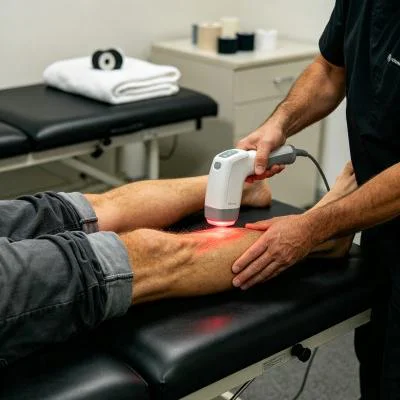
Лечение поверхностных поражений относительно просто.
Небольшой участок, подлежащий лечению, можно облучить с использованием относительно небольшой энергии.
Глубокая обработка создаёт иную проблему.
Врач должен подать на поверхность достаточное количество энергии, чтобы компенсировать ослабление в тканях, расположенных над целью.
Однако поверхностные ткани первыми поглощают поступающую энергию.
Это позволяет достичь баланса между глубиной и тепловым комфортом.
Представьте себе, что вы проводите процедуру воздействия на параспинальные мышцы поясничного отдела позвоночника пациента.
Целью не является кожа.
Терапевту, возможно, придется работать с более глубокими слоями мышц и соединительной ткани.
Если производительность слишком низкая, лечение может затянуться.
Если мощность на выходе будет увеличена слишком резко, тепло, исходящее от поверхности, может вызвать дискомфорт.
Затем врач должен уменьшить мощность или замедлить движения настолько, чтобы пациент чувствовал себя комфортно.
Это одна из причин, по которой высокоинтенсивные лазерные системы могут оказаться полезными.
Они обеспечивают больше доступной энергии, но при этом требуют более тщательного контроля.
Что происходит с энергией лазера внутри ткани
Энергия лазера не распространяется через биологические ткани так же, как по прямому электрическому кабелю.
Особое значение имеют два основных вида взаимодействия.
Поглощение
Хромофоры и вода поглощают часть поступающей оптической энергии.
Степень поглощения в значительной степени зависит от длины волны.
Рассеяние
Тканевые структуры изменяют направление движения фотонов.
Это означает, что область воздействия изменяется по мере того, как свет проникает глубже.
В результате получается кривая постепенного затухания.
Плотность энергии уменьшается с увеличением глубины, однако точный ход кривой зависит от состава ткани и длины волны.
Поэтому было бы неверно предполагать, что устройство, излучающее 20 Вт на поверхности кожи, излучает 20 Вт в ткани, расположенные на глубине нескольких сантиметров под кожей.
Нет.
Отправной точкой служит выходной сигнал на выходе.
Клинически значимое воздействие на глубине зависит от того, что происходит между лечебной головкой и целью.
Почему длина волны 810 нм представляет интерес для более глубоких целей
В области около 810 нм поглощение воды относительно невелико по сравнению с более длинными длинами волн, например 1470 нм.
Это позволяет большей доле ближнего инфракрасного излучения проникать глубже в ткани, прежде чем оно поглотится.
Это не означает, что излучение с длиной волны 810 нм проходит через ткани без потерь.
Рассеяние по-прежнему играет важную роль.
Хромофоры крови и других тканей по-прежнему оказывают влияние на оптическое поле.
Однако относительно благоприятные характеристики поглощения воды являются одной из причин, по которой длины волн в диапазоне около 810 нм уже давно изучаются в области фотобиомодуляции и применения в глубоких слоях тканей.
Для реабилитационной клиники это означает, что выбор длины волны может иметь большее значение, чем просто выбор аппарата с максимальной мощностью.
Почему длина волны 980 нм обеспечивает иные ощущения во время процедуры
Длина волны 980 нм вступает в более сильное взаимодействие с водой, чем длина волны 810 нм.
Кроме того, он обладает значительным поглощением со стороны хромафоров крови.
В результате энергия, излучаемая в диапазоне этой длины волны, может вызывать более заметный тепловой отклик.
Это не обязательно плохо.
Контролируемое повышение температуры может быть полезно в рамках некоторых стратегий лечения.
Проблема возникает, когда нагрев становится ограничивающим фактором.
Если пациент начинает испытывать дискомфорт на коже до того, как будет подана запланированная энергия, дальнейшее увеличение мощности не решает клиническую проблему.
Терапевту нужна ещё одна контрольная переменная.
Эта переменная может определять структуру импульса.
Рабочий цикл может изменить тепловой профиль
Предположим, что лазер высокой мощности работает с пиковой мощностью 20 Вт.
Это не обязательно означает, что на ткань постоянно воздействует мощность 20 Вт.
Если лазер работает в импульсном режиме с коэффициентом заполнения 25%, излучение происходит только в течение части цикла.
В течение периода активности пиковая мощность остается на высоком уровне.
Средняя мощность за весь цикл ниже.
Это позволяет терапевту работать с более высокой мгновенной мощностью, одновременно ограничивая непрерывное накопление тепла.
Точный ответ на лечение по-прежнему зависит от длительности импульса, частоты, области воздействия, характеристик тканей и общей энергии.
Таким образом, рабочий цикл не является каким-то волшебным параметром безопасности.
Это управляющая переменная.
Это различие имеет значение при оценке оборудование для лазерной терапии для серьезного клинического применения.
Пример моделирования реабилитации
Приведенный ниже случай представляет собой смоделированный клинический сценарий, созданный для демонстрации того, как можно комплексно учитывать возможности оборудования, параметры лечения и экономические аспекты лечения. Это не является задокументированной историей болезни пациента и не должно интерпретироваться как универсальное предписание по лечению.
Идентификация дела
| Клинический параметр | Моделируемая запись |
|---|---|
| Отдел | Физическая медицина и реабилитация |
| Идентификатор смоделированного случая | PMR-HILT-2026-0831 |
| Пациент | 68-летняя женщина |
| Диагноз | Остеоартроз коленного сустава с хронической периартикулярной болью |
| Степень патологического изменения | Келлгрен-Лоуренс, III степень |
| Страница «Лечение» | Правое колено |
| Продолжительность симптомов | 4 года |
| Базовый NPRS | 7/10 |
| Исходные показатели по шкале WOMAC | 67/96 |
| Исходное значение активного сгибания | 98° |
| Базовый тест «Timed Up-and-Go» | 14,7 секунд |
| Основная клиническая проблема | Боль при спуске по лестнице и длительном нахождении в положении стоя |
| Лазерная платформа | LaserMedix-MAX |
| Основная длина волны | 810 нм |
| Вторичные длины волн | 915 нм и 940 нм |
| Компонент с регулируемым тепловым режимом | 980 нм |
| Начальная пиковая мощность | 10 W |
| Максимальная пиковая потребляемая мощность | 24 Вт |
| Начальная частота | 15 Гц |
| Более поздняя частота | 20 Гц |
| Начальный рабочий цикл | 25% |
| Поздний рабочий цикл | 30% |
| Занятие 1. Энергия | 800 J |
| Сессия 2. Энергетика | 1,000 J |
| Занятие 3. Энергия | 1,200 J |
| Занятие 4. Энергия | 1 400 Дж |
| Занятие 5. Энергия | 1 550 Дж |
| Занятие 6. Энергия | 1 650 Дж |
| Занятие 7. Энергия | 1 750 Дж |
| Занятие 8. Энергия | 1 850 Дж |
| Частота лечения | Три занятия в неделю |
| Дополнительная реабилитация | Тренировка на укрепление и повышение подвижности четырехглавой мышцы бедра |
| 1-я неделя NPRS | 6/10 |
| 2-я неделя NPRS | 5/10 |
| 3-я неделя NPRS | 4/10 |
| 4-я неделя NPRS | 2–3/10 |
| 4-я неделя: WOMAC | 43/96 |
| 4-я неделя: активное сгибание | 116° |
| 4-я неделя: тест «Up-and-Go» с хронометражем | 11,1 секунды |
| Термическая реакция | Умеренное тепло без длительного раздражения кожи |
| Корректировка лечения | Сокращение времени выдержки в медиальной части колена и сохранение импульсного облучения |
Почему терапевт не начал с 24 W
Эта платформа могла бы обеспечивать значительно более высокую производительность.
Однако это не означало, что 24 Вт было правильной отправной точкой.
The patient had chronic degenerative joint disease.
The treatment target was deeper than the skin.
The therapist needed to determine how the patient responded to the optical and thermal load.
The first session therefore used 10 W with a 25% duty cycle.
The treatment head moved continuously.
Total energy was limited to 800 J.
The patient reported warmth but no burning or sharp discomfort.
This created a baseline.
The next sessions could then be adjusted using actual patient response rather than an arbitrary maximum-power setting.
That is one of the most important differences between owning a high-output machine and knowing how to use one.
Прогрессирование лечения
Во время второго сеанса общая энергия была увеличена до 1 000 Дж.
Третий достиг 1 200 Дж.
By the fourth session, the therapist used higher peak output during deeper treatment passes and increased total energy to 1,400 J.
The fifth and sixth sessions reached 1,550 J and 1,650 J.
During the sixth treatment, the medial joint region became warmer than the surrounding tissue.
The therapist did not reduce the entire protocol.
Instead, the applicator movement was increased over that area.
The seventh session delivered 1,750 J.
The eighth delivered 1,850 J.
By the end of four weeks, the simulated patient reported substantially less pain during stair descent and chair transfers.
The important point is not the exact joule value.
It is the progression.
The treatment was adjusted according to tolerance, clinical response and functional goals.
Why This Matters When Calculating Deep Tissue Laser Therapy Cost
A patient may see a price such as $100 or $200 for a treatment session and ask whether that is expensive.
A clinic owner has a different calculation.
The clinic needs to consider:
- Equipment acquisition cost
- Время лечения
- Therapist labor
- Patient throughput
- Техническое обслуживание
- Обучение
- Расходные материалы
- Space utilization
- Частота лечения
- Patient retention
- Local reimbursement or cash-pay structure
Сайт лазерная терапия глубоких тканей стоимость therefore has two sides.
There is the patient’s treatment price.
And there is the clinic’s operating cost.
Those numbers are not the same.
A clinic charging $150 per session does not necessarily earn $150 in profit.
Likewise, a machine that costs more to purchase does not necessarily produce a worse return.
The key is utilization.
A Simple Clinic Economics Model
Consider a hypothetical clinic that charges $120 per deep tissue laser session.
If the clinic treats five patients per day, five days per week, that creates 25 treatment sessions per week.
At 48 operating weeks, that is approximately 1,200 sessions per year.
At $120 per session, gross treatment revenue associated with those sessions would be approximately $144,000 before labor, rent, maintenance, taxes, marketing and other operating costs.
Now change the treatment volume.
If the equipment allows the clinic to treat eight patients per day instead of five, the annual treatment capacity changes substantially.
This is why treatment speed matters.
Сайт Лазерная терапия глубоких тканей стоимость should be evaluated against usable clinical capacity, not just the purchase invoice.
Why Treatment Time Can Be More Important Than Purchase Price
Suppose one machine requires 20 minutes for a particular treatment.
Another high-output system allows the therapist to complete the same treatment workflow in 10 minutes while maintaining appropriate clinical control.
The second machine may cost more.
But the therapist has potentially freed ten minutes of appointment capacity.
Across several patients per day, that difference becomes significant.
A clinic owner should therefore ask:
How many minutes does a typical treatment require?
How much therapist involvement is required?
Can the therapist treat another patient while the laser is operating?
How quickly can the treatment area be covered?
Can one device serve multiple indications?
These questions often provide more useful financial information than comparing purchase prices alone.
What FotonMedix Laser Therapy Equipment Brings to the Calculation
LaserMedix-MAX is specified with five wavelengths:
650 nm, 810 nm, 915 nm, 940 nm and 980 nm.
Its maximum output configuration is 30 W.
The system is designed for non-invasive high-energy treatment and includes temperature indication and dual hot-and-cold treatment functions.
For a clinic, the practical attraction is the combination of energy capacity and wavelength flexibility.
One patient may require a deeper near-infrared strategy.
Another may need a different wavelength balance.
A third patient may require a more conservative pulsed treatment because of thermal sensitivity.
The equipment can therefore be integrated into different treatment workflows rather than being restricted to one narrow protocol.
Does More Expensive Equipment Mean Better Treatment?
Not automatically.
A more expensive machine is only valuable if the additional capability is actually used.
For example, a clinic that treats only small superficial areas may not benefit enough from a high-output multi-wavelength system to justify the investment.
A busy rehabilitation department treating chronic joint pain, sports injuries, large muscle groups and postoperative patients may have a stronger use case.
Именно поэтому лучшие оборудование для лазерной терапии depends on the clinic’s patient population.
The right purchasing question is not:
“Which machine is the best?”
Это:
“Which machine gives our therapists the control and throughput required by our actual patient mix?”
Why Five Wavelengths Can Change Workflow Flexibility
A single wavelength forces the clinician to work within one optical profile.
Система с пятью длинами волн предоставляет врачу больше возможностей.
The LaserMedix-MAX configuration includes:
650 нм
Useful when a more superficial optical component is desired.
810 нм
Relevant to deeper near-infrared treatment strategies because of relatively low water absorption.
915 нм
Provides another near-infrared option within the treatment platform.
940 нм
Adds another wavelength choice for tissue interaction and treatment planning.
980 нм
Provides stronger water interaction and a more noticeable thermal component.
The goal is not to use every wavelength in every session.
The value comes from having choices.
Why 1470 nm Belongs in a Different Clinical Conversation
A buyer researching оборудование для лазерной терапии may also encounter 1470 nm systems.
Длина волны 1470 нм характеризуется сильным поглощением водой.
That makes it particularly useful in surgical applications where controlled tissue interaction is required.
FotonMedix’s SurgMedix-MAX uses 1470 nm and 980 nm, with an additional 635 nm component, for applications including incision, excision, coagulation and evaporation.
That is a different clinical purpose from non-invasive physical therapy.
Это различие имеет большое значение.
A wavelength with strong water absorption can be excellent for precise surgical tissue interaction while being a poor choice if the objective is to transmit optical energy deeply through intact tissue.
There is no universal best wavelength.
There is a wavelength appropriate to a particular clinical task.
Why Patients Ask Whether Cold Laser Therapy Works
From the patient’s perspective, the question is understandable.
They have pain.
They may have already tried medication, exercise, manual therapy or other physical modalities.
They want to know whether putting light over the painful area will actually do anything.
The answer should not be an exaggerated promise.
Photobiomodulation has biological mechanisms that have been investigated in laboratory and clinical research.
The proposed effects include changes in mitochondrial signaling, ATP-related cellular activity, inflammatory signaling and tissue repair responses.
But clinical results vary.
The condition matters.
Параметры лечения имеют значение.
Длина волны имеет значение.
Доза имеет значение.
The treatment schedule matters.
The quality of the underlying clinical diagnosis matters.
So работает ли холодная лазерная терапия?
For some clinical applications, research supports therapeutic effects from appropriately dosed photobiomodulation.
But that does not mean every cold laser device, every wavelength and every protocol will produce the same outcome.
Cold Laser and Class 4 Treatment Are Not the Same Thing
The term “cold laser” generally emphasizes low thermal effect.
Class 4 laser therapy systems can operate at substantially higher output levels.
The difference is not merely terminology.
Higher output provides more energy-delivery capacity.
That can reduce treatment time and make larger treatment areas more practical.
But higher output also creates greater responsibility for thermal management.
The therapist needs to understand:
- Пиковая мощность
- Средняя мощность
- Рабочий цикл
- Частота
- Общая энергия
- Зона обработки
- Скорость движения
- Глубина ткани
- Ощущения пациента
This is why high-intensity laser treatment should not simply be described as a stronger version of cold laser treatment.
They can overlap in photobiomodulation principles while using very different delivery strategies.
Why “Cold” Does Not Mean “Weak”
A cold laser is not necessarily ineffective because it does not produce strong heat.
The biological response of light is not determined only by temperature.
Photobiomodulation involves interactions between light and cellular systems.
That is why low-level treatments can have biological effects even when the patient feels almost nothing.
However, the absence of heat also means that patient sensation cannot be used as a direct measure of dose.
A patient feeling nothing does not prove that the treatment has no biological effect.
A patient feeling warmth does not prove that the deeper target received the correct dose.
Objective treatment parameters remain important.
Why High-Intensity Treatment Needs More Clinical Discipline
The higher the available output, the more important treatment control becomes.
A therapist using a high-output device should not simply park the applicator over one point and wait.
Treatment movement, dwell time and energy distribution matter.
If the treatment area is small, excessive local energy can accumulate quickly.
If the treatment area is large, insufficient movement may create uneven exposure.
If the target is deep, the therapist needs to consider attenuation through the superficial tissue.
This is why high-output оборудование для лазерной терапии should be accompanied by proper clinical training.
What the Patient Experience Looked Like in the Simulated Case
The patient initially expected a strong heating sensation.
Instead, the first treatment felt like moderate warmth.
The therapist explained that stronger sensation was not the objective.
The goal was controlled energy delivery.
By the third treatment, the patient reported that the knee felt less stiff when standing after prolonged sitting.
By the fifth treatment, stair descent became easier.
By the eighth treatment, the patient reported less pain during daily activities.
The treatment was still combined with exercise.
This is important because the laser was not presented as a replacement for active rehabilitation.
It was integrated into it.
Comparing Laser With Traditional Physical Therapy
Laser treatment does not need to compete with conventional therapy.
Exercise remains fundamental for strength, mobility and functional recovery.
Manual therapy can address mechanical restrictions.
Education can change movement behavior.
Weight management can reduce joint loading where appropriate.
Medication can sometimes provide symptom control.
Surgery may be appropriate for certain structural conditions.
The value of laser is that it can become another tool within this system.
Its non-invasive nature may allow it to be used without adding a wound, injection or prolonged recovery period.
For patients who have difficulty tolerating aggressive manual techniques during painful phases, a well-controlled laser session may be easier to tolerate.
But the final clinical decision still belongs to the treating professional.
The Economic Question Is Also About Patient Compliance
There is another factor hidden inside Лазерная терапия глубоких тканей стоимость.
Patients are more likely to complete a treatment plan when appointments are tolerable and convenient.
A treatment that requires a long appointment every time can become difficult for patients who work full-time.
A treatment that causes excessive discomfort can reduce compliance.
A treatment that fits naturally into a rehabilitation session can be easier to integrate.
That can affect the real-world value of the equipment.
A clinic should therefore consider not only treatment price but also treatment practicality.
A Better Way to Calculate Equipment ROI
A useful purchasing calculation can begin with five numbers.
Equipment Investment
The complete acquisition cost of the system, accessories and initial training.
Average Revenue Per Session
The actual local price charged to patients or reimbursed by the payer.
Daily Treatment Volume
The realistic number of treatments the clinic can perform.
Therapist Time
How much staff time is required for each treatment.
Annual Utilization
How many operating days the equipment will realistically be used.
From there, the clinic can estimate gross treatment capacity and compare it with total ownership costs.
The calculation should also include service, maintenance and downtime.
A machine that cannot be serviced quickly can create a hidden financial cost even if the initial purchase price looks attractive.
What International Buyers Should Ask a Supplier
When purchasing from an overseas Поставщик лазерного оборудования, the buyer should request more than a quotation.
Ask for the complete technical specification.
Ask for treatment modes.
Ask about wavelength configuration.
Ask about output control.
Поинтересуйтесь системой регулирования частоты пульса.
Ask about thermal monitoring.
Ask for regulatory documents applicable to the target market.
Ask about warranty terms.
Ask about service response.
Ask about spare parts.
Ask about operator training.
Ask about packaging and shipping.
Ask about electrical compatibility.
Ask about distributor support.
These details often determine the real cost of ownership.
Why the Cheapest Laser Is Not Always the Cheapest Option
Imagine two machines.
Machine A costs less but has one wavelength, limited output control and a longer average treatment time.
Machine B costs more but provides five wavelengths, higher output capacity, pulse control and a broader clinical application range.
If the clinic uses only one treatment indication, Machine A may be perfectly reasonable.
If the clinic treats multiple conditions every day, Machine B may create greater clinical and operational value.
The purchase decision therefore needs to be connected to patient volume.
The question is not simply “How much does the machine cost?”
It is “How much useful clinical work can the machine perform over its service life?”
The Difference Between Treatment Price and Treatment Value
A patient paying $120 for a session is not necessarily buying 120 dollars of laser energy.
They are paying for the entire clinical service.
That includes:
Assessment.
Professional judgment.
Treatment planning.
Equipment.
Therapist time.
Facility costs.
Follow-up.
Documentation.
The machine is one component.
This is why clinics should avoid competing purely on price.
A high-quality rehabilitation service is built around clinical outcomes and patient experience.
Laser can support that service when it is used appropriately.
What the Simulated Case Teaches
The 68-year-old patient in this scenario had Grade III knee osteoarthritis and significant functional limitations.
The therapist did not start with maximum power.
The treatment was progressively increased.
The primary wavelength strategy favored deeper exposure.
Проводился мониторинг тепловой реакции.
Duty cycle was used as part of energy management.
Treatment was combined with exercise.
Pain and function were measured.
By week four, the simulated patient had improved across pain, mobility and functional testing.
The case demonstrates a principle that is often missed in equipment marketing.
The value of high-output laser therapy is not simply the amount of power available. It is the amount of controllable clinical energy that can be delivered efficiently and reproducibly.
What to Look for in Laser Therapy Equipment
For a rehabilitation clinic, a practical system should provide enough flexibility to adapt to real patients.
That means considering:
Несколько длин волн
Different wavelengths create different absorption and scattering profiles.
Adequate Output
Higher output can make large-area and deep-treatment workflows more practical.
Управление импульсами
Duty cycle and frequency provide another level of treatment control.
Термическая обратная связь
Temperature indication can help the therapist monitor the patient’s treatment experience.
Practical Applicators
The device needs to be comfortable and efficient for repeated clinical use.
Treatment Documentation
Reproducible parameters support consistent clinical workflows.
Service Support
Equipment downtime can directly affect clinic capacity.
Regulatory Documentation
International buyers need clear market-specific compliance information.
These factors are more useful than simply searching for the machine with the largest wattage.
The Real Answer to Does Cold Laser Therapy Work
Yes, there is a legitimate scientific basis for photobiomodulation, and clinical research has investigated its effects across a range of musculoskeletal and rehabilitation applications.
But that answer needs an important qualification.
The result depends on the treatment.
A poorly matched wavelength, insufficient dose, inappropriate treatment area or poorly controlled protocol can produce a very different outcome from a carefully designed treatment.
This is why the question should move from:
“Does cold laser therapy work?”
to:
“Does this specific treatment protocol provide an appropriate optical dose for this patient and target tissue?”
That is a much more useful clinical question.
The Real Answer to Deep Tissue Laser Therapy Cost
There is no universal price.
Treatment prices vary by country, clinic, anatomical region, equipment class, treatment duration, practitioner expertise and the number of sessions.
The previously published FotonMedix pricing discussions describe broad examples of approximately $80–$250 per session, depending on the treatment setting and equipment, with multi-session programs varying substantially. These figures should be treated as market examples rather than a fixed global price.
For a clinic owner, the more important calculation is total treatment economics.
A device that reduces treatment time, supports multiple indications and allows high patient throughput may have a different economic profile from a lower-cost device that requires longer sessions.
The purchase price is only the beginning.
The Final Lesson for Clinics
The real challenge in deep tissue treatment is not simply delivering more light.
It is controlling where, when and how that energy is delivered.
The surface receives the energy first.
The target lies deeper.
Wavelength determines how strongly tissue components interact with the light.
810 nm provides a different optical profile from 980 nm.
1470 nm behaves differently again because of its much stronger water absorption.
Частота импульсов и коэффициент заполнения влияют на временное распределение энергии.
Treatment movement affects local energy accumulation.
Total joules describe cumulative exposure.
Patient feedback and functional testing provide the clinical context.
When all of these factors are considered together, оборудование для лазерной терапии becomes more than a high-powered light source.
It becomes a controllable treatment platform.
For clinics evaluating a new system, the smartest purchase is rarely the cheapest machine or the machine with the biggest wattage number.
It is the system that matches the clinic’s patients, treatment areas, workflow, staff capability and regulatory requirements.
For patients, the same principle applies.
The question should not be whether laser sounds modern.
The question is whether the treatment is appropriate for the diagnosis, whether the clinician can control the dose, and whether progress is being measured.
That is the practical difference between selling a machine and building a useful laser treatment service.