 FotonMedix












犬骨关节炎中的深层关节囊缺氧
行业新闻 127
Synchronized 980nm and 1470nm Class IV emission bypasses periarticular fibrous barriers, activates synovial microperfusion, and suppresses synovial inflammation through dynamic thermal relaxation without superficial skin overheating.
Equine and companion animal clinicians routinely encounter therapeutic failure when treating chronic degenerative joint disease in large canine breeds: low-intensity handpieces disperse across dense fibrotic joint capsules, losing photodynamic intensity before encountering the intra-articular synovium. Clinicians often compensate by raising continuous optical output to force beam depth, but the patient reacts with thermal pain, superficial skin scalds, and the treatment cycle is cut short. Overcoming chronic cartilage degeneration demands more than raw photonic energy; it requires matching the optical absorption dynamics of inflamed synovial fluid while respecting thermal relaxation limits to safeguard connective tissues.
Modern practices investing in veterinary laser therapy equipment often struggle with single-frequency systems that overheat superficial tissue long before reaching intra-articular structures. When reviewing professional veterinary laser for sale offerings, clinical teams must look beyond peak wattage and scrutinize how dual-band optical penetration, interstitial fluid dissipation, and targeted duty cycling overcome dense periarticular scatter.
Structural Scatter and Absorption Impedance in Fibrotic Joint Capsules
Delivering targeted photon density across chronic osteoarthritic stifles requires overcoming thick dermal coats, dense subcutaneous adipose deposits, thickened collateral ligaments, and hypertrophied fibrous joint capsules. Photon propagation within these multi-layered structures is severely disrupted by Mie and Rayleigh scattering mechanisms. In an osteoarthritic joint, periarticular soft tissue proliferates with disorganized type I collagen fibers that scatter incoming infrared photons, shedding up to sixty-five percent of delivered surface irradiance within the initial four millimeters of tissue.
Biophysical modeling of non-linear light transport shows that photon penetration within mammalian joints is dictated by the tissue’s total attenuation coefficient, which incorporates both structural absorption and reduced scattering variables. When a standard single-wavelength beam penetrates dense collagenous tissue, photon energy drops off exponentially according to the Beer-Lambert law adapted for dense fibrous media. Unless the delivered beam accounts for the competitive absorption profiles of congested synovial fluid and localized extravascular blood pools, photon density fails to reach the critical intra-articular threshold of six to ten joules per square centimeter at the cartilage-pannus junction.
This scattering process creates a dangerous physical bottleneck. Superficial skin layers, rich in melanin and superficial capillary plexuses, absorb excessive surface photons, generating localized caloric spikes. The therapist is forced to keep the applicator moving in broad sweeps to prevent burns, which leads to unpredictable, sub-therapeutic dosing inside the joint space. Resolving this challenge requires coordinated dual-band optical targeting that simultaneously targets local blood congestion and interstitial joint effusion, maintaining deep therapeutic penetration without burning superficial tissues.
Coordinated Optical Mechanisms in Chronically Degenerated Joints
Targeted photobiomodulation in chronic joint disease requires specific wavelengths that address distinct pathophysiological elements of articular inflammation. Single-band lasers cannot address tissue congestion, capillary stasis, and intra-articular swelling at the same time.
980nm Optical Targeting of Capillary Stasis and Inflammatory Extravasation
The 980nm spectrum balances moderate water absorption with a pronounced affinity for deoxygenated hemoglobin. In chronic degenerative joints, mechanical friction and persistent chondrocyte degradation create chronic synovial ischemia and hypoxic pooling in periarticular capillary beds. Photons at 980nm trigger controlled, sub-ablative thermal gradients within these stagnated microvessels. This reaction drives the release of bound endothelial nitric oxide from cytochrome c oxidase complexes, triggering rapid precapillary vasodilation.
When a high-output veterinary laser therapy machine introduces 980nm energy into a chronically inflamed joint capsule, local capillary blood flow jumps. This sudden influx of oxygen-rich blood neutralizes tissue acidosis, dilutes localized pain-inducing cytokines like substance P and bradykinin, and reduces tension on articular nerve endings. This vascular flushing also changes the joint capsule’s optical clarity: moving, oxygenated blood scatters fewer photons than congested venous pools, clearing an optical path for companion wavelengths to reach deep subchondral bone layers.
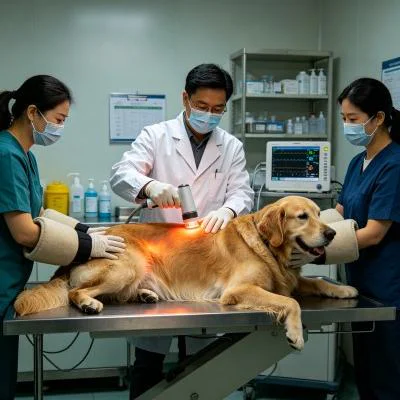
1470nm Fluid-Specific Energy Delivery for Synovial Effusion
Targeting the deeper articular capsule requires a wavelength fine-tuned to free water resonance. The 1470nm frequency has a water absorption profile roughly forty times stronger than standard near-infrared bands below 1000nm. Because chronic canine osteoarthritis triggers continuous synovial effusions, capsular edema, and periarticular swelling, the 1470nm wave concentrates its energy within these fluid-swollen compartments.
Rather than scattering into surrounding bone cortex, 1470nm photons interact directly with interstitial water, stimulating lymphatic clearance by gently warming fluid pathways to open microscopic lymphatic valves. This fluid movement relieves persistent intra-capsular pressure. By draining accumulated fluid within the closed joint capsule, 1470nm energy restores joint fluid balance, decreases capsular tightness, and lets the joint move through a wider range of motion without mechanical resistance.
Thermal Relaxation Times and Pulsed Duty Cycle Controls
Using continuous wave emission on a high-power Class IV laser to treat a dense joint capsule risks heating collagenous tissues past 42 degrees Celsius, which can trigger inflammatory thermal damage and denature cellular proteins. Effectively treating deep joint degeneration requires sustained, localized photon delivery into the articular core rather than brief surface sweeps. Safely managing this requires pulsed delivery and adjustable duty cycle profiles.
The thermal relaxation time of vascularized periarticular soft tissue defines the duration needed for treated structures to lose half their accumulated optical heat. By delivering energy in microsecond bursts followed by measured pauses, the laser handpiece allows surrounding microvessels to carry away superficial heat during the off-cycle.
Thermal Relaxation Pulse Balance in Deep Fibrotic Joint Structures:

High-Amplitude On-Phase  [==== 15ms ====] -> High photon density penetrates articular capsule
Passive Relaxation Off-Phase             [================== 85ms ==================] -> Capillary flow clears heat
Synovial Temperature    [-- Safe Rise --] [-- Blood Evacuates Thermal Energy, Skin Stays Cool --]
Running at a fifteen to twenty-five percent duty cycle allows instantaneous peak outputs of up to thirty watts to pass through dense skin and fascial layers without triggering pain or dermal burns. High-intensity photon packets penetrate deep into target tissues during the on-phase, stimulating mitochondrial cytochrome c oxidase inside chondrocytes and synovial fibroblasts. During the subsequent off-phase, thermal conduction dissipates heat into surrounding capillaries, safeguarding the epidermis while delivering a high, effective cumulative dose to damaged intra-articular cartilage.
详细临床病例记录
The treatment record below details an intensive multi-wavelength Class IV rehabilitation protocol for end-stage canine coxofemoral osteoarthritis in a private orthopedic referral setting.
| Clinical Measurement Parameter | 案件规格记录 |
| 案件参考代码 | VET-ORTHO-2026-112C |
| 患者简介 | Canine, Labrador Retriever, 9.5 Years, Female Spayed, 34.5 kg |
| 临床表现 | Severe chronic bilateral hip pain, muscle atrophy, reluctance to rise |
| 确诊 | Bilateral Coxofemoral Osteoarthritis, Grade 4 Bio-Degenerative Phase |
| Laser System Classification | 多波长IV类系统(Fotonmedix高功率平台) |
| 波长调制 | 980nm (Vascular recruitment) + 1470nm (Synovial fluid resonance) |
| 峰值输出功率 | 26 Watts (Synchronized Dual-Band Matrix) |
| Pulse Modulation Profile | 100 Hz to 250 Hz Variable Step-Down Frequency |
| 占空比配置 | 20% (4ms Pulse Width, 16ms Inter-Pulse Quiescent Window) |
| Delivery Optical Handpiece | 35 mm Collimated Deep-Tissue Contour Contact Handpiece |
| Target Fluence Rate | 14 Joules per square centimeter across the coxofemoral joint space |
| Delivered Dose Per Joint | 5,600 Joules per hip joint over a 400 square centimeter grid |
| Clinical Protocol Arc | Three treatments weekly for Weeks 1-2; Two treatments weekly for Weeks 3-4 |
Functional Mobility Recovery Markers
Kinetic Progression Timeline Across 28-Day Regimen:

Day 01  [CBPI Pain Index 7.8/10] -> Severe lameness, difficulty rising, avoids weight on hindquarters.
Day 08  [CBPI Pain Index 5.2/10] -> Morning stiffness eases, stands unassisted without vocalizing.
Day 16  [CBPI Pain Index 3.4/10] -> Sits squarely, hind limb muscle tone improves, stairs climbed safely.
Day 28  [CBPI Pain Index 1.1/10] -> Symmetric weight-bearing trot, pain-free joint manipulation, active play.
Initial therapy focused on easing severe periarticular muscle tension and clearing chronic inflammatory edema around both acetabular margins. By Day 8, muscle spasms around the gluteal muscle groups had subsided, and the patient began rising from resting positions without hesitation. Mid-point gait analysis on Day 16 confirmed improved hind-limb extension and a twenty-two percent increase in pelvic limb weight-bearing on pressure-sensitive walkway plates. By Day 28, passive hip extension reached normal angles without guarding, and the patient resumed off-leash walking, completely eliminating the need for scheduled total hip replacement surgery.
Conventional Medical Management Versus Deep-Penetrating Photobiomodulation
Standard treatment protocols for advanced canine osteoarthritis typically depend on a lifelong cycle of non-steroidal anti-inflammatory drugs, gabapentin, and intra-articular corticosteroid injections. While pharmaceuticals temporarily suppress systemic pain signals, they do not resolve the underlying structural hypoxia, persistent joint capsule edema, or cartilage degeneration driving the disease.
Chronic reliance on NSAIDs presents significant systemic health risks. Canine renal and hepatic systems gradually deteriorate under sustained pharmaceutical exposure, routinely leading to gastric ulcers, elevated liver enzymes, and chronic kidney disease. Furthermore, intra-articular corticosteroid injections accelerate long-term cartilage breakdown and soft-tissue weakening, hastening degenerative changes within the joint space. Most importantly, systemic oral drugs rely on intact microvascular networks to reach their target, meaning they struggle to penetrate ischemic, scar-encased joint capsules where capillary flow is compromised.
High-power multi-wavelength veterinary laser therapy equipment bypasses these biological limitations by treating joint disease through direct physical and metabolic mechanisms:
- Restores microvascular blood flow directly within thickened joint capsules, washing away inflammatory waste without taxing kidney or liver function.
- Clears chronic joint capsule fluid by resonating interstitial water molecules, relieving capsular tension without invasive fluid aspiration.
- Elevates cellular ATP production in chondrocytes and synoviocytes, restoring normal synovial fluid production and supporting cartilage matrix health.
- Delivers immediate pain relief directly at the joint capsule, allowing older patients to participate in targeted muscle rehabilitation without heavy sedation.
- Eliminates the risk of intra-articular joint infections, pharmaceutical drug conflicts, and chronic digestive side effects.
Adopting advanced high-power multi-wavelength laser technology fundamentally upgrades clinical outcomes for veterinary rehabilitation practices. Pet owners see their companions regain comfortable, drug-free mobility without worrying about internal organ damage, while veterinary teams gain an effective, repeatable, non-invasive protocol for severe joint disease. By overcoming deep-tissue scatter and tissue overheating, targeted Class IV laser therapy gives clinics a proven, practical path to treat advanced degenerative joint conditions.