 FotonMedix











Advanced Photobiomodulation and High-Precision Surgical Protocols for Canine Intervertebral Disc Disease (IVDD)
The application of Class 4 laser therapy in neurologically compromised canine patients facilitates the rapid reduction of perineural edema and uperregulates axonal regeneration via the mitochondrial respiratory chain, providing a non-invasive alternative to stabilize Grade 1-2 IVDD cases.
Neuro-Regenerative Modalities in Spinal Cord Injury and Compression
For the B2B surgical center or neurological specialist, managing Intervertebral Disc Disease (IVDD) requires a multifaceted approach that balances immediate decompression with long-term functional recovery. While the market frequently discusses the best cold laser therapy device, clinical experts recognize that therapeutic efficacy in spinal cases is a function of “energy at depth.” The laser therapy for dogs arthritis protocols, while effective for joints, must be significantly modified when targeting the spinal cord through the dense epaxial musculature and the vertebral canal.
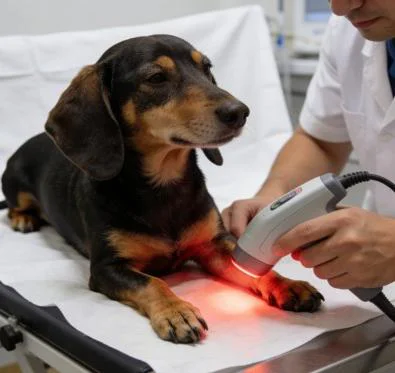
A professional laser therapy machine operating in Class 4 utilizes high-wattage diode arrays to deliver photons to the targeted spinal segment. The objective is to trigger photobiomodulation (PBM) at the level of the ventral and dorsal nerve roots. By utilizing the 810nm wavelength, we target the Cytochrome c Oxidase within the mitochondria of damaged neurons, which increases the production of Adenosine Triphosphate (ATP) and reactive oxygen species (ROS) in a controlled manner, effectively “rebooting” cellular metabolism and inhibiting the pro-apoptotic pathways that lead to secondary spinal cord injury.
Physics of Trans-Vertebral Photon Delivery and Fluence Rates
To successfully treat a 35kg canine with lumbar disc compression, the laser energy must overcome the high scattering coefficient of the skin and the absorption of the overlying muscle mass. The depth of penetration for a Class 4 system is significantly greater than Class 3b due to the high irradiance ($W/cm^2$) which pushes the photon flux deeper into the tissue before the beam reaches the “noise” level of biological scattering.
The energy distribution within the spinal canal can be estimated using the modified Beer-Lambert Law for scattering media:
$$A = \log_{10} \frac{I_0}{I} = \epsilon \cdot c \cdot L \cdot D + G$$
Where:
- $I_0$ is the incident light intensity.
- $L$ is the physical path length.
- $D$ is the “differential pathlength factor” (DPF) that accounts for the increase in optical path length due to scattering.
- $G$ is a geometry-dependent factor.
By increasing the power output to 15W–20W, the system ensures that a sufficient number of photons reach the ventral horn of the spinal cord to inhibit the release of Substance P and other nociceptive neurotransmitters, providing an immediate analgesic effect that is vital for patients in the acute phase of spinal pain.
Clinical Case Study: Conservative Management of Type I IVDD in a Dachshund
Patient Profile and Neurological Assessment
- Subject: 5-year-old female Dachshund, 7kg.
- Diagnosis: Grade 2 Hansen Type I IVDD localized to T13-L1.
- Presenting Symptoms: Paraparesis, “knuckling” of hind limbs, deep pain perception present but delayed proprioception, and severe thoracolumbar hyperesthesia.
Multi-Wavelength Class 4 Intervention Protocol
The treatment was designed to reduce localized edema and provide neuroprotection.
| Treatment Phase | Wavelength/Mode | Fluence/Dose | Clinical Logic |
| Acute De-inflammation | 980nm (Continuous) | $12 J/cm^2$ | Maximizing water absorption to reduce edema |
| Neuro-regeneration | 810nm (Pulsed) | $10 J/cm^2$ | Upregulating ATP in the spinal cord neurons |
| Pain Gating | 1064nm (Super-Pulsed) | $8 J/cm^2$ | Deep penetration for root pain inhibition |
Recovery and Clinical Trajectory
- Day 3: Significant reduction in spinal guarding. Proprioception in the left hind limb returned to near-normal levels.
- Day 10: The patient was able to maintain a standing posture independently. Ataxia was reduced by 60%.
- Month 1: Full return to mobility. The integration of high-intensity canine mobility laser sessions allowed the patient to avoid surgical hemilaminectomy, a major benefit for owners seeking non-invasive options.
Comparison of Recovery Pathways: Traditional Crate Rest vs. Laser-Accelerated Rehab
For a B2B veterinary clinic, the ability to shorten the recovery window of an IVDD patient translates directly to improved patient turnover and client satisfaction.
| Recovery Metric | Traditional Crate Rest + Meds | Class 4 Laser Integrated Protocol |
| Pain Resolution Time | 14-21 Days | 5-7 Days (Direct PBM effect) |
| Proprioceptive Return | Variable (4-8 weeks) | Accelerated (2-4 weeks) |
| Muscle Atrophy Risk | High (Due to prolonged immobility) | Low (Earlier return to controlled exercise) |
| Secondary Complications | GI upset from high NSAID doses | Minimal (Non-systemic therapy) |
| Hospital Revenue | Low (Occasional check-ups) | High (Regular therapeutic sessions) |
The use of a class 4 veterinary laser provides a clinical “safety net,” ensuring that the patient’s metabolic health is optimized even during the restricted movement phase.
Technical Risk Management and Device Longevity
In a professional medical setting, the reliability of the diode system is paramount. High-power lasers generate substantial heat, which, if not managed, can cause “diode drift”—a shift in wavelength that renders the treatment sub-therapeutic.
Maintenance and Professional Calibration
- Active Cooling Verification: Ensure the unit’s internal fans and heat sinks are free of veterinary clinic dust and hair. Overheating is the primary cause of diode failure in B2B environments.
- Fiber Cleaving Technique: In surgical mode, the fiber must be cleaved with a diamond scribe to ensure the beam remains “collimated” and does not scatter at the tip. A poorly cleaved fiber can result in accidental thermal damage to the surrounding skin.
- Safety Interlocks: Always verify the functionality of the “E-stop” and the foot-switch. In Class 4 environments, the ability to instantly terminate the beam is a mandatory safety requirement for hospital accreditation.
Strategic Market Positioning for Regional Distributors
For distributors, the “Neurology and Orthopedic” package is a powerful sales narrative. A high-end Fotonmedix system isn’t just another laser therapy machine; it is a tool that allows general practitioners to keep complex cases “in-house” rather than referring them to expensive surgical specialists. By demonstrating how the laser can treat everything from laser therapy for dogs arthritis to acute IVDD, you help the clinic diversify its revenue. Professional veterinary groups are increasingly looking for “capital equipment” that offers clinical versatility and can be operated by trained technicians, thereby freeing up the veterinarian’s time while maintaining a high standard of care.
FAQ: Professional Insights on Spinal PBM
Can laser therapy be used post-hemilaminectomy?
Yes. It is highly recommended. Post-surgical application reduces the localized inflammation caused by the surgical trauma itself and accelerates the healing of the surgical site and the underlying spinal cord.
Is there a risk of “over-heating” the spinal cord?
When using the “scan” technique with a Class 4 laser, the probe is in constant motion. This, combined with the “pulsed” mode, ensures that the thermal relaxation time of the tissue is respected, preventing any dangerous rise in the temperature of the spinal canal.
How does laser therapy assist in “nerve-root” pain?
The laser light inhibits the action of the enzyme cyclooxygenase-2 (COX-2) and reduces the levels of bradykinin, both of which are primary mediators of nerve pain and inflammation.