 فوتون ميديكس




التغلب على نقص الأكسجة الغضروفية ومقاومة الحاجز الزليلي
Multi-spectral coherent photons overcome periarticular scattering, dynamically adjusted pulse duty cycles prevent thermal boundary stacking, and targeted near-infrared energy restores chondrocyte mitochondrial respiration while suppressing synovial inflammatory cytokines.
A 63-year-old retired assembly line technician sits on the edge of the examination table, unable to fully extend the right knee without bracing both hands against the thigh. Every attempt to rise from a low chair triggers an audible crepitus paired with a sharp, sickening ache behind the patella. The joint capsule presents visible swelling, with the infrapatellar fat pad thickened and tender to manual palpation. Over the past five years, the patient has cycled through hyaluronic acid viscosupplementation, repeated intra-articular corticosteroid infiltrations, and daily non-steroidal anti-inflammatory medications. While the injections initially yielded a few weeks of dampened pain, each subsequent cycle brought shorter relief windows, culminating in persistent nocturnal throbbing that fragments sleep. Orthopedic consultation offered only total joint arthroplasty as the remaining alternative. The central clinical bottleneck confronting rehabilitation physicians is optical tissue scattering: human articular cartilage sits beneath dense fibrous envelopes, adipose blankets, and stagnant synovial fluid pools that scatter and absorb non-targeted light. Low-power modalities disperse in the skin layers, failing to deliver threshold therapeutic doses to subchondral bone. Delivering meaningful structural and symptomatic improvement demands driving calibrated photon fluxes through dense periarticular layers to reactivate hypoxic chondrocytes and drain congested synovial beds.
Optical Attenuation Curves and Depth-Targeted Spectral Coupling
Delivering therapeutic photon counts into a compromised synovial joint requires navigating complex optical coefficients across layered biological tissues. Human skin, adipose reserves, and fibrous joint capsules scatter and absorb photons, rapidly weakening the therapeutic beam before it reaches articular cartilage.
Targeted Multi-Wavelength Saturation in Arthritic Cartilage
Applying high-intensity class IV optical therapy relies on matching coherent wavelengths to primary target chromophores inside the degenerate joint capsule. Relying on single-wavelength emitters forces an operational compromise, whereas combining distinct near-infrared wavelengths accomplishes vascular and cellular modulation simultaneously:
- Microvascular recruitment and capillary clearing at 980nm: The 980nm wavelength matches the optical absorption profile of oxygenated hemoglobin and local water. In osteoarthritic synovium, microvascular capillary beds are compressed, resulting in tissue hypoxia and trapped metabolic byproducts. Photons operating at 980nm create localized microthermal gradients within vessel walls, releasing endothelial nitric oxide, opening dormant capillary sphincters, and jumpstarting stagnant periarticular lymphatic drainage.
- Mitochondrial cytochrome c oxidase saturation at 1064nm: The 1064nm band exhibits the lowest scattering coefficient among near-infrared therapeutic spectra in dense fibrous tissues. These photons travel straight through dense capsular ligaments to reach the subchondral bone plate and articular cartilage. Inside dormant chondrocytes and subchondral osteocytes, they bind to cytochrome c oxidase, displacing inhibitory nitric oxide, rebuilding the mitochondrial proton gradient, and driving adenosine triphosphate (ATP) production needed for cellular repair.
Thermal Dissipation Kinetics via Calibrated Pulse Duty Cycles
Directing high continuous optical power over a joint space creates rapid superficial thermal buildup. Continuous wave emission quickly exceeds the thermal relaxation time of human skin, triggering cutaneous pain receptors and risking epidermal blistering long before the joint capsule receives an adequate dose.
Modern high-intensity class IV clinical platforms solve this limitation through variable pulse duty cycle gating. By modulating beam delivery into microsecond bursts (ranging from 20 Hz to 20,000 Hz) with fine-tuned on/off pulse ratios, high peak power reaches deep tissues during the active phase, while superficial capillaries conduct heat away during the rest phase. This thermal regulation keeps epidermal temperatures safely below 42 degrees Celsius, enabling clinicians to apply sustained laser therapy for joint conditions without risking photothermal burns.
+--------------------------------------------------------------------------------------------------+
|                              ARTICULAR CAPSULE PHOTON PROPAGATION                                |
+--------------------------------------------------------------------------------------------------+
| Quartz Glass Handpiece Contact Compression                                                       |
|   |                                                                                              |
|   v                                                                                              |
| [Epidermis & Dermis]        ---> Cutaneous heat dissipated via microsecond duty cycle pauses     |
|   |                                                                                              |
|   v                                                                                              |
| [Subcutaneous Adipose]     ---> Mechanical probe pressure clears interstitial water barrier      |
|   |                                                                                              |
|   v                                                                                              |
| [Capsular Ligament Layer]   ---> 980nm dilates compressed capillaries, clearing metabolic wastes  |
|   |                                                                                              |
|   v                                                                                              |
| [Synovial Membrane Pocket]  ---> Downregulation of IL-1beta, TNF-alpha, and COX-2 enzymes         |
|   |                                                                                              |
|   v                                                                                              |
| [Articular Cartilage & Bone]---> 1064nm activates Cytochrome C Oxidase to restore ATP production  |
+--------------------------------------------------------------------------------------------------+
Biochemical Pathways: Halting Cartilage Catabolism and Nociceptive Sensitization
Managing degenerative osteoarthritis requires addressing structural tissue loss, chronic biochemical inflammation, and persistent peripheral nerve sensitization. Degenerated chondrocytes and inflamed synovial cells produce catabolic cytokines, including interleukin-1 beta (IL-1β), tumor necrosis factor-alpha (TNF-α), and matrix metalloproteinases (MMPs), which break down type II collagen and aggrecan while sensitizing articular nociceptors.
Applying a targeted laser for arthritis interrupts this destructive cycle. Coherent near-infrared irradiation downregulates nuclear factor kappa B (NF-κB) transcription inside synovial fibroblasts, decreasing the production of inflammatory mediators like prostaglandin E2 (PGE2) and cyclooxygenase-2 (COX-2) to help protect cartilage integrity.
وفي الوقت نفسه، يؤثر تطبيق العلاج المنظم بالليزر لالتهاب المفاصل بشكل مباشر على المسارات العصبية الحسية. حيث يؤدي توصيل جرعات عالية من الفوتونات إلى فرط استقطاب الألياف C غير الميالينية والألياف A-دلتا ذات الميالين الرقيق داخل المحفظة المفصلية. تُظهر الأبحاث التي أجراها بيوردال وزملاؤه في مجال إعادة التأهيل البدني أن الإضاءة عالية الطاقة في نطاق الأشعة تحت الحمراء القريبة تقلل من سرعة التوصيل العصبي المحيطي وتحد من تراكم مادة P في الأنسجة المحيطة بالمفصل، مما يوفر تخفيفًا سريعًا ودائمًا للألم دون آثار جانبية جهازية.
توثيق الحالات السريرية: إعادة التأهيل العظمي للمرضى الخارجيين
The documented case below outlines the outpatient rehabilitation course of a patient with advanced knee osteoarthritis, managed using a multi-wavelength Class IV rehabilitation laser platform equipped with a specialized quartz massage applicator.
الملف الشخصي للمريض والبيانات السريرية الأساسية
- Case Identifier: OSTEO-KNEE-2026-0518
- Patient Age / Sex: 63-Year-Old Male
- Primary Diagnosis: Severe Tricompartmental Knee Osteoarthritis (Kellgren-Lawrence Grade III) with Medial Joint Space Narrowing, Subchondral Sclerosis, Suprapatellar Synovitis, and Secondary Flexion Contracture, confirmed via Weight-Bearing Radiographs and High-Resolution Musculoskeletal Ultrasound.
- History: 60 months of progressive right knee pain, joint stiffness, and mobility loss. Failed conservative measures including physical therapy, oral NSAIDs, hyaluronic acid injections, and repeated cortisone injections. Patient experiences severe pain during stair climbing, cannot walk beyond 200 meters without resting, and demonstrates marked antalgic gait.
- Baseline Metrics: Numerical Pain Rating Scale (NPRS) at 8/10 during weight-bearing movement; Western Ontario and McMaster Universities Osteoarthritis Index (WOMAC) at 68/96; Knee Active Range of Motion (AROM) Flexion restricted to 90°, Extension lacking 12° (flexion contracture); Knee joint circumference at mid-patella measured at 42.8 cm.
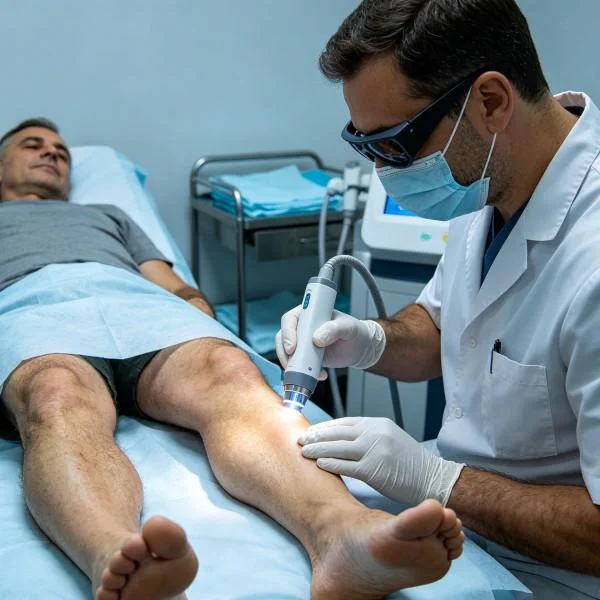
نظام علاجي متعدد المراحل
تألف برنامج العلاج من عشر جلسات سريرية تم تحديد مواعيدها على مدار أربعة أسابيع، بدءًا من إدارة الألم في المراحل المبكرة والتصريف اللمفاوي وصولاً إلى التحفيز الحيوي العميق للمفاصل والحركة الوظيفية.
| رقم الجلسة. | المرحلة السريرية والهدف | إعداد الطول الموجي | طاقة التشغيل (واط) | تردد النبض (هرتز) | دورة التشغيل (%) | الطاقة المسلمة (J) | الجرعة التراكمية (جول) |
| الجلسة 01 | التحكم في الإحساس بالألم والتصريف من منطقة المرفق | 980 نانومتر (65%) + 1064 نانومتر (35%) | 12.0 واط | 8,000 هرتز | 40% | 3,600 J | 3,600 J |
| الجلسة 02 | إزالة الاحتقان من الحيز الوسطي | 980 نانومتر (60%) + 1064 نانومتر (40%) | 14.0 واط | 4,000 هرتز | 50% | 4,200 جول | 7,800 ج |
| الجلسة 03 | غسل السائل الزليلي فوق الرضفة | 980 نانومتر (50%) + 1064 نانومتر (50%) | 16.0 واط | 2,000 هرتز | 60% | 4,800 جول | 12,600 جول |
| الجلسة 04 | إزالة الحساسية من الوسادة الدهنية تحت الرضفة | 980 نانومتر (40%) + 1064 نانومتر (60%) | 18.0 واط | 500 هرتز | 65% | 5,400 J | 18,000 J |
| الجلسة 05 | تليين ليفي عميق في المحفظة | 980 نانومتر (35%) + 1064 نانومتر (65%) | 20.0 واط | 250 هرتز | 70% | 6,000 J | 24,000 ج |
| الجلسة 06 | تثبيط السيتوكينات في الخلايا الليفية الزلالية | 980 نانومتر (30%) + 1064 نانومتر (70%) | 22.0 واط | 100 هرتز | 75% | 6,600 جول | 30,600 جول |
| الجلسة 07 | دفع عملية التنفس في الخلايا الغضروفية عالية التدفق | 980 نانومتر (20%) + 1064 نانومتر (80%) | 24.0 واط | مستمر (CW) | 100% | 7,200 J | 37,800 ج |
| الجلسة 08 | تشبع مصفوفة العظم تحت الغضروف | 980 نانومتر (20%) + 1064 نانومتر (80%) | 24.0 واط | مستمر (CW) | 100% | 7,200 J | 45,000 ج |
| الجلسة 09 | التكامل الميكانيكي الحيوي للتمديد الديناميكي | 980 نانومتر (30%) + 1064 نانومتر (70%) | 20.0 واط | 150 هرتز | 75% | 6,000 J | 51,000 ج |
| الجلسة 10 | التثبيت النهائي للأنسجة والخروج من المستشفى | 980 نانومتر (40%) + 1064 نانومتر (60%) | 16.0 واط | 400 هرتز | 65% | 4,800 جول | 55,800 ج |
مؤشرات التطور السريري والنتائج
WEEK 1 (Sessions 1-3):
- Deep contact sweeping over the popliteal drainage basin and medial joint line reduced periarticular tension.
- Resting nocturnal pain subsided; NPRS dropped from 8/10 to 4/10.
- Patient slept through the night without waking from positional joint aching after Session 2.
- Mid-patellar joint circumference decreased from 42.8 cm to 40.5 cm as effusion drained.

WEEK 2 (Sessions 4-6):
- Knee active flexion expanded from 90° to 118°; extension deficit reduced from 12° to 4°.
- Patient climbed household stairs hand-over-hand without requiring pauses on intermediate steps.
- Ultrasound evaluation showed suprapatellar fluid pocket thickness decreased from 12 mm to 3 mm.
- WOMAC functional score improved from 68 to 34.

WEEK 3 (Sessions 7-8):
- Continuous wave delivery applied over the patellar retinaculum and tibiofemoral margins with firm compression.
- Patient walked 1.5 kilometers outdoors without joint catching, sudden giving way, or post-activity swelling.
- Crepitus during active knee flexion softened considerably as synovial membrane congestion subsided.

WEEK 4 (Sessions 9-10):
- Full active knee extension achieved (0° neutral); active flexion reached 130°.
- Mid-patellar circumference stabilized at 38.6 cm, matching the unaffected contralateral limb.
- Final NPRS recorded at 1/10 during extended walking and 0/10 at rest.
- WOMAC score reached 7/96, restoring daily mobility and deferring surgical total knee replacement.
تحليل مقارن: الليزر عالي الكثافة مقابل الأساليب التقليدية
يُظهر تقييم الضوء عالي الكثافة من الفئة الرابعة جنبًا إلى جنب مع الخيارات السريرية التقليدية السبب الذي يدفع مراكز الطب الفيزيائي الحديثة إلى دمج أجهزة الليزر متعددة الأطوال الموجية في الرعاية اليومية:
حقن الكورتيكوستيرويدات داخل المفصل
تعمل حقن الستيرويدات كمثبطات كيميائية واسعة النطاق للمناعة، حيث تخفي مؤقتًا التهاب المفاصل. ومع ذلك، فإن التعرض المتكرر للستيرويدات داخل المفصل يُسرّع من فقدان الغضروف، ويضر بحيوية الخلايا الغضروفية الأصلية، ويهدد بتضييق الفراغ المفصلي بمرور الوقت. ويوفر العلاج بالليزر عالي الكثافة ومتعدد الأطوال الموجية بديلاً غير جراحي وغير مدمر. فبدلاً من إتلاف الخلايا الغضروفية، تعمل الفوتونات المركزة على تحفيز الدورة الدموية في الأوعية الدموية الدقيقة، وتعزيز تخليق ATP الخلوي، وتخفيف الألم في المفاصل دون أي سمية كيميائية.
استبدال مفصل الركبة بالكامل (TKA)
تتمثل عملية استبدال المفاصل الجراحية في إزالة الأسطح الطبيعية للمفصل واستبدالها بغرسات معدنية وبولي إيثيلين. ورغم فعالية هذه الجراحة في حالات التلف التشريحي الشديد، إلا أنها تنطوي على مخاطر مثل الإصابة بالعدوى في الفترة المحيطة بالجراحة، والتخثر الوريدي العميق، وترخي الغرسة، وفترات إعادة التأهيل الطويلة. يوفر العلاج بالليزر من الفئة الرابعة علاجًا غير جراحي فعالًا يحافظ على التشريح الطبيعي للمفصل، ويقلل من التهاب المحفظة، ويعيد القدرة على الحركة دون التعرض لصدمة جراحية.
الأدوية المضادة للالتهاب غير الستيرويدية (NSAIDs) التي تُؤخذ عن طريق الفم
تنتشر الأدوية المضادة للالتهابات الجهازية في جميع أنحاء الجسم، مما يثبط عمل البروستاجلاندينات الواقية في بطانة المعدة والكلى، في حين تصل تركيزات محدودة من الدواء إلى الغضروف المفصلي الذي يعاني من ضعف التروية الدموية. وينطوي الاستخدام المزمن لمضادات الالتهاب غير الستيرويدية (NSAID) على مخاطر موثقة جيدًا تتمثل في الإصابة بقرحة المعدة وارتفاع ضغط الدم والضعف الكلوي. يستهدف العلاج بالليزر عالي الكثافة توجيه الطاقة العلاجية مباشرةً إلى كبسولة المفصل المتضررة، مما يخفف آلام المفاصل وتيبسها محليًّا دون آثار جانبية جهازية.
التطبيق السريري العملي والدروس المستفادة على الصعيد التشغيلي
يتطلب تحقيق نتائج سريرية متسقة عند استخدام أنظمة الليزر عالية الكثافة لعلاج التنكس المزمن في المفاصل اتباع نهج منظم:
- الضغط الديناميكي باستخدام مجسات التدليك الكوارتزية: يجب على الأطباء ممارسة ضغط قوي وثابت باستخدام مجس التلامس الكوارتزي على حدود الأنسجة الرخوة المحيطة بوتر الرضفة وخطوط المفصل الساقي الفخذي. يعمل الضغط الفيزيائي على إزاحة الماء السطحي والدم الوريدي بعيدًا عن مسار الحزمة، مما يخلق مسارًا بصريًّا مثاليًّا يوفر عددًا أكبر من الفوتونات إلى الهياكل العميقة للمحفظة.
- التطهير اللمفاوي الإقليمي: يجب دائمًا معالجة المسارات اللمفاوية القريبة أولاً. إن مسح الفراغ المأبضي والمثلث الفخذي وعضلات الساق القريبة قبل توجيه الطاقة إلى كبسولة المفصل يؤدي إلى تطهير مسارات السوائل وتسريع تعافي الأنسجة.
- بروتوكول التدرج الترددي: ابدأ بترددات نبضية عالية (4,000 هرتز إلى 8,000 هرتز) خلال الزيارات الأولية لتهدئة المسارات العصبية الطرفية شديدة الحساسية، ثم انتقل إلى نبضات معتدلة (100 هرتز إلى 500 هرتز) لتحسين التروية المحلية وتخفيف تصلب المحفظة، واختتم العلاج بإرسال موجة مستمرة (CW) لتحفيز التمثيل الغذائي للخلايا الغضروفية وإعادة تشكيلها الهيكلي بمجرد أن يهدأ الألم الحاد.
يتيح تطبيق العلاج بالليزر متعدد الأطوال الموجية من الفئة الرابعة، القائم على فيزياء الأنسجة البصرية، لعيادات جراحة العظام والعلاج الطبيعي التي تستقبل المرضى في العيادات الخارجية معالجة حالات التنكس المفصلي المزمنة والمستعصية، ومساعدة المرضى على العودة إلى حياة يومية نشطة وخالية من الألم.