 フォトンメディックス




軟骨低酸素状態と滑膜バリアの抵抗性の克服
Multi-spectral coherent photons overcome periarticular scattering, dynamically adjusted pulse duty cycles prevent thermal boundary stacking, and targeted near-infrared energy restores chondrocyte mitochondrial respiration while suppressing synovial inflammatory cytokines.
A 63-year-old retired assembly line technician sits on the edge of the examination table, unable to fully extend the right knee without bracing both hands against the thigh. Every attempt to rise from a low chair triggers an audible crepitus paired with a sharp, sickening ache behind the patella. The joint capsule presents visible swelling, with the infrapatellar fat pad thickened and tender to manual palpation. Over the past five years, the patient has cycled through hyaluronic acid viscosupplementation, repeated intra-articular corticosteroid infiltrations, and daily non-steroidal anti-inflammatory medications. While the injections initially yielded a few weeks of dampened pain, each subsequent cycle brought shorter relief windows, culminating in persistent nocturnal throbbing that fragments sleep. Orthopedic consultation offered only total joint arthroplasty as the remaining alternative. The central clinical bottleneck confronting rehabilitation physicians is optical tissue scattering: human articular cartilage sits beneath dense fibrous envelopes, adipose blankets, and stagnant synovial fluid pools that scatter and absorb non-targeted light. Low-power modalities disperse in the skin layers, failing to deliver threshold therapeutic doses to subchondral bone. Delivering meaningful structural and symptomatic improvement demands driving calibrated photon fluxes through dense periarticular layers to reactivate hypoxic chondrocytes and drain congested synovial beds.
Optical Attenuation Curves and Depth-Targeted Spectral Coupling
Delivering therapeutic photon counts into a compromised synovial joint requires navigating complex optical coefficients across layered biological tissues. Human skin, adipose reserves, and fibrous joint capsules scatter and absorb photons, rapidly weakening the therapeutic beam before it reaches articular cartilage.
Targeted Multi-Wavelength Saturation in Arthritic Cartilage
Applying high-intensity class IV optical therapy relies on matching coherent wavelengths to primary target chromophores inside the degenerate joint capsule. Relying on single-wavelength emitters forces an operational compromise, whereas combining distinct near-infrared wavelengths accomplishes vascular and cellular modulation simultaneously:
- Microvascular recruitment and capillary clearing at 980nm: The 980nm wavelength matches the optical absorption profile of oxygenated hemoglobin and local water. In osteoarthritic synovium, microvascular capillary beds are compressed, resulting in tissue hypoxia and trapped metabolic byproducts. Photons operating at 980nm create localized microthermal gradients within vessel walls, releasing endothelial nitric oxide, opening dormant capillary sphincters, and jumpstarting stagnant periarticular lymphatic drainage.
- Mitochondrial cytochrome c oxidase saturation at 1064nm: The 1064nm band exhibits the lowest scattering coefficient among near-infrared therapeutic spectra in dense fibrous tissues. These photons travel straight through dense capsular ligaments to reach the subchondral bone plate and articular cartilage. Inside dormant chondrocytes and subchondral osteocytes, they bind to cytochrome c oxidase, displacing inhibitory nitric oxide, rebuilding the mitochondrial proton gradient, and driving adenosine triphosphate (ATP) production needed for cellular repair.
Thermal Dissipation Kinetics via Calibrated Pulse Duty Cycles
Directing high continuous optical power over a joint space creates rapid superficial thermal buildup. Continuous wave emission quickly exceeds the thermal relaxation time of human skin, triggering cutaneous pain receptors and risking epidermal blistering long before the joint capsule receives an adequate dose.
Modern high-intensity class IV clinical platforms solve this limitation through variable pulse duty cycle gating. By modulating beam delivery into microsecond bursts (ranging from 20 Hz to 20,000 Hz) with fine-tuned on/off pulse ratios, high peak power reaches deep tissues during the active phase, while superficial capillaries conduct heat away during the rest phase. This thermal regulation keeps epidermal temperatures safely below 42 degrees Celsius, enabling clinicians to apply sustained laser therapy for joint conditions without risking photothermal burns.
+--------------------------------------------------------------------------------------------------+
|                              ARTICULAR CAPSULE PHOTON PROPAGATION                                |
+--------------------------------------------------------------------------------------------------+
| Quartz Glass Handpiece Contact Compression                                                       |
|   |                                                                                              |
|   v                                                                                              |
| [Epidermis & Dermis]        ---> Cutaneous heat dissipated via microsecond duty cycle pauses     |
|   |                                                                                              |
|   v                                                                                              |
| [Subcutaneous Adipose]     ---> Mechanical probe pressure clears interstitial water barrier      |
|   |                                                                                              |
|   v                                                                                              |
| [Capsular Ligament Layer]   ---> 980nm dilates compressed capillaries, clearing metabolic wastes  |
|   |                                                                                              |
|   v                                                                                              |
| [Synovial Membrane Pocket]  ---> Downregulation of IL-1beta, TNF-alpha, and COX-2 enzymes         |
|   |                                                                                              |
|   v                                                                                              |
| [Articular Cartilage & Bone]---> 1064nm activates Cytochrome C Oxidase to restore ATP production  |
+--------------------------------------------------------------------------------------------------+
Biochemical Pathways: Halting Cartilage Catabolism and Nociceptive Sensitization
Managing degenerative osteoarthritis requires addressing structural tissue loss, chronic biochemical inflammation, and persistent peripheral nerve sensitization. Degenerated chondrocytes and inflamed synovial cells produce catabolic cytokines, including interleukin-1 beta (IL-1β), tumor necrosis factor-alpha (TNF-α), and matrix metalloproteinases (MMPs), which break down type II collagen and aggrecan while sensitizing articular nociceptors.
Applying a targeted laser for arthritis interrupts this destructive cycle. Coherent near-infrared irradiation downregulates nuclear factor kappa B (NF-κB) transcription inside synovial fibroblasts, decreasing the production of inflammatory mediators like prostaglandin E2 (PGE2) and cyclooxygenase-2 (COX-2) to help protect cartilage integrity.
同時に、構造化されたレーザー関節炎治療の実施は、感覚神経経路に直接作用します。高光子線量を照射することで、関節包内の非髄鞘化C線維および薄髄鞘化A-δ線維が過分極されます。 理学リハビリテーション分野におけるBjordalらによる研究では、高エネルギーの近赤外光照射が末梢神経伝導速度を低下させ、関節周囲組織におけるサブスタンスPの蓄積を抑制し、全身的な副作用を伴わずに迅速かつ持続的な疼痛緩和をもたらすことが実証されている。.
臨床症例記録:外来における整形外科リハビリテーション
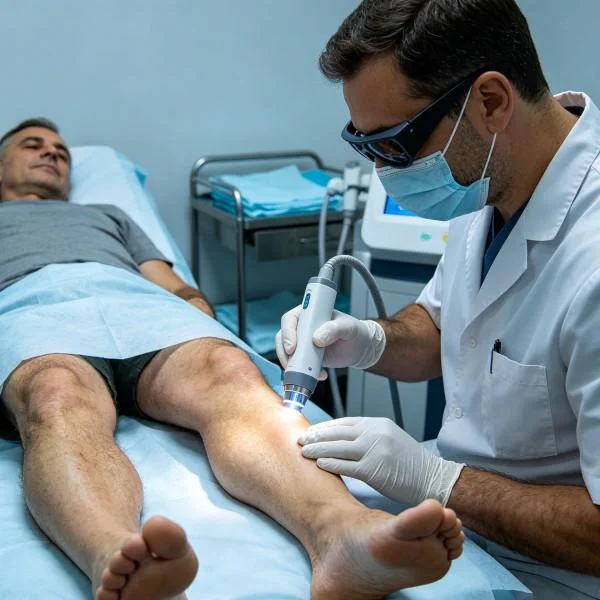
The documented case below outlines the outpatient rehabilitation course of a patient with advanced knee osteoarthritis, managed using a multi-wavelength Class IV rehabilitation laser platform equipped with a specialized quartz massage applicator.
患者のプロファイルおよび臨床的ベースライン
- Case Identifier: OSTEO-KNEE-2026-0518
- Patient Age / Sex: 63-Year-Old Male
- Primary Diagnosis: Severe Tricompartmental Knee Osteoarthritis (Kellgren-Lawrence Grade III) with Medial Joint Space Narrowing, Subchondral Sclerosis, Suprapatellar Synovitis, and Secondary Flexion Contracture, confirmed via Weight-Bearing Radiographs and High-Resolution Musculoskeletal Ultrasound.
- History: 60 months of progressive right knee pain, joint stiffness, and mobility loss. Failed conservative measures including physical therapy, oral NSAIDs, hyaluronic acid injections, and repeated cortisone injections. Patient experiences severe pain during stair climbing, cannot walk beyond 200 meters without resting, and demonstrates marked antalgic gait.
- Baseline Metrics: Numerical Pain Rating Scale (NPRS) at 8/10 during weight-bearing movement; Western Ontario and McMaster Universities Osteoarthritis Index (WOMAC) at 68/96; Knee Active Range of Motion (AROM) Flexion restricted to 90°, Extension lacking 12° (flexion contracture); Knee joint circumference at mid-patella measured at 42.8 cm.
多段階治療レジメン
治療コースは、4週間にわたって予定された10回の臨床セッションで構成され、初期の疼痛管理やリンパドレナージから、深部関節の生体刺激や機能的可動域の改善へと段階的に進められました。.
| セッション番号. | 臨床段階および目的 | 波長の設定 | 動作電力(W) | パルス周波数 (Hz) | デューティ・サイクル(%) | 供給エネルギー (J) | 累積線量(J) |
| セッション01 | Nociceptive Gating & Popliteal Drainage | 980nm (65%) + 1064nm (35%) | 12.0 W | 8,000 Hz | 40% | 3,600 J | 3,600 J |
| セッション02 | Medial Compartment Decongestion | 980nm (60%) + 1064nm (40%) | 14.0 W | 4,000 Hz | 50% | 4,200 J | 7,800 J |
| セッション03 | Suprapatellar Synovial Flushing | 980nm (50%) + 1064nm (50%) | 16.0 W | 2,000 Hz | 60% | 4,800 J | 12,600 J |
| セッション04 | Infrapatellar Fat Pad Desensitization | 980nm (40%) + 1064nm (60%) | 18.0 W | 500 Hz | 65% | 5,400 J | 18,000 J |
| セッション05 | Deep Capsular Fibrotic Softening | 980nm (35%) + 1064nm (65%) | 20.0 W | 250 Hz | 70% | 6,000 J | 24,000 J |
| セッション06 | 滑膜線維芽細胞によるサイトカインの抑制 | 980nm (30%) + 1064nm (70%) | 22.0 W | 100 Hz | 75% | 6,600 J | 30,600 J |
| セッション07 | 高フラックス軟骨細胞呼吸推進プロジェクト | 980nm (20%) + 1064nm (80%) | 24.0 W | 連続(CW) | 100% | 7,200 J | 37,800 J |
| セッション08 | Subchondral Bone Matrix Saturation | 980nm (20%) + 1064nm (80%) | 24.0 W | 連続(CW) | 100% | 7,200 J | 45,000 J |
| セッション09 | Dynamic Extension Biomechanical Integration | 980nm (30%) + 1064nm (70%) | 20.0 W | 150 Hz | 75% | 6,000 J | 51,000 J |
| セッション10 | 最終的な組織の固化および排出 | 980nm (40%) + 1064nm (60%) | 16.0 W | 400 Hz | 65% | 4,800 J | 55,800 J |
臨床経過および転帰指標
WEEK 1 (Sessions 1-3):
- Deep contact sweeping over the popliteal drainage basin and medial joint line reduced periarticular tension.
- Resting nocturnal pain subsided; NPRS dropped from 8/10 to 4/10.
- Patient slept through the night without waking from positional joint aching after Session 2.
- Mid-patellar joint circumference decreased from 42.8 cm to 40.5 cm as effusion drained.

WEEK 2 (Sessions 4-6):
- Knee active flexion expanded from 90° to 118°; extension deficit reduced from 12° to 4°.
- Patient climbed household stairs hand-over-hand without requiring pauses on intermediate steps.
- Ultrasound evaluation showed suprapatellar fluid pocket thickness decreased from 12 mm to 3 mm.
- WOMAC functional score improved from 68 to 34.

WEEK 3 (Sessions 7-8):
- Continuous wave delivery applied over the patellar retinaculum and tibiofemoral margins with firm compression.
- Patient walked 1.5 kilometers outdoors without joint catching, sudden giving way, or post-activity swelling.
- Crepitus during active knee flexion softened considerably as synovial membrane congestion subsided.

WEEK 4 (Sessions 9-10):
- Full active knee extension achieved (0° neutral); active flexion reached 130°.
- Mid-patellar circumference stabilized at 38.6 cm, matching the unaffected contralateral limb.
- Final NPRS recorded at 1/10 during extended walking and 0/10 at rest.
- WOMAC score reached 7/96, restoring daily mobility and deferring surgical total knee replacement.
比較分析:高出力レーザーと従来の治療法
Evaluating high-intensity class IV light alongside traditional clinical options shows why modern physical medicine centers integrate multi-wavelength lasers into daily care:
関節内コルチコステロイド注射
Steroid injections act as broad chemical immunosuppressants that temporarily mask joint inflammation. However, repeated intra-articular steroid exposure accelerates cartilage loss, damages native chondrocyte viability, and risks narrowing the joint space over time. High-intensity multi-wavelength laser therapy provides a non-invasive, non-destructive alternative. Rather than damaging chondrocytes, concentrated photons stimulate microvascular circulation, boost cellular ATP synthesis, and reduce joint discomfort without chemical toxicity.
Total Knee Arthroplasty (TKA)
Surgical joint replacement removes native joint surfaces and replaces them with metal and polyethylene implants. While effective for severe anatomical destruction, surgery carries risks of perioperative infection, deep vein thrombosis, implant loosening, and lengthy rehabilitation timelines. Class IV laser therapy provides an effective non-surgical treatment that preserves native joint anatomy, reduces capsular inflammation, and restores mobility without operative trauma.
経口非ステロイド性抗炎症薬(NSAIDs)
Systemic anti-inflammatory medications circulate throughout the body, inhibiting protective prostaglandins in the gastric lining and kidneys while delivering limited drug concentrations into poorly vascularized articular cartilage. Chronic NSAID use carries well-documented risks of gastric ulceration, hypertension, and renal impairment. High-intensity laser therapy targets therapeutic energy directly into the damaged joint capsule, relieving joint pain and stiffness locally without systemic adverse effects.
臨床現場での実践的な応用と運用上のポイント
Achieving consistent clinical results when using high-intensity laser systems for chronic joint degeneration requires structured execution:
- Dynamic compression with quartz massage probes: Clinicians should apply firm, steady pressure with the quartz contact probe into the soft-tissue boundaries surrounding the patellar tendon and tibiofemoral joint lines. Physical compression displaces superficial water and venous blood away from the beam path, creating an optimal optical pathway that delivers higher photon counts into deep capsule structures.
- Regional lymphatic clearing: Always treat proximal lymphatic pathways first. Sweeping the popliteal space, femoral triangle, and proximal calf musculature before directing energy into the joint capsule clears fluid pathways and accelerates tissue recovery.
- 周波数漸増プロトコル:初回の来院時には、過敏になった末梢神経経路を鎮静させるため、高いパルス周波数(4,000 Hz~8,000 Hz)から開始し、局所の血流を改善して関節包の硬直を緩和するために中程度のパルス周波数(100 Hz~500 Hz)へと移行し、 急性疼痛が治まった後は、連続波(CW)照射に切り替えて、軟骨細胞の代謝と構造的リモデリングを促進する。.
Applying class IV multi-wavelength laser therapy grounded in tissue optical physics allows outpatient orthopedic and physical therapy clinics to resolve stubborn, chronic joint degeneration and help patients return to active, pain-free daily lives.