 FotonMedix




Преодоление гипоксии хрящевой ткани и сопротивления синовиального барьера
Multi-spectral coherent photons overcome periarticular scattering, dynamically adjusted pulse duty cycles prevent thermal boundary stacking, and targeted near-infrared energy restores chondrocyte mitochondrial respiration while suppressing synovial inflammatory cytokines.
A 63-year-old retired assembly line technician sits on the edge of the examination table, unable to fully extend the right knee without bracing both hands against the thigh. Every attempt to rise from a low chair triggers an audible crepitus paired with a sharp, sickening ache behind the patella. The joint capsule presents visible swelling, with the infrapatellar fat pad thickened and tender to manual palpation. Over the past five years, the patient has cycled through hyaluronic acid viscosupplementation, repeated intra-articular corticosteroid infiltrations, and daily non-steroidal anti-inflammatory medications. While the injections initially yielded a few weeks of dampened pain, each subsequent cycle brought shorter relief windows, culminating in persistent nocturnal throbbing that fragments sleep. Orthopedic consultation offered only total joint arthroplasty as the remaining alternative. The central clinical bottleneck confronting rehabilitation physicians is optical tissue scattering: human articular cartilage sits beneath dense fibrous envelopes, adipose blankets, and stagnant synovial fluid pools that scatter and absorb non-targeted light. Low-power modalities disperse in the skin layers, failing to deliver threshold therapeutic doses to subchondral bone. Delivering meaningful structural and symptomatic improvement demands driving calibrated photon fluxes through dense periarticular layers to reactivate hypoxic chondrocytes and drain congested synovial beds.
Optical Attenuation Curves and Depth-Targeted Spectral Coupling
Delivering therapeutic photon counts into a compromised synovial joint requires navigating complex optical coefficients across layered biological tissues. Human skin, adipose reserves, and fibrous joint capsules scatter and absorb photons, rapidly weakening the therapeutic beam before it reaches articular cartilage.
Targeted Multi-Wavelength Saturation in Arthritic Cartilage
Applying high-intensity class IV optical therapy relies on matching coherent wavelengths to primary target chromophores inside the degenerate joint capsule. Relying on single-wavelength emitters forces an operational compromise, whereas combining distinct near-infrared wavelengths accomplishes vascular and cellular modulation simultaneously:
- Microvascular recruitment and capillary clearing at 980nm: The 980nm wavelength matches the optical absorption profile of oxygenated hemoglobin and local water. In osteoarthritic synovium, microvascular capillary beds are compressed, resulting in tissue hypoxia and trapped metabolic byproducts. Photons operating at 980nm create localized microthermal gradients within vessel walls, releasing endothelial nitric oxide, opening dormant capillary sphincters, and jumpstarting stagnant periarticular lymphatic drainage.
- Mitochondrial cytochrome c oxidase saturation at 1064nm: The 1064nm band exhibits the lowest scattering coefficient among near-infrared therapeutic spectra in dense fibrous tissues. These photons travel straight through dense capsular ligaments to reach the subchondral bone plate and articular cartilage. Inside dormant chondrocytes and subchondral osteocytes, they bind to cytochrome c oxidase, displacing inhibitory nitric oxide, rebuilding the mitochondrial proton gradient, and driving adenosine triphosphate (ATP) production needed for cellular repair.
Thermal Dissipation Kinetics via Calibrated Pulse Duty Cycles
Directing high continuous optical power over a joint space creates rapid superficial thermal buildup. Continuous wave emission quickly exceeds the thermal relaxation time of human skin, triggering cutaneous pain receptors and risking epidermal blistering long before the joint capsule receives an adequate dose.
Modern high-intensity class IV clinical platforms solve this limitation through variable pulse duty cycle gating. By modulating beam delivery into microsecond bursts (ranging from 20 Hz to 20,000 Hz) with fine-tuned on/off pulse ratios, high peak power reaches deep tissues during the active phase, while superficial capillaries conduct heat away during the rest phase. This thermal regulation keeps epidermal temperatures safely below 42 degrees Celsius, enabling clinicians to apply sustained laser therapy for joint conditions without risking photothermal burns.
+--------------------------------------------------------------------------------------------------+
|                              ARTICULAR CAPSULE PHOTON PROPAGATION                                |
+--------------------------------------------------------------------------------------------------+
| Quartz Glass Handpiece Contact Compression                                                       |
|   |                                                                                              |
|   v                                                                                              |
| [Epidermis & Dermis]        ---> Cutaneous heat dissipated via microsecond duty cycle pauses     |
|   |                                                                                              |
|   v                                                                                              |
| [Subcutaneous Adipose]     ---> Mechanical probe pressure clears interstitial water barrier      |
|   |                                                                                              |
|   v                                                                                              |
| [Capsular Ligament Layer]   ---> 980nm dilates compressed capillaries, clearing metabolic wastes  |
|   |                                                                                              |
|   v                                                                                              |
| [Synovial Membrane Pocket]  ---> Downregulation of IL-1beta, TNF-alpha, and COX-2 enzymes         |
|   |                                                                                              |
|   v                                                                                              |
| [Articular Cartilage & Bone]---> 1064nm activates Cytochrome C Oxidase to restore ATP production  |
+--------------------------------------------------------------------------------------------------+
Biochemical Pathways: Halting Cartilage Catabolism and Nociceptive Sensitization
Managing degenerative osteoarthritis requires addressing structural tissue loss, chronic biochemical inflammation, and persistent peripheral nerve sensitization. Degenerated chondrocytes and inflamed synovial cells produce catabolic cytokines, including interleukin-1 beta (IL-1β), tumor necrosis factor-alpha (TNF-α), and matrix metalloproteinases (MMPs), which break down type II collagen and aggrecan while sensitizing articular nociceptors.
Applying a targeted laser for arthritis interrupts this destructive cycle. Coherent near-infrared irradiation downregulates nuclear factor kappa B (NF-κB) transcription inside synovial fibroblasts, decreasing the production of inflammatory mediators like prostaglandin E2 (PGE2) and cyclooxygenase-2 (COX-2) to help protect cartilage integrity.
Одновременно проведение структурированного лазерного лечения артрита оказывает прямое воздействие на сенсорные нервные пути. Подача высоких доз фотонов вызывает гиперполяризацию немиелинизированных С-волокон и тонкомиелинизированных А-дельта-волокон внутри суставной капсулы. Исследования Бьордала и его коллег, опубликованные в литературе по физической реабилитации, показывают, что высокоэнергетическое облучение в ближнем инфракрасном диапазоне снижает скорость проводимости периферических нервов и сдерживает накопление вещества P в периартикулярных тканях, обеспечивая быстрое и длительное облегчение боли без системных побочных эффектов.
Документация клинических случаев: амбулаторная ортопедическая реабилитация
The documented case below outlines the outpatient rehabilitation course of a patient with advanced knee osteoarthritis, managed using a multi-wavelength Class IV rehabilitation laser platform equipped with a specialized quartz massage applicator.
Характеристика пациента и исходные клинические данные
- Case Identifier: OSTEO-KNEE-2026-0518
- Patient Age / Sex: 63-Year-Old Male
- Primary Diagnosis: Severe Tricompartmental Knee Osteoarthritis (Kellgren-Lawrence Grade III) with Medial Joint Space Narrowing, Subchondral Sclerosis, Suprapatellar Synovitis, and Secondary Flexion Contracture, confirmed via Weight-Bearing Radiographs and High-Resolution Musculoskeletal Ultrasound.
- History: 60 months of progressive right knee pain, joint stiffness, and mobility loss. Failed conservative measures including physical therapy, oral NSAIDs, hyaluronic acid injections, and repeated cortisone injections. Patient experiences severe pain during stair climbing, cannot walk beyond 200 meters without resting, and demonstrates marked antalgic gait.
- Baseline Metrics: Numerical Pain Rating Scale (NPRS) at 8/10 during weight-bearing movement; Western Ontario and McMaster Universities Osteoarthritis Index (WOMAC) at 68/96; Knee Active Range of Motion (AROM) Flexion restricted to 90°, Extension lacking 12° (flexion contracture); Knee joint circumference at mid-patella measured at 42.8 cm.
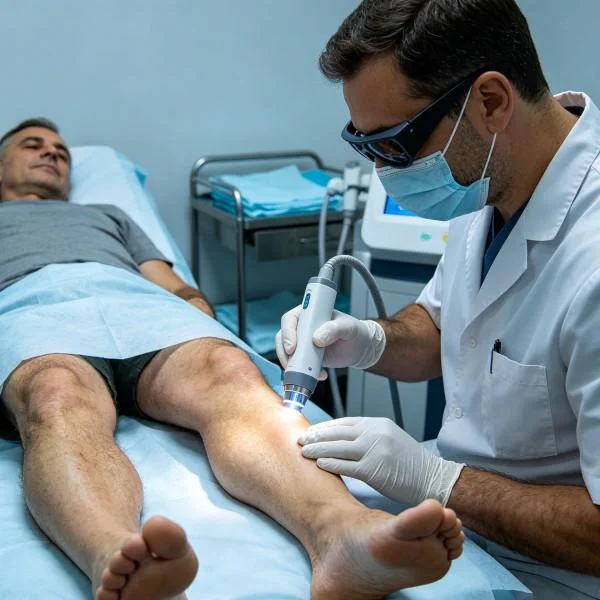
Многоэтапная схема лечения
Курс лечения включал десять клинических сеансов, распределенных на четыре недели, с постепенным переходом от раннего обезболивания и лимфодренажа к глубокой биостимуляции суставов и восстановлению функциональной подвижности.
| Номер сессии. | Клиническая фаза и цель | Настройка длины волны | Рабочая мощность (Вт) | Частота импульсов (Гц) | Рабочий цикл (%) | Поставляемая энергия (Дж) | Накопленная доза (Дж) |
| Сессия 01 | Nociceptive Gating & Popliteal Drainage | 980 нм (65%) + 1064 нм (35%) | 12,0 Вт | 8 000 Гц | 40% | 3,600 J | 3,600 J |
| Сессия 02 | Medial Compartment Decongestion | 980 нм (60%) + 1064 нм (40%) | 14,0 Вт | 4 000 Гц | 50% | 4 200 Дж | 7 800 Дж |
| Сессия 03 | Suprapatellar Synovial Flushing | 980 нм (50%) + 1064 нм (50%) | 16,0 Вт | 2 000 Гц | 60% | 4 800 Дж | 12 600 Дж |
| Занятие 04 | Infrapatellar Fat Pad Desensitization | 980 нм (40%) + 1064 нм (60%) | 18,0 Вт | 500 Гц | 65% | 5,400 J | 18,000 J |
| Сессия 05 | Deep Capsular Fibrotic Softening | 980 нм (35%) + 1064 нм (65%) | 20,0 Вт | 250 Гц | 70% | 6,000 J | 24 000 Дж |
| Занятие 06 | Подавление выработки цитокинов синовиальными фибробластами | 980 нм (30%) + 1064 нм (70%) | 22,0 Вт | 100 Гц | 75% | 6,600 J | 30 600 Дж |
| Сессия 07 | Проект по исследованию дыхания хондроцитов с высоким потоком | 980 нм (20%) + 1064 нм (80%) | 24,0 Вт | Непрерывный (CW) | 100% | 7,200 J | 37 800 Дж |
| Сессия 08 | Subchondral Bone Matrix Saturation | 980 нм (20%) + 1064 нм (80%) | 24,0 Вт | Непрерывный (CW) | 100% | 7,200 J | 45 000 Дж |
| Сессия 09 | Dynamic Extension Biomechanical Integration | 980 нм (30%) + 1064 нм (70%) | 20,0 Вт | 150 Гц | 75% | 6,000 J | 51 000 Дж |
| Сессия 10 | Окончательная уплотнение ткани и выгрузка | 980 нм (40%) + 1064 нм (60%) | 16,0 Вт | 400 Гц | 65% | 4 800 Дж | 55 800 Дж |
Показатели клинического развития и исходов
WEEK 1 (Sessions 1-3):
- Deep contact sweeping over the popliteal drainage basin and medial joint line reduced periarticular tension.
- Resting nocturnal pain subsided; NPRS dropped from 8/10 to 4/10.
- Patient slept through the night without waking from positional joint aching after Session 2.
- Mid-patellar joint circumference decreased from 42.8 cm to 40.5 cm as effusion drained.

WEEK 2 (Sessions 4-6):
- Knee active flexion expanded from 90° to 118°; extension deficit reduced from 12° to 4°.
- Patient climbed household stairs hand-over-hand without requiring pauses on intermediate steps.
- Ultrasound evaluation showed suprapatellar fluid pocket thickness decreased from 12 mm to 3 mm.
- WOMAC functional score improved from 68 to 34.

WEEK 3 (Sessions 7-8):
- Continuous wave delivery applied over the patellar retinaculum and tibiofemoral margins with firm compression.
- Patient walked 1.5 kilometers outdoors without joint catching, sudden giving way, or post-activity swelling.
- Crepitus during active knee flexion softened considerably as synovial membrane congestion subsided.

WEEK 4 (Sessions 9-10):
- Full active knee extension achieved (0° neutral); active flexion reached 130°.
- Mid-patellar circumference stabilized at 38.6 cm, matching the unaffected contralateral limb.
- Final NPRS recorded at 1/10 during extended walking and 0/10 at rest.
- WOMAC score reached 7/96, restoring daily mobility and deferring surgical total knee replacement.
Сравнительный анализ: высокоинтенсивный лазер против традиционных методов лечения
Сравнение высокоинтенсивного излучения класса IV с традиционными клиническими методами лечения показывает, почему современные центры физической медицины используют многоволновые лазеры в повседневной практике:
Внутрисуставные инъекции кортикостероидов
Steroid injections act as broad chemical immunosuppressants that temporarily mask joint inflammation. However, repeated intra-articular steroid exposure accelerates cartilage loss, damages native chondrocyte viability, and risks narrowing the joint space over time. High-intensity multi-wavelength laser therapy provides a non-invasive, non-destructive alternative. Rather than damaging chondrocytes, concentrated photons stimulate microvascular circulation, boost cellular ATP synthesis, and reduce joint discomfort without chemical toxicity.
Total Knee Arthroplasty (TKA)
Surgical joint replacement removes native joint surfaces and replaces them with metal and polyethylene implants. While effective for severe anatomical destruction, surgery carries risks of perioperative infection, deep vein thrombosis, implant loosening, and lengthy rehabilitation timelines. Class IV laser therapy provides an effective non-surgical treatment that preserves native joint anatomy, reduces capsular inflammation, and restores mobility without operative trauma.
Нестероидные противовоспалительные препараты (НПВП) для перорального применения
Systemic anti-inflammatory medications circulate throughout the body, inhibiting protective prostaglandins in the gastric lining and kidneys while delivering limited drug concentrations into poorly vascularized articular cartilage. Chronic NSAID use carries well-documented risks of gastric ulceration, hypertension, and renal impairment. High-intensity laser therapy targets therapeutic energy directly into the damaged joint capsule, relieving joint pain and stiffness locally without systemic adverse effects.
Практическое клиническое применение и практические выводы
Achieving consistent clinical results when using high-intensity laser systems for chronic joint degeneration requires structured execution:
- Dynamic compression with quartz massage probes: Clinicians should apply firm, steady pressure with the quartz contact probe into the soft-tissue boundaries surrounding the patellar tendon and tibiofemoral joint lines. Physical compression displaces superficial water and venous blood away from the beam path, creating an optimal optical pathway that delivers higher photon counts into deep capsule structures.
- Очищение регионарных лимфатических путей: всегда начинайте с проработки проксимальных лимфатических путей. Проведение процедуры в подколенном пространстве, бедренном треугольнике и проксимальной части икроножной мышцы перед направлением энергии в суставную капсулу очищает лимфатические пути и ускоряет восстановление тканей.
- Протокол постепенного увеличения частоты: На первых сеансах следует начинать с высоких частот импульсов (от 4 000 Гц до 8 000 Гц) для успокоения гиперчувствительных периферических нервных путей, затем переходить к умеренной частоте импульсов (от 100 Гц до 500 Гц) для улучшения местного кровоснабжения и устранения капсулярной ригидности, и завершите процедуру подачей непрерывной волны (CW) для стимуляции метаболизма хондроцитов и структурной ремоделировки после стихания острой боли.
Applying class IV multi-wavelength laser therapy grounded in tissue optical physics allows outpatient orthopedic and physical therapy clinics to resolve stubborn, chronic joint degeneration and help patients return to active, pain-free daily lives.