 FotonMedix











Bio-Optic Standards for Canine Neurological Recovery: Overcoming the Trans-Vertebral Barrier in IVDD Management
The clinical management of Intervertebral Disc Disease (IVDD) and acute spinal cord injury (SCI) represents the most demanding frontier of veterinary physical medicine. For the specialized practitioner, the objective is not merely the suppression of pain, but the active modulation of the secondary injury cascade that follows mechanical compression. Historically, recovery was dictated by the severity of the primary insult and the speed of surgical decompression. However, the introduction of high-intensity Photobiomodulation (PBM) has introduced a biologically active modality that addresses the neuro-metabolic “stall” at the cellular level. When evaluating a vet laser for sale, the clinician must prioritize the physics of trans-vertebral penetration, ensuring that the device can deliver a therapeutic irradiance to the spinal parenchyma through the dense cortical bone of the vertebral arch.
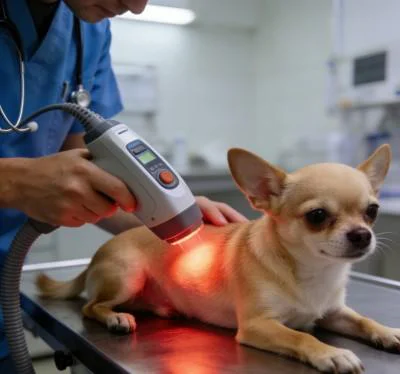
As a clinical expert with two decades in the field, I have observed that the success of photobiomodulation therapy for animals in neurological cases is fundamentally limited by “photon pressure.” A low-power device may provide superficial metabolic support, but it lacks the irradiance necessary to influence the mitochondrial environment of the spinal cord. This article examines the biophysical imperatives of treating the canine nervous system with a class 4 laser for dogs, focusing on the bioenergetics of axonal repair and the strategic management of the paralyzed patient.
The Physics of Depth: Navigating the Verterbral Column
The canine spinal cord is encased in a formidable biological fortress. To reach the dorsal or ventral horns, photons must navigate through the thick epaxial muscles and the dense bone of the vertebral laminae. This is where the distinction between “cold laser” and high-intensity therapy becomes a matter of clinical physics. The scattering coefficient of bone is significantly higher than that of soft tissue, requiring a higher wattage to ensure that the “Density of Dose” at the target site reaches the therapeutic threshold of 6-10 J/cm².
Wavelength selection is the primary determinant of this penetration success. While 810nm is the “gold standard” for cytochrome c oxidase absorption, it experiences more scattering in bone than longer wavelengths. The inclusion of 1064nm in modern class 4 laser for dogs protocols is a non-negotiable requirement for neurological work. The 1064nm wavelength resides at a unique point in the optical window where it exhibits minimal absorption in melanin and water, allowing it to act as a “scout,” navigating through the vertebral bone to deliver energy directly to the site of the disc extrusion.
Mitochondrial Bioenergetics: Resolving the Neuro-Metabolic Stall
Following an IVDD event, the spinal cord enters a state of metabolic crisis. Mechanical compression leads to localized ischemia, which in turn causes a failure of the mitochondrial respiratory chain. This “metabolic stall” results in a rapid depletion of Adenosine Triphosphate (ATP) and a surge in glutamate excitotoxicity, leading to secondary neuronal death.
Photobiomodulation addresses this crisis by targeting the copper centers of cytochrome c oxidase (CCO). When photons from a high-power vet laser for sale interact with CCO, they facilitate the dissociation of nitric oxide (NO). This dissociation is the catalyst for:
- ATP Resurgence: Allowing the neurons and glial cells to resume active transport mechanisms and maintain membrane potential.
- Reduction of Oxidative Stress: Modulating the production of reactive oxygen species (ROS) to prevent further lipid peroxidation of the neuronal membranes.
- Axonal Transport Support: Providing the energetic substrate required for the movement of essential proteins from the cell body to the distal axonal terminals.
By providing an exogenous energy source, we are essentially “buying time” for the nervous system, preventing the expansion of the secondary injury zone and facilitating the transition from the acute inflammatory phase to the remodeling phase of recovery.
Strategic Implementation: Managing the Grade 4 and 5 IVDD Patient
The most profound application of photobiomodulation therapy for animals is found in the non-surgical management of paralyzed patients or the post-operative rehabilitation of those who have undergone hemilaminectomy. In these cases, the laser serves as a powerful potentiator for neuroplasticity.
A professional class 4 laser for dogs should be used to treat not just the site of the lesion, but the entire “neural circuit.” This includes:
- The Site of Compression: Using high-irradiance Continuous Wave (CW) to penetrate the spinal canal.
- The Nerve Roots: Targeting the exit points of the peripheral nerves to manage localized radiculopathy.
- The Distal Muscle Groups: Using pulsing modes to stimulate microcirculation in the paralyzed limbs and combat disuse atrophy.
This holistic approach ensures that when the spinal cord does begin to recover, the peripheral “hardware” (muscles and nerves) is ready to receive the signals. This synergy is what significantly shortens the time to first voluntary motor function and improves the overall quality of life for the patient.
Clinical Case Study: Neuro-Regeneration in a Grade 4 IVDD Patient
This case study illustrates the transition from a non-ambulatory, paralyzed state to functional mobility utilizing a high-power Class 4 PBM protocol as a primary intervention.
Patient Background
- Subject: “Oliver,” a 6-year-old male neutered Dachshund.
- Weight: 8.2 kg.
- History: Acute onset of hindlimb paralysis following a jump. Oliver was presented within 12 hours of the event. The owner opted for conservative management due to personal and financial constraints regarding emergency neurosurgery.
- Initial Status: Non-ambulatory paraplegia. Absent withdrawal reflex and superficial pain sensation in both hindlimbs. Deep pain sensation (DPS) remained intact but was diminished.
Preliminary Diagnosis
- Acute Intervertebral Disc Disease (IVDD) at T13-L1 (Grade 4).
- Localized spinal cord edema and secondary paraspinal muscle spasms.
Treatment Parameters and Protocol
The objective was to deliver a high “Density of Dose” to the T11-L3 spinal segments to reduce cord edema and stimulate axonal repair. A multi-wavelength vet laser for sale was utilized.
| Treatment Phase | Frequency | Power (Watts) | Wavelengths | Mode | Dose (J/cm²) | Total Energy (J) |
| Acute (Week 1) | Daily (7 days) | 8W | 810+980nm | Pulsed (20Hz) | 10 J/cm² | 3,000 J |
| Active (Weeks 2-4) | 3x per week | 12W | 810+1064nm | CW | 15 J/cm² | 5,000 J |
| Maintenance (Wk 5+) | 1x per week | 10W | 810+1064nm | CW | 12 J/cm² | 4,000 J |
Clinical Application Details
During the acute phase, the laser was applied over the dorsal midline from T11 to L3 using a non-contact technique to avoid pressure on the painful spine. The 980nm wavelength was prioritized in pulsed mode to facilitate rapid edema resorption. As Oliver entered the active phase (Week 2), the protocol transitioned to a contact-massage technique with a heavy emphasis on 1064nm to ensure photons reached the deep spinal parenchyma through the vertebrae. The triceps and quadriceps were also treated to manage muscle tone.
Post-operative Recovery and Results
- Day 4: Return of superficial pain sensation and improved withdrawal reflex in the right hindlimb.
- Week 2: Oliver began to show “spinal walking” (reflexive movement). Voluntary bladder control was regained.
- Week 6: The patient was ambulatory with a moderate “drunken sailor” gait. Deep pain sensation was fully restored.
- Week 12 (Follow-up): Oliver was able to walk 50 meters unassisted. He was maintained on a once-per-month maintenance schedule.
- Conclusion: The high-irradiance delivery from the class 4 laser for dogs provided the necessary metabolic fuel to overcome the ischemic crisis in the spinal cord. By targeting the mitochondria in the neurons and glial cells, the photobiomodulation therapy for animals facilitated a functional recovery in a case that was previously destined for permanent paraplegia.
Strategic Selection: Beyond the “Cold Laser” Label
For the practice owner, the acquisition of a vet laser for sale for neurological work requires a departure from entry-level equipment. A “wellness” laser lacks the engineering to resolve a Grade 4 IVDD case. When evaluating hardware, the clinician must prioritize:
- Trans-Vertebral Irradiance: A minimum of 15W of peak power is required to ensure enough photons survive the journey through the vertebral bone.
- 1064nm Inclusion: This wavelength is the “neuro-specialist.” Its ability to bypass superficial scattering makes it the most effective tool for deep spinal work.
- Advanced Pulsing Protocols: The nervous system is highly sensitive to heat. Using super-pulsed or gated modes in the acute phase allows for high power delivery without triggering a thermal inhibitory response.
The investment in a high-quality class 4 laser for dogs is an investment in the clinic’s ability to offer a “non-surgical alternative” to owners who are desperate for hope. The perceived value of these treatments is exceptionally high, leading to strong client retention and word-of-mouth referrals within the paralyzed pet community.
Frequently Asked Questions
Can laser therapy replace surgery for IVDD?
For Grade 1-3 cases, laser therapy is often the primary treatment of choice. For Grade 4-5 cases (paralysis), surgery remains the gold standard for decompression. However, for owners who cannot opt for surgery, high-power photobiomodulation therapy for animals provides the best possible biological chance for recovery. It is also an essential post-operative tool for every surgical case.
Is it safe to use a high-power laser on a dog with a “slipped disc”?
Yes, but the technique must be precise. The clinician must keep the laser head moving to prevent focal thermal buildup. Professional vet laser for sale systems include safety software that guides the user through the correct power and time settings based on the dog’s size and coat color.
How does laser therapy help with “nerve pain”?
The laser helps by reducing the production of pro-inflammatory cytokines that irritate the nerve roots. It also stabilizes the nerve cell membrane potential, preventing the “over-firing” that causes the shooting, neuropathic pain associated with disc extrusion.
How many sessions are typically required for a paralyzed dog?
Neurological recovery is a marathon, not a sprint. A typical protocol involve a “loading phase” of daily treatments for the first week, followed by 2-3 times per week for at least a month. Most owners see the first signs of neurological improvement within 7 to 14 days.
Will laser therapy make my dog walk again?
While no treatment can guarantee a return to walking, high-power PBM provides the nervous system with the cellular energy it needs to repair itself. When used as part of a multimodal plan (including crate rest and physical therapy), it significantly increases the statistical probability of a successful neurological outcome.
The Neuro-Regenerative Outlook
The evolution of the class 4 laser for dogs has provided the veterinary community with a tool that mimics the precision of a scalpel but with the regenerative power of biology. We are no longer content to “wait and see” if a paralyzed dog recovers; we are now in the era of driving that recovery. By mastering the application of light to the spinal cord, we are giving our patients a second chance at a functional, pain-free life.
The success seen in patients like Oliver is a testament to the power of targeted energy. By providing the body with the resources it needs to heal itself, we are moving away from the era of “managed disability” toward an era of “restored mobility.” The vet laser for sale is the cornerstone of this transition—a tool that bridges the gap between mechanical injury and biological excellence. In the modern neurological practice, the photon is just as important as the diagnostic scan, ensuring that every patient has the best possible chance at a return to functional life.