 FotonMedix











news
Company News丨Industry News丨Products News
Search the whole station
Company News丨Industry News丨Products News
Lower-extremity musculoskeletal disorders represent one of the most challenging categories for rehabilitation clinicians. Chronic inflammation, degenerative breakdown, synovial thickening, tendon dysfunction, and pain hypersensitivity often accumulate simultaneously, leading to the progressive deterioration of mobility and quality of life. With increased interest in non-invasive modalities in modern orthopedic medicine, laser therapy for knee pain has become a central therapeutic tool due to its ability to influence biological repair rather than simply masking symptoms.
This article evaluates the physiological impact of knee photobiomodulation, the clinical advantages of knee laser therapy, and why addressing associated gait abnormalities through laser therapy for feet frequently determines whether a patient experiences stable long-term improvement.
Laser therapy functions through controlled photonic absorption and the stimulation of intracellular chromophores. This activation triggers biochemical responses essential for tissue repair.
Laser energy reduces key inflammatory mediators in synovial tissues, alleviating:
Collagen organization and fibroblast proliferation accelerate, especially in:
Knee laser therapy increases microvascular flow, speeds removal of inflammatory by-products, and reduces chronic stiffness.
Laser energy influences peripheral nerve excitability, decreasing abnormal firing in nociceptive pathways that contribute to chronic knee pain.
Hospitals and sports clinics frequently implement laser therapy for:
Laser therapy is particularly useful when traditional conservative methods—NSAIDs, injections, bracing—provide partial improvement but fail to restore functional mobility.
Biomechanical continuity between foot and knee has extensive clinical documentation. Abnormalities such as flatfoot, midfoot collapse, and chronic plantar inflammation alter tibial rotation, shift knee loading patterns, and slow rehabilitation.
For this reason, hospitals often include laser therapy for feet when:
Addressing the foot reduces mechanical stress transmitted upward into the knee.
A proper evaluation often includes:
Hospitals often select:
When patients have foot contributing factors, laser therapy for feet is applied at 8–10 W for 5–8 minutes over plantar fascia, midfoot joints, or Achilles regions.
Laser therapy complements:
“Knee Osteoarthritis With Associated Anteromedial Tendinopathy Managed Through Combined Knee Laser Therapy and Foot Biomechanical Correction”
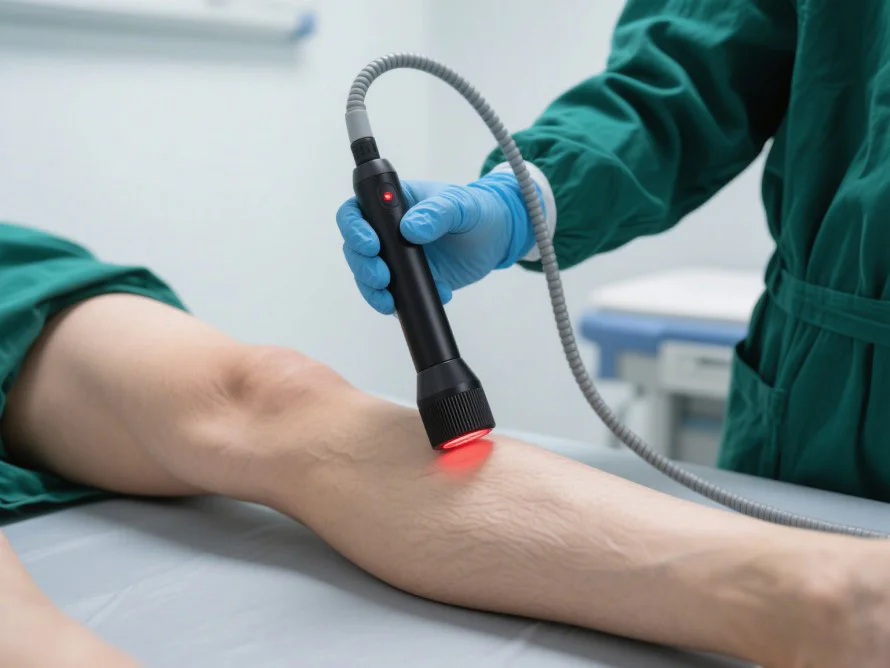
This case demonstrates how knee and foot photobiomodulation influences structural alignment and reduces cumulative strain across the lower kinetic chain.
Photobiomodulation provides a regenerative, non-invasive, and clinically validated approach to treating chronic knee disorders. By pairing laser therapy for knee pain with appropriate lower-extremity biomechanical correction—including laser therapy for feet—clinicians routinely achieve better functional recovery and longer-lasting symptom control than conventional therapy alone.