 FotonMedix











Canine Bicipital Tenosynovitis Optical Hurdles
Dual spectral absorption peaks trigger deep tendon sheath perfusion while gated microsecond pulses prevent shoulder periosteal overheating.
A five-year-old Border Collie pulls up sharply during agility practice, holding its left thoracic limb off the grass in a non-weight-bearing crouch. Digital palpation across the bicipital groove of the cranial humerus triggers sudden retraction, vocalization, and intense spasm across the supraspinatus and biceps brachii muscles. Diagnostic ultrasound confirms acute-on-chronic bicipital tenosynovitis with marked synovial effusion, fibrillar disruption, and peritendinous adhesions. The handler faces a difficult crossroad: ultrasound-guided corticosteroid injections carry risks of tendon rupture and collagen degradation, while open tenodesis surgery requires extensive crate rest that could end the dog’s competitive career. When discussing conservative rehabilitation, the immediate stumbling block is the cumulative dog laser therapy cost alongside doubts over whether low-power light can penetrate the thick brachiocephalicus muscle and dense bicipital retinaculum without burning the overlying skin.
Reaching the inflamed bicipital tendon core requires calculating light decay across layered muscular and fibrous tissues. The canine shoulder presents a challenging anatomical arrangement: dense epidermal hair and melanin cover the area, followed by thick layers of brachiocephalicus and superficial pectoral muscles, and finally the dense, unyielding transverse humeral retinaculum. Without sufficient energy penetrating these stratified barriers, bio-stimulation cannot reach the hypoxic core of the tendon. Class 4 laser therapy for dogs bridges this gap, delivering high energy densities safely through dense shoulder tissues to accelerate connective tissue repair.
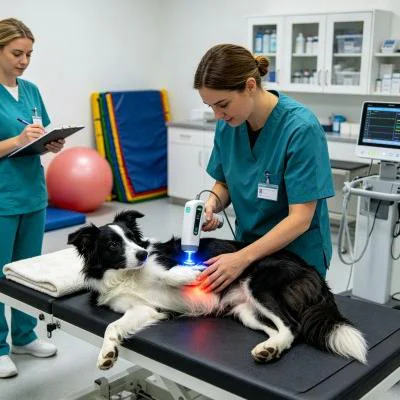
Overcoming Tissue Dispersion Across The Cranial Shoulder
Treating deep shoulder tendinopathies requires addressing exponential light decay through layered tissue interfaces. Melanin in the dermis absorbs incoming light, turning focused energy into surface heat. Beneath the dermal barrier, the fibrous sheets of the deltoideus and brachiocephalicus muscles cause severe forward scattering, dispersing a narrow beam into a broad, diffuse optical cone before it reaches the bicipital groove.
[Incident High-Intensity Dual Beam]
                 │
                 ▼ (Epidermal Melanin & Dermal Scatter)
      [Dense Brachiocephalicus Muscle Bed]
                 │
                 ▼ (Hemoglobin Stripping in Vascular Muscle)
      [Transverse Humeral Retinaculum]
                 │
                 ▼ (Mie Scattering in Dense Tendon Sheath)
      [Synovial Effusion & Tendon Subsheath]
                 │
                 ▼ (Residual Deep Flux > Tenocyte Activation Threshold)
      [Hypoxic Biceps Tendon Core & Insertion]
Low-power devices lose coherence within the first few millimeters of muscle, dissipating energy into superficial tissue without reaching the tendon. To stimulate tenocyte migration and collagen synthesis, photon density must remain above the biological repair threshold inside the joint capsule. When handlers evaluate how much does laser therapy cost for dogs, the calculation depends directly on device capabilities: low-power units require months of frequent sessions with limited deep impact, while high-intensity Class 4 protocols deliver targeted doses that speed tissue recovery and shorten treatment timelines.
Bypassing these anatomical barriers requires coordinated emission across two targeted wavelengths. Combining distinct absorption peaks delivers focused stimulation directly to deep tendon structures.
Target Tissue Layer             Matched Wavelength Band    Primary Physiological Mechanism
-----------------------------------------------------------------------------------------
Brachial Muscle Spasms          980 nm                     Capillary vasodilation, waste clearing
Effusive Tendon Sheath          1470 nm                    Selective water drainage, decompression
Core Tendon Fibril Matrix       980 nm / 1470 nm Ratio     Fibroblastic synthesis, ATP regeneration
The 980nm Hemoglobin Profile And Tenocyte Reoxygenation
The 980nm wavelength matches the absorption spectra of oxygenated and deoxygenated hemoglobin within the peri-tendinous microvasculature. In bicipital tenosynovitis, chronic mechanical friction creates focal ischemia along the avascular tendon core, causing tissue hypoxia and local lactic acid buildup.
Absorbing 980nm photons induces localized photothermal dilation within deep capillary beds surrounding the bicipital groove. Nitric oxide dissociates from red blood cell carriers, relaxing smooth muscle sphincters and restoring microvascular blood flow. This flush of oxygenated blood delivers nutrients to hypoxic tenocytes, activating cytochrome c oxidase inside their mitochondria. Elevated adenosine triphosphate production provides the cellular energy needed to repair micro-tears and synthesize organized type-I collagen fibers.
The 1470nm Water Resonance Mechanism In Tendon Hydrops
Inflammation of the biceps tendon sheath causes excessive fluid accumulation, creating hydrostatic pressure that pinches sensory nerve endings against the transverse humeral retinaculum. The 1470nm wavelength targets free water molecules within this trapped fluid, offering an absorption coefficient significantly higher than standard near-infrared spectra.
When 1470nm photons strike edematous tendon tissues, energy absorption alters interstitial fluid pressure gradients. This mobilizes trapped synovial fluid into surrounding lymphatic drainage pathways, relieving pressure inside the bicipital groove. Combining 1470nm fluid drainage with 980nm vascular stimulation delivers rapid pain relief. This combined action helps lower the overall cold laser therapy for dogs cost by decreasing the total number of clinical visits required to restore joint mobility.
Duty Cycle Engineering For Periosteal Safety
Directing high average power through thin soft tissue over the humerus carries a continuous risk of periosteal overheating. Cortical bone in the bicipital groove absorbs continuous wave emissions rapidly. If an unmodulated beam stays focused over these bony landmarks, heat accumulates quickly, causing periosteal pain and forcing clinicians to interrupt treatment before delivering an effective dose to the tendon sheath.
Gated dynamic duty cycles prevent these thermal spikes. Modulating the beam creates microsecond pulse bursts separated by thermal relaxation intervals.
Continuous Wave (Rapid Periosteal Thermal Build-Up):
Power ────────────────────────────────────────── (Periosteal Pain & Tissue Irritation)

Gated Dynamic Duty Cycle (Controlled Thermal Relaxation):
Power ┌───┐    ┌───┐    ┌───┐    ┌───┐    ┌───┐
      │   │    │   │    │   │    │   │    │   │   (Maximum Tendon Fluence / Zero Burn)
Base  ┘   └────┘   └────┘   └────┘   └────┘   └────
      |Ton|    Toff     |
Because dense muscle and tendon sheaths dissipate heat faster than they absorb peak energy pulses, dynamic duty cycles allow clinicians to deliver high peak irradiance through the brachiocephalicus muscle while keeping surface and bone temperatures safe. Operating between 35 percent and 50 percent duty cycles enables safe treatment directly over the cranial humerus without discomfort.
Adjusting pulsing frequencies between 20 Hertz and 750 Hertz targets specific recovery phases: low frequencies suppress sensory nerve firing to relieve acute movement pain, while higher frequencies speed fibroblast alignment and collagen cross-linking during later rehabilitation stages.
Clinical Field Case Report
The data below comes from Veterinary Sports Medicine and Rehabilitation records, documenting non-surgical recovery metrics in a canine athlete with chronic bicipital tenosynovitis.
Patient Profile And Diagnostic Staging
Case File Number: VSM-2026-5509
Subject: Canine, Border Collie
Age: 5 Years 8 Months
Sex: Male (Neutered)
Weight: 19.6 Kilograms
Presenting Complaint: Acute left thoracic limb lameness after landing from an agility jump, marked head bob at the trot, unwillingness to extend the shoulder forward.
Physical Examination: Severe pain reaction during the biceps stretch test (simultaneous shoulder extension and elbow flexion); firm, painful swelling along the cranial humeral groove; compensatory trapezius muscle spasm.
Ultrasonographic Diagnosis: High-resolution ultrasound shows a thickened biceps tendon sheath with disrupted, non-parallel fibrillar architecture, extensive anechoic fluid pooling, and localized peritendinous adhesions. Pre-treatment Canine Brief Pain Inventory Pain Severity Score: 6.8 out of 10. Pain Interference Score: 7.2 out of 10.
| Session ID | Day | Treatment Site | Wavelength Distribution | Peak Power (W) | Duty Cycle (%) | Pulse Frequency (Hz) | Total Energy (J) | Clinical Observations |
| S-01 | D-01 | Cranial Shoulder Groove | 80% 980nm / 20% 1470nm | 8.0 | 35% | 20 | 1,800 | Marked retraction during scanning; contact sweeps applied across the bicipital groove. |
| S-02 | D-03 | Shoulder & Trapezius | 75% 980nm / 25% 1470nm | 10.0 | 40% | 40 | 2,400 | Brachiocephalicus guarding decreases; patient permits palpation without pulling back. |
| S-03 | D-06 | Bicipital Sheath & Origin | 70% 980nm / 30% 1470nm | 12.0 | 40% | 80 | 3,000 | Fluid accumulation along the tendon sheath decreases by half on ultrasound checks. |
| S-04 | D-09 | Cranial Shoulder Complex | 65% 980nm / 35% 1470nm | 14.0 | 45% | 150 | 3,800 | Biceps stretch test elicits minimal resistance; toe-touching changes to full weight stance. |
| S-05 | D-13 | Shoulder & Pectorals | 60% 980nm / 40% 1470nm | 16.0 | 50% | 300 | 4,600 | Stride length during trot expands by 9 cm; compensatory trapezius spasm resolves. |
| S-06 | D-17 | Whole Shoulder Girdle | 50% 980nm / 50% 1470nm | 18.0 | 50% | 500 | 5,400 | Full active shoulder extension returns; dog navigates weave poles at a slow trot. |
| S-07 | D-22 | Tendon Sheath & Retinaculum | 50% 980nm / 50% 1470nm | 16.0 | 45% | Dynamic | 4,800 | Follow-up ultrasound shows parallel collagen fiber realignment across the tendon core. |
| S-08 | D-28 | Kinetic Maintenance Zone | 50% 980nm / 50% 1470nm | 14.0 | 40% | Dynamic | 4,000 | Full athletic function restored; agility course sprint cleared with zero lameness. |
Objective Functional Recovery Metrics
Day 1 (Admission Baseline)
[Pain Severity: 6.8/10]      ██████████████░░░░░░
[Stride Deficit: -14 cm]     ████████████████████

Day 13 (Midway Status)
[Pain Severity: 2.8/10]      ██████░░░░░░░░░░░░░░
[Stride Deficit: -5 cm]      ███████░░░░░░░░░░░░░

Day 28 (Discharge Status)
[Pain Severity: 0.6/10]      █░░░░░░░░░░░░░░░░░░░
[Stride Deficit: 0 cm]       ░░░░░░░░░░░░░░░░░░░░
By session eight on Day 28, the canine athlete achieved complete structural and functional recovery. The Canine Brief Pain Inventory Pain Severity Score dropped from 6.8 to 0.6, while the Pain Interference Score decreased from 7.2 to 0.8. Thoracic limb stride length symmetry fully normalized, eliminating the head bob at both trot and gallop.
Follow-up ultrasound on Day 28 confirmed total resolution of anechoic fluid in the tendon sheath, with hyperechoic, parallel collagen fibers aligned across the bicipital core. The patient returned to active agility training under a bi-weekly maintenance schedule without requiring corticosteroid injections or anti-inflammatory drugs.
Practice Workflow And Financial Return Over Conventional Protocols
Managing canine shoulder tendinopathies presents tough choices in clinical practice. Corticosteroid injections provide rapid short-term relief but weaken tendon collagen structures over time, increasing the risk of complete rupture under athletic stress. Surgical options like biceps tenodesis require general anesthesia, surgical site management, and months of strict crate rest, leading to significant financial expenses and potential loss of agility performance. Conservative drug protocols with NSAIDs often provide incomplete relief, masking pain while the underlying tissue remains mechanically weakened.
Low-power laser devices struggle with deep tendinopathies. Low-wattage units require twenty to thirty minutes of hands-on delivery per session to reach deep anatomy, tying up clinical staff and treatment rooms. This approach drives up clinic labor costs while delivering slow, inconsistent progress that frustrates owners.
High-power Class 4 multi-wavelength protocols overcome these operational limitations. Delivering up to eighteen watts of peak power through balanced 980nm and 1470nm wavelengths shortens hands-on treatment times to under eight minutes per shoulder. This efficiency allows veterinary practices to treat deep tendon sheaths quickly, doubling daily room capacity and reducing stress on energetic patients.
Dynamic pulse gating protects sensitive periosteal surfaces over the humeral groove, preventing thermal buildup while delivering therapeutic doses to the tendon core. Pet owners observe clear gait improvements within the first three visits, keeping compliance high across the complete rehabilitation plan. For veterinary clinics, combining rapid tissue healing with efficient scheduling turns complex sports injuries into a reliable, non-invasive clinical service.