 FotonMedix











news
Company News丨Industry News丨Products News
Search the whole station
Company News丨Industry News丨Products News
In the realm of physical rehabilitation and sports medicine, the management of chronic tendinopathies remains one of the most stubborn clinical challenges. Among these, Rotator Cuff Tendinopathy—specifically involving the supraspinatus tendon—is notoriously difficult to treat due to the tissue’s hypovascular nature.
With the proliferation of therapeutic devices entering the market, clinicians are right to be skeptical. The first question we must rigorously answer is: Is laser therapy a viable, evidence-based intervention for tendon repair, or is it merely an expensive placebo?
The clinical consensus, backed by meta-analyses, confirms that High-Intensity Laser Therapy (HILT) is indeed effective, but with a caveat: it must be dosage-dependent and wavelength-specific. Low-power devices simply do not penetrate the depth required to reach the subacromial space.
Once we establish that it works, we must pivot to the more critical engineering and biological question: Why does it work on avascular tissue, and how do we program a laser therapy machine to replicate these results?
This article dissects the pathophysiology of tendon repair, the specific high intensity laser therapy benefits (our first semantic keyword), and provides a blueprint for treating shoulder pathologies.
To understand why traditional modalities (like ultrasound or TENS) often fail with rotator cuff injuries, we must look at the anatomy. The supraspinatus tendon has a region known as the “critical zone”—an area of hypovascularity near its insertion on the greater tuberosity.
When micro-tears occur here, the body lacks the blood supply to transport cytokines and fibroblasts necessary for repair. Instead of healing, the collagen degenerates into a disorganized mucinous matrix (tendinosis).
Here lies the primary value proposition of a Class IV laser therapy machine. It is not about “heating” the tissue; it is about metabolically jump-starting a stalled healing process through Photobiomodulation (PBM).
If we accept that the primary barrier to healing is a lack of energy and blood flow, laser therapy provides the physiological workaround.
The specific mechanism distinguishing high-power lasers involves the stimulation of endothelial cells. Coherent light at wavelengths between 810nm and 980nm stimulates the release of Vascular Endothelial Growth Factor (VEGF).
Why is this vital? In the “critical zone” of the rotator cuff, this promotes angiogenesis—the formation of new capillary loops. This re-vascularization transforms a degenerative, non-healing state into an active, metabolic repair state.
Tendinosis is characterized by Type III collagen (weak, disorganized) rather than Type I collagen (strong, aligned).
Research suggests that PBM stimulates fibroblast proliferation. More importantly, it modulates the extracellular matrix turnover. The energy absorbed by the mitochondria increases ATP production, which fuels the fibroblasts to synthesize organized collagen fibrils.
The Clinical Result: We are not just masking pain; we are physically improving the tensile strength of the tendon structure.
Unlike cold laser therapy machine applications which are strictly non-thermal, Class IV HILT generates a controlled thermal gradient.
Why does heat matter here? The gentle rise in tissue temperature (maintained between $40^{\circ}C – 42^{\circ}C$) alters the viscoelastic properties of the collagen. This reduces stiffness and increases the range of motion (ROM) immediately post-treatment, allowing for more effective manual therapy or eccentric loading exercises immediately after the laser session.
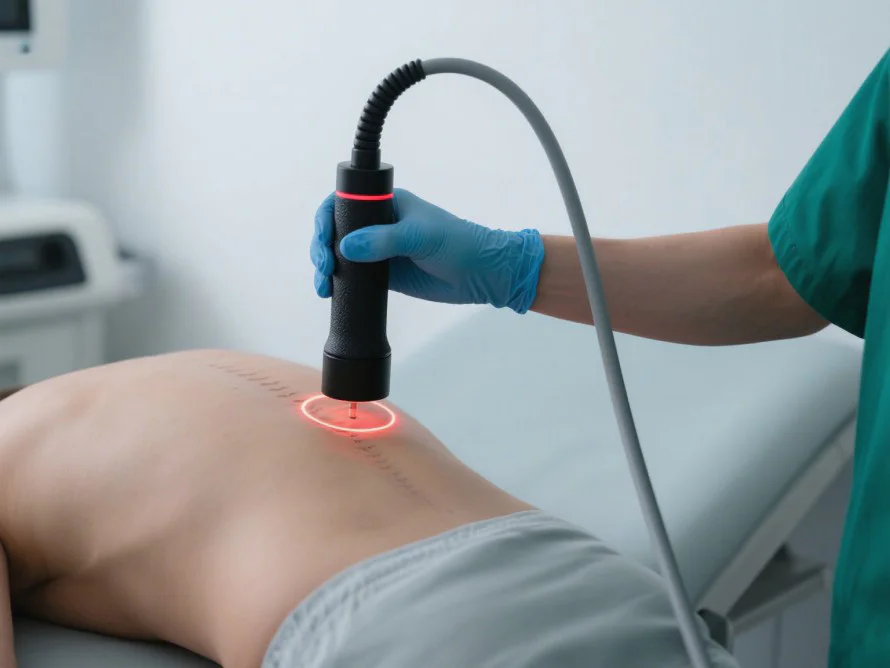
A common error in laser therapy for tendonitis (our second semantic keyword) is treating the skin rather than the tendon. The supraspinatus tendon lies deep beneath the deltoid muscle and subcutaneous fat.
To reach this target, we rely on the optical transmission equation. A significant portion of photon energy is scattered by the dermis. Therefore, to deliver a therapeutic dose of 10 Joules/cm² to the tendon depth, the surface dosage must be significantly higher.
Using a 0.5 Watt laser for a shoulder is clinically futile. To overcome the depth of the deltoid, a power output of 10 to 15 Watts (Continuous Wave equivalent) is often required. This ensures that the photon density at the target depth is sufficient to trigger the CCO (Cytochrome C Oxidase) reaction.
The following case illustrates the integration of HILT into a rehabilitation plan.
The goal was to utilize class iv laser mechanism (our third semantic keyword) to reduce inflammation (first week) and then stimulate collagen repair (subsequent weeks).
Equipment: High-Intensity Diode Laser (Class IV), 20W Max Power.
| Parameter | Setting | Clinical Rationale |
| Wavelength | 980nm Dominant | Focus on analgesia and gating pain receptors. |
| Power | 8 – 10 Watts | Moderate power to introduce therapy without aggravating inflamed tissue. |
| Mode | Pulsed (ISP – Intense Super Pulse) at 50Hz | Pulsing prevents thermal buildup while delivering high peak power for depth. |
| Technique | Painting/Scanning | Covering the entire deltoid and trapezius trigger points to relax guarding muscles. |
| Dosage | 6 Joules/cm² | Approx. 2000 Total Joules per session. |
| Parameter | Setting | Clinical Rationale |
| Wavelength | 810nm (High) + 980nm (Low) | Shift focus to biostimulation (repair) rather than just pain relief. |
| Power | 12 – 15 Watts (CW) | Continuous Wave allows for maximum photon saturation (Heat is monitored). |
| Mode | Continuous Wave (CW) | CW generates the necessary thermal effects to alter collagen viscoelasticity. |
| Technique | Static & Grid Scanning | Patient arm placed in internal rotation (Hand behind back) to expose the supraspinatus tendon. |
| Dosage | 10-15 Joules/cm² | Approx. 4000-5000 Total Joules per session. |
Week 5 Assessment:
Conclusion: The high-power laser provided the metabolic window of opportunity for the patient to perform eccentric strengthening exercises pain-free, leading to a functional resolution.
Clinicians often ask where HILT fits in the modality spectrum.
| Modality | Primary Mechanism | Best For | Limitation |
| Ultrasound | Sound waves/Thermal | Superficial inflammation | Poor penetration depth; energy scatters easily in bone/joint interfaces. |
| Shockwave (ESWT) | Mechanical trauma/Cavitation | Calcific Tendonitis, breaking scar tissue | Extremely painful; requires recovery time between sessions. |
| High-Intensity Laser | Photochemical/Metabolic | Tissue regeneration, deep pain, acute or chronic | Requires operator skill to avoid burns; initial equipment cost. |
HILT is unique because it is non-destructive. Unlike Shockwave, which creates micro-trauma to stimulate healing, Laser adds energy to the system, making it suitable for acute injuries where Shockwave is contraindicated, as well as chronic degenerative conditions.
For a medical facility, integrating a Class IV laser is not just clinical; it is operational.
Treating a rotator cuff injury manually requires extensive physical effort from the therapist. Laser therapy allows for a 10-minute treatment window that pre-conditions the tissue, making subsequent manual adjustments or exercises significantly more effective.
Furthermore, as a cash-based or adjunct service, it offers patients a high-tech solution to avoid corticosteroid injections or surgery, positioning the clinic as a leader in non-invasive technology.
With great power comes great responsibility. Class IV lasers (output > 500mW) introduce ocular hazards and thermal risks.
The era of “wait and see” for tendon injuries is over. By utilizing the advanced physics of laser therapy machines, we can actively intervene in the cellular lifecycle of the tendon. For the manufacturer and the clinician alike, the focus must shift from simply “reducing pain” to “restoring energy.”
When we treat the mitochondria, we treat the patient. The result is a faster return to sport, reduced recurrence of injury, and a higher standard of care.
Q1: How does High-Intensity Laser Therapy differ from LLLT (Cold Laser) for shoulder pain?
A: Depth and Dosage. LLLT (Class IIIb) is effective for surface wounds and superficial nerves but often lacks the power to penetrate the deltoid muscle to reach the rotator cuff effectively in a reasonable time. HILT (Class IV) delivers a much higher number of photons (Energy) to deep tissues, creating both a photochemical and a bi-phasic thermal effect that LLLT cannot achieve.
Q2: Can laser therapy be used if the patient has a metal implant or anchor in the shoulder?
A: Yes, generally. Laser light reflects off metal but does not heat the metal internally like Ultrasound or Diathermy would. However, caution is advised: the light can heat the tissue surrounding the metal faster due to reflection. Treatment should be done with lower power and in pulsed mode to monitor patient comfort.
Q3: Is the treatment safe for acute rotator cuff tears?
A: Yes. In the acute phase, laser therapy is excellent for reducing edema (swelling) and preventing the formation of excessive scar tissue. However, the settings would be different—lower power, pulsed mode, and non-thermal—compared to the chronic settings used for tendinosis regeneration.
Q4: What does the patient feel during the session?
A: With a Class IV system, the patient will feel a deep, soothing warmth. It is often described as a “warm massage.” This is distinct from Cold Laser, where the patient feels nothing. The warmth helps relax the surrounding muscle guarding, providing immediate range-of-motion improvements.
Q5: How quickly can a patient return to sports after laser treatment?
A: Laser therapy speeds up recovery, but biological healing still takes time. While pain relief may be immediate, collagen remodeling takes weeks. A typical protocol involves 6-10 sessions. Patients can usually continue modified training during treatment, but full load-bearing return depends on the severity of the original tear.